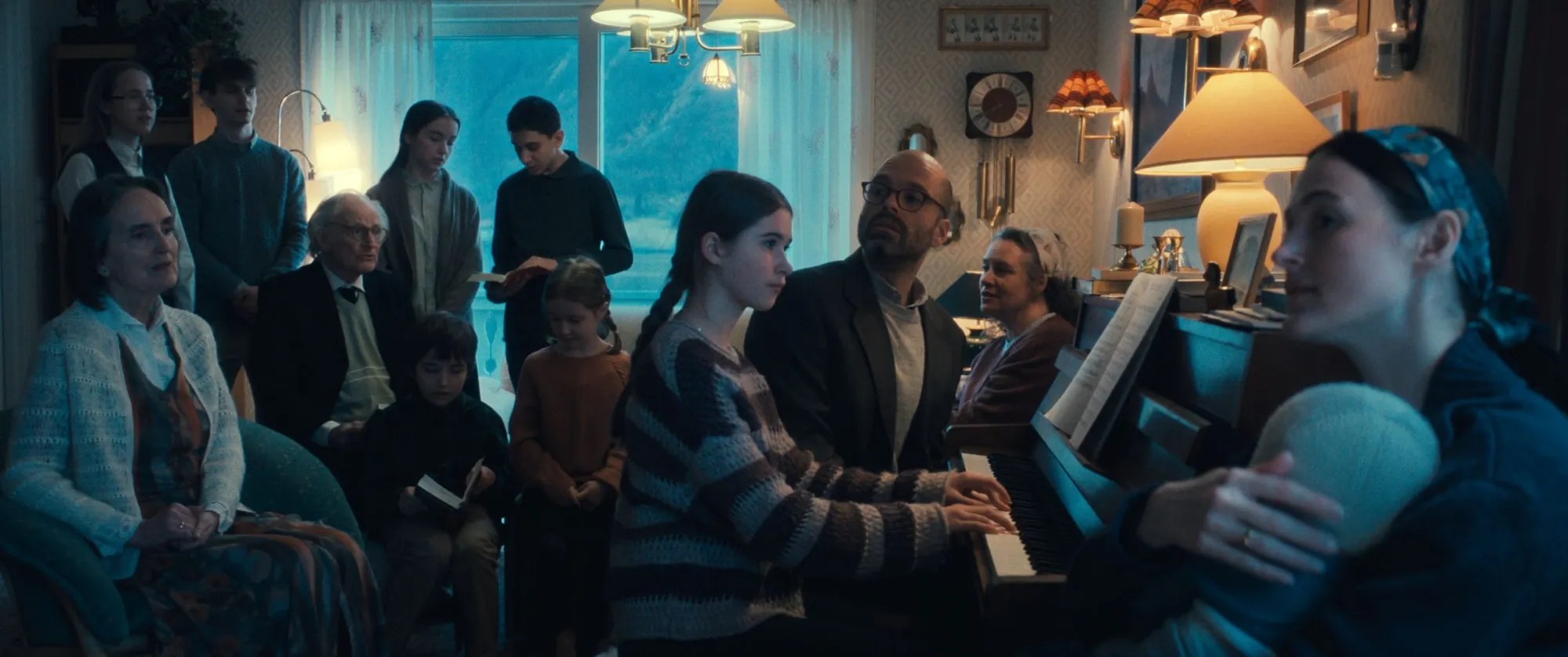
Adrian McElwee in “Remake.” Credit: Courtesy of Music Box Films
⭐⭐⭐1/2 Rating: 3.5 out of 4
Ross McElwee’s “Remake” opens with a wry proposition: a Hollywood producer wants to turn McElwee’s 1986 documentary, “Sherman’s March” — the filmmaker’s meandering meditation on love, Southern culture, and romantic rejection — into a conventional scripted feature, perhaps even a comedy. Questions abound: Who would play McElwee? How could its accidental encounters and intimate revelations be scripted? McElwee picked up a camera to document the cinematic transformation but, as both efforts inched forward, McElwee’s film takes on a more painful tone. The Cambridge-based filmmaker’s lens turns inward on decades of footage of his son Adrian, who died from a fentanyl overdose in 2016 at age 27, eight years into McElwee’s project. In the rewinds, we watch Adrian grow from an imaginative, playful child into a sullen teenager and then a young man struggling with addiction, mental-health issues, and the burden of finding his own identity — particularly as an aspiring filmmaker living in the shadow of a celebrated documentarian father.
McElwee, an avuncular, reflective man whose deeply personal work has always blurred the line between home movie, essay, and autobiography, does not spare himself. Had the camera brought father and son closer, or placed an obstructive lens between them? Did appearing in his father’s films distort Adrian’s understanding of reality? And did Ross’s attempts to mentor Adrian — from “Sherman’s March,” we know his own father never encouraged his filmmaking — carry expectations the son could not meet?
For anyone who has seen “Sherman’s March,” the notion of turning the captivating documentary into anything else would seem improbable, if not wrong — but the outcome will surprise you. And that’s the gentle initial humor of “Remake,” underscored by McElwee’s patient cynicism. While there are moments of joy and tenderness with Adrian, those images — the two at Cannes with Adrian shooting his own mockumentary about a film honcho, Haskell-Wexler style — take on a secondary weight as the catalyst for “Remake” gets pushed to the corners of the frame. It’s a devastating film about the way grief slowly and surely guts you. “Remake” is as much a loving memorial as it is an agonizing act of self-interrogation. Some things can be remembered, revisited, and even remade — but never repaired.
A still from “Teenage Sex and Death at Camp Miasma.” Credit: Courtesy of MUBI
⭐⭐⭐Rating: 3 out of 4
In this latest art-horror curio from Jane Schoenbrun, the alt-indie hand behind psycho-chillers “We’re All Going to the World’s Fair” (2021) and “I Saw the TV Glow” (2024), the “Friday the 13th” film franchise and gender politics get skewered with bloody orgasmic gusto. There is plenty of sex and death, as the title promises, with the bloodshed bringing the joy more than any muted, intoned, crest of pleasure. A head gets cut off and an arc of crimson red gushes 30 feet into the air, so over-the-top it’s comical. The effects are gorgeously framed by Eric Yue, who worked with Schoenbrun on their previous projects.
Camp Miasma is somewhere in the wooded Pacific Northwest at a lake, which was many years ago the setting of a slasher film starring Billy Presley (Gillian Anderson) as an ingénue. It becomes a long-running series of films and Presley, the “final girl,” now lives as a recluse at the site.
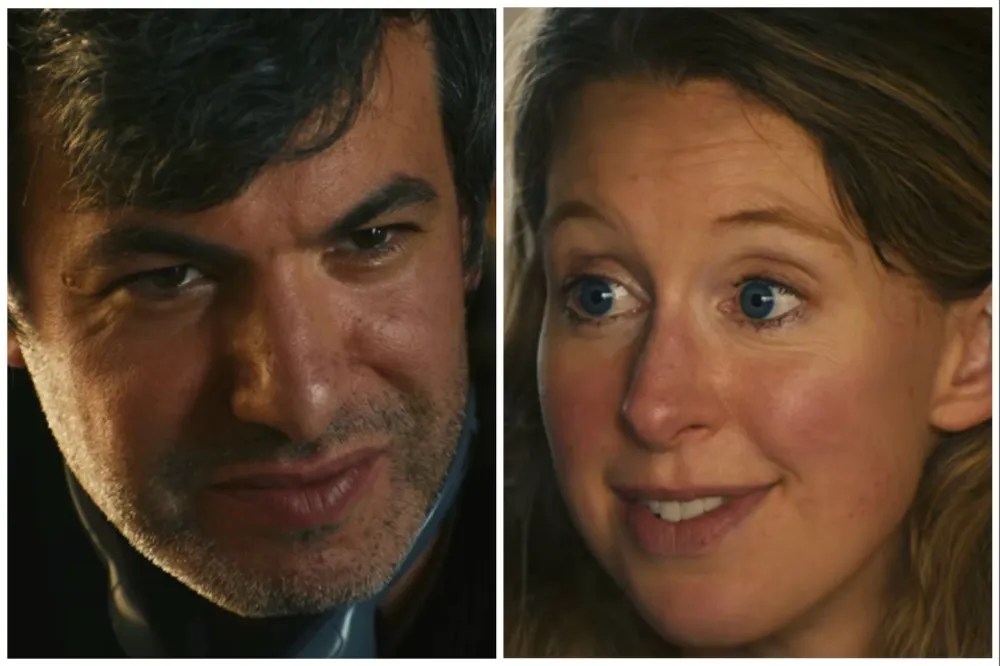
Enter Kris (Hannah Einbinder, “Hacks”), a young queer indie film director hired to reboot the franchise. Kris hopes to recruit Billy for her project (think Jamie Lee Curtis or Neve Campbell). The set up’s clearly self-referential — and part of the backdrop is that the original films have become criticized for their treatment of gender — namely trans. Kris — a clear stand-in for Schoenbrun—is an adoring fan of Billy’s and given the cold foreboding nights (it’s winter) the two end up smoking weed, watching old “Miasma Camp” videos and working on Kris’s failures at sex — she’s in a polyamorous relationship, but appreciates companionship more for the intellectual than the physical.
Much is asked of Einbinder in range — goofy, sexy, witty but shy — and she pulls it off, but it’s Anderson, with her bumper-bangs-and-victory-rolls updo (and menacingly aloof cattiness) that drives the film and alluringly so. It’s an intoxicating and immersive performance that holds the film together as it slips into alter realities and other strange and wonderfully murky segues. We see plenty of Little Death (Jack Haven) the being at the bottom of the lake, who when hungry, rises from the depths in a Devo Hazmat suit with a ceiling air vent for a mask, and eviscerates any and all with a double-bladed spear. The cherry on the top is seeing Eva Victor (“Sorry Baby”)’s cameo as a punked-out ’80s DJ — mohawk and all — with sassitude.
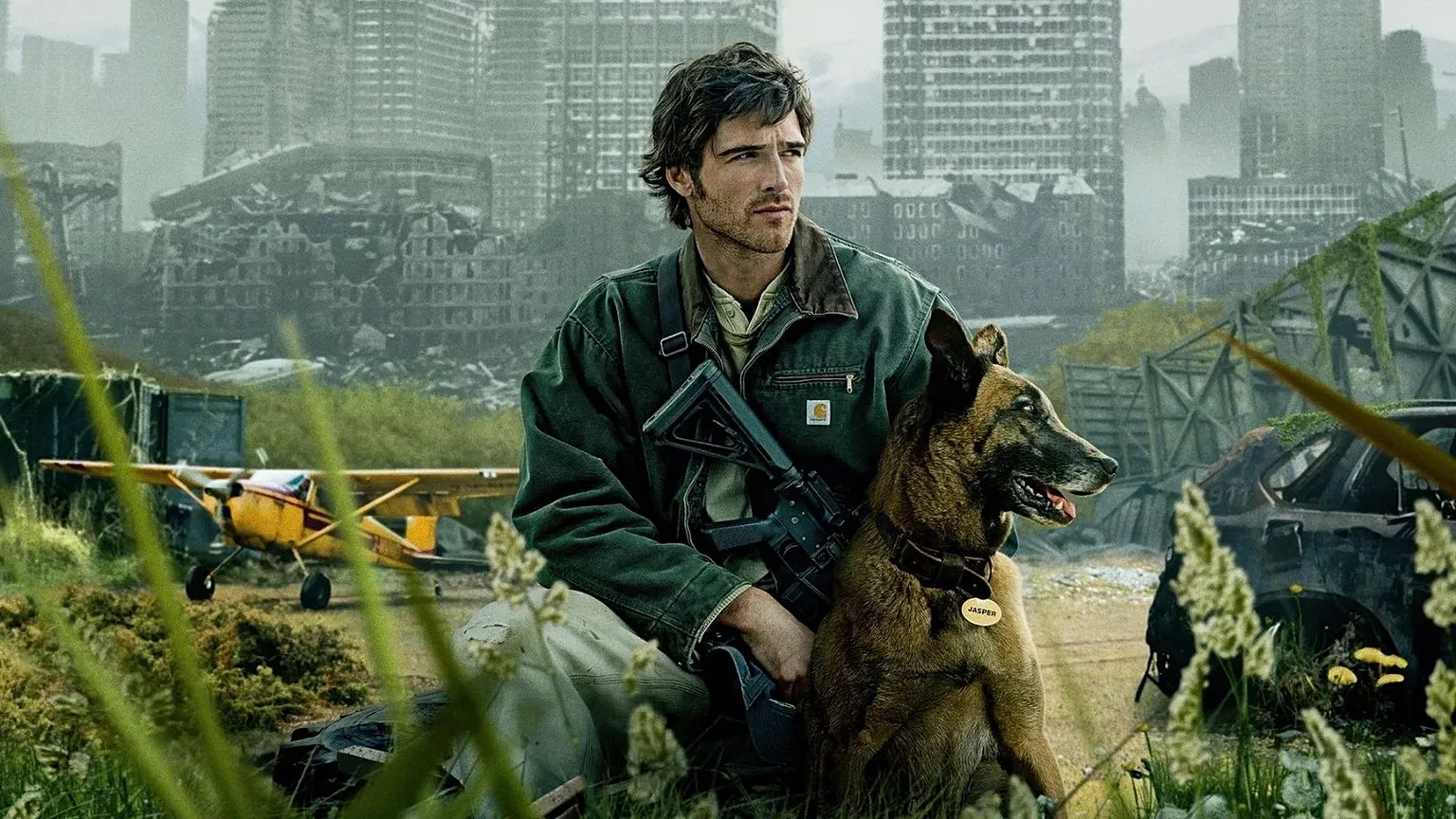
Ridley Scott has been down apocalyptic-ish roads before, notably with game changing sci-fi classics “Alien” (1979) and “Blade Runner” (1982). In “The Dog Stars,” adapted from Peter Heller’s 2012 novel, we trek through uneven end-of-times terrain. A virus has wiped out most of humanity, leaving Hig (Jacob Elordi), a skilled mechanic and bush pilot aviator who lost his wife during the pandemic, holed up at an abandoned Colorado airfield with his dog Jasper (a handsome and regal German Shepherd) and Bangley (Josh Brolin), a heavily armed ex-Marine. Bangley’s survivalist instincts are considerably sharper than Hig’s — the dude retrieves his casings to repoint the bullets so he can use them again. There are marauders roaming about, and somehow the grid is still limping along. Hig picks up a faint radio transmission, and the possibility of other survivors lures him out of his relatively secure perimeter and into the unknown.
It’s an intriguing setup, and Scott can still give scorched-earth spectacle scale and tactile heft (the man is something of a world building master), but “Dog Stars” never settles into a satisfying rhythm. It also has a lot of nagging questions that hang around like pugnacious mosquitos. The plot lurches and splits between Hig (the main focus), Bangley, who remains behind, and the so-called Reapers, bloodthirsty looters who look fresh out of a 1990s mosh pit. They seemingly have created their own language and alphabet — the why, another gnat buzz. The best and most bizarre is Allison Janney as the matriarch of a small, insular community with specialized culinary leanings (don’t look in the meat locker) and a retro bent — the interior of the hive is practically a verbatim recreation of J. F. Sebastian’s flat of replicant misprints in “Blade Runner.”
One problem with the film is that as Hig, Elordi, while blessed with the physical dimensions of a post-apocalyptic hero, never quite convinces us he’s the hardened, macho survivor the film needs. Brolin, by contrast, wears Bangley’s wary, shoot-first pragmatism as comfortably as an old field jacket. The rapport between the two works but doesn’t feel as genuine as the narrative insists.
Hig’s journey leads him to Cima (Margaret Qualley) and her father, Pops (Guy Pearce), opening the possibility of connection — and romance — in a world reduced to isolation and suspicion. Here, and at a Mennonite compound near the overgrown airstrip, is where “Dog Stars” finds its humanity. But Qualley, a live wire in “Honey Don’t!“ and “Once Upon a Time … in Hollywood,” is strangely muted here, lacking the sass and unpredictability that make her such a compelling screen presence.
Then there are those marauding Reapers, rendered as primal throwbacks seemingly beamed in from the era of black-and-white Westerns, replete with the genre’s cringeworthy “savage horde” imagery. It’s an unfortunate retrograde touch and a stark and lazy offset in a film ostensibly interested in what remains of our humanity after civilization disappears.
Scott keeps “The Dog Stars” muscular enough visually, but muscles aren’t the issue. Like its leading man, the film looks the part without ever fully inhabiting it.
What if a top tennis player faltered in their career and had to slum it on the pickleball circuit? That’s kind of the loose “Happy Gilmore”—esque concept behind this not quite pickled-enough comedy that stars Jake Johnson (“New Girl,” “Drinking Buddies”) as said fictional tennis star Dustin Boyd. Boyd is a one-time rival of real-life great Andy Roddick, but an injury means he now toils as a club pro. When he dips his toe into the pickleball waters he gets crushed by a pair of 70-year-old grannies — Dustin, known as “The Hammer” in his tennis heyday, doesn’t understand finesse or the parameters of the smaller court. Then there’s the heralded, anemic drop-shot of the title (which the film uses as a running gag until it is past tired).
As the might-have-been superstar trying to pivot, Johnson doesn’t quite have the bravado needed for the part. The ace serve here — the script’s written by “Kevin Can F*** Himself” scribe Sean Clements—comes in Dustin falling for an older woman (a pitch perfect Mary Steenburgen) who’s not so sure she’s attracted to her younger suitor. The May-December pairing does score points when the two sit down for a movie night “date” and watch “The Graduate” and Dustin, busts on the other Dustin for having a big nose (Johnson has a pretty protuberant proboscis himself).
Directed by Josh Greenbaum (“Strays”) and co-produced by Ben Stiller, who has a small part too, the flick built around a feeble flick shot does best when the Greek chorus of feisty Floridian nanas are taunting Dustin and Roddick — who plays himself — in a match where the winner claims the deed to the tennis club owned by Dustin’s dad (Ed Harris, poorly used here). Heckling, it turns out, is the crosscourt humor that saves this cinematic dink from busted string ruin and John McEnroe’s woefully wooden intonations.
Questions of happiness and fulfillment take center stage in “The Invite,” a barbed comedy about a couple at a bitter crossroads in their marriage. Angela (Olivia Wilde) and Joe (Seth Rogen) are further challenged by their upstairs neighbors who, over the course of a single dinner, amplify every marital tension with passive-aggressive relish. Wilde, the actress who served notice as a filmmaker with the puckishly insightful “Booksmart” (2019), then faltered with the 2022 “Don’t Worry Darling,” gets back to her funny-not-funny roots with this adaptation of the 2020 Spanish film “The People Upstairs.”
The tart script by Will McCormack and Rashida Jones feels like it was written for the nuanced personalities of this cast. Seth Rogen centers the ensemble with his large and loud everyman, Joe, a failed musician who teaches music at a middling conservatory. Angela is a soul adrift. What defines them most as a couple — and holds them together — is their preteen daughter and their collective unease with their station in life. Bougie problems, to be sure, but palpable and real. They also haven’t had sex in nearly a year, and that’s why the dinner invite to the newish couple upstairs is such a loaded gambit. Joe wants to confront them about the raucous sex that keeps them up at night, while Angela admires the woman’s ability to have vigorous and vocal orgasms.
A myth reconsidered in this grim but powerfully told version of a life that might not have been heroic.
Revisionism is a powerful dispeller of myth. Consider how Oliver Stone, Francis Ford Coppola, and Stanley Kubrick reframed the public understanding of the Vietnam War. Or how Sergio Leone, Sam Peckinpah, and Clint Eastwood cut the morally righteous reins on the American Western.
What about Robin Hood, the legend who stole from the rich and gave to the poor? A regular champion of the poor, like Mother Teresa, and a candidate for a Nobel prize? Not so much in Michael Sarnoski‘s dark reckoning, where Mr. Hood is looking for atonement before his book closes on his not-so-noble reputation. He’s played by
Hugh Jackman with world-weary gravitas, conveying sadness in his eyes and the simmer of rage in his heart.
The film is gorgeously shot by Paul Scola, who worked with Sarnoski previously on “Pig” (2021) — then again, the bare north mountains of Ireland do a lot of this movie’s heavy lifting. We learn early on that this is not Errol Flynn’s swashbuckling Robin Hood. Our Robin has been enmeshed in the cycle of violence all his life, hunted by the kin of those he killed. He’s adroit at bloodshed. There’s no flashback to show us whether the younger Robin’s deeds were derring-do or thuggish savagery.
Reviews of “The Devil Wears Prada 2” and “Is God Is”
“The Devil Wears Prada 2”
It’s been 20 years since the original “Devil Wears Prada” made office politics and the pandemonium of high fashion intoxicating. While the main cast — Meryl Streep, Anne Hathaway, Stanley Tucci and Emily Blunt — barely look a decade older, times have definitely changed. Social media, micro-aggressions and HR rules have changed life for Streep’s Miranda Priestly (fashioned after famed “Vogue” editor Anna Wintour, whose former junior assistant penned the book the first movie was based on). She has to have her latest assistant (Simone Ashley) police her language in board meetings.
At the end of the last Manhattan fairytale, Hathaway’s Andy Sachs left “Runway” magazine for the world of hard-hitting journalism—an endeavor that pays considerably less. When we catch up with Andy, she’s collecting a coveted award for her integrity-driven stories, only to learn that she and everyone at the paper have been sacked by the paper’s new parent company (a scenario all too familiar and real these days). Simultaneously, “Runway” gets egg on its face for a feature it ran on a fashion line that it didn’t know uses sweatshops for its threads. Nothing like an out-of-work scribe and a company in a PR tailspin to get the team back together again. Natch, Miranda barely remembers Andy (or feigns such) and per usual sets her up to fail. Still at Miranda’s side is Nigel (a well-postured Tucci bringing back his blasé-faire élan), loyal vanguard of haute fashion and barbed witticisms, with Emily (Blunt) now over at Dior and a chief buyer of ad-space from “Runway” (the real-life model for the Emily character recently fessed up and the parallels are to-the-curb tight).
In the first “Prada” we had Paris, here we get Milan and a meandering side thread about a takeover of Elias-Clarke, the parent company of “Runway.” What that does besides putting too much yarn in the air is to weave Lucy Liu, Kenneth Branagh with an enviably rich mane, Justin Theroux (unrecognizable as a goofball tech-bro) and B.J. Novak as the mealy-mouthed scion of Elias-Clarke’s CEO, into the fold. The sharp script, again written by Aline Brosh McKenna, and tight direction by David Frankel — also returning — go far, but nearly falters along the final walk as the overly complicated corporate mega blah ties up. The cast, though, is all in, lovingly bringing back the personas so many identified with and rooted for. Miranda may not be the firebrand she was back in 2006, as time and mega-mergers have tamped her down. She’s less a pop-off-the-screen paw scratch, but also more vulnerable and human. “Prada 2” is a comfortable nostalgic fit, with clean lines and even seams.
“Is God Is”
Adapted from her own stage play, Aleshea Harris’s “Is God Is” is a slow burn of a revenge tale that twists in strange, stylized ways as it follows the travails of twin sisters Anaia (Mallori Johnson) and Racine (Kara Young, the upcoming “I Love Boosters”). The twins, after receiving a letter from their disfigured mother (an unrecognizable Vivica A. Fox), set off on a quest to avenge her by killing their father (Sterling K. Brown, “Moonlight,” “Paradise”). What ensues is something of a lo-fi spaghetti western filtered through the lens of a Greek tragedy with bubbles of Afrofuturist hip — in a loose stylistic sense, think “Sinners” and, to a lesser degree, “Him.”
Of the twins, Racine is as — if not more — scarred than her mother from the fiery act of cruelty inflicted by Brown’s father—the flashback of which is dark, eerie and hard to watch. The credits list him only as “Man.” Mom is referred to as Ruby God, which, I guess, is what gives her agency to command the act of vengeance from her long-simmering death bed somewhere in the dusty fields of Virginia.
The command that Ruby has over the girls is curious as she has been long absent from their lives — since the incident. They grew up in foster care hell. The two also have a form of ESP, where they can look at each other and communicate in full sentences — for the rest of us it helps that we see them on screen in closed-captioned psychic subtitles.
The violence that comes — and there’s lots of it — is fast, bloody and brutal. It’s also at times comedic, with a touch of mean poetry to it — something Quentin Tarantino elevated to an art form and Harris is not too bad at. The girls’ tools of choice? A rock in a bloody white sock — looking like David’s sling — and a pair of pruning loppers.
As the twins, Johnson and Young are asked much of, and shoulder it well, but the film feels too long for what it is as the quiet moments of talky contemplation before the next, far-too-intimate beat down, often feel flat and don’t add anything new. Brown and Fox smolder in their brief parental parts, and the ever-elegant Janelle Monáe is a portrait of troubled grace as Man’s current wife. “Is God Is” comes out swinging and fierce, but there’s a hollowness to it that resonates more than the searing anger it postures.
Renny Harlin heads back to the deep blue — but this time the sharks aren’t the problem so much as the movie around them.
This return to shark-infested waters is a rote exercise compared to Harlin’s quirkier, “Deep Blue Sea” (1999), since “Deep Water” unspools as a by-the-numbers disaster flick. We’re introduced to a cast of personalities in Los Angeles, boarding a jumbo jet bound for Singapore. On the flight deck, Ben Kingsley is our captain, with a dutiful Aaron Eckhart as the first officer — one’s a karaoke-crooning charmer chasing a golden girl in every port; the other’s a straightlaced, former Air Force pilot with a few trauma skeletons in the closet. The X-factor in the misadventure is a bellicose, self-entitled slob (Angus Sampson) — basically everything that’s wrong with America — who chain-smokes wherever he pleases and leaves an e-device plugged into a charger in his checked luggage. Not good; you know it’s only a matter of time (though, given the film’s long developing arc, about halfway through the movie) before a fire breaks out in the hold and the plane goes down in the middle of the oceanic nowhere. A coral reef holds a few severed sections tenuously above water.
The crash also serves as a dinner bell for a shiver of ravenous sharks that take opportunistic pounds of flesh — limbs make for tasty hors d’oeuvres. The pat survivor-hell bears all the trappings of the cheesy, B-level disaster thrillers of the 1970s (“The Towering Inferno” and “The Poseidon Adventure”), but none of their lean-in bravado (and the special effects are lame, especially by today’s standards — “Sharknado” included).
Harlin cut his teeth on sequels in the “Die Hard” and “Nightmare on Elm Street” franchises. He never really found a directorial footing to call his own, and most recently helmed the god-awful chapters of “The Strangers.” He again reverts to a banal retread that no one will remember.
The latest from off-kilter impresario Kristoffer Borgli is a dark, sardonic rom-com with a sharp morality barb — one so pointed and polarizing that it will repel many viewers. Others will be provoked, but still hop on board with Borgli’s go-for-broke vision. Of course, the real reason we’re all on tenterhooks about “The Drama,” starring hot properties Zendaya and Robert Pattinson as an engaged couple, is because the movie was shot here in Cambridge and Boston, with a pivotal scene playing out at Porter Square stalwart Andy’s Diner.
The one thing “The Drama” is not: predictable. It’s also surprisingly funny in awkward, uncomfortable ways. As with “Dream Scenario” (2023), Borgli plants his biggest twists in small, mundane scenes. Things begin innocuously as Pattinson’s Charlie eyes Zendaya’s Emma at a Back Bay Tatte, where she’s reading a novel (it’s fictional fiction, although it shares the name as real novel by Caitlin Wahrer). He’s instantly smitten, looks up the book online, and pretends to have read it for his goofy, gawky overture. Emma ignores him. It’s not a classic cold shoulder, though: An earbud blasts beats in one of her ears, concealed by hair, and the other is deaf — the why of it, revealed later, packs a twist worthy of a Wes Anderson film.
Weir’s self-published first novel was hailed for its deep scientific detail and accuracy but “Hail Mary” trades hard science for a more fantastical plot.
⭐⭐⭐Rating: 3 out of 4.
Fans of Andy Weir’s “The Martian” — and Ridley Scott’s 2015 film adaptation starring Matt Damon — will find familiar bones in this deep space drama with a side of buddy comedy based on Weir’s third novel, “Project Hail Mary.” Weir’s self-published first novel was hailed for its deep scientific detail and accuracy but “Hail Mary” trades hard science for a more fantastical plot. As in Christopher Nolan’s weighty “Interstellar” (2014), we learn early on that the Earth is dying — here, because an alien microorganism called “Astrophage” is eating away the sun. Without adequate sunlight, famine will arrive in 20 to 30 years; the wars triggered by the diminishing food supply will crack civilization far sooner.
It’s not just an Earth problem, either. The ravenous Astrophage are devouring nearly all the stars in the galactic neighborhood — except one, some 12 light-years away. A team of astronauts has been sent to study this star, find out why it is resilient, and return to Earth with the solution. The caveat: The ship has only enough fuel for a one-way trip. The astronauts will send the solution back to Earth via probe, while they drift around for a few more years with various forms of painless euthanasia at their disposal. It’s not exactly something most people would raise their hand for. But the alternative is slow starvation — or worse — before your newly refinanced mortgage is paid off.