The documentary about Theranos’s fallen founder Elizabeth Holmes is riveting.
⭐⭐⭐1/2 Rating: 3.5 out of 4.
Nathan Fielder and Lance Oppenheim’s documentary about fallen tech star Elizabeth Holmes is a riveting head trip and wild genre-bender that intoxicatingly combines classic journalism with inventive narrative departures. This eely shape-shifter burrows into you and won’t let go.
The making of the film is as much the story as its subject, who — at the time Fielder and Oppenheim catch up with her — is 34 days from beginning an 11-year prison sentence for defrauding investors of hundreds of millions of dollars. Theranos, her blood-testing start-up that promised to revolutionize health care and help detect cancer early, could only perform a small number of the 240-plus analytical tests it claimed. Holmes founded the company at 19. She and her Theranos partner and lover, Sunny Balwani, were exposed in a 2015 Wall Street Journal investigative piece and later tried on felony charges for fraud and fiscal deceit, sentenced in 2022 (Balwani got 12 years), and ordered to pay more than $450 million in restitution.
Fielder embeds with Holmes, her current partner, Billy Evans, and their two young children at a rented seaside bungalow near San Diego for the month before Holmes starts her sentence at a minimum-security prison in Texas.
If you’re not familiar with Fielder’s deadpan comic style, you could think of him as the synthesized hybrid of Ashton Kutcher and Steven Wright. The Comedy Central alum (“Dumb Starbucks”) goes after his subjects in the film with a sharklike hunger in his eyes and proves impressively adroit — if a bit too rapacious — in his ability to leverage half-answers and awkward silences. When Evans says that in 2017 it was love at first sight for him when he encountered Holmes, already under investigation, Fielder pushes back: “So you saw all this and just decided, ‘I want this to be my life? Sign me up!’”
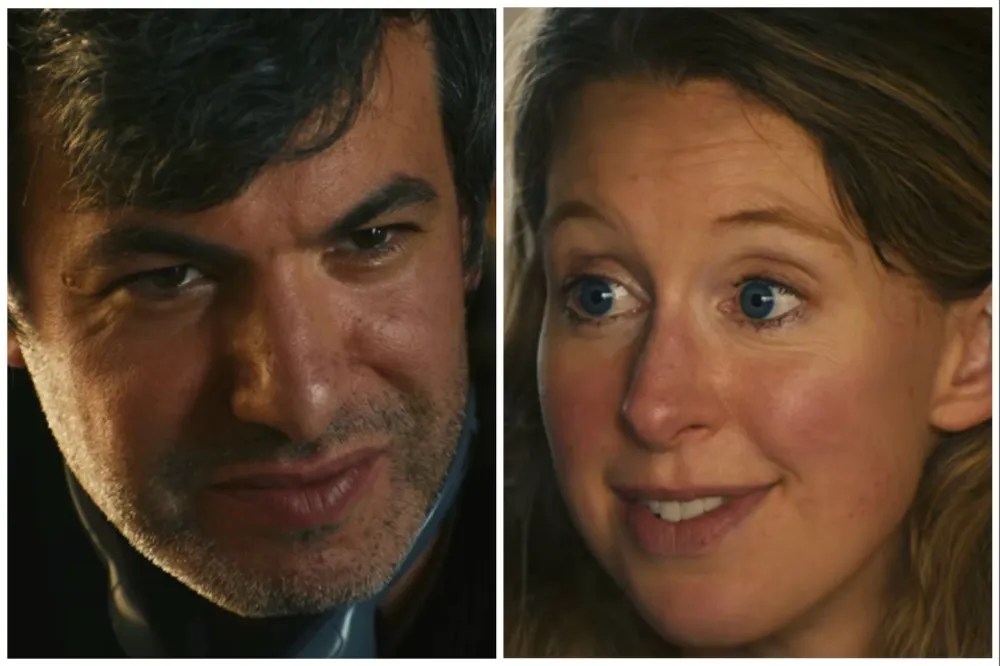
Oppenheim and the crew behind the camera gain fly-on-the-wall access and frame Fielder, Holmes, and Evans in such tight close-ups that you can see nearly every blemish and pore on their faces, often shooting in contorted, uneven angles that enhance the surreal effect. Holmes, who has large luminous eyes and a calm, convincing demeanor, initially seemed the villain both in the news and in the Hulu series “The Dropout” (she left Stanford to launch Theranos). This film makes you wonder if she wasn’t just naive or an idiot savant manipulated by Balwani and other men in her life — including Evans. Fielder shows Holmes the famous Abbott and Costello “Who’s on First?” comedy routine, subversively likening it to Holmes’s half-answers about what she knew and believed while running Theranos. She laughs, but never quite gets the joke, even after Fielder spells it out for her.
Evans manages Holmes in front of the camera. There’s something off-putting and narcissistic about him from the jump. In one scene, he boldly allows a full-frontal nude shot, and in a strange meet-up later on, he tells Amanda Seyfried, who played Holmes in the Hulu series, how great a lover he is. He never seems sincere, but then again, Fielder and Evans seem to have a quietly combative aggro thing going on, and you wonder if some of those emotions didn’t make their way into the editing bay. Fielder’s relationship with Holmes is more nuanced, leaning increasingly sympathetic over the film’s duration.
The title of the film comes from a text Holmes sent Fielder during the ramp-up. It seems like a hollow promise, but as the film goes on, you begin to believe that she believes she is being open and transparent with Fielder and Oppenheim. It seems impossible given the conclusion of the court, but the film allows both truths to live side-by-side. (Holmes is still in jail but set to move to a halfway house next year.)
How and why “You Can See Everything” got made is an intriguing undercard that begets a series of plot twists best not revealed. In fact, it’s amazing that the film ever got made. It took nearly four years to shoot (it begins with a pugnacious Fielder and ends with a gaunt and greyed soul in need of a rest) and clocks in at 174 minutes. Still, it never feels long. Those 34 days before prison account for about half the film’s running time. Once Holmes is behind bars, the enigma of Holmes, Evans and Theranos does not ebb — if anything, it grows — and some nifty narrative conventions concocted by Oppenheim and Fielder come into play. They included Seyfried, who had no contact with Holmes for her part in the miniseries that won her an Emmy, the financial structuring of the film and a dry pony fart.
It’s a strange brew that mystifies as it beguiles. What might be taken at face value as a witch hunt is anything but. It’s not so much an exploration for the truth as a plumbing of the characters’ souls, and their motivations. You might not buy all of the answers — but you will be riveted by them.


Leave a Reply