Art horror, serial killer nonchiller, espionage comedy and a gorefest
“Teenage Sex and Death at Camp Miasma”
⭐⭐⭐Rating: 3 out of 4
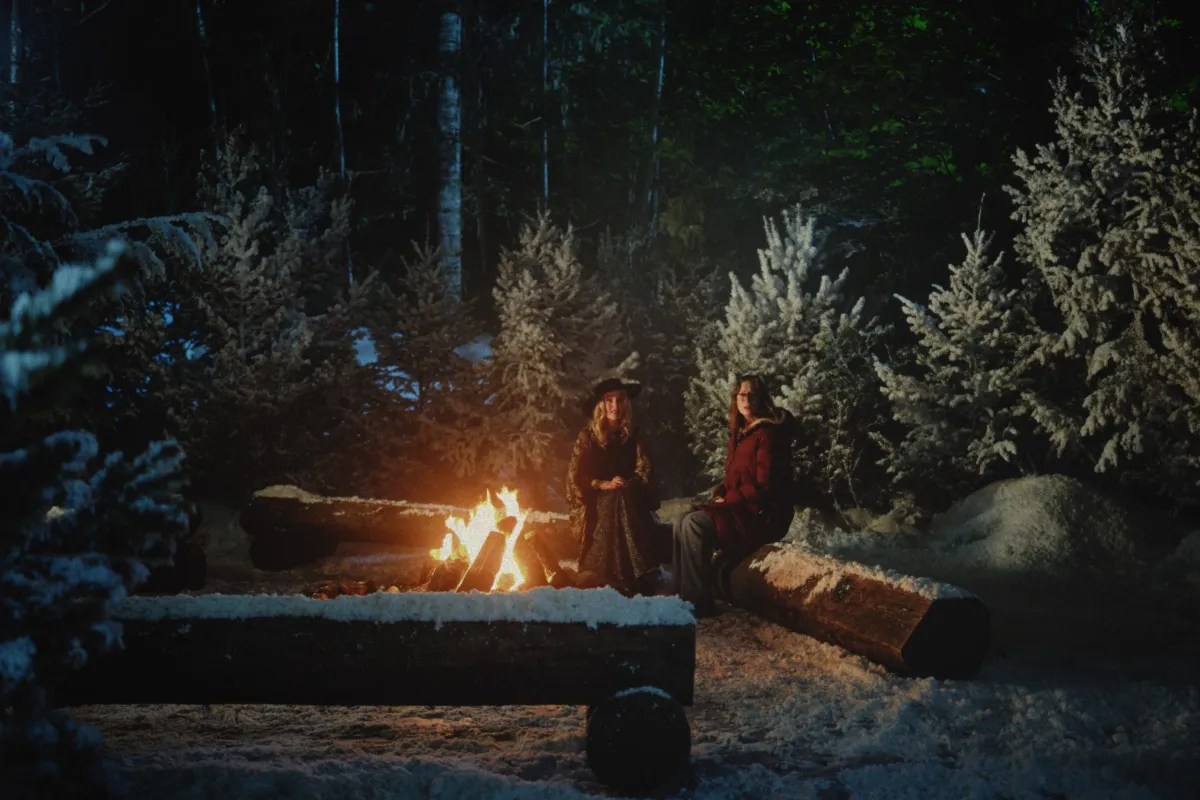
In this latest art-horror curio from Jane Schoenbrun, the alt-indie hand behind psycho-chillers “We’re All Going to the World’s Fair” (2021) and “I Saw the TV Glow” (2024), the “Friday the 13th” film franchise and gender politics get skewered with bloody orgasmic gusto. There is plenty of sex and death, as the title promises, with the bloodshed bringing the joy more than any muted, intoned, crest of pleasure. A head gets cut off and an arc of crimson red gushes 30 feet into the air, so over-the-top it’s comical. The effects are gorgeously framed by Eric Yue, who worked with Schoenbrun on their previous projects.
Camp Miasma is somewhere in the wooded Pacific Northwest at a lake, which was many years ago the setting of a slasher film starring Billy Presley (Gillian Anderson) as an ingénue. It becomes a long-running series of films and Presley, the “final girl,” now lives as a recluse at the site.
Enter Kris (Hannah Einbinder, “Hacks”), a young queer indie film director hired to reboot the franchise. Kris hopes to recruit Billy for her project (think Jamie Lee Curtis or Neve Campbell). The set up’s clearly self-referential — and part of the backdrop is that the original films have become criticized for their treatment of gender — namely trans. Kris — a clear stand-in for Schoenbrun—is an adoring fan of Billy’s and given the cold foreboding nights (it’s winter) the two end up smoking weed, watching old “Miasma Camp” videos and working on Kris’s failures at sex — she’s in a polyamorous relationship, but appreciates companionship more for the intellectual than the physical.
Much is asked of Einbinder in range — goofy, sexy, witty but shy — and she pulls it off, but it’s Anderson, with her bumper-bangs-and-victory-rolls updo (and menacingly aloof cattiness) that drives the film and alluringly so. It’s an intoxicating and immersive performance that holds the film together as it slips into alter realities and other strange and wonderfully murky segues. We see plenty of Little Death (Jack Haven) the being at the bottom of the lake, who when hungry, rises from the depths in a Devo Hazmat suit with a ceiling air vent for a mask, and eviscerates any and all with a double-bladed spear. The cherry on the top is seeing Eva Victor (“Sorry Baby”)’s cameo as a punked-out ’80s DJ — mohawk and all — with sassitude.
“The Whisper Man”

A still from “Whisper Man.” Credit: Courtesy of Netflix
⭐⭐Rating: 1.5 out of 4
This flatfooted serial killer chiller staring Oscar winners Robert De Niro and Michael Keaton comes off as little more than a lazy, B-tier hack of Jonnathan Demme’s 1991 genre classic, “The Silence of the Lambs,” where an incarcerated killer (Keaton) holds the profiling keys to the copycat du jour on a spree. I wouldn’t be surprised if AI was used in the origin of the unoriginal script, and — as if taking a cue from the title — everyone in the cast talks in hushed tones. The strange, sanctified silence carries so deep into the film I began to wonder if director James Ashcroft didn’t have a bag man on set to dole out sedation meds.
De Niro and Michelle Monaghan play the cops trying capture a serial killer who is copying Keaton’s Hannibal surrogate, in jail for killing 12-year-old boys by mummifying and entombing them. De Niro’s grandson has gone missing — his son (Adam Scott who with this and “Hokum” seems to be drifting toward underdeveloped dark fare) writes crime novels based on De Niro’s detective’s past accomplishments. Many of the interview scenes with Keaton’s killer look shot in separate locales or on separate days, but maybe that’s just the result of the stilted dialogue and flat interaction. Much time is spent in dark basements and interrogation rooms — did the state of New Jersey decide to operate the grid at half capacity? It’s all poppy cock that gains traction too late, after an almost inert build up. Nearly every scene feels ripped directly from the “Silence of the Lambs.” It’s got a lot of thespian timber, but no bite.
“Mayday”

⭐⭐⭐Rating: 2.5 out of 4
This is espionage comedy brought to us by co-directors John Francis Daley and Jonathan Goldstein (“Game Night,” “Dungeons & Dragons: Honor Among Thieves”). It’s the tail end of the Cold War and pairs Ryan Reynolds and Kenneth Branagh, an odd couple who click like Eddie Murphy and Nick Nolte in “48 Hrs.” (1982).
Reynolds plays Lieutenant Troy “Assassin” Kelly, a top naval fighter pilot, a la Tom Cruise’s Maverick from “Top Gun” (1985). He gets a black ops CIA assignment to fly a SR-71 plane over Russia to collect intel (the aerial sequences in “Mayday” are pretty boss). Over the target, the cloud cover’s too thick and the spy craft must dip into radar view. It gets shot down by a MIG. Behind enemy lines, Kelly is taken in by Branagh’s Nickolai Ustinov, an isolated farmer and hooch brewer with a bootleg copy of “Top Gun” and a love for all things “American.” He’s also former KGB, skilled in hand-to hand combat, and can MacGyver his way out of a rat hole. The two pretty much roll like John Cena and Idris Elba in “Heads of State” (2025), only more effusively.
The production values and sets recreate the feel of the era (much of it was filmed in Canada). The chemistry between the leads is a plus. Reynolds is dialed down from his “Dead Pool” wise-cracker but still irreverent, and Branagh, jumping off from his mysterious Eastern Bloc manipulator from “Tenet” (2020), seamlessly flows between stoic soldier and America-loving goofball. It’s a buddy movie in the end, and it mostly works.
“Onslaught”

⭐⭐Rating: 2 out of 4
Adam Wingard, who cut his teeth in mumblegore (“V/H/S,” “You’re Next”), stumbled with the “Blair Witch” reboot (2016) and then showed some big-budget filmmaking pizzazz with the monster beatdown “Godzilla vs. Kong” (2021), returns to his lo-fi gut-and-gore roots with this derivative grindhouse mashup.
The framing is murky: a Germanic evil genius (Dan Stevens, donning an uneven aging makeup job) is living in the New Mexico desert, where he dutifully performs toe-kissing subservience to his Marlene Dietrich-esque wife (Rebecca Hall, who appeared in Wingard’s ’Zilla flicks). He also runs a secret military lab where he experiments on soldiers thought to have died in battle to create a platoon of super warriors. These über-grunts have no moral compass — they execute with extreme prejudice (the concept is clearly stolen from Walter Hill’s 1987 militia thriller starring Nick Nolte) — thanks in part to being imbued with night vision (their eyes glow like wolves) and an ability to flex their muscles so densely that bullets have diminished impact: organic Kevlar, I guess.
The what and why for their creation and murderous mission are never adequately explained. There’s some oblique nod to Nazi experimentation and Operation Paperclip, but it’s all an air kiss so the three beefy commandos can saddle up and eradicate the late-night denizens at a local truck stop. They commandeer a semi and go to their next bloodbath target, a crummy trailer park. The three hop out of their truck looking like Jason, Michael Myers and Leatherface in ICE gear, and hey, they also deliver misery, pain and death.
But the mad doctor’s ointment has a fly: Celeste (a generic Adria Arjona from “Andor”), a single mom suffering PTSD from combat deployments who happens to possess a crowd-quieting cache of firearms. It’s basically Ripley versus Jason multiplied by three.
Not much of “Onslaught” holds together, and few of the characters endear. Hall is riveting, but she’s not onscreen much. The film is best appreciated for Oren Soffer’s trippy, slick camerawork and brooding soundtrack — best heard in Dolby surround sound and a cool but total cop from one of John Carpenter’s classics. With a lithe running time of 90 minutes, you’d think“Onslaught” would fly by, but once the three speechless lads lace up and get at it, it begins to slog and feel repetitive and pointless. To pay homage does not put one on par.


Leave a comment