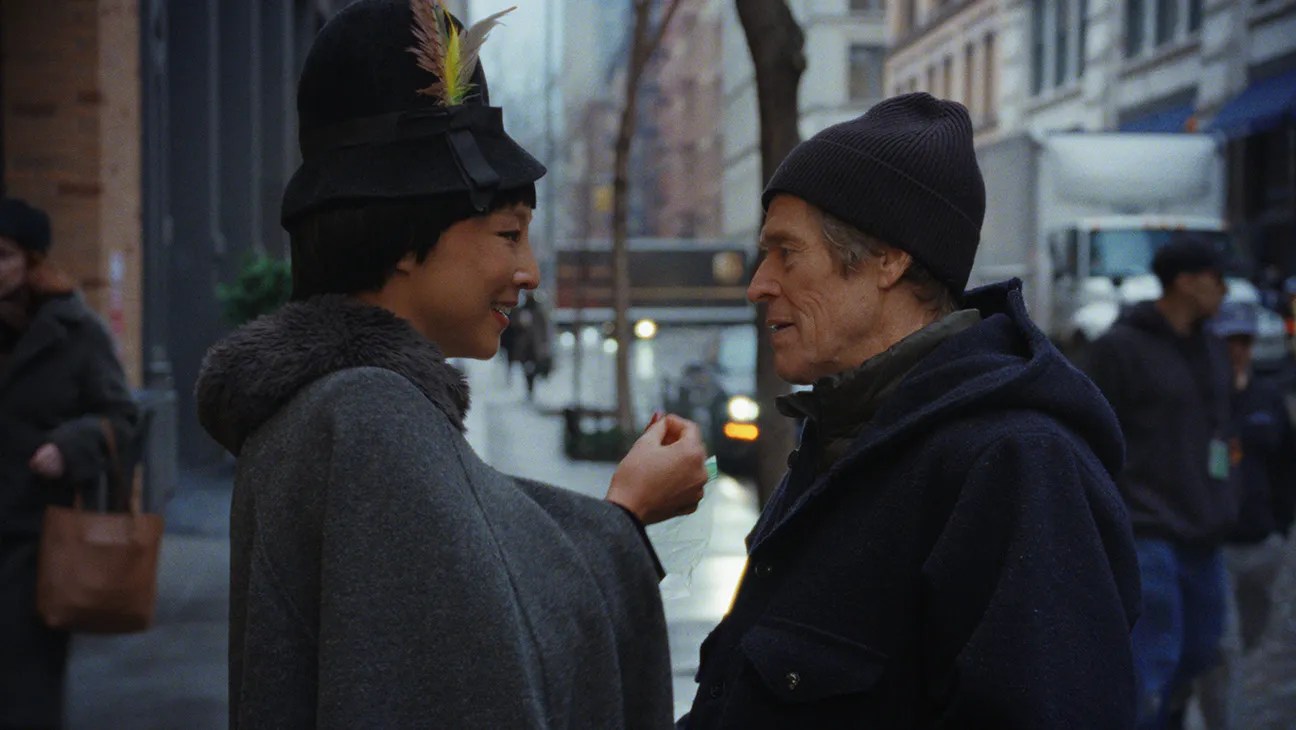
Director Kent Jones (“Diane“ (2018)) works with a killer cast in this reset of a novella by Arthur Schnitzler, with 1890s Vienna transposed to modern day New York City (the script’s by Samy Burch, “May December” and the upcoming “Coyote vs Acme”). The esteemed Willem Dafoe stars as Ed Saxberger, a New York City postal worker who back-in-the-1980s-day penned an obscure work of revered poems. He’s rediscovered by a gaggle of youthful writers and artists who brand themselves the Enthusiasm Society. There’s a beatnik vibe to the group, led by a scarf-wearing dilettante who goes by the moniker of just Meyers (Edmund Donovan, who gives his pompous character a modicum of depth and vulnerability). They embrace Ed as something of a Bukowski-esque literary lion and through fawning flattery entreat him into their circle. The newfound notoriety rekindles Ed’s creative passions. As he starts to see the world through the progressive lens of his admirers, he calls out fellow old White guys for the intolerance he had become numb to over the years. The rising arc becomes Ed’s mounting affections for the much younger Gloria (Greta Lee, the soulful heart of “Past Lives”), the group’s aspiring actress, chanteuse and something of a Blanche DuBois in the making.
Lee, who you can also catch in the subpar sci-fi thriller, “The Last House“ over on Netflix, strikes the screen as a luminous wonder, but at times feels miscast and out of place. She does strike a genuine (if more platonic than romantic) chord with her veteran costar. Ultimately, the film feels drawn out, as Dafoe’s Ed never brings congruence to a hodgepodge of ideas and icons, despite the actor’s affable effort.
By nine o’clock the video had been viewed more than nine thousand times.
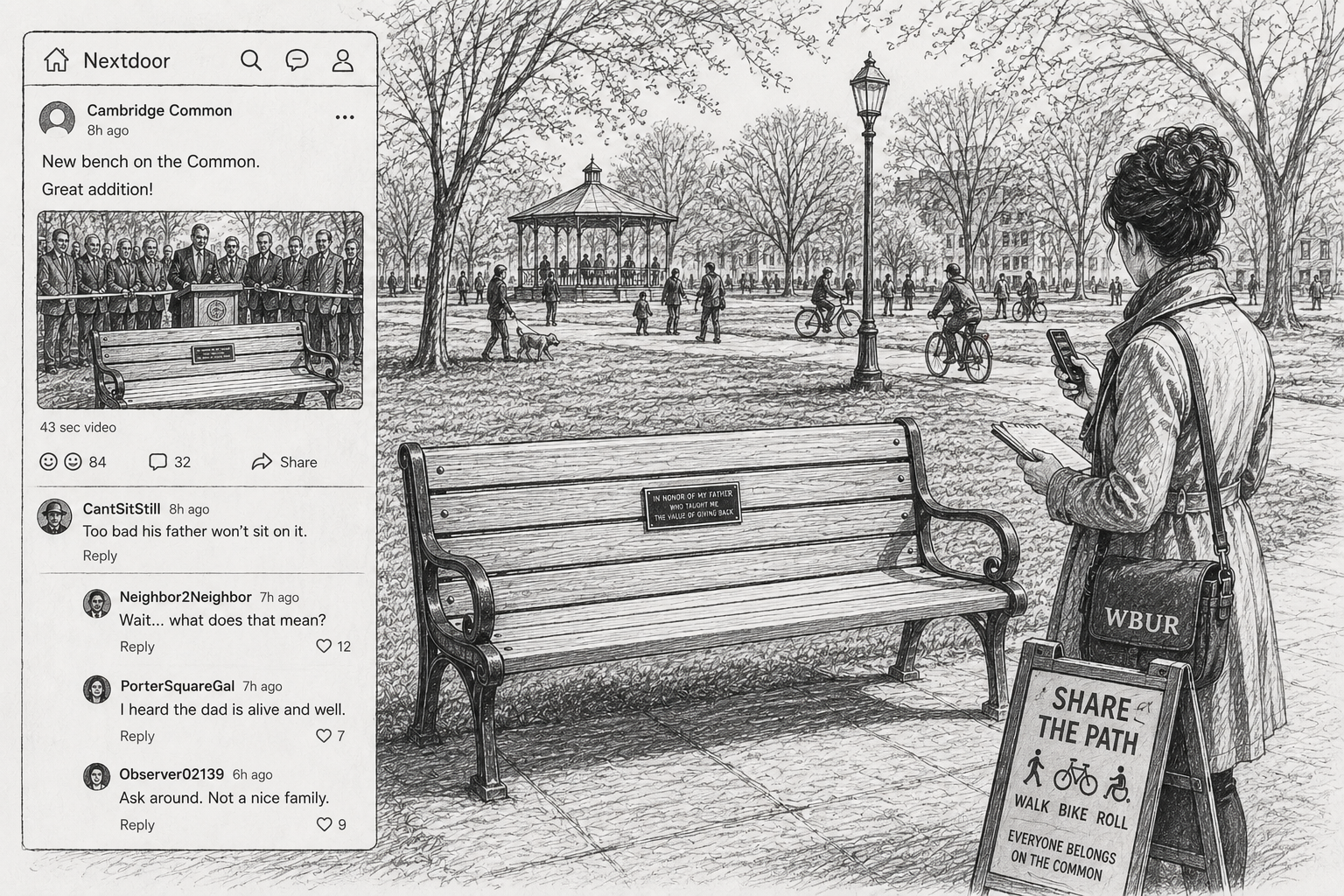
It wasn’t much to look at. Forty-three seconds of shaky cell phone footage posted to Nextdoor. A ribbon fluttering in the breeze. A city councilor applauding. A bronze plaque catching the afternoon sun. Somewhere off-camera, a child let out a sing-song whine about ice cream.
The title read simply: “That new bench on the Common.”
The first dozen comments were predictable.
“Beautiful addition.”
“Nice to see people giving back.”
“Great, but needs shade trees.”
Then, at 8:17 p.m., CantSitStill, an anonymous account that no one seemed to recognize, joined the conversation. “Too bad his father won’t sit on it,” was all they said, and nothing more.
By morning, the post had turned into an online trial.
Victor Haskell refreshed the thread every thirty seconds. He half-expected the dedication to earn a polite newspaper brief and perhaps get a well-framed photograph for the annual report of the Haskell Foundation. Instead, strangers were debating his childhood, his marriage, his taxes, his politics and, most bafflingly, his father.
“Isn’t his dad dead?”
“No, just saw him at Whole Foods.”
“T heard they’re estranged.”
“My cousin worked for Victor. He can be difficult. Believe the comment.”
“Believe what?”
“Believe what you see is not reality. Wealth comes easily to those who have not earned it.” CantSitStill responded and then went silent in the wake of the tidal wave of follow-up questions.
Victor had paid nearly forty thousand dollars for the bench —fine, marbled New Hampshire granite, reclaimed ash and a custom bronze plaque honoring his father:
Based on the bestselling 2022 novel by Shelby Van Pelt and directed by Olivia Newman (“Where the Crawdads Sing”), “Remarkably Bright Creatures” channels Nicholas Sparks by way of centenarian wildlife expert David Attenborough. If that sounds like a lot of tentacles, it should, as the film is narrated by an aging giant octopi named Marcellus. Marcellus lives in an aquarium on the Puget Sound and likes to get out and scamper about at night, which brings him into contact with Tova (Sally Field), a retiree who works the late-night janitorial shift, both to keep busy and to help settle past traumas. One affectionate tentacle touch and Marcellus can tell that there is a “hole” in Tova’s heart. Things get more complicated when Lewis Pullman’s Cameron, a broke struggling musician, takes over Tova’s shift after she twists an ankle. The Sparks-ian angle — human trauma distilled into an airy lite confection — has all three finding closure on that past and healing in the now, through interaction with each other. For the audience, there’s an unsolved mystery to add intrigue.
Marcellus, voiced by Alfred Molina, gives us all the Attenborough octopi factoids we need, and while the film is best when Marcellus is at the center (the FX and such are excellent), Field and her gaggle of aging gal pals — the “knit-wits,” a sewing club with Joan Chen, Beth Grant and Kathy Baker — charm in devilishly understated ways. It’s heartwarming for sure, but never maudlin. Field, a veteran presence, carries the film and knows when to cede the stage to her eight-armed co-star.
Watching “Creatures” sparked the desire in me to go back and watch the Academy Award-winning documentary “My Octopus Teacher” (2020), which plays like “Creatures” IRL. It also has me wanting to reread Sy Montgomery’s excellent and emotionally insightful “The Soul of an Octopus,” which, like Tova, is about the author’s interaction with a polypous named Athena at our beloved New England Aquarium.
Samara Weaving seems to be typecast as an onscreen punching bag. In the “Ready or Not” films and now this dour rom com/thriller, she plays a fetching can-do femme transformed by the masochistic madness of the plot into a purple bloody mess. Directed by Jorma Taccone, “Over Your Dead Body” is a remake of 2021’s grim Norwegian film “I Onde Danger” (lamely rebranded as “The Trip” in the United States).
The story begins with Weaving’s Lisa and her husband Dan (Jason Segal) having marital problems, not least of which are a two-year drought in the conjugal bliss department. He’s an indie film director who scored critical success early but now is relegated to making “pop-up ads.” Lisa is a struggling stage actress cheating on Dan with a fellow thespian. Money is another sizable problem. A getaway to Dan’s dad’s cabin on a lake in Upstate New York during a stunning fall season (the landscapes are shot in Finland but look legit) becomes an opportunity for Dan to off Lisa and cash in an insurance policy. But when he hesitates to apply Chloroform, she tases him and ties him to a kitchen chair to put her own permanent separation plan in play. But then, murder interruptus — a trio of escaped convicts (Timothy Olyphant, Keith Jardine and Juliette Lewis) drop through the ceiling. The couple have to team up or die.
The main problem with “Over Your Dead Body” is that neither Lisa nor Dan is all that interesting or likable. It’s the trio of malevolent misfits that hold our attention, especially Olyphant’s smooth but demonic mastermind and Lewis’s edgy Allegra, who is sexually aroused by the clamor of violent confrontation. The movie may be even more gruesome than its Norwegian inspiration, though “Dead Body” somehow manages to make whimsy from the severing of fingers, ears and noses. Turns out romantic separation is always messier than it has to be.
It was a typical bustling day at the Porter Square shopping mall made more so by the beautiful spring day, a gift from Mother Nature after a week of overcast skies and two torrential rain storms that caused drain basins to back up and overflow. Chaz Perkins, his sciatica acting up, gingerly baby stepped his way out of the CVS, skirted his way around one of the many lingering puddles that dotted the parking lot and a his way towards old Betsy, his trusted Honda CRV with more than 15 years of reliable service. He had parked Betsy near the pharmacy with strategic intent to minimize the taxation of his hip. As he had envisioned it, he would first hit up Ace Hardware for his spring planting needs (a new trowel to replace the rusty, ineffective relic that had been in the condo’s basement since before the Boston Tea Party, and nasturtium and magnolias seeds for the planters that abutted the sidewalk in front of the three story walkup) and then the liquor store for a half case of Vino Verde to go with the Portuguese fisherman’s stew he had made for his book club which would be arriving at his Huron Village abode within the next three hours. Everything was going according to plan, the trowel, seeds and wine had been deposited in Betsy’s boot, what Chaz didn’t bargain for was the demanding woman insisting that the pharmacist check and recheck his records as he stood by on achy joint waiting to claim his ‘scipts and pay for the much needed vial of Advil and coveted Reeses Peanut Cups. When it was revealed that the woman’s prescription order had been placed at another CVS some two miles away, the woman, who Chaz felt possessed the melodramatic air of Blanche DuBois, launched into an indignant tirade shaming the pharmacist for her mistake and adding another five minutes of hip grinding discomfort to his day.
Outside in the cloudless blue Chaz examined the space between the blue Tesla and Betsy. It was sideways sliding tight, but every space in the parking lot was ridiculously small. It was as if some over zealous planner decided to take normal sized spots and reduce them all to compact size so they could squeeze in an extra fifteen or twenty cars, but for what gain? Anyone with a minivan or plus size SUV took up two spaces and the rear of the monstrosity often jutted out, adding to the lot’s chaotic traffic flow woes. Chaz imagined that the number of insurance claims filed at Porter Square had to be substantially higher than those at the suburban shopping expanses like Burlington or Natick where you could park an apatosaurus-sized family truckster without fear of losing a sideview and still have ample room to swing your door open without dinging your neighbor.
A historic wall in Harvard Square may be up against it, as business owners and city officials are banging their heads against the problem of how to fix it.
The stone wall was built more than 200 years ago, mostly hidden behind Charlie’s Beer Garden, was erected in the late 1700s and early 1800s to channel the spring-fed Town Creek to the Charles River. The project made Winthrop Square — then a knoll and the heart of Harvard Square — a more stable and level gathering spot by protecting it from a creek winding toward the Charles River.
The wall might also have been intended for a more ambitious project: a wharf on Eliot Street, said Charles Sullivan, executive director of the Cambridge Historical Commission. Like the West End in Boston, some parts of Cambridge near the Charles River were previously underwater and later filled in.
The wall partially collapsed in 2020 and was never repaired. Scarce funding and complicated jurisdiction left it crumbling, and rats — lots of rats — moved in. Last year, Denise Jillson, the Harvard Square Business Association’s executive director, asked public health experts in Cambridge and at Harvard University for help analyzing the problem.
“That site is akin to a prairie dog village … but with rats,” said Richard J. Pollack, Harvard’s senior environmental public health officer.
In March, Jillson issued a release calling on the community and stakeholders to “together to find a solution to the complex challenge of preserving this historical relic that sits on private property.” The release included an illustrated comic about the wall and its history created by Caro Taylor, a Cambridge resident and a junior at the Commonwealth School in Boston who was an intern at the HSBA last summer.
The “Old Stone Wall” runs from Winthrop Street, through Charlie’s Beer Garden, and out to Eliot Street. The better-preserved section, which divides Charlie’s and the former Red House restaurant (soon to be relaunched as the Cox Hicks Club), is an impressive 8- to 10-foot high structure, still intact. The collapsed section of the wall — adjacent to Eliot Street, tucked behind the IHOP — is not publicly visible except through a small alley. Here the wall is 4 or 5 feet tall.
A combination of factors likely contributed to its deterioration, according to the city and the Harvard Square Business Association: age, erosion, weather, ongoing disturbances from area construction, and rats.
A relatively intact section of a historic wall in the Harvard Square alleyway between the former Red House and Charlie’s Kitchen.
The wall was built with large fieldstones laid in a battered profile that lean inward — a technique used in early retaining walls to release pressure. The rocks were dry-laid to allow water to pass through the wall rather than build up behind it. The stones are local: Roxbury Puddingstone from that neighborhood’s Parker Hill and granite from quarries on the Boston Harbor Islands.
“It’s not the only stone wall in Harvard Square, but it is by far the largest and most significant,” Sullivan said.
The wall is located within the Harvard Square Conservation District, which means work requiring a building permit generally requires review by the historical commission. However, the commission’s jurisdiction applies only to features visible from a public way. Portions of the wall are located behind buildings on private property and cannot be seen from the street, limiting the commission’s authority over those sections.
Given the wall’s historic value, the city appropriated $200,000 in Community Preservation Act (CPA) funds in 2021 to shore up the Eliot Street section of the wall. The estimated cost was about $400,000, however, and since it is on private property Sullivan asked commercial property owners to contribute the additional $200,000.
Of the property owners, only Paul Overgaag, who owns 98 Winthrop Street (previously home to The Red House) and also Charlie’s Kitchen at 10 Eliot Street, agreed to contribute. Raj Dhanda, owner of the Crimson Galeria building and the property at 96 Winthrop Street (formerly the House of Blues, now The Boiling Crab), expressed concerns about the scope of the project and the financial burden. The project stalled, and in 2024, the city reallocated the CPA funds.
In a recent phone interview, Dhanda said he believed the city should have paid more of the project’s cost. He also disputed the $400,000 price tag. At the time, his own contractor estimated that the work would cost less than $200,000.
Rat traps line a dilapidated segment of a historic wall in the Harvard Square alleyway between the former Red House and the IHOP, parallel to Eliot Street.
One of the primary concerns has been the growing rat population in the alley near the wall. As the wall continues to deteriorate, it might create even more hiding and nesting pockets for rats, Jillson said. The imminent public health risks from rats — and their recent surge in Cambridge — have been well documented. At a public meeting last year, Cambridge City Manager Yi-An Huang said, “These rodents are, as I understand it, reproducing faster than we can possibly catch up.”
Jillson also fears that the burrowing rats might also be destabilizing the soil and thus contributing to the wall’s deterioration. “That wall is basically infested with rodents, and it’s compromising the integrity of the soil,” she said.
The alleyway behind the Too Hot Sichuan restaurant and IHOP is a hotbed of rat activity in the square, Pollack said. Had the restoration moved ahead, it would have included implementing a cement backing to the wall. That would have helped secure the stones and abate erosion. It would also have effectively blocked the rats from burrowing.
Jillson hopes her press release spurs action. The economic climate, however, is significantly different.
This silly and inane movie is a star vehicle for Priyanka Chopra Jonas (the wife of singer Nick Jonas). She plays Ercel, a housewife of the Caribbean married to a seafarer (Ismael Cruz Córdova) who is off on a mission. Ercel is caring for their son Issac (Vedanten Naidoo) and her much younger sister-in-law Elizabeth (Safia Oakley-Green, “Anemone,” “Out of the Darkness”) on Cayman Brac. Their idyllic tropical paradise is suddenly visited by a posse of unsavories demanding a stash of gold.
Turns out Ercel was previously “Bloody Mary,” a cutthroat pirate captain of the high seas. She toggles to Caribbean kick-ass queen and dispatches the first wave of henchmen, leading to a showdown with Mary/Ercel’s former running mate, Captain Connor (Karl Urban), who has taken her husband hostage.
Director Frank E. Flowers (“Haven”) then sends Jonas, dressed up ninja-style, through a disjointed montage of action sequences. She slices up baddies, or blows them up in various creative ways (the use of explosives is one of the more innovative aspects of the film) as her charges and betrothed sit haplessly by. ”The Bluff”’s title comes from the broad cliffside — or brac — of the island, where Mary has weapons stashed throughout a maze of booby-trapped tunnels. Flowers, who is from the Caymans, allegedly concocted the story from historical happenings and local lore. It’s half-baked, hackneyed mid-1800s high seas mush. Jonas most certainly deserved a better wing-spreader and Urban, who brings some of his cheeky, gruff machismo from “The Boys” to the part, isn’t enough to right the ship. Paging Jack Sparrow.
Cantabrigian teacher and poet Charles Coe died Friday Nov. 21.
The spirit of creativity in Cambridge dimmed last week when longtime resident, teacher and poet Charles Coe died Monday from complications related to prostate cancer surgery. His death was sudden and stunned many. In addition to touching people with his words, often delivered in a deep, mellifluous baritone, Coe offered mentorship, leadership and a sense of community. He was 73.
He was an omnipresent figure in local literary circles: the Mass Poetry Festival, long-running literary salons across Cambridge and Somerville, the Writers’ Room, Black Writers Reading series, arts advocacy boards. If there was a gathering where people were wrestling with words or art or community, chances were good Coe had either helped organize it or slipped quietly into a seat to listen.
The first film from indie stalwart Hal Hartley in more than 10 years – a Kickstarter campaign got it off the ground before a Covid pandemic delay – is a loose, autobiographical reflection on the director’s life and body of work like Almodóvar’s deeply personal “Pain and Glory” (2019). At the center is Joseph Fulton (Bill Sage), a lion in winter edging toward 60 and one-time maker of successful romantic comedies who’s taking a break from the director chair to get his last will and testament together. He also has a desire to put his hands in mother earth, and applies for a job as a cemetery groundskeeper. Through a comedy of miscommunication, Joe’s girlfriend, Muriel (Kim Taff), an actor in Season 14 of her “Wonder Woman”-esque TV series, and his niece and assistant, Veronica (Katelyn Sparks) discover an unopened, confidential letter from a hospital and think it all adds up to Joe dying. Adding fuel to the fire is the subplot about a wannabe screenwriter (Jeremy Hendrik) claiming to be Joe’s son. It’s a stoic, reflective affair with some strong writing. The best moment is when a film studies professor (Aida Johannes) challenges Joe with SAT word salad and Rorschach test reasoning about the meaning of his films. It’s blazingly brilliant, but begs the question as to why Joe’s rom-coms are being intellectualized as if they’re “One Battle After Another.” No offense to rom-coms, but it’s apples and oranges – and Joe, a likable sort, doesn’t really emanate the auteur je ne sais quoi that many in the film seem to heap on him. As to the title, the film begins and ends with a Shackleton-esque-esque ship amid rough seas – a clear metaphor for hitting a patch of turbulence late in life and what to do. It works, even if weakly employed. As with most Hartley (or Mamet, for that matter) films, it’s less about the oblique references and more about matters of the heart and struggling soul.
The text came in at 12:22 in the morning. “I have ur cat. The $$ is now $200.”
Miriam had been unable to sleep that evening, it had been three days since Speedo scampered out the door of their third-floor walk-up and hadn’t returned. It wasn’t the first time the black cat with a white blaze across its face and one white paw went on a “walkabout” as Miriam and Charles affectionately called it. The first time he disappeared Miriam was riddled with angst and emailed the neighborhood listserv at 4:30 in the morning, “Our cat Speedo has gone missing. Have you seen him? We are worried sick. If you see him, please call.” She included her cellphone number and attached her favorite picture of the pet, which was the embodiment of kitty cuteness, though the creature’s piercing green eyes probed the viewer as if the cat knew the beholder’s deepest, darkest secret. Later that day, the McFadden’s son, home from college on a laundry run, found Speedo batting around a balled-up paper bag in the basement. To thank the boy, Miriam and Charles invited the young McFadden up for a brunch of vegetarian black bean chili crowned with poached eggs and hollandaise along with Miriam’s personal pride, home cured lox on bagel crisps with whipped cream cheese and chive. As Miriam arduously whisked the thick yellow sauce, the scene of Charles assembling a bagel as he listened to the boy talk excitedly about his future plans—something outdoors, urban planning, land conservation or maybe renewables—tweaked memories of the weekends that Leah would come home from veterinary school for comfort food and quiet. She laughed inwardly for a second because Charles always overloaded his bagel with a triple spread and a double heaping of onions with capers rolling off a teetering crown of sprouts, and then there was the two layers of her meaty, thick lox, and as usual, a good portion of it ended up in his bushy beard. She was about to do a subtle chin point behind the boy’s back but paused in mid motion as a hot tear welled up and made its way down her cheek and into the hollandaise.
More overnight “Where’s Speedo?” disappearances happened, but the cat always returned the next day for his mid-morning feeding, and seemed to be eerily cognizant that Wednesday, Friday and Sunday, were sardine days as he’d always be there waiting in the kitchen for Miriam, excitedly purring and crashing into her legs, nearly tripping her as she tried to fork a pungent headless filet into the cat’s bowl. As Speedo escape days became more and more, the mode of which, the stealthily trailing of a pant leg of an unwary resident, delivery person or anyone else operating the heavy wooden door that closed with creaking, achey slowness, Miriam and Charles began to fret less, often sharing a glass of crisp kosher white wine and laughing about, “Speedo being Speedo.” “He’s out saving the world,” Charles said one night as he sipped wine and noshed on crackers crowned with a diced mixture of Miriam’s lox, capers and pickles. To Miriam’s non-reaction he reiterated, “I’m serious, I think he morphs into a giant crime-fighting kitty.”
Miriam took a long sip of wine, savored the buttery oak sweetness for a contemplative beat, and then nodded in reluctant agreement.
“See?” Charles said, perching forward in his chair, “I’m telling you, it’s a thing. What do you think his superpower is?”
Again, Miriam regarded the question with pause and said, “Laser beam eyes and saber claws, or maybe, he can command other cats as allies like the rat girl in ‘The Suicide Squad’?”
“A giant starfish and Jim Ignatowski with Christmas tree lights popping out of his head? That movie was utter poop!” Charles bellowed. “Superhero films are ruining cinema.”
“So says the grown-up man who collects kewpie dolls.”












 For What it's Worth