Archive | March, 2026

Reviewed: “Project Hail Mary”

21 Mar

Weir’s self-published first novel was hailed for its deep scientific detail and accuracy but “Hail Mary” trades hard science for a more fantastical plot.

⭐⭐⭐Rating: 3 out of 4.

Fans of Andy Weir’s “The Martian” — and Ridley Scott’s 2015 film adaptation starring Matt Damon — will find familiar bones in this deep space drama with a side of buddy comedy based on Weir’s third novel, “Project Hail Mary.” Weir’s self-published first novel was hailed for its deep scientific detail and accuracy but “Hail Mary” trades hard science for a more fantastical plot. As in Christopher Nolan’s weighty “Interstellar” (2014), we learn early on that the Earth is dying — here, because an alien microorganism called “Astrophage” is eating away the sun. Without adequate sunlight, famine will arrive in 20 to 30 years; the wars triggered by the diminishing food supply will crack civilization far sooner.

It’s not just an Earth problem, either. The ravenous Astrophage are devouring nearly all the stars in the galactic neighborhood — except one, some 12 light-years away. A team of astronauts has been sent to study this star, find out why it is resilient, and return to Earth with the solution. The caveat: The ship has only enough fuel for a one-way trip. The astronauts will send the solution back to Earth via probe, while they drift around for a few more years with various forms of painless euthanasia at their disposal. It’s not exactly something most people would raise their hand for. But the alternative is slow starvation — or worse — before your newly refinanced mortgage is paid off.

Continue reading
The Renty daguerreotypes find a home, but Harvard’s legal fight lingers

17 Mar

After six long years, the Harvard-Renty controversy came to a close last week when 15 daguerreotypes of Renty Taylor, his daughter Delia and five other enslaved people were transferred to the International African American Museum in South Carolina. The court case – Lanier vs. President & Fellows of Harvard College – had Renty’s great-great-great granddaughter, Tamara Lanier, suing Harvard for possession of the 176-year-old depictions, which were commissioned by Harvard biologist Louis Agassiz in 1850 as evidence for his racist polygenic theory that whites were intellectually superior to Blacks. Its conclusion in May came after many turns and twists. (Harvard has said it cannot confirm that Lanier is related to Renty.)

What stands out is that just after Lanier initiated the case in 2019, Harvard launched the Committee on Harvard & the Legacy of Slavery. That committee’s 2022 report showed that Harvard had enslaved 70 or more people and benefited financially and otherwise from their enslavement. It prompted Harvard to create a $100 million initiative to support descendant communities and educational initiatives tied to that legacy.

Yet it was during that time that Harvard fought Lanier’s claim, citing she lacked property rights – seeming antithetical to a mission to document and atone. To observers the question became: Was Harvard operating out of different ideological silos, or simply talking out of both sides of its mouth?

Continue reading

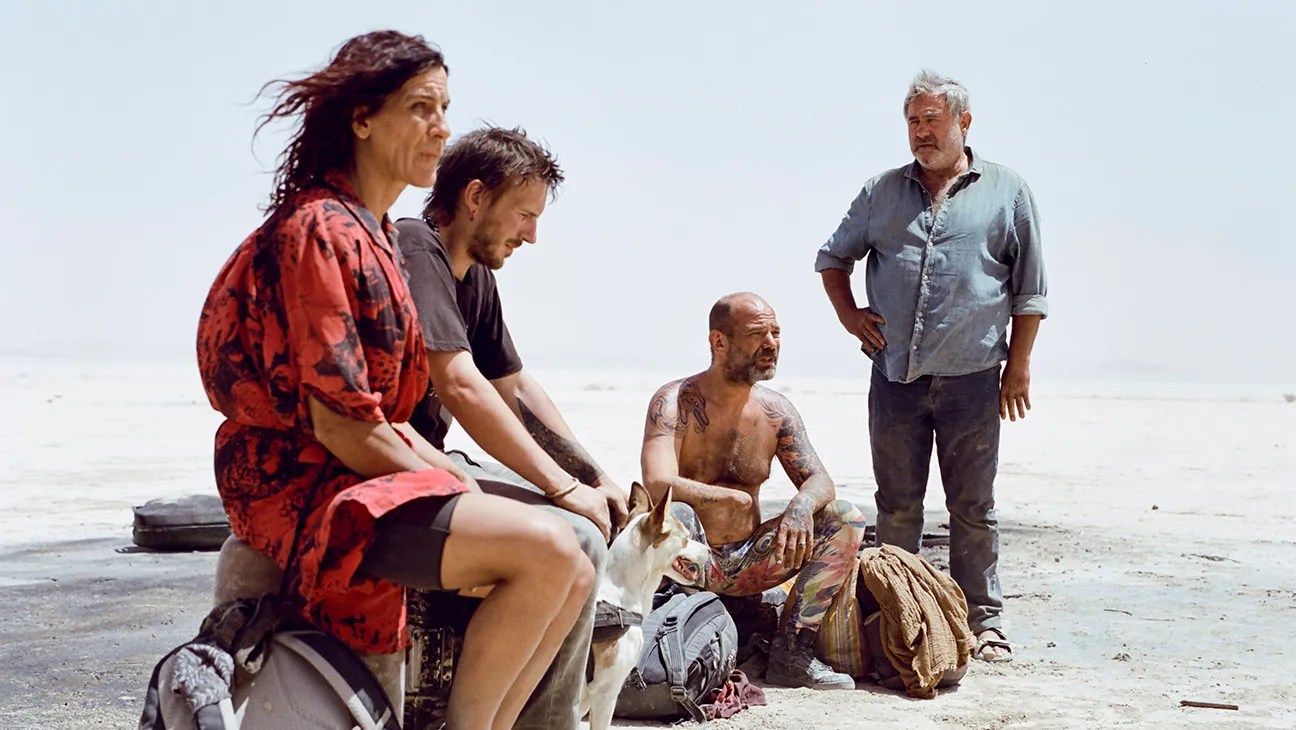
Reviewed: ‘Sirât,’ ‘War Machine,’ & ‘The Dutchman’

14 Mar

A spiritual journey through the Sahara, a violent, alien transformer, and a NYC man who may have strayed in the wrong direction.

“Sirât”

This sprawling wonderment from director Óliver Laxe unfolds as a stark meditation on faith, displacement, and moral endurance. Set in the harsh, borderless landscape of the endless Moroccan Sahara — and its precipitous mountains — a father and son go looking for their missing daughter/sister who’s last been seen embedded with a nomadic rave collective partying its way through the vast, arid nowhere. The film’s spiritual journey is shaped as much by silence and ritual (the rave parties are transfixing) as by events that often startle and shock. Laxe frames fate and belief not as certainty but as friction between devotion and doubt, discipline and compassion, and isolation and responsibility. Beneath its austere beauty, “Sirât” (loosely meaning the path to spiritual enlightenment or paradise) engages quietly but pointedly with contemporary political tensions, touching on migration, gender identity, radicalization, and the fragile line separating faith from ideology.

Driven by a pulsating techno score from David Letellier, known professionally as Kangding Ray, “Sirât” resists easy allegory while allowing meaning to emerge through gesture and repetition. The ensemble’s nuanced performances are restrained and inward, grounding the film’s metaphysical inquiry in palpable human vulnerability. \

Continue reading

Tracking The Monster and his Bride through the many versions of Mary Shelley’s ‘Frankenstein’

13 Mar

Jessie Buckley and Christian Bale in Maggie Gyllenhaal’s “The Bride!”

Right now cinemagoers can double their Frankenstein pleasure with “The Bride!” and Guillermo del Toro’s “Frankenstein,” up for the Best Picture Oscar this Sunday. Sure, “Frankenstein” is streaming on Netflix – it’s practically left theaters – but it is one of those films best seen on the big screen, as is Maggie Gyllenhaal’s newly opened grand spectacle. They play like bookends to the original story by Mary Shelley, just 18 at the time she wrote her 1818 novel subtitled “The Modern Prometheus.”

In the book, The Bride was promised but never made. It’s in the 1935 James Whale-directed sequel to “Frankenstein” (1931) and Gyllenhaal’s “The Bride!” that we get the realization of the corpse bride via very different narratives. Wedding crashers in the genre are “Frankenstein: The True Story” (1973), starring Jane Seymour and David McCallum of the “Man from U.N.C.L.E.,” and an emotionally inert 1985 version of “The Bride” pairing Jennifer Beals (“Flashdance”) with Sting, in which the rendering of The Bride was defined by the performer’s comely, magazine-cover self.

Continue reading

Reviewed: “The Bride!”

13 Mar

The narrative flip from the book’s Gothic Europe to post-Prohibition Chicago is a kitschy and vibrant reimagining.

Maggie Gyllenhaal’s “The Bride!” is a hot mess — both the title character and the film. It’s a wildly ambitious project with a distinctive female lens, and while it’s rife with social commentary, those themes often feel stitched on — and at times, carelessly so. The film flounders despite a killer cast, including Gyllenhaal’s husband, Peter Sarsgaard, and her brother, Jake, who appear in supporting roles. But the main reason to see the film is the bravura headline by Jessie Buckley, who’s been nominated for a best actress Oscar for her deeply emotional portrait of grief in “Hamnet” (2025).

Buckley can do no wrong in “The Bride!” She previously partnered with Gyllenhaal for her critically acclaimed directorial debut “The Lost Daughter” (2021), for which Buckley received a best supporting actress nod. Here she carries the film’s heaviest load, both as the shadowy visage of “Frankenstein” author Mary Shelley hurling barbs of foreboding from a dark dreamscape, and as Ida, a brash flapper-era Chicagoan party girl whose demise leads to her reincarnation — or “reinvigoration” in the film — as the bride.

Continue reading

Reviewed: “The Bluff” and “Man on the Run”

13 Mar

“The Bluff”

This silly and inane movie is a star vehicle for Priyanka Chopra Jonas (the wife of singer Nick Jonas). She plays Ercel, a housewife of the Caribbean married to a seafarer (Ismael Cruz Córdova) who is off on a mission. Ercel is caring for their son Issac (Vedanten Naidoo) and her much younger sister-in-law Elizabeth (Safia Oakley-Green, “Anemone,” “Out of the Darkness”) on Cayman Brac. Their idyllic tropical paradise is suddenly visited by a posse of unsavories demanding a stash of gold.

Turns out Ercel was previously “Bloody Mary,” a cutthroat pirate captain of the high seas. She toggles to Caribbean kick-ass queen and dispatches the first wave of henchmen, leading to a showdown with Mary/Ercel’s former running mate, Captain Connor (Karl Urban), who has taken her husband hostage.

Director Frank E. Flowers (“Haven”) then sends Jonas, dressed up ninja-style,  through a disjointed montage of action sequences. She slices up baddies, or blows them up in various creative ways (the use of explosives is one of the more innovative aspects of the film) as her charges and betrothed sit haplessly by. ”The Bluff”’s title comes from the broad cliffside — or brac — of the island, where Mary has weapons stashed throughout a maze of booby-trapped tunnels. Flowers, who is from the Caymans, allegedly concocted the story from historical happenings and local lore. It’s half-baked, hackneyed mid-1800s high seas mush. Jonas most certainly deserved a better wing-spreader and Urban, who brings some of his cheeky, gruff machismo from “The Boys” to the part, isn’t enough to right the ship. Paging Jack Sparrow.

Continue reading