Tag Archives: movies

Reviews of “Teenage Sex and Death at Camp Miasma,” “The Whisper Man,” “Mayday” and “Onslaught”

3 Sep

Art horror, serial killer nonchiller, espionage comedy and a gorefest


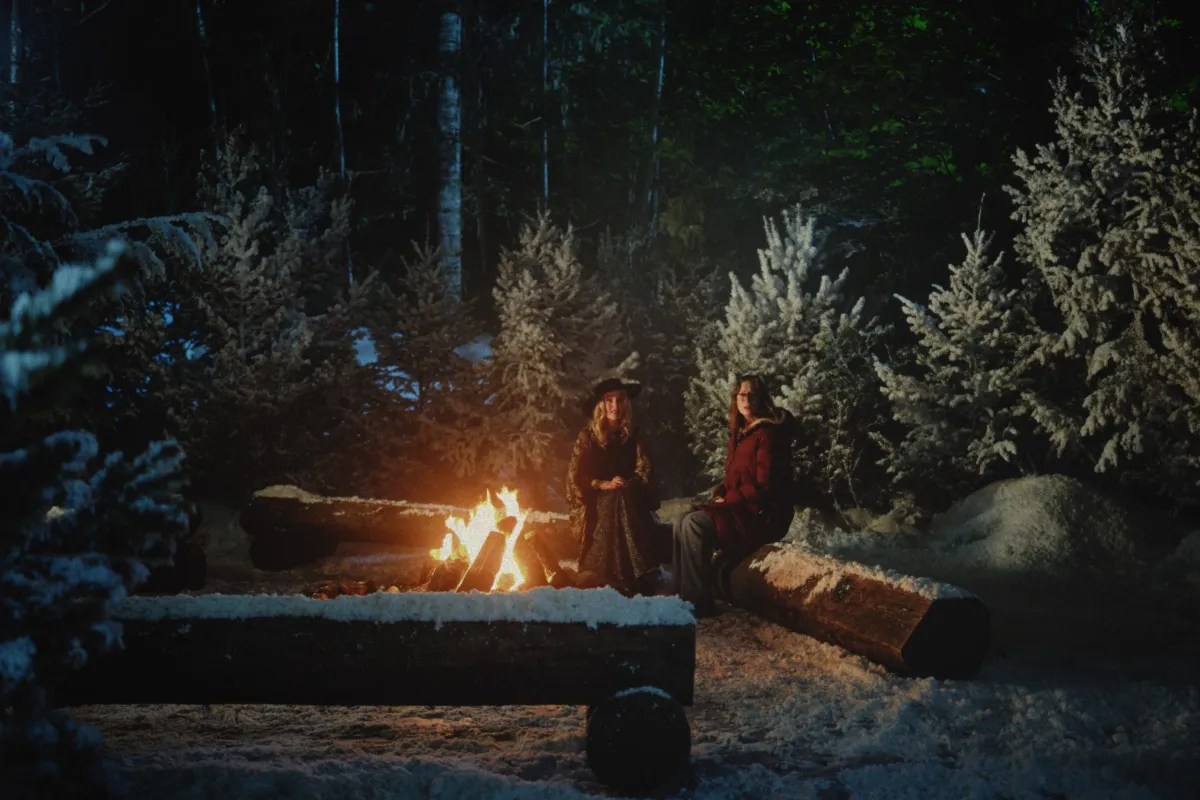
“Teenage Sex and Death at Camp Miasma”

A still from “Teenage Sex and Death at Camp Miasma.” Credit: Courtesy of MUBI

⭐⭐⭐Rating: 3 out of 4

In this latest art-horror curio from Jane Schoenbrun, the alt-indie hand behind psycho-chillers “We’re All Going to the World’s Fair” (2021) and “I Saw the TV Glow” (2024), the “Friday the 13th” film franchise and gender politics get skewered with bloody orgasmic gusto. There is plenty of sex and death, as the title promises, with the bloodshed bringing the joy more than any muted, intoned, crest of pleasure. A head gets cut off and an arc of crimson red gushes 30 feet into the air, so over-the-top it’s comical. The effects are gorgeously framed by Eric Yue, who worked with Schoenbrun on their previous projects.

Camp Miasma is somewhere in the wooded Pacific Northwest at a lake, which was many years ago the setting of a slasher film starring Billy Presley (Gillian Anderson) as an ingénue. It becomes a long-running series of films and Presley, the “final girl,” now lives as a recluse at the site. 

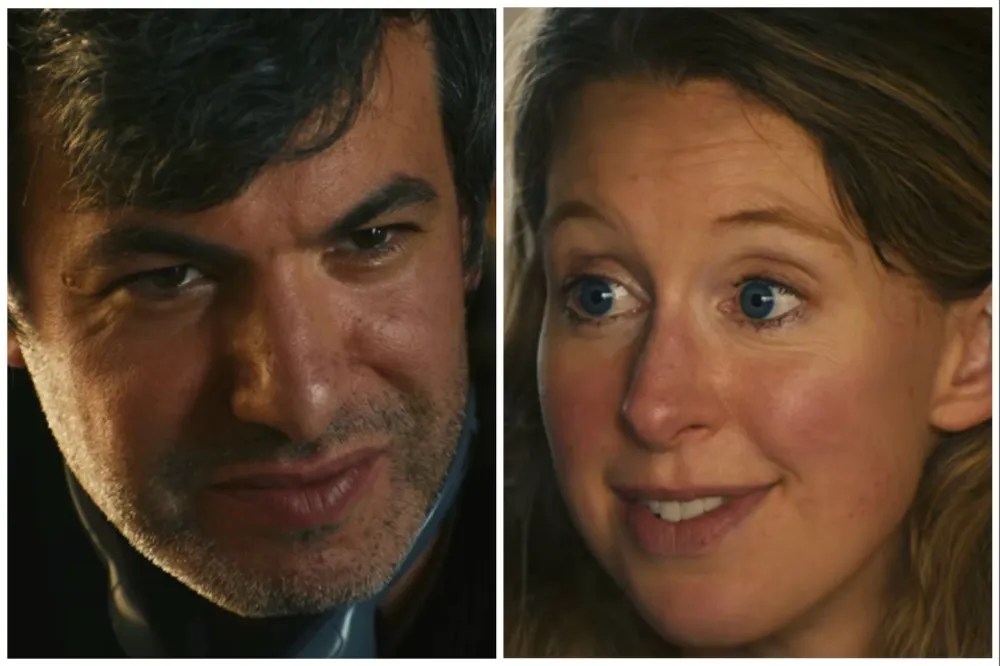
Enter Kris (Hannah Einbinder, “Hacks”), a young queer indie film director hired to reboot the franchise. Kris hopes to recruit Billy for her project (think Jamie Lee Curtis or Neve Campbell). The set up’s clearly self-referential — and part of the backdrop is that the original films have become criticized for their treatment of gender — namely trans. Kris — a clear stand-in for Schoenbrun—is an adoring fan of Billy’s and given the cold foreboding nights (it’s winter) the two end up smoking weed, watching old “Miasma Camp” videos and working on Kris’s failures at sex — she’s in a polyamorous relationship, but appreciates companionship more for the intellectual than the physical. 

Much is asked of Einbinder in range — goofy, sexy, witty but shy — and she pulls it off, but it’s Anderson, with her bumper-bangs-and-victory-rolls updo (and menacingly aloof cattiness) that drives the film and alluringly so. It’s an intoxicating and immersive performance that holds the film together as it slips into alter realities and other strange and wonderfully murky segues. We see plenty of Little Death (Jack Haven) the being at the bottom of the lake, who when hungry, rises from the depths in a Devo Hazmat suit with a ceiling air vent for a mask, and eviscerates any and all with a double-bladed spear. The cherry on the top is seeing Eva Victor (“Sorry Baby”)’s cameo as a punked-out ’80s DJ — mohawk and all — with sassitude.

Continue reading

Review “The Dog Stars”

28 Aug

“The Dog Stars”

⭐⭐Rating: 2 out of 4

Ridley Scott has been down apocalyptic-ish roads before, notably with game changing sci-fi classics “Alien” (1979) and “Blade Runner” (1982). In “The Dog Stars,” adapted from Peter Heller’s 2012 novel, we trek through uneven end-of-times terrain. A virus has wiped out most of humanity, leaving Hig (Jacob Elordi), a skilled mechanic and bush pilot aviator who lost his wife during the pandemic, holed up at an abandoned Colorado airfield with his dog Jasper (a handsome and regal German Shepherd) and Bangley (Josh Brolin), a heavily armed ex-Marine. Bangley’s survivalist instincts are considerably sharper than Hig’s — the dude retrieves his casings to repoint the bullets so he can use them again.  There are marauders roaming about, and somehow the grid is still limping along. Hig picks up a faint radio transmission, and the possibility of other survivors lures him out of his relatively secure perimeter and into the unknown.

It’s an intriguing setup, and Scott can still give scorched-earth spectacle scale and tactile heft (the man is something of a world building master), but “Dog Stars” never settles into a satisfying rhythm. It also has a lot of nagging questions that hang around like pugnacious mosquitos. The plot lurches and splits between Hig (the main focus), Bangley, who remains behind, and the so-called Reapers, bloodthirsty looters who look fresh out of a 1990s mosh pit. They seemingly have created their own language and alphabet — the why, another gnat buzz. The best and most bizarre is Allison Janney as the matriarch of a small, insular community with specialized culinary leanings (don’t look in the meat locker) and a retro bent — the interior of the hive is practically a verbatim recreation of J. F. Sebastian’s flat of replicant misprints in “Blade Runner.”

One problem with the film is that as Hig, Elordi, while blessed with the physical dimensions of a post-apocalyptic hero, never quite convinces us he’s the hardened, macho survivor the film needs. Brolin, by contrast, wears Bangley’s wary, shoot-first pragmatism as comfortably as an old field jacket. The rapport between the two works but doesn’t feel as genuine as the narrative insists. 

Hig’s journey leads him to Cima (Margaret Qualley) and her father, Pops (Guy Pearce), opening the possibility of connection — and romance — in a world reduced to isolation and suspicion. Here, and at a Mennonite compound near the overgrown airstrip, is where “Dog Stars” finds its humanity. But Qualley, a live wire in “Honey Don’t!“ and “Once Upon a Time … in Hollywood,” is strangely muted here, lacking the sass and unpredictability that make her such a compelling screen presence.

Then there are those marauding Reapers, rendered as primal throwbacks seemingly beamed in from the era of black-and-white Westerns, replete with the genre’s cringeworthy “savage horde” imagery. It’s an unfortunate retrograde touch and a stark and lazy offset in a film ostensibly interested in what remains of our humanity after civilization disappears.

Scott keeps “The Dog Stars” muscular enough visually, but muscles aren’t the issue. Like its leading man, the film looks the part without ever fully inhabiting it. 

Reviews of “Hope” and “Coyote vs. Acme”

27 Aug

In these films, creatures and cartoon characters live among us

“Hope”

A still from “Hope”

⭐⭐1/2 Rating: 2.5 out of 4

For those who relish Korean creature-feature flicks laced with social commentary — think “The Host” (2006) or the gonzo zombie blast “Train to Busan” (2016) — “Hope” may scratch your itch. But be advised, you’ll be nearly an hour in before the first beastie rears its ugly head (I’m being colloquial, not judging beauty), and the film runs nearly three hours. Set in a small seaside town where residents work the earth and harvest fruits de mer, the chief of police, Bum-seok (Hwang Jung-min), is called out to investigate a mutilated bull — a scene that feels lifted from the opener of “Busan.” (Incidentally, Director Yeon Sang-ho’s ten-year followup, “Colony,” also opens in theaters this week, but not in Camberville.) Puzzled by the grim disemboweling — a tiger is suspected — Bum-seok makes his way back to his department’s humble headquarters, but the streets of the cloistered village are strangely desolate, several buildings have been laid to waste, and blood is smeared on walls like a bad stab at an alfresco Rothko. The ominous scene is punctuated by the echo of gunfire, coupled with loud sonorous growls — and every now and then, a car sails through the air and crashes through a rooftop. It’s a riveting build-up, orchestrated with adroit skill by director Na Hong-jin and his filmmaking crew: The choreography is critically tight, the set work impeccable, and Bum-seok’s hyperbolic reactions add a splash of comedy to the taut suspense. Then, just as all hell breaks loose, one of Bum-seok’s deputies, Sung-ae (Hoyeon, “Squid Game”), zips in on cue to demonstrate her boss-level grenade-launching and F1 driving skills. 

Loath to give away further details, I’ll just say Grendel would be smiling. The second half of the film doesn’t quite marry up to the blistering start; action sequences go on too long, likely an indulgence of cheap CGI. The narrative, too — which, like “The Host,” hinges on human folly — gets weak in the knees late, and the premise, never deepened enough, begins to sag. As “Hope” wraps, it feels like you’ve just seen Part 1 of a two-parter — and clearly something that could have been made tighter and sharper with better editing and narrative restraint. Na hadn’t made a film in a decade since “The Wailing” in 2016, and if that was the full incubation period of “Hope,” perhaps it cooked too long. If you’re curious about the title, Hope Harbor is the fictional inlet where the action takes place. The film also boasts international stars Michael Fassbender and Alicia Vikander as the voices of the shape-shifting humanoids dislocated and in conflict.

Continue reading

Reviews of “The Last House” and “The End of Oak Street”

14 Aug

In these movies, home is where the hell is


It’s family survival week in a pair of punchy sci-fi thrillers, where death lurks just beyond the mailbox. “The Last House,” on Netflix, finds a Pacific Northwest family sealed inside their house due to mysterious forces at play. Over at the “End of Oak Street,” a big-screen undertaking with Spielberg-ian overtones, dinosaurs move into a tranquil suburb — call it Jurassic Estates. Both movies trap their main characters in a survival hell house, but one of them consigns viewers to audience purgatory and one does not. 

“The Last House” undercuts its gifted cast through lazy execution. It seems meant to be a commentary on COVID-19, though Louis Leterrier’s lame mashup is vague about what exactly afflicts this suburban Seattle neighborhood. Rising stars Greta Lee (“Past Lives”) and Wagner Moura (Oscar-nominated in “The Secret Agent”) play a couple with an eight-year-old daughter (Riley Chung) and 12-year-old son (Noah Alexander Sosnowski) who all wake up one morning and can’t exit their house — the doors won’t open and if you smash a window, the glass magically reforms. Worse, there’s no Wi-Fi. 

Continue reading

Reviews of “The Dink” and “Motor City”

26 Jul

A mishit and a backfire from two new movies

“The Dink”

⭐⭐Rating: 2 out of 4

What if a top tennis player faltered in their career and had to slum it on the pickleball circuit? That’s kind of the loose “Happy Gilmore”—esque concept behind this not quite pickled-enough comedy that stars Jake Johnson (“New Girl,” “Drinking Buddies”) as said fictional tennis star Dustin Boyd. Boyd is a one-time rival of real-life great Andy Roddick, but an injury means he now toils as a club pro. When he dips his toe into the pickleball waters he gets crushed by a pair of 70-year-old grannies — Dustin, known as “The Hammer” in his tennis heyday, doesn’t understand finesse or the parameters of the smaller court. Then there’s the heralded, anemic drop-shot of the title (which the film uses as a running gag until it is past tired).

As the might-have-been superstar trying to pivot, Johnson doesn’t quite have the bravado needed for the part. The ace serve here — the script’s written by “Kevin Can F*** Himself” scribe Sean Clements—comes in Dustin falling for an older woman (a pitch perfect Mary Steenburgen) who’s not so sure she’s attracted to her younger suitor. The May-December pairing does score points when the two sit down for a movie night “date” and watch “The Graduate” and Dustin, busts on the other Dustin for having a big nose (Johnson has a pretty protuberant proboscis himself).

Directed by Josh Greenbaum (“Strays”) and co-produced by Ben Stiller, who has a small part too, the flick built around a feeble flick shot does best when the Greek chorus of feisty Floridian nanas are taunting Dustin and Roddick — who plays himself ­— in a match where the winner claims the deed to the tennis club owned by Dustin’s dad (Ed Harris, poorly used here). Heckling, it turns out, is the crosscourt humor that saves this cinematic dink from busted string ruin and John McEnroe’s woefully wooden intonations. 

Continue reading

“The Odyssey”

17 Jul

Epic storytelling brings the original anti-hero to life

⭐⭐⭐Rating: 3 out of 4

Christopher Nolan’s $250 million retelling of Homer’s classic sword-and-sandal epic is here. And it is also epic, with a nearly three-hour running time. The film delivers, if unevenly, but when the bow is strung and taut, “The Odyssey” flies with fury and purpose. Even though we know how the millennia-old story ends, there are plenty of surprises and moments of wonder. 

The central conflict in “The Odyssey” is not battle. It’s a post-war saga centered on Odysseus’s 20-year trek home after the conclusion of the 10-year Trojan War — you know, the one over Helen, the face that launched a thousand ships. Troy (in modern-day Turkey) was a strategic foothold and a gateway between the Aegean and Black seas — you could think of it as the Strait of Hormuz circa 1200 B.C.

Continue reading

Reviews of “Masters of the Universe” and “Leviticus”

25 Jun

“Leviticus”

Nothing like a homophobic township with the power of God behind it to execute a modern version of the “Crucible,” complete with supernatural manifestations. Adrian Chiarella’s directorial debut depicts two teens who are tormented for who they are by the usual posse of bullies, as well as a supernatural manifestation.

We meet the boyishly naive Naim (Joe Bird) and edgier Ryan (Stacy Clausen) as two kids exploring an abandoned mill. They get to horsing around, trading punches and falling to the ground in a violent bear hug that quickly relaxes into a loose hug and ultimately a kiss. There it is, they’re rebel lovers going against the grain in the deeply religious rural Australian town where they live.

Naim later witnesses Ryan intimately grappling with another classmate, Hunter (Jeremy Blewitt). Jealous, Ryan tells the town’s pastor (Ewen Lesley), who happens to be Hunter’s dad. What ensues is an exorcism performed by a “deliverance preacher” (Nicholas Hope) brought in to force the gay out of the lads (Naim’s mom, Mia Wasikowska of “Alice in Wonderland,” forces him to endure the ritual because he’s too close to Ryan).

It seems hokey at first, but the brief fire and brimstone rite unleashes a personal demon that torments each boy in isolation, by taking the form of the person each boy desires most (Naim for Ryan, and vice versa). Lust is its lure, bloodlust its mission. It’s a frightening change that no one else can see, and it leads to terrible ends first for a young woman and then for Hunter. Yet somehow, their bullying classmates manage to be worse.

The film’s title refers to the Bible’s third book, which contains Old Testament laws defining sin, purity and sexual conduct that some use to condemn homosexuality.

The small-town dwellers are shepherded into an angry horde by Hope’s outsider. The performances by Bird and Clausen are pivotal, and the rest of the ensemble are also strong. But the characters of Naim and especially Ryan feel underdeveloped. The supernatural element also is wispy. The message, however, is not. Chiarella creates effective eerie and edgy moments. He’s another budding horror auteur like Kane Parsons (“Obsession”) and Curry Baker (“Backrooms”), who know how to craft mood and scene beyond their years, but have room to grow to conjure spirit and soul.

Continue reading

Toy Story’s 5th another fine production

24 Jun

The much-loved franchise in “Toy Story 5” continues to tap into universal human themes with care and soul.

The latest installation of the “Toy Story” franchise extends its record as one of the most adaptable film franchises. Perhaps its success comes from its palpable themes of vulnerability — being replaced, being outgrown or forgotten, becoming irrelevant. Maybe it’s the potpourri of misfits, voiced by A-list talent, that come together to seal the rift du jour dividing them. Of course, the initial 1995 “Toy Story” set the gold standard of CGI animation and pretty much was the catalyst for the Oscar for Best Animated Feature that came into being in 2001 — the 1995 film won a special Oscar for ground-breaking animation, while “Toy Story 3” (2010) and “Toy Story 4” (2019) both won that “Best” award. It also has creative continuity — this new version is directed by Andrew Stanton, who’s been involved in the script and story from the get-go, back in the John Lasseter/pre-Disney years. Stanton’s no slouch behind the lens, with “Finding Nemo” (2003) and “WALL-E” (2008) to his credits (he did also direct the 2012 box-office flop “John Carter”).

In “Toy Story 5,” co-directed by McKenna Harris, Cowgirl Jesse (Joan Cusack) takes center focus, during an all-out effort to find a like-minded companion for eight-year-old Bonnie (Scarlett Spears), who is having difficulty making friends. In “Toy Story 3” Bonnie was gifted the olio of toys when older brother Andy grew up and went off to college.

Continue reading

“The Death of Robin Hood”

21 Jun

A myth reconsidered in this grim but powerfully told version of a life that might not have been heroic.

Revisionism is a powerful dispeller of myth. Consider how Oliver Stone, Francis Ford Coppola, and Stanley Kubrick reframed the public understanding of the Vietnam War. Or how Sergio Leone, Sam Peckinpah, and Clint Eastwood cut the morally righteous reins on the American Western.

What about Robin Hood, the legend who stole from the rich and gave to the poor? A regular champion of the poor, like Mother Teresa, and a candidate for a Nobel prize? Not so much in Michael Sarnoski‘s dark reckoning, where Mr. Hood is looking for atonement before his book closes on his not-so-noble reputation. He’s played by

Hugh Jackman with world-weary gravitas, conveying sadness in his eyes and the simmer of rage in his heart.

The film is gorgeously shot by Paul Scola, who worked with Sarnoski previously on “Pig” (2021) — then again, the bare north mountains of Ireland do a lot of this movie’s heavy lifting. We learn early on that this is not Errol Flynn’s swashbuckling Robin Hood. Our Robin has been enmeshed in the cycle of violence all his life, hunted by the kin of those he killed. He’s adroit at bloodshed. There’s no flashback to show us whether the younger Robin’s deeds were derring-do or thuggish savagery.

Continue reading

Reviews of “The Breadwinner,” “Pressure” and the Netflix documentary, “The Crash”

6 Jun

Exploring war (D-Day), gender, and true crime on film

“Pressure”

Who knew that the timing of D-Day was much ado about dueling meteorologists? Obviously, David Haig, whose play about this little-known chapter of the war gets the big-screen treatment in the capable hands of Anthony Maras (the deft thriller, “Hotel Mumbai”) — and Haig, who co-wrote the screenplay. The setting is the Southwick House — a sprawling mansion in England — some 72 hours before the planned invasion that would change the course of history. General Dwight D. “Ike” Eisenhower (Brendan Fraser) tries to hone the fine details of the landing with the other commanders, including British general Bernard Montgomery and his U.S. counterpart, Omar Bradley. The big question is the weather.

Churchill recommends his chief weather guy, Scottish meteorologist Group Captain James Stagg (Andrew Scott, stoic and complex), who gets posted above Ike’s weather guy, Irving Krick (Chris Messina, Michael Jordan’s brash agent in “Air”) — and that’s where the rub comes. Krick, who notched great success in the North Africa campaigns, lives by almanacs and historical trends, while Stagg works from real-time data and tracks the current conditions. Two different methods, two different calls drive Ike and the command team bonkers with just two days until the launch. Stagg predicts 10-foot waves that would blow the landing force off course.

History books chronicle how it all plays out, but Maras and the inspired ensemble reenact it to a deeply compelling effect. Scott and Fraser, a long way from “Mummy” (1999)— anchor the film, with Damian Lewis stealing scenes as Montgomery, both anxious and devilishly cheeky. Kerry Condon makes Kay Summersby, Ike’s indispensable aide, feel essential, her warmth and resolve a counterweight to the chaos around her. Backstories about a failed earlier attempt, led by Ike, that got a lot of young men killed, and the bombing of the hospital where Stagg’s pregnant wife is convalescing, lend human depth. Some of the best insights of “Pressure” are the stark contrast between the British stiff upper lip and American maverick arrogance. The title is a play on weather pressure, the decision to go or not, and the weight of the world. Towards the end, the film shows some ancillary staging of the landing (the 82nd anniversary is nigh), but nothing that will end up in conversations with “Saving Private Ryan” (1998) or “The Longest Day” (1962).

Continue reading