A new 4K restoration of the 35-year-old classic by director Zhang Yimou is breathtaking
⭐⭐⭐⭐Rating: 4 out of 4
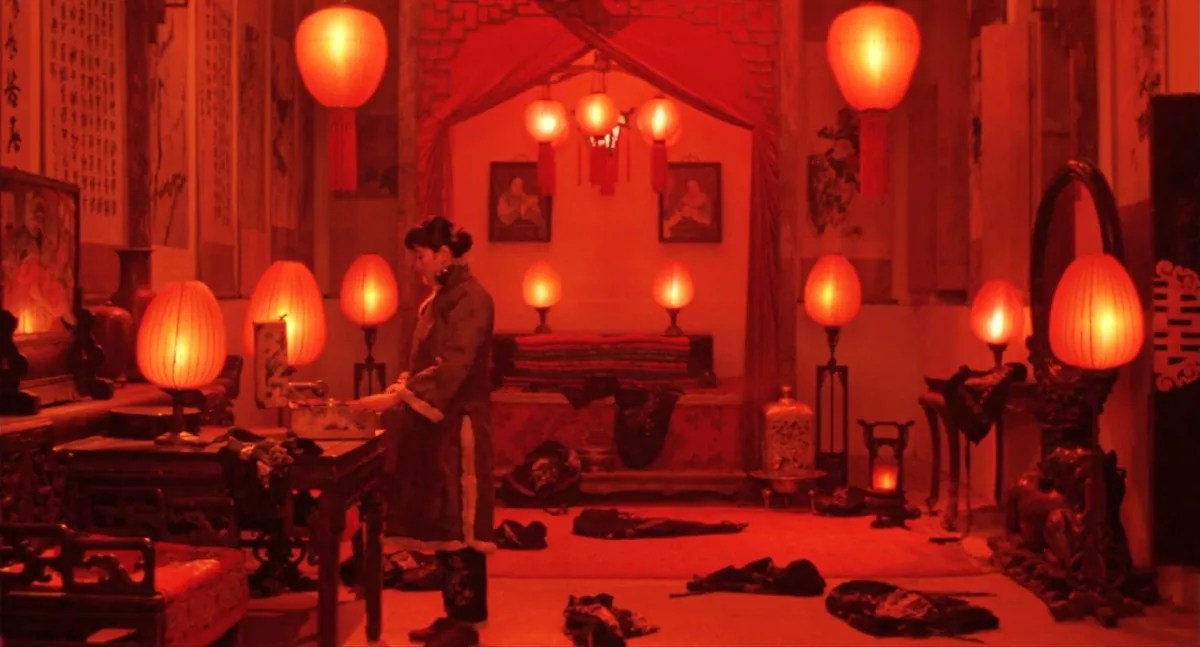
There’s a striking beauty and an equally chilling cruelty to Zhang Yimou’s “Raise the Red Lantern” (1991), a sumptuous period piece about power, privilege and the destructive consequences of women pitted against one another for the favor of a man who holds all the cards. The film, which lost out on Academy Award for best foreign language film (now best international feature) to “Mediterraneo,” will celebrate its 35th anniversary with a limited nine-day run at the Brattle Theatre. The new version is a stunning 4K restoration that makes Zhang’s already arresting imagery look sharper, deeper and richer. The reds are more vibrant, the blues more ominous and the shadows more pronounced, bringing new dimension to the architectural textures of the sprawling compound where nearly all the action takes place.
Adapted from Su Tong’s 1989 novella “Wives and Concubines,” the film unfolds in 1920s China, during a period of political and social upheaval when centuries-old patriarchal traditions remained firmly entrenched and Mao’s revolution looms on the horizon. Gong Li (“Miami Vice,” “Memoirs of a Geisha”), striking and angular, fierce and soft, plays Songlian, a 19-year-old university student forced to abandon her studies after her father dies and the family fortune evaporates. With few options, Songlian agrees to become the fourth mistress of Chen Zuoqian (Ma Jingwu), a wealthy patriarch whose household operates according to an elaborate set of rituals and rigid hierarchies.
The Master, as he’s generally called, is a curious presence. We hear him, see him from a distance or catch him partially obscured, but rarely get a clear look at him. He’s an enigmatic presence, more institution than man, an omnipresent authority whose whims determine the daily lives of the women under his roof. Each evening he chooses which mistress will receive his company. Red lanterns are illuminated outside her quarters (each has her own wing in the compound, replete with servants), signaling her elevated status for the night. The chosen woman receives a luxurious foot massage and the privilege of determining the next day’s menu. The other women are left to stew.
The arrangement creates a ruthless competition among the four mistresses, who occupy positions within a household that encourages them to behave like rivals. The First Mistress, Yuru (Jin Shuyuan), is older, reserved and largely resigned to her circumstances. The Second, Zhuoyun (Cao Cuifen), greets Songlian with apparent warmth, though her friendliness masks a calculating and manipulative nature. The Third, Meishan (He Saifei), a former opera singer, is theatrical, outspoken and openly resentful of her diminished standing. Songlian, initially proud and resistant to the household’s customs, soon discovers that survival means learning to play the game.
She’s hardly an innocent. Intelligent and stubborn, Songlian can also be cold, vindictive and cruel, particularly toward her maid Yan’er (Kong Lin), who harbors ambitions of becoming a mistress herself and secretly keeps red lanterns in her humble quarters, a childlike fantasy and pathetic imitation of the privileges she covets. Their antagonism becomes one of the film’s more unsettling pivots, as Songlian, herself a victim of the household’s oppressive structure, turns its inherent mechanism of humiliation against someone even less powerful.
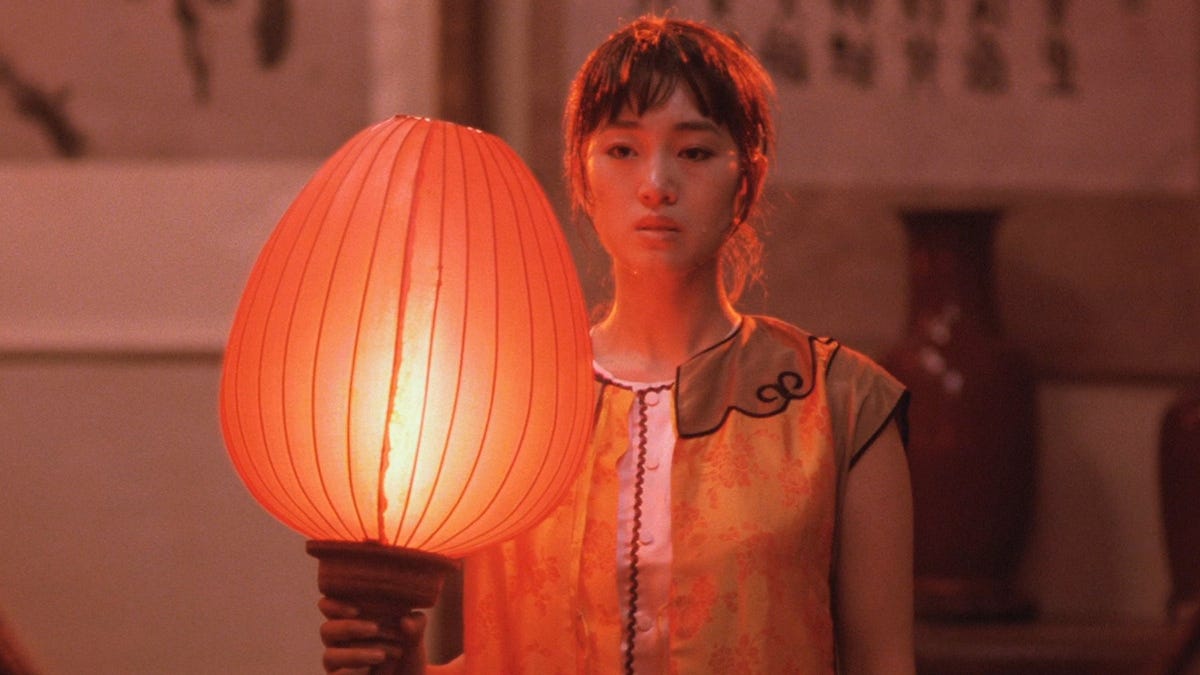
Zhang stages much of this psychological warfare within the imposing walls of the Chen family compound, filmed at the historic Qiao Family Courtyard in Shanxi province. The sets are extraordinary, a labyrinth of courtyards, stone passageways, rooftop terraces and symmetrically arranged chambers that seem to shift in tenor with the time of day and the mood of the film. Zhang’s meticulous visual aesthetic is clearly informed by his early career as a cinematographer. Here he works with director of photography Zhao Fei, who would later shoot several Woody Allen films, including “Sweet and Lowdown” (1999). Sunlight brings a deceptive warmth, while dusk and darkness transform the compound into something closer to a mausoleum. The rigid geometry of the architecture reinforces the social order, and the women, often framed within doorways or isolated against massive walls, appear increasingly imprisoned by their surroundings.
The red lanterns themselves, an invention of the film rather than Su Tong’s original novella, are both gorgeous and sinister. Their warm glow suggests intimacy and celebration, but their illumination is ultimately a public declaration of ownership and control. Even the foot massages, initially presented as a sensual indulgence, become another means of reinforcing the hierarchy.
As jealousies intensify and secrets surface, the competition takes an increasingly devastating toll. What begins as a lavish domestic drama gradually becomes a chilling study of institutionalized cruelty, with the women both victims and enforcers of a system designed to deny them autonomy. Zhang never needs to take us beyond the compound’s walls to convey the larger social order it represents. In this beautifully restored edition, the visual splendor is more intoxicating than ever, making the brutality beneath it all the more unsettling.
The film marks one of nine feature-film collaborations between Gong and Zhang, a partnership that began with his directorial debut, “Red Sorghum” (1988), and includes “To Live” (1994), “Ju Dou” (1990) and “Coming Home” (2014). “Raise the Red Lantern” deserves not only to be revered as Zhang’s magnum opus, but also, perhaps, the finest film ever to emerge from China.


Leave a Reply