Archive | Review RSS feed for this section

Reviews of “Teenage Sex and Death at Camp Miasma,” “The Whisper Man,” “Mayday” and “Onslaught”

3 Sep

Art horror, serial killer nonchiller, espionage comedy and a gorefest


“Teenage Sex and Death at Camp Miasma”
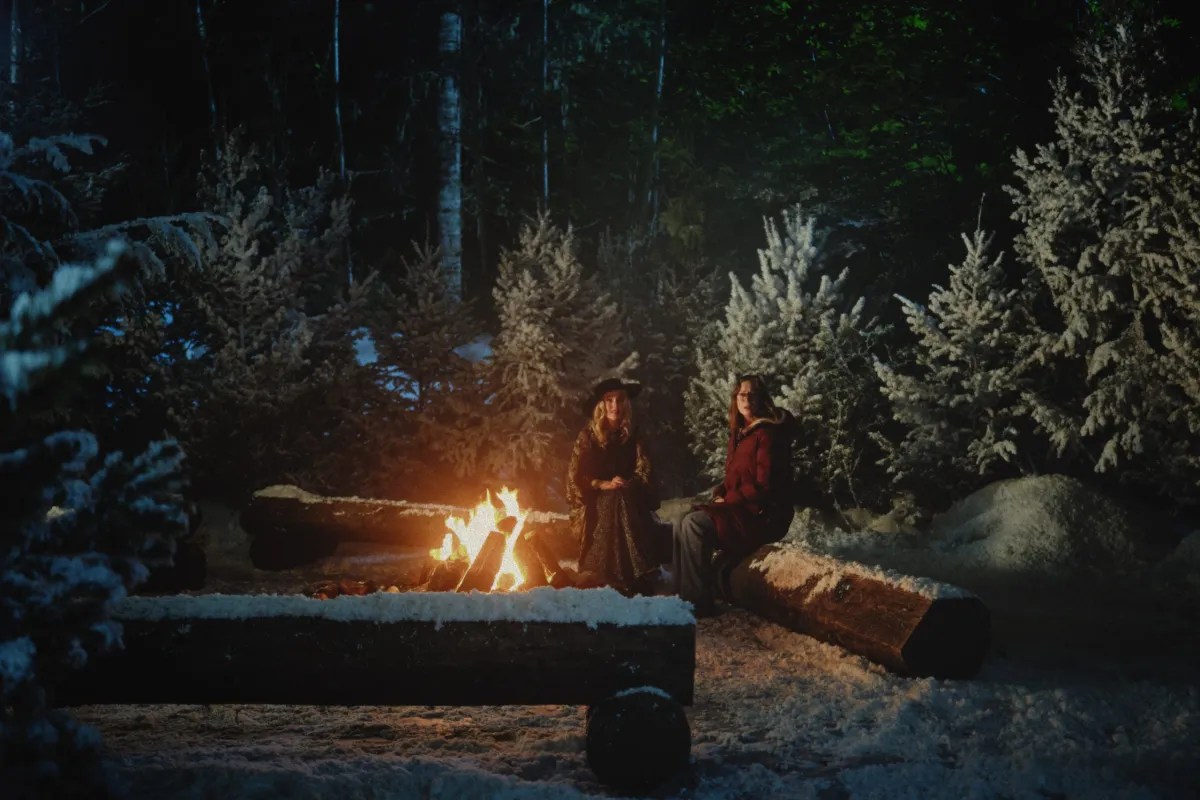
A still from “Teenage Sex and Death at Camp Miasma.” Credit: Courtesy of MUBI

⭐⭐⭐Rating: 3 out of 4

In this latest art-horror curio from Jane Schoenbrun, the alt-indie hand behind psycho-chillers “We’re All Going to the World’s Fair” (2021) and “I Saw the TV Glow” (2024), the “Friday the 13th” film franchise and gender politics get skewered with bloody orgasmic gusto. There is plenty of sex and death, as the title promises, with the bloodshed bringing the joy more than any muted, intoned, crest of pleasure. A head gets cut off and an arc of crimson red gushes 30 feet into the air, so over-the-top it’s comical. The effects are gorgeously framed by Eric Yue, who worked with Schoenbrun on their previous projects.

Camp Miasma is somewhere in the wooded Pacific Northwest at a lake, which was many years ago the setting of a slasher film starring Billy Presley (Gillian Anderson) as an ingénue. It becomes a long-running series of films and Presley, the “final girl,” now lives as a recluse at the site. 

Enter Kris (Hannah Einbinder, “Hacks”), a young queer indie film director hired to reboot the franchise. Kris hopes to recruit Billy for her project (think Jamie Lee Curtis or Neve Campbell). The set up’s clearly self-referential — and part of the backdrop is that the original films have become criticized for their treatment of gender — namely trans. Kris — a clear stand-in for Schoenbrun—is an adoring fan of Billy’s and given the cold foreboding nights (it’s winter) the two end up smoking weed, watching old “Miasma Camp” videos and working on Kris’s failures at sex — she’s in a polyamorous relationship, but appreciates companionship more for the intellectual than the physical. 

Much is asked of Einbinder in range — goofy, sexy, witty but shy — and she pulls it off, but it’s Anderson, with her bumper-bangs-and-victory-rolls updo (and menacingly aloof cattiness) that drives the film and alluringly so. It’s an intoxicating and immersive performance that holds the film together as it slips into alter realities and other strange and wonderfully murky segues. We see plenty of Little Death (Jack Haven) the being at the bottom of the lake, who when hungry, rises from the depths in a Devo Hazmat suit with a ceiling air vent for a mask, and eviscerates any and all with a double-bladed spear. The cherry on the top is seeing Eva Victor (“Sorry Baby”)’s cameo as a punked-out ’80s DJ — mohawk and all — with sassitude.

Continue reading →
Review “The Dog Stars”

28 Aug

“The Dog Stars”

⭐⭐Rating: 2 out of 4

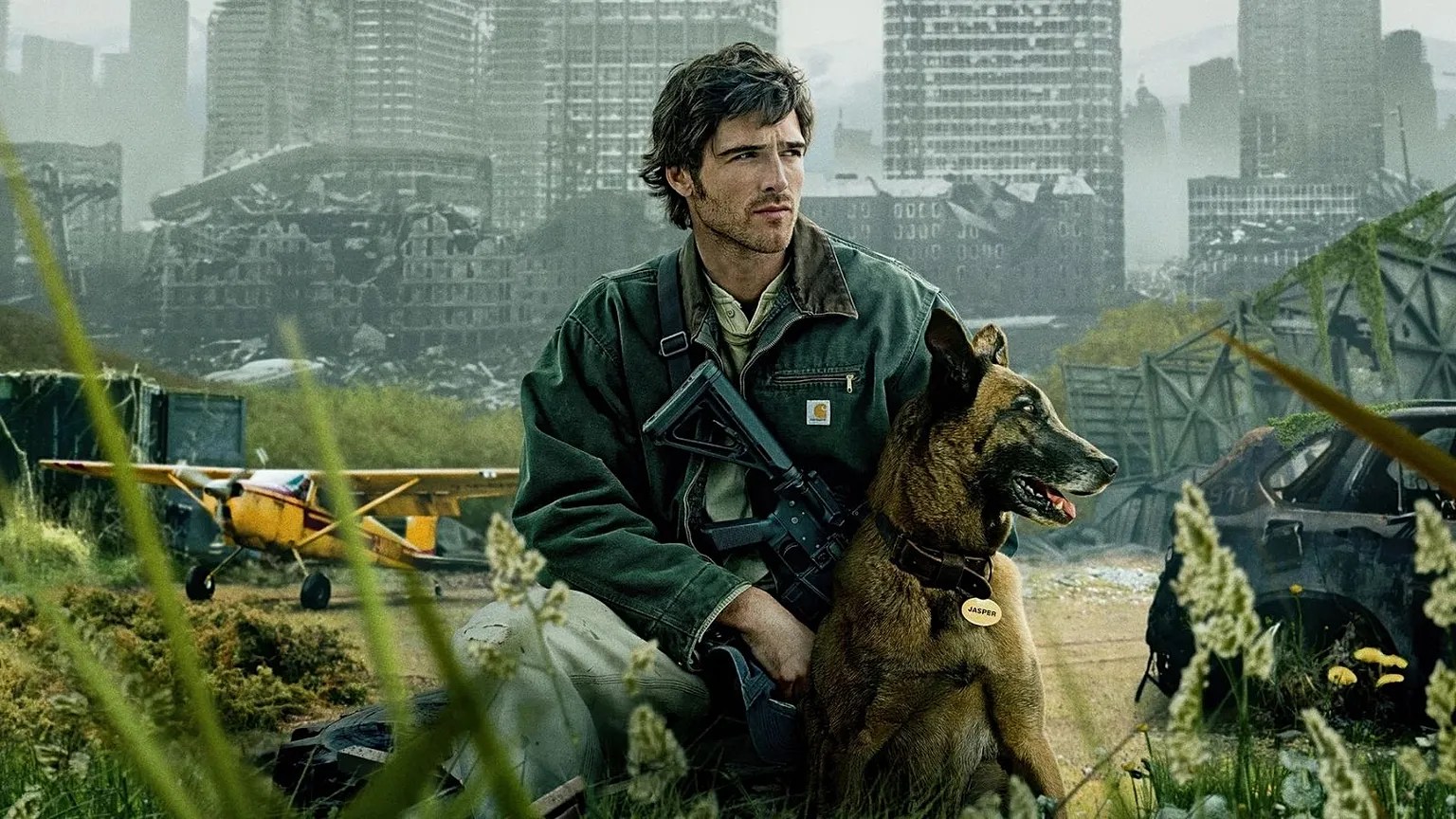
Ridley Scott has been down apocalyptic-ish roads before, notably with game changing sci-fi classics “Alien” (1979) and “Blade Runner” (1982). In “The Dog Stars,” adapted from Peter Heller’s 2012 novel, we trek through uneven end-of-times terrain. A virus has wiped out most of humanity, leaving Hig (Jacob Elordi), a skilled mechanic and bush pilot aviator who lost his wife during the pandemic, holed up at an abandoned Colorado airfield with his dog Jasper (a handsome and regal German Shepherd) and Bangley (Josh Brolin), a heavily armed ex-Marine. Bangley’s survivalist instincts are considerably sharper than Hig’s — the dude retrieves his casings to repoint the bullets so he can use them again.  There are marauders roaming about, and somehow the grid is still limping along. Hig picks up a faint radio transmission, and the possibility of other survivors lures him out of his relatively secure perimeter and into the unknown.

It’s an intriguing setup, and Scott can still give scorched-earth spectacle scale and tactile heft (the man is something of a world building master), but “Dog Stars” never settles into a satisfying rhythm. It also has a lot of nagging questions that hang around like pugnacious mosquitos. The plot lurches and splits between Hig (the main focus), Bangley, who remains behind, and the so-called Reapers, bloodthirsty looters who look fresh out of a 1990s mosh pit. They seemingly have created their own language and alphabet — the why, another gnat buzz. The best and most bizarre is Allison Janney as the matriarch of a small, insular community with specialized culinary leanings (don’t look in the meat locker) and a retro bent — the interior of the hive is practically a verbatim recreation of J. F. Sebastian’s flat of replicant misprints in “Blade Runner.”

One problem with the film is that as Hig, Elordi, while blessed with the physical dimensions of a post-apocalyptic hero, never quite convinces us he’s the hardened, macho survivor the film needs. Brolin, by contrast, wears Bangley’s wary, shoot-first pragmatism as comfortably as an old field jacket. The rapport between the two works but doesn’t feel as genuine as the narrative insists. 

Hig’s journey leads him to Cima (Margaret Qualley) and her father, Pops (Guy Pearce), opening the possibility of connection — and romance — in a world reduced to isolation and suspicion. Here, and at a Mennonite compound near the overgrown airstrip, is where “Dog Stars” finds its humanity. But Qualley, a live wire in “Honey Don’t!“ and “Once Upon a Time … in Hollywood,” is strangely muted here, lacking the sass and unpredictability that make her such a compelling screen presence.

Then there are those marauding Reapers, rendered as primal throwbacks seemingly beamed in from the era of black-and-white Westerns, replete with the genre’s cringeworthy “savage horde” imagery. It’s an unfortunate retrograde touch and a stark and lazy offset in a film ostensibly interested in what remains of our humanity after civilization disappears.

Scott keeps “The Dog Stars” muscular enough visually, but muscles aren’t the issue. Like its leading man, the film looks the part without ever fully inhabiting it. 

Reviews of “Hope” and “Coyote vs. Acme”

27 Aug

In these films, creatures and cartoon characters live among us

“Hope”

A still from “Hope”

⭐⭐1/2 Rating: 2.5 out of 4

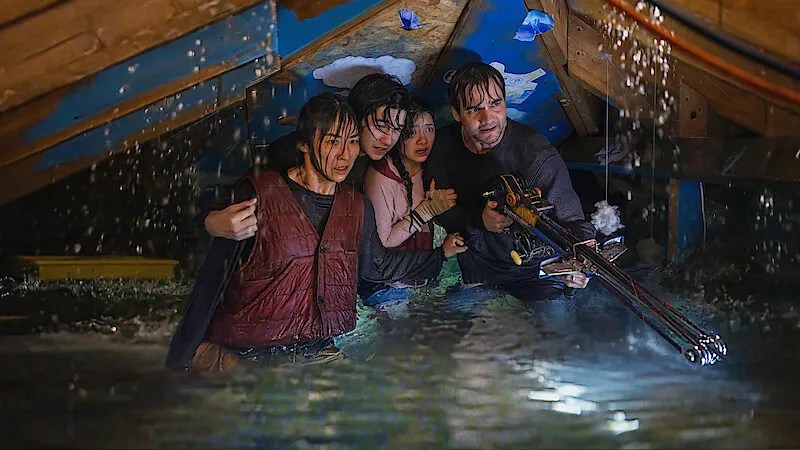
For those who relish Korean creature-feature flicks laced with social commentary — think “The Host” (2006) or the gonzo zombie blast “Train to Busan” (2016) — “Hope” may scratch your itch. But be advised, you’ll be nearly an hour in before the first beastie rears its ugly head (I’m being colloquial, not judging beauty), and the film runs nearly three hours. Set in a small seaside town where residents work the earth and harvest fruits de mer, the chief of police, Bum-seok (Hwang Jung-min), is called out to investigate a mutilated bull — a scene that feels lifted from the opener of “Busan.” (Incidentally, Director Yeon Sang-ho’s ten-year followup, “Colony,” also opens in theaters this week, but not in Camberville.) Puzzled by the grim disemboweling — a tiger is suspected — Bum-seok makes his way back to his department’s humble headquarters, but the streets of the cloistered village are strangely desolate, several buildings have been laid to waste, and blood is smeared on walls like a bad stab at an alfresco Rothko. The ominous scene is punctuated by the echo of gunfire, coupled with loud sonorous growls — and every now and then, a car sails through the air and crashes through a rooftop. It’s a riveting build-up, orchestrated with adroit skill by director Na Hong-jin and his filmmaking crew: The choreography is critically tight, the set work impeccable, and Bum-seok’s hyperbolic reactions add a splash of comedy to the taut suspense. Then, just as all hell breaks loose, one of Bum-seok’s deputies, Sung-ae (Hoyeon, “Squid Game”), zips in on cue to demonstrate her boss-level grenade-launching and F1 driving skills. 

Loath to give away further details, I’ll just say Grendel would be smiling. The second half of the film doesn’t quite marry up to the blistering start; action sequences go on too long, likely an indulgence of cheap CGI. The narrative, too — which, like “The Host,” hinges on human folly — gets weak in the knees late, and the premise, never deepened enough, begins to sag. As “Hope” wraps, it feels like you’ve just seen Part 1 of a two-parter — and clearly something that could have been made tighter and sharper with better editing and narrative restraint. Na hadn’t made a film in a decade since “The Wailing” in 2016, and if that was the full incubation period of “Hope,” perhaps it cooked too long. If you’re curious about the title, Hope Harbor is the fictional inlet where the action takes place. The film also boasts international stars Michael Fassbender and Alicia Vikander as the voices of the shape-shifting humanoids dislocated and in conflict.

Continue reading →

Reviews of “Late Fame” and “The Brink of War”

21 Aug

“Late Fame”

⭐⭐1/2 Rating: 2.5 out of 4

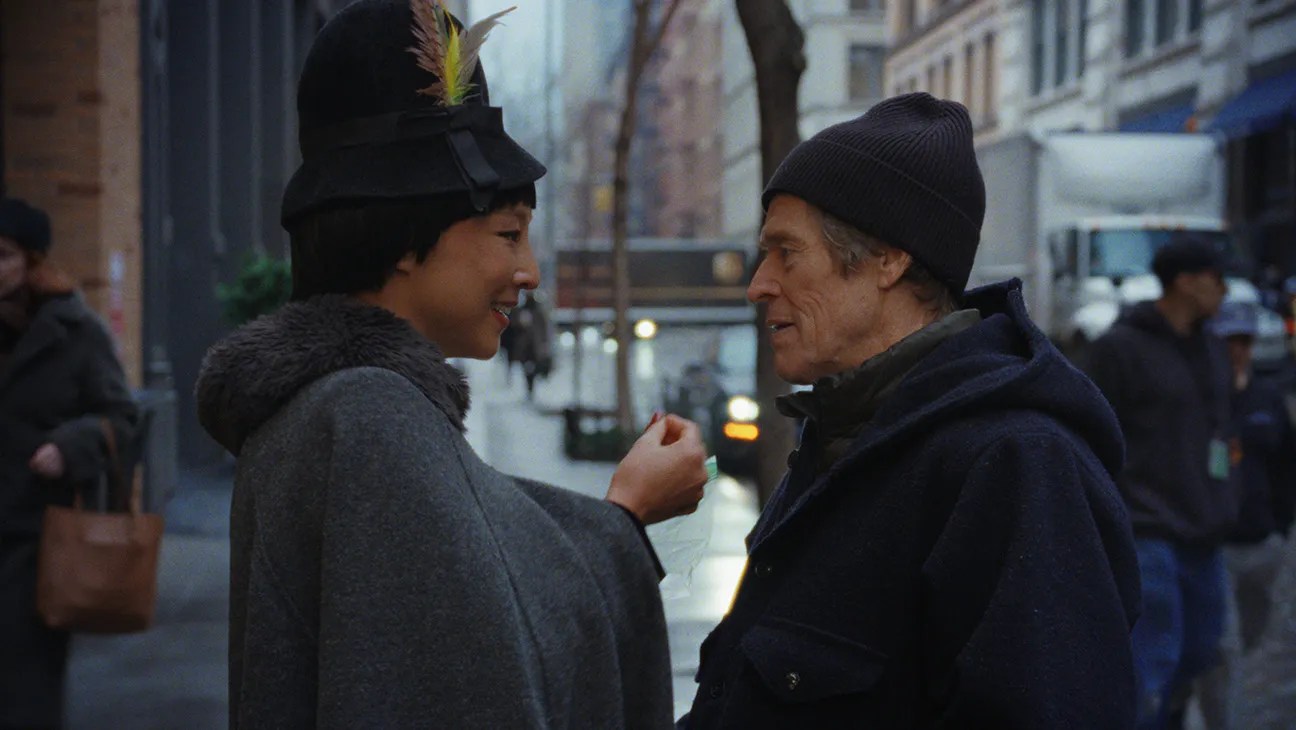
Director Kent Jones (“Diane“ (2018)) works with a killer cast in this reset of a novella by Arthur Schnitzler, with 1890s Vienna transposed to modern day New York City (the script’s by Samy Burch, “May December” and the upcoming “Coyote vs Acme”). The esteemed Willem Dafoe stars as Ed Saxberger, a New York City postal worker who back-in-the-1980s-day penned an obscure work of revered poems. He’s rediscovered by a gaggle of youthful writers and artists who brand themselves the Enthusiasm Society. There’s a beatnik vibe to the group, led by a scarf-wearing dilettante who goes by the moniker of just Meyers (Edmund Donovan, who gives his pompous character a modicum of depth and vulnerability). They embrace Ed as something of a Bukowski-esque literary lion and through fawning flattery entreat him into their circle. The newfound notoriety rekindles Ed’s creative passions. As he starts to see the world through the progressive lens of his admirers, he calls out fellow old White guys for the intolerance he had become numb to over the years. The rising arc becomes Ed’s mounting affections for the much younger Gloria (Greta Lee, the soulful heart of “Past Lives”), the group’s aspiring actress, chanteuse and something of a Blanche DuBois in the making. 

Lee, who you can also catch in the subpar sci-fi thriller, “The Last House“ over on Netflix, strikes the screen as a luminous wonder, but at times feels miscast and out of place. She does strike a genuine (if more platonic than romantic) chord with her veteran costar. Ultimately, the film feels drawn out, as Dafoe’s Ed never brings congruence to a hodgepodge of ideas and icons, despite the actor’s affable effort.

Continue reading →

Reviews of “The Last House” and “The End of Oak Street”

14 Aug

In these movies, home is where the hell is


It’s family survival week in a pair of punchy sci-fi thrillers, where death lurks just beyond the mailbox. “The Last House,” on Netflix, finds a Pacific Northwest family sealed inside their house due to mysterious forces at play. Over at the “End of Oak Street,” a big-screen undertaking with Spielberg-ian overtones, dinosaurs move into a tranquil suburb — call it Jurassic Estates. Both movies trap their main characters in a survival hell house, but one of them consigns viewers to audience purgatory and one does not. 

“The Last House” undercuts its gifted cast through lazy execution. It seems meant to be a commentary on COVID-19, though Louis Leterrier’s lame mashup is vague about what exactly afflicts this suburban Seattle neighborhood. Rising stars Greta Lee (“Past Lives”) and Wagner Moura (Oscar-nominated in “The Secret Agent”) play a couple with an eight-year-old daughter (Riley Chung) and 12-year-old son (Noah Alexander Sosnowski) who all wake up one morning and can’t exit their house — the doors won’t open and if you smash a window, the glass magically reforms. Worse, there’s no Wi-Fi. 

Continue reading →

Reviews of “Blue Heron” and “One Night Only”

7 Aug

A devastating drama and a near-future rom-com

“Blue Heron”

⭐⭐⭐1/2 Rating: 3.5 out of 4

In case you missed the best film of the year (so far) — it didn’t play a Cambridge or Somerville theater — you can now catch the devastating picture digitally. In Sophy Romvari’s semi-autobiographical film, a Hungarian family relocates to Vancouver Island, Canada in the 1990s. She fuses family diary, conjured memory and the desire to understand the past within the lens of the present in a haunting, provocative way. It’s also groundbreaking in its narrative structure, bending reality and time to delve deeper into the emotional turmoil and familial pathos that cloud the borders of each frame. 

The first part of the film is told from the point of view of the young daughter — the wide-eyed Sasha, played by Eylul Guven, who is the lone girl among three brothers. The oldest, Jeremy (Edik Beddoes) from the mother’s prior marriage, is often mean to her — interfering with her rock castles at the beach, making a shield of cereal boxes at the breakfast table so he doesn’t have to look at his siblings. Those ripples become more troublesome later when he comes home in handcuffs, takes perilous roof walks, and utters veiled threats to burn down the house. Not normal and not safe, which leaves mom and dad (Iringó Réti and Ádám Tompa) at a loss about what to do. Throughout it all, there’s an edgy “We Need to Talk About Kevin” (2011) vibe, despite its home-movie-style naturalism. How the family attempts to resolve the crisis has future consequences, and that’s where we — and the film — jump ahead to the adult Sasha (Amy Zimmer), reflective and steely, making a documentary about a social work case from the 1990s: as you might expect, it’s Jeremy’s. 

The camerawork and camera placements — outside a window, aloofly watching the action from afar, or inside an adjacent room, overhearing conflict and life-altering information through a wall — are subtle and extraordinary. The cast gives robust, yet nuanced, performances. Réti and Tompa are restrained but stressed as the unnamed parents. Zimmer’s fill-in for Romvari burns soulfully in her quest for answers and closure, and Beddoes is at once viperish and intimidating, yet sympathetically vulnerable. The whole composition is a remarkable accomplishment, especially given such humble resources. The cathartic reflection and reframing of events from varying points in time is poetically akin to Cantabrigian Ross McElwee’s latest, “Remake,” likewise propelled by loss and tragedy — which, like “Blue Heron,” has yet to get a feature run this side of the Charles.

Continue reading →

Reviews of “Dead Souls,” “I Want Your Sex” and “Spider-Man: Brand New Day”

30 Jul

A spaghetti western based on a 1842 Nikolai Gogol novel, a new Spider-Man and Gregg Araki gets back to sex basics

Cooper Hoffman and Olivia Wild in “I Want Your Sex”

⭐⭐⭐Rating: 3 out of 4

It’s been 12 years since Gregg Araki made his last film, “White Bird in a Blizzard,” a competently done mystery and something of a restrained effort compared to his gloriously gonzo, queer-leaning, desperado films of the 1990s (“Totally F***ed Up,” “The Doom Generation” and “The Living End”). The good news with “I Want You Sex” is that master of irreverent cinema is back and in boundary-pushing form. Instead of getting fucked up, people here are getting fucked—both literally and figuratively. We begin shades of “Sunset Boulevard” as a young art assistant (Cooper Hoffman, “Licorice Pizza”) in boxers and with a noticeably bloodied face stumbles out the sliding glass doors of a poolside bungalow to find his artist boss (Olivia Wilde) buck-naked and floating face down. From there we rewind back to the gallery where Hoffman’s naïve and far-too-trusting Elliot is part of a merry band of art boys who line-up, mouths masticating gobs of red gum with intense rapidity and then attach their chewed wads to an inchoate mural of parted labia majora—vagina gum art, who knew? The LA based gallery is the muse hive of Erika Tracy (Wilde) a Koons kitschy pop artist of note—and also a high priestess of sexual deviancy, ever dressed in stylish S&M office wear with a blasé come-hither look ever etched on her face. She’s Cruella de Vil with a fetish laundry list. In short she makes a sex slave out of Elliot who at home is in sexless relationship with his bookish girlfriend (Charli xcx). Anal probing (seemingly a cinematic trend these days as evidenced by this, “Little Brother” and “The Invite” also starring Wilde), spanking and threesomes ensue. Through it all Elliot looks like a lamb going to slaughter, but it’s hard to feel sorry for him. In regard to that opening scene, the current action is driven by detectives (Johnny Knoxville and Margret Cho) trying to untangle what has taken place. If there’s any letdown to “Sex” it’s that Araki and co-writer, Karley Sciortino, bumble the climax—the dark raucous sex comedy goes too quietly into the night. The film however is a showcase for Wilde, who glides into the part with relish and vim without going over-the-top. It’s a piquant antithetical spin from that other movie playing in theaters (“The Invite”) that she directed and plays a frustrated, not-had-sex-in-a-year San Franciscan housewife.

Continue reading →

Ross McElwee: Processing pain and grief on film

29 Jul

Interview: the new film is a devastating must see

The Cambridge-based filmmaker on his new documentary “Remake,” which looks at his son’s death, and the 40th anniversary release of “Sherman’s March.”

Ross McElwee in “Sherman’s March.” Credit: Courtesy of Music Box Films

Ross McElwee, the affable, soft-spoken southern gentleman who bares all in his autobiographical documentaries, has often chronicled personal pain. In his groundbreaking work, “Sherman’s March” (1986), we see a budding young filmmaker’s lost loves and unrealized yearnings. In his latest, “Remake,” he wrestles with the tragic death of his son in 2016.

The two complementary films begin an extended run at the Coolidge Corner Theatre this week to commemorate the newly remastered 4K, 40th anniversary rerelease of “Sherman’s March,” as well as the release of “Remake.” To kick off the run Thursday night, McElwee will be in conversation with fellow Cantabrigian filmmaker and Harvard professor, Robb Moss, following a screening of “Sherman’s March.”

McElwee’s films are intoxicating in their quiet, observant demeanor — revelations that wash over you sans any didactic ice-bucket deluge. Their subtle, lingering resonance is not far off from the hypnotic vexations that became the signature of fellow Cambridge filmmaker Frederick Wiseman throughout his impressive body of work. Their styles and approaches, however, are vastly different: the recently deceased Wiseman gave you fly-on-the-wall direct cinema, whereas McElwee’s more immediately accessible chronicles provide you with in-the-moment perspectives that, in their intimacy, feel genuinely honest and self-deprecating — especially given the filmmaker’s willingness to expose his vulnerabilities.

Continue reading →

Reviews of “The Dink” and “Motor City”

26 Jul

A mishit and a backfire from two new movies

“The Dink”

⭐⭐Rating: 2 out of 4

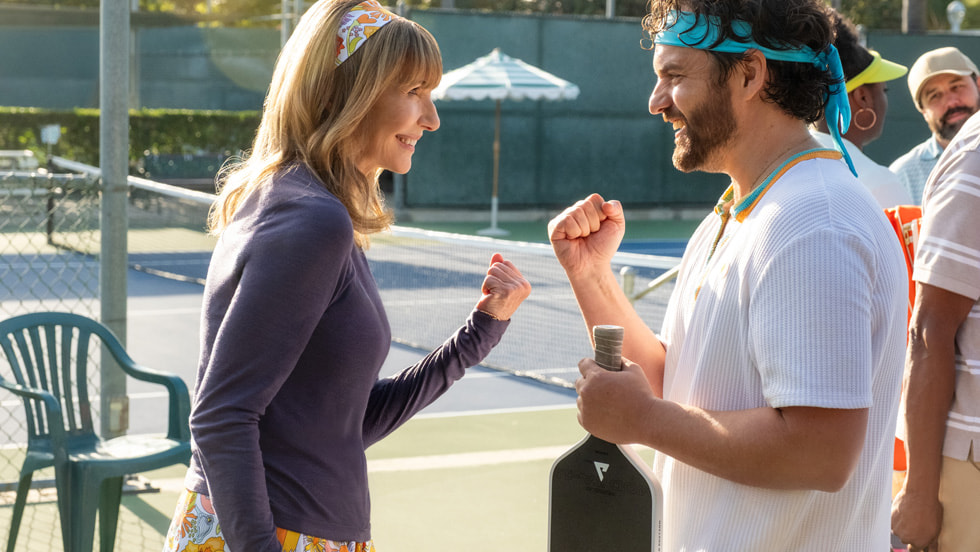
What if a top tennis player faltered in their career and had to slum it on the pickleball circuit? That’s kind of the loose “Happy Gilmore”—esque concept behind this not quite pickled-enough comedy that stars Jake Johnson (“New Girl,” “Drinking Buddies”) as said fictional tennis star Dustin Boyd. Boyd is a one-time rival of real-life great Andy Roddick, but an injury means he now toils as a club pro. When he dips his toe into the pickleball waters he gets crushed by a pair of 70-year-old grannies — Dustin, known as “The Hammer” in his tennis heyday, doesn’t understand finesse or the parameters of the smaller court. Then there’s the heralded, anemic drop-shot of the title (which the film uses as a running gag until it is past tired).

As the might-have-been superstar trying to pivot, Johnson doesn’t quite have the bravado needed for the part. The ace serve here — the script’s written by “Kevin Can F*** Himself” scribe Sean Clements—comes in Dustin falling for an older woman (a pitch perfect Mary Steenburgen) who’s not so sure she’s attracted to her younger suitor. The May-December pairing does score points when the two sit down for a movie night “date” and watch “The Graduate” and Dustin, busts on the other Dustin for having a big nose (Johnson has a pretty protuberant proboscis himself).

Directed by Josh Greenbaum (“Strays”) and co-produced by Ben Stiller, who has a small part too, the flick built around a feeble flick shot does best when the Greek chorus of feisty Floridian nanas are taunting Dustin and Roddick — who plays himself ­— in a match where the winner claims the deed to the tennis club owned by Dustin’s dad (Ed Harris, poorly used here). Heckling, it turns out, is the crosscourt humor that saves this cinematic dink from busted string ruin and John McEnroe’s woefully wooden intonations. 

Continue reading →

“The Odyssey”

17 Jul

Epic storytelling brings the original anti-hero to life

⭐⭐⭐Rating: 3 out of 4

Christopher Nolan’s $250 million retelling of Homer’s classic sword-and-sandal epic is here. And it is also epic, with a nearly three-hour running time. The film delivers, if unevenly, but when the bow is strung and taut, “The Odyssey” flies with fury and purpose. Even though we know how the millennia-old story ends, there are plenty of surprises and moments of wonder. 

The central conflict in “The Odyssey” is not battle. It’s a post-war saga centered on Odysseus’s 20-year trek home after the conclusion of the 10-year Trojan War — you know, the one over Helen, the face that launched a thousand ships. Troy (in modern-day Turkey) was a strategic foothold and a gateway between the Aegean and Black seas — you could think of it as the Strait of Hormuz circa 1200 B.C.

Continue reading →