Usher Cat and Popcorn Tickets – staffers at the Somerville Theatre – run the weekend “audience participation” screenings of the film “Cats.” (Photo: Tom Meek)
A few weeks back I wrote about the second life (of nine?) for the failed film adaptation of Andrew Lloyd Webber’s hit musical “Cats” taking form at the Somerville Theatre. Turns out the film’s reincarnation as an “audience participation” cult – come in costume, drink alcoholic beverages and shout at the screen – has more claws than the studio’s initial Christmas release: Despite its Oscar ambitions, critics tanked it, and hardly anyone filled the theater. (Opening opposite a hotly anticipated “The Rise of Skywalker” probably wasn’t the wisest choice.) To date the film has made barely more than half its nearly $100 million budget and, because of massive digitalization gaffes, had to be reedited and rereleased by Universal two weeks in. As a regular seven-days-a-week run became just slots on the weekend, though, it’s those late-night Friday and Saturday showings that have sold out. To check out just the freaky furball fun and gauge the cinematic awfulness of the talent-laden miscue (it does have Oscar winners galore), I swung by the Somerville Theatre on Friday.
It was a robust (two-thirds full) and raucous crew (mostly millennials with a boomer here and there), but I was slightly disappointed no audience members were in costume – just the feline-fashioned hosts, Usher Cat and Popcorn Tickets (theater staffers, adding a twist to the phenom) who had a few rules for the audience to follow. “Rule No. 1,” growled Usher Cat, “Don’t be a jerk or a dog.” Another stipulation asked audience members to “take the kitty litter home and not throw any projectiles at the screen,” and lastly, “Cheer for milk!” (when you see it). There were a few rounds of trivia, including the naming of cats in the films “Alien” and “Breakfast at Tiffany’s,” Usher Cat made an oblique reference to “catnip edibles” (part of the conjecture for the the rise of “Cats,” theater manager Ian Judge surmised, is the recent legalization of recreational cannabis). Then it was showtime. Continue reading →
I’ve yet to see the cinematic adaptation of Andrew Lloyd Webber’s “Cats.” Based on reactions from that first trailer and onward, I’ve been avoiding it. But now I might go check out the feline fetish flick that made Boston Globe film critic Ty Burr write, “I’d pay to unsee it.”
The reason? The critical and box office bomb has become something of an immersive joke, akin to Paul Verhoeven’s pole-dance disaster, “Showgirls” from back in 1995, which audiences came to adore as a garish train wreck.
Riding that wave, the Somerville Theatre has begun audience participation screenings (officially, the late-night Friday and Saturday shows, according to Facebook) with hooting and jeering not only okay, but encouraged.
“It started from the first few screenings,” theater manager Ian Judge said. “Once the word got out that something was horrendously wrong with the movie in terms of it just being so bad, so odd, so unsettling in its half-assed effects, so jumbled in plot and such a bizarre mix of stars and talents, people came in large numbers out of a curiosity.”
Raucous audience reactions didn’t sit well with everyone. “We had to issue free passes to a couple of patrons,” Judge said – leading to the more formal embrace of its lameness.
To get an idea of how bad “Cats” is, it’s a $95 million film that made only $6.6 million in its opening weekend, something a limited, arthouse release would be excited about but a death knell for a big-budget production. By comparison, “Star Wars: The Rise of Skywalker” made $177 million in its first days of wide release. On IMDB, “Cats” has a filmgoer rating of 2.8, which is lower than most films made by Steve Bannon (which I had the pleasure to research for the recent run of “American Dharma”). “Showgirls” has an IMDB rating of 4.8.
The film is directed by Tom Hooper, who has such Academy-recognized films in his pocket as “The King’s Speech” (2010) and “The Danish Girl” (2015), and it stars Taylor Swift, Judi Dench, Jennifer Hudson and Rebel Wilson. But it came under scrutiny as soon as its trailer release, with the poor quality and weirdness of its special effects going tsunami viral. An animated or live-action capture film from Pixar or James Cameron takes about four-plus years of visual rendering; the makers of “Cats” did theirs in seven months. The result was so shoddy and uneven that people began hunting immediately for weird and inconsistent fur patterns, bizarre genitalia and butt sculpting, not to mention creepy, monkey-like prehensile tails and scenes in which dame Dench’s human hand, replete with wedding band, showed up. (The studio has reedited and rereleased the film.)
As with classic midnight film “The Rocky Horror Picture Show,” people come to “Cats” dressed up – in cat ears and more. Judge suspects the legalization of recreational marijuana may be aiding in audience appreciation. And did I mention that the Somerville Theatre sells beer and wine? Belly up to the bar and get your best caterwaul on.
The “Cats” screenings with audience participation take place at 9:45 p.m. Friday and Saturday at the Somerville Theatre, 55 Davis Square. General admission is $11.
Cambridge Rindge and Latin School senior Maya Counter, right, leads a discussion Tuesday about changing the name of the Agassiz neighborhood. With her is Ann Charlotte Hogstadius, her mother. (Photo: Tom Meek)
A name change for the Agassiz neighborhood won unanimous approval this week at a community meeting, with the caveat by several voters that more conversation is needed.
The proposal to change the name to the “Baldwin neighborhood” comes from Maya Counter, a resident of the neighborhood and co-president of the Black Student Union at Cambridge Rindge and Latin School. But it’s not new – Counter, a senior, came upon the idea her sophomore year while researching a history class project and learning of the “flawed science and racist beliefs” of namesake Louis Agassiz.
It’s also not an idea new to the neighborhood. In 2002, a School Committee vote renamed the Agassiz School on Oxford Street to address the same discomfort; addressing the neighborhood name might have followed, according to people active in neighborhood politics at the time, had not many of the students and parents who pushed for the change felt burned out by the effort.
The neighborhood’s Maria L. Baldwin School was known as the Agassiz School until 2002. (Photo: Marc Levy)
There was little disagreement Tuesday about Agassiz and the context of his legacy. The Swiss-born scientist who lived from 1807 to 1873 was famous for founding Harvard’s Museum of Comparative Zoology, but controversial for pushing racially divisive theories as science. He believed in polygenism, the idea that human races are of different origins, and that whites were intellectually superior to other races. He has been discredited for his racism, and his belief in creationism lost out to the evolutionary theories of contemporary Charles Darwin.
His name was taken off the local elementary school in honor of Maria Baldwin, who in 1899 became the first black female school principal in the Northeast – “the most distinguished position achieved by a person of negro descent in the teaching world of America,” W.E.B. Du Bois said in 1917.
It was at the school that the Agassiz Neighborhood Council met Tuesday to give Counter the “constructive conversation” she requested, and apositive reaction by the approximately 30 neighborhood residents and staff in attendance.
Maria Baldwin, circa 1885. (Photo: Library of Congress)
Wider involvement sought
But there were concerns about process after Counter announced she had reached out to Mayor Sumbul Siddiqui and planned to present to the City Council at month’s end.
Many at the ANC meeting expressed a strong desire to be involved in the process and felt that one meeting in a neighborhood of approximately 6,000 residents – with only two dozen in attendance – was not enough. (To prepare for the meeting, Counter posted about the idea on the neighborhood social media site Nextdoor. As at the meeting, there was strong support for a name change, though also some challenges that “you can’t erase the past.”) Some people at the meeting were concerned that Counter was rushing to get the change done before graduation.
Some also floated the notion that perhaps the neighborhood was named after Agassiz’s wife, Elizabeth Cabot, a naturalist and the founder of Radcliffe College, and therefore the name might still be applicable. But correspondence from Charles Sullivan, executive director of the Cambridge Historical Commission, stated, “The Agassiz neighborhood was named after the Agassiz School, which is now the Baldwin School.”
No clear-cut process
Renaming a neighborhood lacks a clear-cut process, despite the recent change of Area IV to “The Port.” There too, race played a role, as residents believed the term “Area IV” was a police designation (it was created by the city facilitate analysis of the then upcoming 1940 U.S. Census). The change was made official by a City Council vote in 2015 after several rounds of community solicitation. In that situation too, not everyone felt the process had been inclusive enough, said Lee Farris, a resident of The Port who is active in civic affairs.
The Agassiz change may be simpler. A policy order by city councillor E. Denise Simmons approved unanimously in April asks the city to review the names of streets, schools and public buildings “that may be named in honor of those who have ties to the American slave trade” and work on renaming them “as soon as possible.” Agassiz, while not a slave owner and on record as an abolitionist, could be linked to slavery for espousing the beliefs that enabled it.
“Why keep it?”
There is already some eagerness for a name change among the hosts of the Tuesday meeting.
In 2007 the nonprofit that provides after-school services, runs the Maud Morgan Arts Center, hosts the Agassiz Neighborhood Council meetings and provides other community services, was rebranded the Agassiz Baldwin Community – a half-measure that doesn’t sit well with Counter. “Why keep it?” she said in an interview before the meeting, referring to the “Agassiz” part of the name. “He thought she was biologically inferior. It’s disrespectful to her.”
At the meeting, the nonprofit’s executive director, Maria La Page, agreed that having the name “Agassiz” upfront was a burden for an organization that holds inclusion at its core.
The Agassiz neighborhood is between Harvard and Porter squares and touches on Somerville, defined by Massachusetts Avenue to the west and Kirkland Street to the south.
District Attorney Marian Ryan steps aside at a Thursday press conference in Woburn so Elizabeth Dobbins can speak on the one-year anniversary of the death of her brother, Paul Wilson. (Photo: Tom Meek)
On the one-year anniversary of the killing of Paul Wilson, 60, in Danehy Park, law enforcement officials gathered at the Middlesex District Attorney’s Office in Woburn on Thursday to assure the public they continue to investigate – and to ask again for the public’s help in finding the killer.
Joining them was Wilson’s sister, Elizabeth Dobbins, who reflected on Wilson as big man with a big heart, and a man who valued family and friends. “He could connect with anyone and everyone,” she said, calling his death “incomprehensible and senseless.”
While there was little new to be revealed by District Attorney Marian Ryan and Cambridge police Deputy Superintendent Leonard DiPietro, it was made clear that a bat found at the scene of the crime was not used to kill Wilson.
“There is nothing that connects this item with the crime,” officials said. “A search of the park following the attack resulted in the collection of several samples of biological matter. Forensic testing has been conducted indicating that some of the blood found at the scene was animal blood; testing on further biological evidence remains ongoing.”
An image of Paul Wilson released Thursday by law enforcement officials.
Videos given to police by people in the area have not provided any answers, and Ryan said hundreds of park neighbors and visitors have been interviewed. “By revisiting this anniversary today, we are reminding the community of this crime and reinforcing the need for cooperation and information from the general public,” DiPietro added.
It was also noted that since the attack on Wilson, “investigators have also been made aware of some similar incidents that have occurred in Cambridge and other communities” but are not connected to his death, they said. “He was also found with his belongings on him, including an Apple Watch – suggesting robbery was not the motive.”
On Jan. 2, 2019, Wilson returned from work at IBM to the Porter Square T station and rode a Blue Bike home, parking it by his house on Sherman Street before walking through the park,investigators said. Wilson was found by a passer-by shortly before 6:48 p.m. on an asphalt path near the Danehy Park parking lot and dumpsters, near New Street. He was taken to Beth Israel Deaconess Hospital and pronounced dead from blunt force trauma at around 10:18 p.m.
“There’s no reason to believe the crime didn’t take place where the body was found [and] there’s more reason to believe it did,” Cambridge Police Commissioner Branville G. Bard Jr. said at a public meeting a year ago. “Mr. Wilson was found right under working lights in a well-lit area. That wasn’t the problem.”
The discussion of motive was similar to what was discussed a year ago.Wilson was “brutally murdered,” Bard said, and Ryan said at the time that there was no reason to believe the intention of the attack, in which “most of the blows were to the top of the head,” was a robbery.
The death continues to be investigated by the Middlesex District Attorney’s Office, state police assigned there and by Cambridge police. “We have made some progress but have not ye identified a suspect,” Ryan said Thursday, renewing a call for anyone with information about the incident to call (781) 897-6600.
People with information are also invited to call Cambridge Police at (617) 349-3300. Anonymous reports can be left at (617) 349-3359; sent by text message to 847411 (begin your text with TIP650, then type your message); or by email by visiting CambridgePolice.org/Tips.
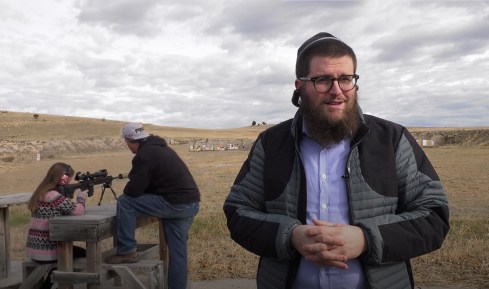
North Cambridge resident Gerald Peary knows a lot about film. He’s been a critic for more than 40 years and a film studies professor and curator for more than a quarter-century, and is about to premiere his third documentary feature, “The Rabbi Goes West,” Sunday night at the Somerville Theatre. The film – co-directed with Peary’s wife, Amy Geller, it follows a Chabad rabbi who moves from Brooklyn, New York, to Bozeman, Montana – closes out this year’s Boston Jewish Film Festival, playing this week and last at the Brattle Theatre and other locations.
The reason for 34-year-old Chaim Bruk’s relocation is a mission to bring his brand of Judaism to the American West by placing a mezuzah (an encased prayer offering) on the door of every Montana Jew – not a large population. Along the way Bruk encounters resistance from within the Jewish community, and more frighteningly, threats from neo-Nazis.
“I wanted to make a film which spoke to my Judaism,” Peary said. “I’m the most secular Jew, who doesn’t attend synagogue but knows who all the Jewish writers, athletes, et cetera, are. I asked myself, ‘What do I like about Judaism?’ I like mezuzahs – the scrolls put up on Jewish doorposts including inside a verse from Deuteronomy. Having a mezuzah on your door tells the world you’re Jewish, and it’s a big ‘fuck you’ to Hitler, Nazis and Neo-Nazis. ‘Jews are here!’”
“The Rabbi Goes West” co-directors Amy Geller and Gerald Peary.
“Anyway, I read on the Internet about a Hasidic rabbi who has a pledge to put a mezuzah on the door of very Jew in the state of Montana – that’s 2,000 Jews in a state 14 times larger than Israel. I called up Rabbi Chaim Bruk in Bozeman, Montana, and he invited Amy out to film him putting up mezuzahs. The rest is our movie,” Peary said.
Geller co-directed “The Guys Next Door” (2016), a documentary about a gay male couple raising daughters, and Peary said he was delighted to work with a partner who is a “brilliant, talented producer first, and second, knows documentaries inside and out.”
“She was also incredibly demanding about our film,” Peary said, “never letting go of any facet of the movie until she felt it was perfect.“ During production, Peary said most nights they would discuss and argue about the film over dinner and while going to bed. “That was all exhausting,” he said, “but if the movie is really good, it’s because of the intensity of our collaboration.”
Over the years, Peary has penned for several alt-weeklies in the area (“Real Paper” and “Boston Phoenix” – both sadly defunct), taught film studies at Suffolk University and continues to run the Cinemathèque program at Boston University and contribute to The Arts Fuse. His first film, “For the Love of Movies: The Story of American Film Criticism” (2009), which Geller co-produced, served as something of a bittersweet elegy for iconic film critics Roger Ebert and Andrew Sarris (both died in the short years following) and poetically pondered the fate and value of film criticism. In 2015, his “Archie’s Betty” explored the roots of the comic book town of Riverdale in Haverhill, where Archie creator Bob Montana had attended high school.
Peary doesn’t think making movies affects what he writes when easing back into the critic’s chair – something Ebert also did, having famously penned Russ Meyers’ bit of 1970s kink, “Beyond the Valley of the Dolls.”
“Everyone making movies has endless hardship stories, especially about the financing part in a country which doesn’t support the arts in any way. But it’s ultimately what’s on screen that counts, and only what counts,” Peary said. “I’ve always been a tough critic with high demands for cinema, and I remain that way.”
Repertory theaters see cause for concern at Disney’s new control over decades’ worth of Fox films, says Ned Hinkle, creative director at Harvard Square’s Brattle Theatre. (Photo: The Brattle Theatre)
The launch of the Disney+ streaming service next week may be good for stay-at-home watchers of the Mouse’s classics and Pixar films, “The Simpsons” and tourists in the “Star Wars” and Marvel universes, but it also could shake up repertory cinemas that screen titles such as “All About Eve,” “The Sound of Music,” “The Revenant,” “Alien,” the original “Planet of the Apes” and Terrence Malick’s “The Thin Red Line” – including Harvard Square’s Brattle Theatre and the Somerville Theatre in Davis Square.
Disney, which acquired 20th Century Fox for $71 billion this year, seems to be quietly locking away the studio’s trove of 100 years of classics into its “vault,” Vulture reported last month. Disney did not announce a policy, but the sudden cancellation of booked screenings of Fox films (“The Omen” and “The Fly”) at theaters around the country sparked panic through the cinematic community that the movies might become no longer be available for exhibition.
One common theory is that Disney doesn’t want a current product (a new film such as the upcoming “Frozen II”) to compete against one of its classic/repertory films (say, “Fantasia” or “Bambi”).
“I understand the rationale might be to send people to Disney’s streaming service,” said Ian Judge, manager of Frame One’s Somerville Theatre. “We had dealt with this issue with Disney before they purchased Fox, and in order to get Disney repertory we had to have them reclassify Somerville as a repertory house in their system, which means we no longer play new Disney product there.”
That means that you’ll see only Disney-owned classics in Davis Square; new films from the company play at Frame One’s Capitol Theatre in Arlington. “We have been lucky to have that option, but for single locations, it’s putting them in a tough spot,” Judge said.
The Brattle happens to be one of those single locations. “At the moment,” said Ned Hinkle, creative director at the Brattle, “this is not an issue for the Brattle – or any other purely repertory cinema – but having such a large corporate entity in charge of such a huge swath of cinema culture has everyone on edge.” Hinkle echoed Vulture’s concern of “not knowing” Disney’s long-term plans for popular repertory titles such as “The Princess Bride,” “Fight Club” and “Aliens” and other entries on Fox’s vast slate. The academically affiliated Harvard Film Archive is another “single location” repertory house that is not affected.
The one Fox film that Disney is keeping its paws off: Late-night cult classic “The Rocky Horror Picture Show,” which has had runs at the shuttered cinemas in Harvard Square and at the Apple Cinema at Fresh Pond (a nonrepertory theater) and is slated to play AMC’s non-rep Boston Common theater Saturday. But “Rocky Horror” has no Disney product to compete with.
More will likely become known as Disney+ launches, but for now, here, let the projectors roll.
Speed limit signs for 25 mph will become more rare in Cambridge this fall, as nearly 80 percent of streets fall to a 20 mph limit. (Photo: Acquaforte via Pixabay)
Beginning in November, the city will begin to reduce speed limits on nearly 80 percent of streets in Cambridge to 20 mph from the statewide 25 mph. The move comes as part of the city’s commitment to its Vision Zero strategy to reduce road deaths.
If a 5 mph reduction seems insignificant, a study from the AAA Foundation for Traffic Safety showed that pedestrians are almost half as likely to be killed or seriously injured if struck by a car traveling 25 mph versus a car traveling 30 mph.
The city enacted the measure in January when looking to expand areas designated as “safety zones,” which had been reserved primarily for roads passing by schools and senior centers. The rollout will see 660 “Safety Zone” signs erected starting in East Cambridge and spreading west over a loose three-month period. The map will be updated to reflect progress as the project moves along.
“We’ve heard concerns about speeding from people throughout the Cambridge community,” said Joseph Barr, director of the city’s Traffic, Parking & Transportation Department. “Reducing the speed limit is an important step toward addressing those concerns. This change will also inform the way that we design our streets and help support our ongoing traffic calming efforts.”
Nate Fillmore, of the Cambridge Bicycle Safety Group, speaks about road safety to the City Council in February 2018. (Photo: Ceilidh Yurenka)
Bicyclists, who have testified to feeling at risk from sharing roads with speeding cars, embraced the announcement. “Changing to the lower speed limit is critical,” said Steve Bercu, a Cambridge resident and member of the board of directors of the Boston Bicyclist Union, “in that it impacts the design speed of all projects going forward.” Nate Fillmore, of the Cambridge Bicycle Safety Group, was more direct on the matter of design: “This change needs to be followed up on with citywide changes to the built environment that reflect the new speed, including narrower lanes, raised crosswalks and protected bicycle lanes on major streets wherever possible.”
One city councillor backing the initiative, Quinton Zondervan, hailed the move. “This will make our city much safer for vulnerable road users, allowing more people to walk and bike, leading to less pollution and a healthier community,” Zondervan said.
Addressing concerns of residents discussed on area listservs, vice mayor Jan Devereux added, “Of course, we will need enforcement to put teeth into this desire to slow down drivers – the lack of speed enforcement is another complaint I hear often. Automated enforcement by camera could help, and the council is on record in support of [a bill] pending on Beacon Hill.” Matters of privacy have always been a concern with camera use enforcement, though it’s the primary mechanism in place for cars without toll transponders on the Massachusetts Turnpike.
The big difference between the reduction to 25 mph from 30 mph made optional statewide a few years ago and this city reduction to 20 mph is that signs are needed to mark the deviation from the statewide default.
Enforcement, the city said, would be data driven as it always has been. “When in doubt, go 20 mph,” said the communication from the city.
Robert Pattinson and Willem DaFoe in Robert Eggers’ “The Lighthouse,” playing now at Davis Square’s Somerville Theatre.
Don’t spend too much time looking for answers about the meaning of “The Lighthouse,” Robert Eggers’ sophomore film, from Eggers himself.
Eggers, interviewed on a swing through town before “The Lighthouse” began screening Thursday at Davis Square’s Somerville Theatre, said he didn’t set out with a specific theme or statement, but “wanted to raise more questions than provide answers.”
The character study of two clashing personalities (Willem DaFoe and Robert Pattinson) tending to a New England beacon far offshore during the late 1800s is in throwback black and white, hard to define – it’s not really arthouse horror or a psychodrama, but a dabble of both and then some – and hits some pretty dark depths. It might not have been made had Eggers not caught Hollywood’s eye with his 2015 Calvinist colonial beguiler “The Witch,” which made a splash at Sundance and won him the Directing Award.
Robert Eggers. (Photo: Tom Meek)
“I had to choose very carefully,” Eggers said of his follow-up, invoking the notoriously fickle nature of the industry. Eggers, intentionally vague, mentioned a flirtation with a bigger project that got made by another filmmaker while “The Lighthouse” came to fruition from a script he and his brother Max had worked on years earlier, inspired by an old Welsh poem and the works of maritime penners of the era such as Melville.
The film, with the provocation, tricks of the light and a dash of the outré now identified as part of Eggers’ signature style, landed two very big fish as its stars with surprising ease. “I didn’t think ‘The Witch’ would find much of an audience, [but] one of its fans was Willem Dafoe, who contacted me and asked me out for lunch – which was like ‘Wow,’ because he was a huge hero of mine. And Robert Pattinson had similarly been in contact with me,” Eggers said. “When they greenlit ‘The Lighthouse,’ I thought, who else?”
Of his journey into film, New Hampshire native Eggers has it down pat: “My dad was a Shakespeare professor at UNH, my mom had a kids’ theater company and I got bad grades – so the only college I got into was an acting school in New York.” Afterward, Eggers joined a theater troupe, where set design became his forte and a skill that ultimately elevated him in the theater and filmmaking industries. Those roots are on display impressively in the “The Lighthouse”; the structure of the title looks like an authentic relic but was built from the ground up for the film. “Anyone who could hold a hammer in Nova Scotia helped out, because we didn’t have a lot of time,” he said.
Because much of the film takes place during a relentless nor’easter that drives the action, that set was erected on Cape Forchu, a rocky peninsula on the southern tip of Nova Scotia that Eggers calls a “the most punishing location we could find that had good road access.”
“It really delivered, but I had never been so cold in my life. I mean, I had experienced colder weather, but the gale force winds on that rock in the North Atlantic were just so relentless, and there’s no respite with all the saltwater spray coming at you,” Eggers said. Many of the scenes are in driving rain – mostly natural, though sometimes driven by a fan and only occasionally helped by a firehose. The short time on location, weather and physical demands of filming meant there was little time for relaxation.
Aside from Dafoe and Pattinson, who give performances worthy of award consideration, the other big star of the film is a clamorous seagull who menaces Pattinson’s newbie with all the brio of the bullish goat Black Phillip in “The Witch.”
“Actually it was three trained seagulls,” Eggers said. “They’re rescue birds, and they’re so smart and clever.” For the scene where the seagull files up to a window and pecks it three times, Eggers thought he was going to have to cut the elements together and maybe use CGI, but the bird did what was in the director’s head on the first take.
Next up for Eggers is “The Northman,” a 10th century viking revenge story staring Nicole Kidman, her “Big Little Lies” costar Alexander Skarsgård, Dafoe and Anna Taylor-Joy (the star of “The Witch”). I had to ask Eggers how he became so obsessed with off-the-grid period pieces. “It’s what rings my bell,” he said. “I prefer to understand where we are and where we are going by exploring where we came from.”
Around town there’s Green Cambridge and Livable Streets helping advocate for a more environmentally friendly coexistence between human, nature and urban landscapes. For some, that’s not enough. Welcome to Extinction Rebellion Massachusetts, an environmental group that feels not enough is being done about human-triggered climate change. The fledgling network of chapters throughout the state – Cambridge so far hosts the largest, organizers say, because it may also be the first in the country – extends a 2018 London-founded organization that showed its strength through street protests this spring and summer.
Some of the group’s goals, such as “legally binding policy measures to reduce carbon emissions to net zero,” echo that of plans adopted by many cities and towns. There are bigger demands, however, such as a “national Citizens Assembly to oversee” government.
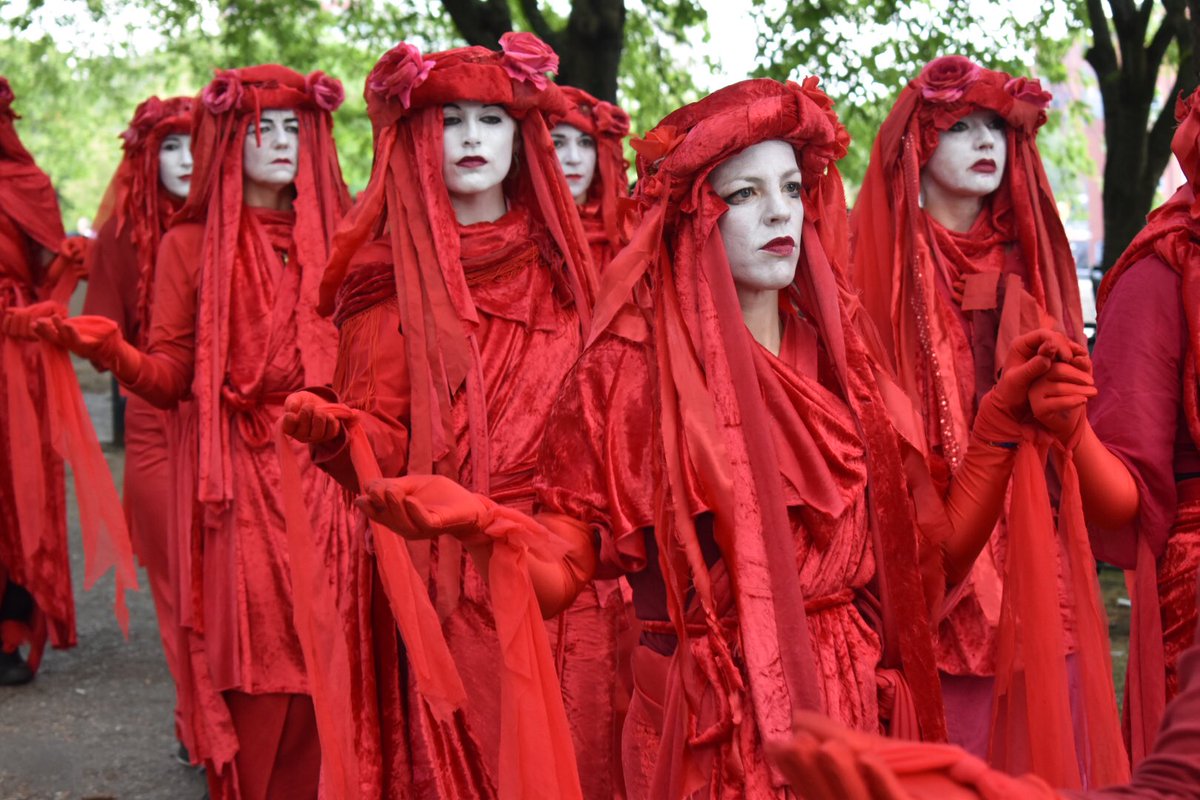
Extinction Rebellion is enigmatic; its media outreach organizer spoke anonymously about plans to launch a Red Rebel Brigade (red-robed protesters reminiscent of the recent remake of “Suspiria,” if the dancers donned Guy Fawkes makeup) like the ones that made an attention-grabbing splash during those London campaigns. Outreach and recruitment are the primary focus, the representative said, with a “Flood the Seaport” event at which the group will “peacefully disrupt business” slated for Sept. 27.
First comes the “Diagonal Life Circus and The Normality Rebellion Pageant,” the year’s free Bread and Puppet Theater show at 3 p.m. Sunday on Cambridge Common, near Harvard Square, where the Extinction Rebellion will set up a mobile recruitment center. A Red Brigade launch discussion is set for 6:30 p.m. Tuesday at Caffè Nero, 589 Massachusetts Ave., Central Square. Both events are open to the public.
John Wayne and Angie Dickinson talk with Howard Hawks on the set of “Rio Bravo” in 1959.
Howard Hawks may be the greatest American filmmaker you never really think about. His name should be right up there in the conversation with Coppola, Chaplin, Scorsese, Tarantino, Ford and Welles, but rarely is. His output – dozens of films, most during the 1930s, ’40s and ’50s Golden Era of Hollywood – is an astounding list, filled with iconic stars, yet Hawks never won an Oscar and was nominated only once as director, for “Sergeant York” (1941). Beginning Friday, the Harvard Film Archive will commemorate Hawks’ incredible career with “The Complete Howard Hawks.” The slate of 40 films will be exhibited throughout the summer, concluding Aug. 30 with “Monkey Business” (1952).
The classics include “Red River” (1948, screening Aug. 4 and 11), “Gentlemen Prefer Blondes” (1953, June 15 and 23), “Bringing Up Baby” (1938, June 15-16) and “The Big Sleep” (1946, June 29-30), peppered with Hollywood A-listers such as James Cagney, Gary Cooper, John Wayne, Humphrey Bogart, Marilyn Monroe and even a young James Caan. “Sergeant York” screens Aug. 12.
Hawks had a pretty rich life. He grew up in a family that possessed a small industrial fortune, attended Phillips Exeter Academy and earned a degree in mechanical engineering from Cornell. His interest in film came when his family transplanted from the Midwest to Pasadena, California. After a stint in the U.S. Air Force during World War I and some dabbling as a gambler and race car driver, Hawks fell in with the likes of Cecil B. DeMille and Douglas Fairbanks. Hawks made several silent films in the 1920s, including the hedonistic “A Girl in Every Port” (1928, July 8), the Arabian-Parisian romance “Fazil” (1928, July 22) – both to be screened with a live accompaniment by Robert Humphreville – and his debut about a woman coming to terms with her sudden blindness, “The Road to Glory” (1926, not on the calendar and not to be confused with the 1936 war movie of the same title by Hawks that plays Aug. 16).
Many of Hawks’ works mirrored his life. He made several war films with a focus on aviation, including “Today We Live” (1933, Aug. 24), “Only Angels Have Wings” (1939, June 14 and 16), “Dawn Patrol” (1930, July 13 and 28) and the chaotic post-Pearl Harbor bombing epic, “Air Force” (1943, July 14 and 21), as well car racing dramas such as “The Crowd Roars” (1932, Aug. 19) starring Cagney and “Red Line 7000” (1965, Aug. 23).
Hawks’ diverse, genre-spanning slate included crime dramas (“Scarface,” 1932, June 29 and July 7), noir (“The Big Sleep”), romantic comedies (“His Girl Friday,” 1940, June 24 and Aug. 30), westerns (“Rio Bravo,” 1959, July 26 and Aug. 10) where he was often competing for audience share against friend John Ford, and a foray into science fiction (“The Thing From Another World,” 1951, July 13 and 21, from the same source material as John Carpenter’s 1982 sci-fi horror film “The Thing”).
Personal favorites include the adaptation of Raymond Chandler’s pulp noir “The Big Sleep” which boasts a screenwriting credit from Willam Faulkner, “Bringing Up Baby,” which I feel is the greatest rom-com of all time – but, then again, I wanted to be a paleontologist growing up – and “Scarface,” with Paul Muni setting the standard for classic bad guy performances. Then there’s the classic showdown “High Noon,” which paired Gary Cooper (one of Hawks’ two longtime collaborators, the other being Cary Grant) as the sheriff with an “X” on his back and Grace Kelly, and the grim and dark “Rio Bravo,” which would become the basis for another Carpenter film, the 1976 urban crime thriller, “Assault on Precinct 13.” Angling back toward the light is the newsroom romp “His Girl Friday.” Perhaps one reason Hawks is left out when it comes to talking greats is his appetite for a smorgasbord of subjects and his quietly competent compositions – for better or worse, you don’t feel the filmmaker in there trying to make a splash or leave his signature, as you do with many star directors. Hawks’ films have always been about narrative and character and letting the combination make the magic that pulls in the audience. It’s something he did repeatedly.
“The Complete” series at the HFA was the brainchild of programmer David Pendleton, who sadly passed in 2017. Previous series have focused on Jean Renoir, Fritz Lang and Alfred Hitchcock.