Reviewed: ‘Bound,’ ‘Holland’ and ‘We Were Dangerous’
‘We Were Dangerous’
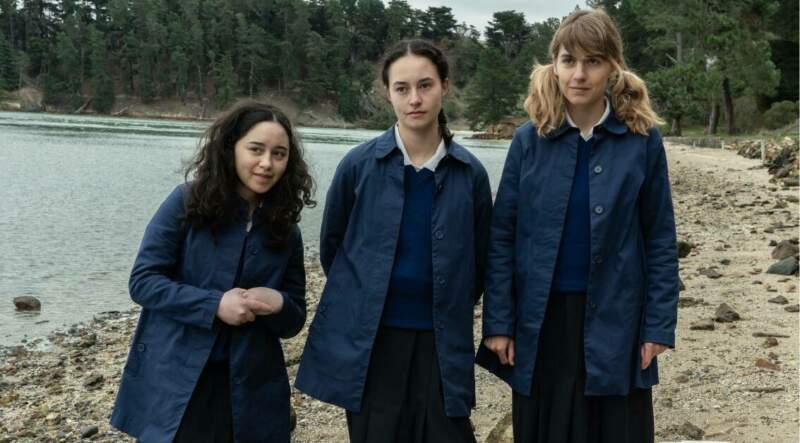

The historical ills of the three Cs (colonialism, capitalism and Christianity) loom at the fore of Josephine Stewart-Te Whiu’s feature debut, a coming-of-age tale about two Māoris and one Pākehā (a white New Zealander) sent to an island reform school for delinquent girls. Nellie (Erana James) and Daisy (Manaia Hall) are sent to the school to whitewash the Māori out of them and accept the word of god. Lou (Nathalie Morris), a rebellious, well-off white girl, is there for remediation of sexual perversions – nothing worse than dad catching you making out with your female babysitter back in the conservative 1950s. As in RaMell Ross’ adaptation of Colson Whitehead’s “Nickel Boys” last year, there are different rules when it comes to people of color, even in a hellhole. In the still of the night, from one hut, blood-curdling screams are heard. We never really learn what goes on there, just that whatever it is, it isn’t good, and that the school marm (Rima Te Wiata, “Hunt for the Wilderpeople”) is quick to slap any Māori incantation from the mouths of Nellie and Daisy, even though she is of Māori origin and ostensibly came up through the same system. Tellingly, Daisy can’t read and the school doesn’t seem interested in her education; just her assimilation and Christian brainwashing. Part of the school’s mission is to keep the teens chaste (a remote island helps with that logistically) and get them prepared to become demurring housewives, a low bar made even lower by the persistent patronization and Draconian discipline. The driving force to the film is the playful kinship between the trio (aided by the chemistry among the three performers) and their never-give-in resolve despite the dead-end hopelessness of their situations. Gorgeously shot by Maria Ines Manchego (“Uproar”) and executive produced by Taika Waititi (“Wilderpeople,” “JoJo Rabbit”), “We Were Dangerous” is a quiet reminder of the sins of religious imperialism, the agency of lateral violence that accompanies it and the sexual oppression and subjugation of women during the rising tide of world prosperity.
Continue reading





 Bujalski’s first film cost just $30,000 to make (it grossed about $75,000) and starred no-name actors; here he’s blessed with the reliable Guy Pearce, Cobie Smulders (Agent Maria Hill in the “Avengers” movie and “Agents of S.H.I.E.L.D.” television series) and character actor Kevin Corrigan (“Superbad” and “Goodfellas”) who steps to the fore and delivers a knockout performance. “Results” is based on the well-being fad, in which everyone wants to get physically and emotionally fit and fortified. Danny (Corrigan) newly and painfully out of a marriage he didn’t want to exit, transplants to Austin. He’s doughy, rich and angry. He also wants to be able to take a punch, so he signs up for a personal trainer at Power for Life, a boutique health spa run by Trevor (a gaunt and toned Pearce) who pushes the philosophy that wellness is more than physical beauty, even though his crew of crack coaches look like magazine cover specimens. The upbeat but aggressive Kat (Smulders) gets the assign and spends time at Danny’s palatial spread trying to get him lean and buff, but he drags her down into his routine of single-malt scotch and weed. Turns out she’s a bit depressed and angry too. If there’s a deadbeat client, Kat’s more than happy to switch over to into loan collector mode, and boy can she run – look out Lola, she’s on your tail.

 Colin Firth gets a big scene-chewing role as Stanley Crawford, a 1920s illusionist who takes the stage as a Fu Manchu-like incarnation known as the Great Wei Ling Soo. He wows audiences, making elephants disappear and sawing women in half and, like Houdini did in his time, debunks hoaxes, which Stanley agrees to do when fellow magician Howard Burkan (Simon McBurney) asks him to come to a country villa in France to expose a young American woman shaking down a susceptible and well-off widow (Jackie Weaver). The young American woman in question, Sophie Baker, is played by none other than Emma Stone, a big-eyed cutie with auburn locks and by logistical association alone muse du jour to Allen. But she’s no Diane Keaton, not even a Mia Farrow or Mia Sorvino, for that matter. She’s game, but asked to do a lot with a little and beyond her range. Thankfully she has Firth to play off of, and he’s masterful. Initially when the game is afoot in the gorgeous greenery of Southern France, there’s promise and a playfulness in the air. The film suggests twist and turns to come, false reveals and oneupmanship, but then romance floats into the picture, and the notion of god too. What a buzzkill.
 For What it's Worth