News of the deal brought relief and excitement to local leaders and cinephiles. The new owners have launched a GoFundMe to help pay some of the downpayment.
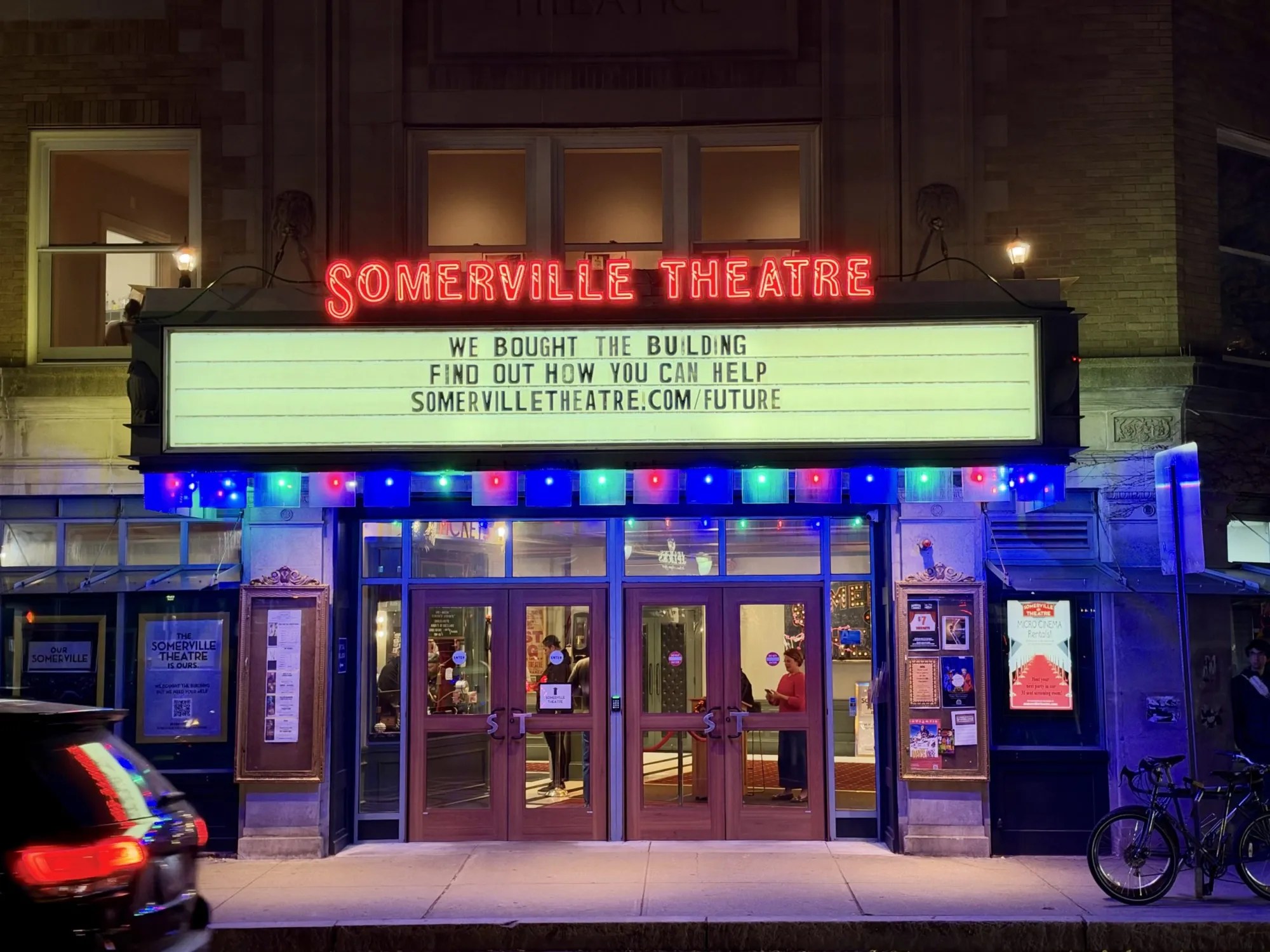
The future of the Somerville Theatre came into clear focus today when it was announced that ownership of the Hobbs Building, which houses the historic theater, was transferred to CSB Theatres, Inc.
CSB is co-owned by longtime theater managers Ian Judge, Ian Brownell, Jamie Mattchen and John O’Leary. Judge’s name is listed as owner of the limited liability corporation, but he called that a formality.
Judge called the deal “equal parts excitement and nausea.” CSB has launched a GoFundMe campaign to help raise $90,000 to back monies used for the down payment. “It’s scary,” Judge said, “but it’s basically our only chance to make sure that the theater stays around, locally owned in its current form for as long as possible.”
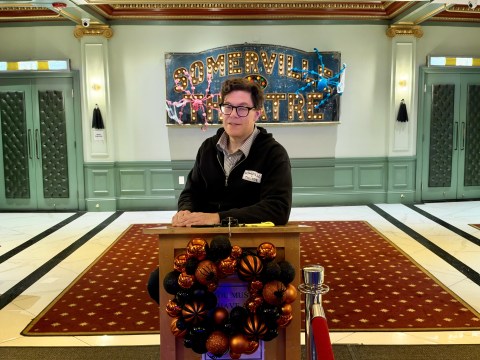
Ian Judge, new co-owner of the Somerville Theatre, was in the lobby greeting patrons. Continue reading →
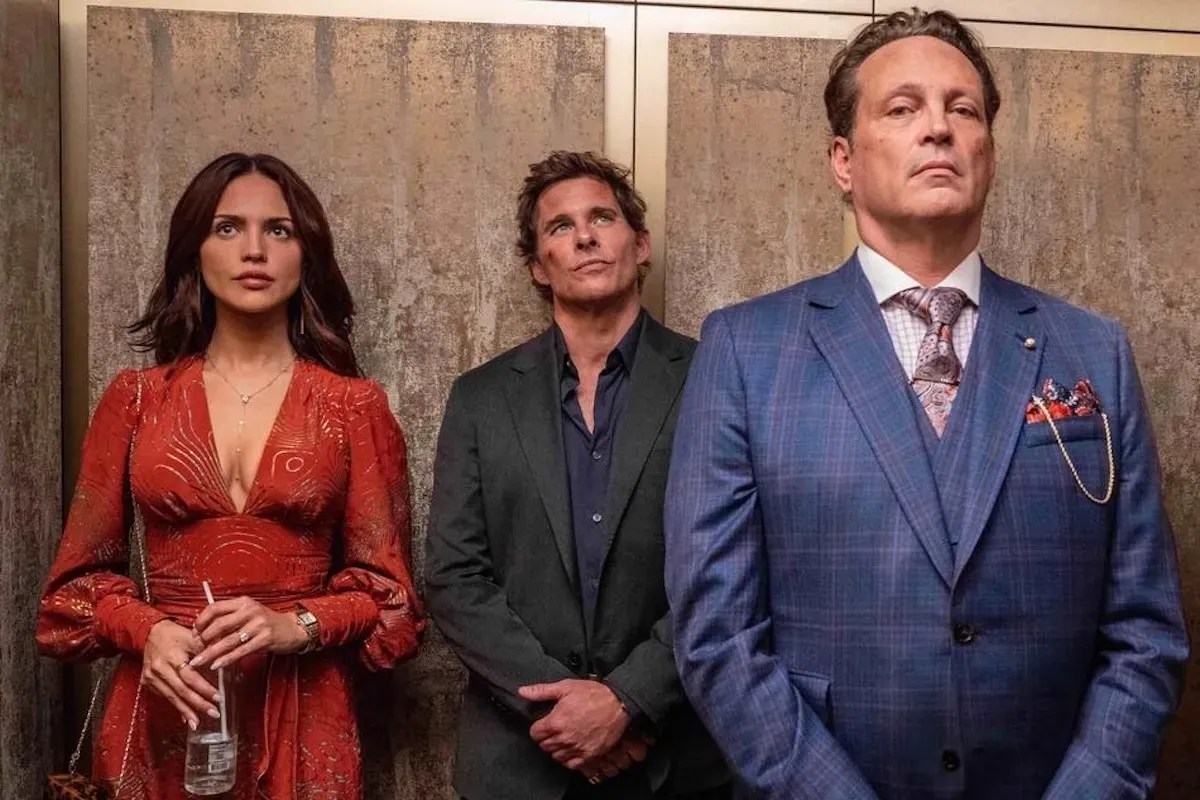
The title of this slack crime comedy-cum-love triangle calls to mind Paul Mazursky’s open relationship romp “Bob & Carol & Ted & Alice.” That 1969 curio starring Natalie Wood and Elliot Gould played on character and the times. Here, as directed by BenDavid Grabinski, “Mike & Nick & Nick & Alice” pretty much steals concepts from elsewhere and mixes them together in the blandest, nod-and-wink, not funny way. Vince Vaughn (“Swingers”) and James Marsden (such a good JFK-like prez in “Paradise”) play Nick and Mike, hitmen who are the target of a local mobster named Sosa (Keith David and his glorious baritone, sadly wasted). Allegedly, it’s because Marsden’s Mike ratted out Sosa’s son Jimmy Boy (Jimmy Tatro, “You’re Cordially Invited”), who got collared and had to do time.
The film’s set in the aftermath of Jimmy’s release. Why Sosa, a Black man, refers to Jimmy, who is not Black, as his son is never fully explained — though both spew the same low brow rhetoric and spend much of their time at strip clubs, ogling and hooting. But then there’s the two Nicks, who happen to be one and the same. Did I mention there’s a time machine? There is, and so Vaughn’s Nick from the future comes back to get the Nick of the present to help save Mike. Adding further complications is that Nick’s estranged wife Alice (a fiery Eliza Gonzalez, who is about the best thing in the movie) is hooking up with Mike.
Much of what transpires is four talking heads hatching overly complicated plans to save Mike from Sosa, who has dispatched the feared cannibal hitman, “The Baron,” to extract his pound of flesh. It’s all punched up pulp pablum made further infuriating by the ersatz use of Wong Kar-wai’s slow-mo, “gun-fu” flare. It’s as insulting to the viewer as it is to Wong. Then there’s the gotcha ending that’s palm plant worthy and then some. If I could hop in a time machine and go back, I’d skip this inanity and spin up Wong’s cool Asian-noir “Chungking Express” (1994).
Cantabrigian teacher and poet Charles Coe died Friday Nov. 21.
The spirit of creativity in Cambridge dimmed last week when longtime resident, teacher and poet Charles Coe died Monday from complications related to prostate cancer surgery. His death was sudden and stunned many. In addition to touching people with his words, often delivered in a deep, mellifluous baritone, Coe offered mentorship, leadership and a sense of community. He was 73.
He was an omnipresent figure in local literary circles: the Mass Poetry Festival, long-running literary salons across Cambridge and Somerville, the Writers’ Room, Black Writers Reading series, arts advocacy boards. If there was a gathering where people were wrestling with words or art or community, chances were good Coe had either helped organize it or slipped quietly into a seat to listen.
Poet Charles Coe is the subject a film screening Wednesday as part of the 22nd Roxbury Film Festival’s opening night lineup. (Photo: Gordon Webster)
As noted in Sunday’s Film Ahead column, the 22nd Roxbury Film Festival kicks off virtually Wednesday, with “The Sit-In: Harry Belafonte Hosts the Tonight Show” by Yoruba Richen, about Johnny Carson stepping aside to let Belafonte host in the wake of race riots in the late ’60s, and the short “Betye Saar: Taking Care of Business” by Christine Turner.
What’s Cambridge-centric about the opening night lineup is the inclusion of another short: Roberto Mighty’s “Charles Coe: Man of Letters,” about the longtime Cambridge resident, poet and musician. If you’ve ever been to a Cambridge or Boston area poetry reading you’ve probably heard Coe deliver one of his truths in his signature baritone voice. Or you may have seen his recent photographic exhibit at the Boston Public Library, “What You Don’t Know about Me” (2018), or as part of Rashin Fahandej’s “A Father’s Lullaby” exhibit at the ICA last year.
Though Coe did not write poetry seriously until the 1990s and published his first collection, “Picnic on the Moon,” in 1999, to date he’s published three collections of poems, been a Boston artist in residence and earned an honorary doctorate – not bad for a guy who never got a bachelor’s degree.
“You know, I swear I was just buying notebooks and pencils with my mom for school,” Coe says, “and the I blinked and I’m turning 68.”
Coe, born in Indianapolis, dropped out of college and played bass in a rock cover band (Motown and Top 40) in Nashville, Tennessee, before making his way to Boston in the mid 1970s.
The trailer for Roberto Mighty’s “Charles Coe: Man of Letters”:Video Player00:0001:35
Before a nearly 20-year career at the Mass Cultural Council, Coe worked as a musician around the city and in the food industry. “I worked at a place called The Hungry Persian on Brattle Street,” Coe said.
It and every other eatery he named are no more. Being in the Hub for so long, Coe has seen a lot come and go.
And remain the same.
As a black man he’s experienced his fair share of infamous Boston racism, as captured in his poem “For the Ancient Boston Bar with Neon Shamrocks in the Windows, Recently Departed,” about an Irish bar where he was not welcomed. Coe said he was experiencing “great grief and dismay” anew over what is happening across the country. “Didn’t we fight those battles?” he asks incredulously. To Coe racism is like tuberculosis: “You think it’s contained and controlled, but you just need the right conditions for it to flare up. And that creature in the Oval Office is doing everything he can to set it off.”