Archive | Review RSS feed for this section

Babylon

24 Dec

Old-timey Hollywood debauchery, indulgent chaos of Biblical proportions
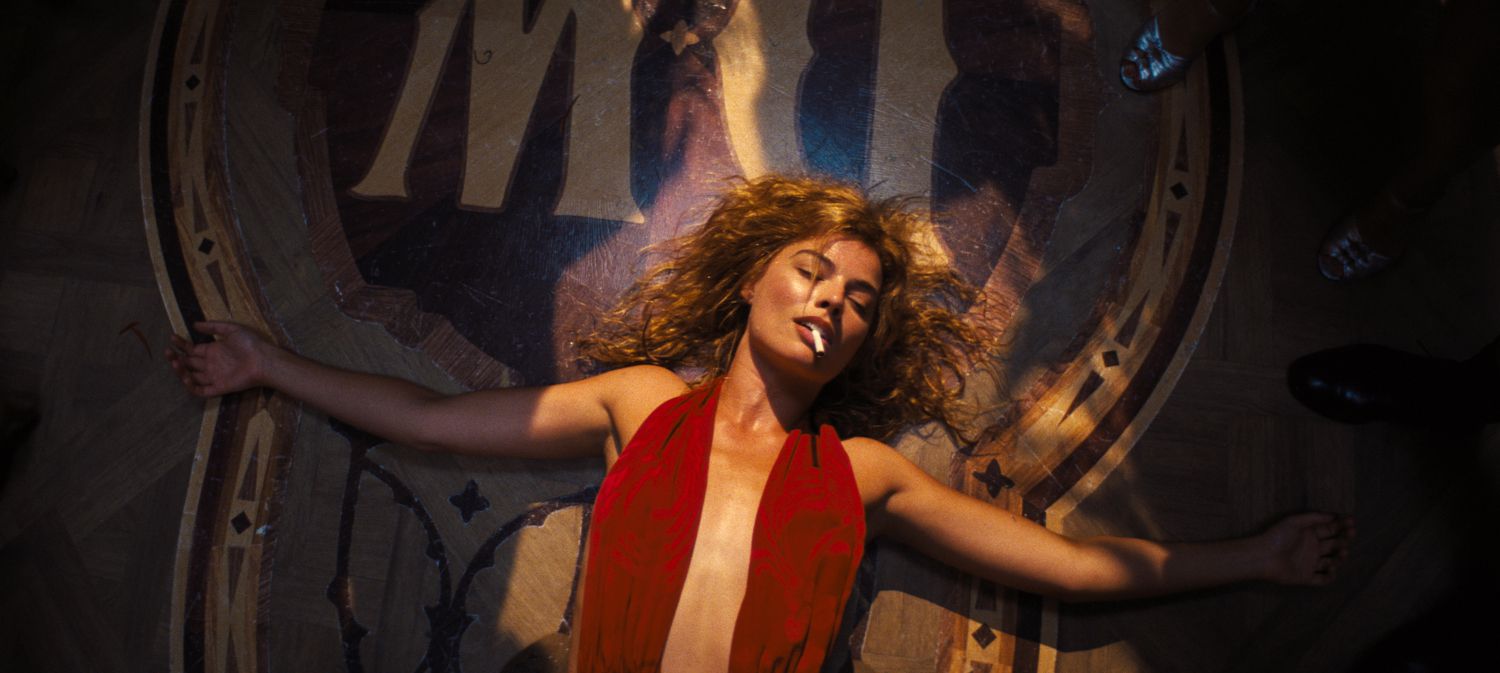
There’s been a lot of self-indulgent film projects this year – “The Fabelmans,” “Amsterdam,” “Bardo,” “Avatar: The Way of Water” and “Top Gun: Maverick” to name a few – and just in time for Christmas, here comes the cherry on top: “Babylon,” from director Damien Chazelle, who with this what-did-I-just-see spectacle of seems hellbent on topping that awe-invoking opening scene in “La La Land” (2016) by any means possible. The film, something of a love letter to the silent-to-talkie crossover era in Hollywood, begins with a torrid gush of a pachyderm’s fecal matter on the head of a some poor Hollywood underling, then ups the stakes with a raucous flapper rave turned pseudo-orgy, replete with a midget riding a giant penis pogo stick that ejaculates. No, I am not making this shit up.

Once there’s a moment to catch your breath and the gonzo, hyperkinetic hedonism comes to a post-coital rest, the film trains its lens casually on a trio right out of central casting: Brad Pitt (“Fury,” “Inglorious Basterds”) as the movie star Jack Conrad, a blend of Fairbanks and Clark Gable; Margot Robbie (“The Suicide Squad,” “The Wolf of Wall Street”) as the Clara Bow-esque modeled Nellie LaRoy, who gets her big break taking center stage at the aforementioned bash; and Diego Calva in a breakthrough turn as Manny Torres, a studio errand boy and fixer (he’s the one who fetched the elephant, but not the one showered by it) who rises in the Hollywood ranks through his happenstance relationship with Jack.

The cast is more than game, the production values are through the roof – every shot screams opulent cinematic artistry – but something’s amiss in all the mayhem and madness. Tarantino’s “Once Upon a Time … in Hollywood,” which also starred Pitt and Robbie (this their third teaming, “The Big Short” being their first), was also steeped in a Tinseltown transition (Golden/TV era to New Hollywood), but that film had soul and flawed characters up against time and imbued with genuine vulnerability. Here Jack and Nellie party 24/7 and never have a hair our of place when on set. Also too, they’re not that interesting, they get their moments at the top and sulk once the sun sets on them.

The film spans a 26-year period, with Manny’s ascent becoming the heart of the film. It’s easy to root for Manny even as he becomes involved with Nellie and shackled by her overindulgences in gambling and cocaine. From there the film goes to some very dark places – I’ll just say that there’s a subterranean party with S&M, a strongman geek and a crocodile that makes that first fete feel tame. In the vast cast there’s a lot of zesty personas hanging on the fringe: Tobey Maguire as a red-eyed fop who runs the numbers game, Eric Roberts as Nellie’s opportunistic father, Red Hot Chili Peppers bassist Flea as a buttoned-up studio exec, director Spike Jonze as a maverick director in the vein of Eric von Stroheim and Li Jun Li, who steals every scene she’s in as the commanding chanteuse Lady Fay Zhu. The rest of the vast cast includes Any Warhol regular Joe Dallesandro, Jonah Hill, Olivia Wilde as one of Jack’s exes, Max Minghella as the real-life Irving Thalberg (the blend of real and fictionalized is curious) and Jovan Adepo as a Black band leader whose narrative thread weaves throughout but never carries much heft. Themes of race, here and with Manny, are largely left unexplored.

And about the title: I’m not that up on my Bible, but clearly the film takes its name from the city that in Biblical lore was the locale for the erection of the tower to reach God that resulted in our vast array of world languages. Later, its licentious activity was the target of God’s ire, as Sodom and Gomorrah were. The metaphor perhaps being that the talkies and the formal studio system were the cleansing of the silent era’s excess? The one going to indulgent extremes, however, is Chazelle. “Babylon” is a clear passion project and it shows. It rivets and dazzles, but forgettably so. 

The Whale

21 Dec

Isolated and literally heartbroken, Fraser’s character carries weight of stagey drama

By Tom Meek, Tuesday, December 20, 2022

Director Darren Aronofsky, a decidedly deft cinematic craftsman, has taken some deep dives into personal torment: “Requiem for a Dream” (2000), “Black Swan” (2010) and “The Wrestler” (2008), to name a few. Here he’s back digging into that all-consuming inner turmoil, but his visual verve – the thing that brings that internalized struggle to the viewer – is missing, emasculated and eradicated by the narrative’s format. Based on Samuel D. Hunter’s 2013 play about a 600-pound recluse struggling with his place in the universe, “The Whale,” as adapted by Hunter and framed by Aronofsky, feels pretty much like a play with the camera perched on the edge of our protagonist’s living room, where nearly all the action takes place. That makes some sense, since Charlie (Brendan Fraser) can’t really get off the couch without the aid of a walker, cane or other hoists.

It’s a game go by Fraser, who put on weight for the part (with the final 300 pounds coming from the obvious use of prosthetics) and was last seen with ample heft as a baby-faced gangster in Steven Soderbergh’s “No Sudden Move” (2021). Much is asked of Fraser in “The Whale,” and he responds convincingly, conveying a troubled yet compassionate soul with more than his share of emotional vulnerability. Charles teaches an online writing class (never using his camera for the video sessions), pushing students writing essays to really dig down and say something from within, not just check the boxes of an assignment. Visiting Charles frequently are his estranged daughter (Sadie Sink, enjoyably nasty, if only two-dimensionally so), his nurse (Hong Chau, last seen being far less compassionate in “The Menu”) and a young religious missionary seeking a soul to redeem (Ty Simpkins). Along the way we learn the reason for his daughter’s vindictive state: Charles abandoned the family for another man, and because that didn’t go so well (the details are never fully explained), Charles fell into a deep depression, with food as his only solace. We’re also told by his nurse that Charles’ blood pressure is through the roof and that he’s suffering mini heart attacks at regular intervals but won’t go to the hospital – another nagging snag to the plot.

The title of the film (in theory) is not a reflection of Charlie’s appearance, but a reference to a cherished essay about “Moby Dick.” This dicey fine line has sparked some backlash, and perhaps deservedly so, if not for the title then perhaps for scenes of consumption as Charles folds a whole pepperoni pizza in half and snarfs it down in fast, carnivorous chomps, or his nurse enabling him by bringing him meatball subs that he eats off the crest of his chest. The scenes are nearly as look-away worthy as those in “Bones and All.” Still, there’s palpable love for Charles and his quest for redemption, and all the threads do converge emotionally in the end, even though it feels somewhat manufactured. And that’s another changeup from Aronofsky – clean clarity, not provocative chaos (as in his 2017 film “Mother!”). The bland, matted cinematography takes some zip off, but Fraser, clearly committed, carries much, and the supporting cast do their part.

Avatar: The Way of Water

17 Dec

After thirteen years, James Cameron gets back in the swim of things

By Tom Meek, Thursday, December 15, 2022

Much was made of James Cameron’s 2009 passion project “Avatar,” a $240 million cinematic (or is that computer?) revolution that mixed live-action humans with 10-foot, blue-skinned humanoids called the Na’vi, an indigenous race on the distant planet of Pandora (don’t open that box!). It was a grand, opulent immersion that scored nine Oscar nods, with wins for Visual Effects, Art Direction and Cinematography, and made nearly $3 billion worldwide, the most by a movie, ever! It was also a fairly flat revisionist fable: White man who is part of the invading forces switches sides, embeds with the technologically inferior natives and leads them to a victory that otherwise could not be achieved – “Dances with Wolves” (1990) circa 2150.

The militarized mining force that devastated Pandora’s ecosystem in that first “Avatar” chapter went by the moniker of the Resources Development Authority, a corporate, colonizing NGO bristling with annexation ’roid rage. The “oorah” mentality fueled and led by Col. Quaritch (Stephen Lang) felt right out of central casting, Snidely Whiplash simplistic without a nod or wink. In the new “Avatar: The Way of Water,” that limited two-dimensionality – and Quaritch – are back, and ready to rumble. What’s at stake this time? Pretty much the same as the last time: the ways and existence of indigenous folk and a delicate ecosystem with which they share a sustainable, symbiotic relationship. The big changeup in “Way of Water” is the milieu for the showdown and the resource the colonizing forces covet; instead of “unobtainium” and the planetary neural net that the Na’vi can plug into via their USB-enabled hair cord, it’s the water-world side of Pandora and the juice from a whalelike creature’s brain that can ease aging in humans.

Jake Sully (Sam Worthington), one of Quaritch’s grunts who last time around earned his pay by having his consciousness transferred into a Na’vi body to act as an RDA envoy, is back to lead the water Na’vi against Quaritch’s Sky People (any affiliation to Skynet?), named so because of their flying and now wave-riding war machines. Jake and Quaritch (seen shot full of arrows last time, now in Na’vi form too) don’t need liquid-filled tanks to lie in for the avatar process; they’re full-on Na’vi, and Jake’s married (funny how earthly traditions span galaxies) to love interest Neytiri (Zoe Saldaña), who taught him the ways of the Na’vi and Pandora. Between the two films, they bore a small brood. Also in the mix as young Na’vis are veteran actors Kate Winslet and Sigourney Weaver, who have worked with Cameron in the past – Winslet on that other water adventure (“Titanic”) and Weaver on “Avatar” and “Aliens” (1986). There’s even a Tarzan-clad human named Spider (Jack Champion) running around with the Na’vi teens.

Visually, the film is stunning, more so than the last, though you can’t escape the fact that it still looks like a video game running on the greatest graphics card of all time. I saw it in 3D Imax and suggest any fan champing at the bit do the same – it’s worth your greenback. The film cost nearly $340 million to make, and for about every $2 million you get one minute of Cameron’s obsession.

Keeping in mind that it took 13 years between the original and “Way of Water,” there are another three “Avatar” sequels on the slate. The sad thing is that the series has already begun to feel a bit like Peter Jackson’s “Hobbit” films: indulgent and long, with flabby, uninspired – recycled is more like it – dialogue. It’s too bad, too, because Cameron has taken concepts such as “Terminator” (1984) and Ridley Scott’s “Alien” (1979) and shepherded those concepts in fresh, new ways.

I did sit through the whole three-plus hours fully engaged, marveling at the effects and the imaginative designs, but when I walked out I felt Camron had just told me the exact same story, and all he did was just add water.

Film Clips

5 Dec

‘The Inspection’

Elegance Bratton’s autobiographical account is about Ellis, a gay Black man (Jeremy Pope) joining the Marines because his mother (Gabrielle Union) kicks him out and, as a homeless Black man, he decides his time on the street is something of a death sentence. Pope’s Ellis tells us he’s going to make his life mean something, but this is during the don’t-ask, don’t-tell era, when a whiff of “gay” would mean being hazed in brutal ways you’ve seen in other boot camp dramas such as “Full Metal Jacket” (1987) and “A few Good Men” (1992). “The Inspection” is not on par with those films in terms of production and scope, but it is deeply personal and moving. Pope does so much behind the eyes to convey the pain of enduring cruelty and repressing his identity during a hateful time, and Bokeem Woodbine sparks fire as an unrelenting drill sergeant, propelling the film the way R. Lee Ermey and Louis Gossett Jr. did in “Metal Jacket” and “An Officer and a Gentleman” (1982) respectively.

‘The Fabelmans’

Steven Spielberg’s nostalgic and self-indulgent semi-autobiographical tale – a theme this week – frames a young filmmaker coming of age during the end of the Great Age of Hollywood in an America rife with antisemitism. We begin with a young Sammy Fabelman (Mateo Zoryan, replaced as the character ages by Gabriel LaBelle, of the “American Gigolo” television series) reluctantly taken to his first film by doting parents (Paul Dano and Michelle Williams). The film, “The Greatest Show on Earth” (1952), and the experience spark an awakening as Sammy becomes obsessed with the film and recreating the train crash scene with miniatures, concocting something of a home movie studio. Then, because dad lands a dream job with IBM in California, the Fabelman clan relocates to the cauldron of cinematic wonders; Sammy, surrounded by blond Adonises, is bullied regularly for being Jewish, but instead of folding Sammy takes up a camera. The results, often shared with the community, is more a uniting salve than a harsh light on inequities and othering. It’s an odyssey of self-definition and embracing one’s inner passion that moves poetically in chapterlike strokes and gives insight into one of the most creative cinematic minds of our generation, a jagged, bittersweet sojourn that made Spielberg the visual fable spinner he is. The solid ensemble includes a gruff Judd Hirsch and Seth Rogen as extended Fabelman kin and a quirky, deft cameo choice as the aged John Ford (not to be named, as it’s a ticklish surprise that should not be ruined, but I will say the person is named elsewhere in this column). It may be the most inspired casting of the year.

Film Clips

29 Nov

‘Strange World’ (2022)

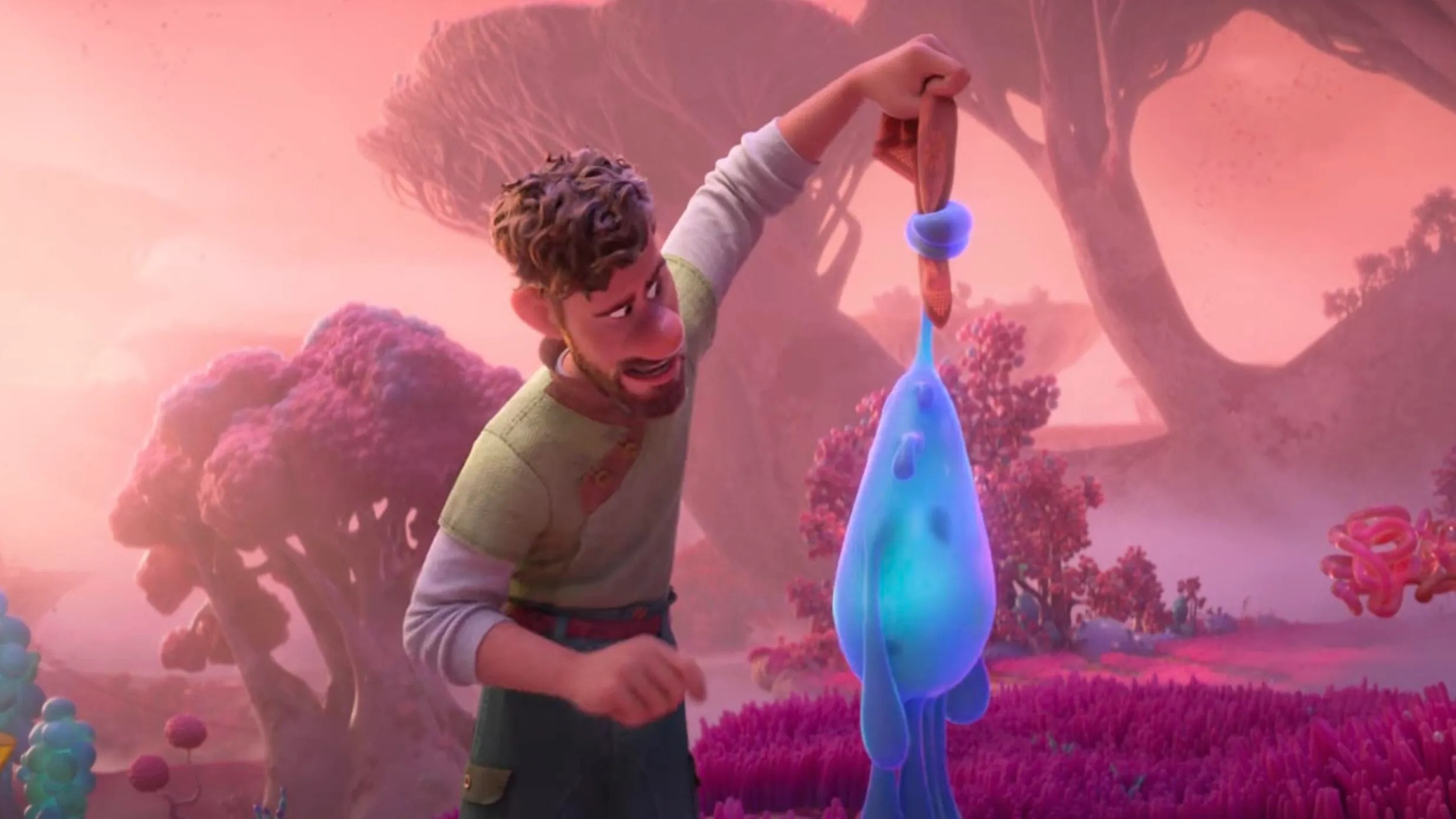
Props to Disney for stepping it up and putting a mainstream face on inclusion. In this animated adventure into the unknown, not only is the family at the center interracial, but the teen son Ethan (Jaboukie Young-White) is gay. On the planet of Avalonia, the Clades are famous: Grandpa Jaeger (Dennis Quaid) is a legendary explorer with a statue in the village square – he’s also been missing for 25 years – and pop Searcher (Jake Gyllenhaal) has his own monument for discovering and harnessing a plant called pando that provides sustenance and a source of power for airships – think “Avatar” (2009). The pando supply is dying, which has something to do with a big hole that just opened up in the mountain, so Searcher reluctantly joins a military detachment to explore the phenom and hopefully save the planet. Ethan, who can’t land his crush and is bored working on the family pando farm, wants to get out and be like grandpa; even though told not to go, Ethan ends up in the mix, as does mom (Gabrielle Union), an ace pilot, and the family’s three-legged dog. In the hands of veteran animators Don Hall and Qui Nguyen, who collaborated on “Raya and the Last Dragon” (2021), “Strange World” channels such classic adventure fare as “Journey to the Center of the Earth” (1959) and “Fantastic Voyage” (1966). It checks all the Disney boxes, though the degree of genuine conflict, even across the generations, feels a bit subdued despite the envelop being pushed.

‘She Said’ (2022)

In a just twist, disgraced multiple-Oscar-winning producer Harvey Weinstein becomes the central subject of a dramatization about two New York Times reporters who investigated his sexual misconduct and helped ignite the #MeToo movement. We meet can-do Megan Twohey (Carey Mulligan) reporting on allegations that Donald Trump assaulted multiple women (that “grab ’em” tape with Billy Bush was fresh at the time), which gets no traction; later she teams with Jodi Kantor (Zoe Kazan) to dig into Rose McGowan’s cataclysmic accusations against Weinstein. Both are mothers with young daughters and feel the urgency to break the story; there’s also pressure from Rowan Farrow poking around over at The New Yorker. The paper chase for the truth comes mostly down to getting victims to go on the record, and that proves challenging because of airtight settlement gag orders. Big-name stars wronged by Weinstein including McGowan (heard only by phone and voiced by Keilly McQuail) and Gwyneth Paltrow stay mostly out of frame, but Ashley Judd, playing herself, steps to the fore in more ways than one. Supporting players Patricia Clarkson and Andre Braugher as the dutiful Times editors overseeing the effort and Jennifer Ehle and Angela Yeoh as victims add to the rich ensemble. Like Kitty Green’s astute 2020 fictional take on the evils of all things Weinstein, “The Assistant,” Harvey also remains mostly off-screen – you never see his face – but is often heard and always felt as a bellowing bull through the phone, bullying, berating and denying. Director Maria Schrader and writer Rebecca Lenkiewicz make sure the focus is on the victims who were silenced by an omnipotent megalomaniac who commanded a squad of legal wranglers to cover his crimes. They now get to have their harrowing ordeals heard.

Bones and All

26 Nov

Searching for where she belongs consumes this cannibal teen

By Tom Meek Friday, November 25, 2022

Not really the kind of movie to see after a Thanksgiving Day feast, or even after the leftovers. No, “Bones and All,” the latest from director Luca Guadagnino (“Suspiria,” “A Bigger Splash”) is not for the meek, squeamish or recently well fed, as its subject matter are the folk known as “eaters,” aka cannibals, and it is, at times, quite gory. (There’s a degree of perversity at play here, as Guadagnino’s career-cementing “Call Me by Your Name” in 2017 starred Armie Hammer, who in the years following would be brought up on sexual abuse allegations that included purported cannibalistic yens.)

Based on the novel by Camille DeAngelis, the film begins innocently enough with 18-year-old Maren (Taylor Russell) hanging out with friend as a slumber party. It’s all what normal girls in nightgowns eating junk food and talking about crushes do, until Maren playful nips one of her cohort’s fingers. It’s no big thing until the third or forth nip, when she tries to bite the whole thing off. Friends intercede and Maren sprints off home, where she and her father (André Holland) pack up and depart to a new whereabouts with new aliases. Dad seems to be a champion of his daughter, but shortly thereafter, Maren is on her own with a tape from her father that she plays now and then, through which we learn about her past misdeeds (babysitters fare poorly in the film). Troubled by her condition, which appears to be genetic, Maren decides to find her mother, whom she never really knew. The quest takes her from northern Maryland to Minnesota, with a lot of lessons and feasting along the way.

The setting is the early 1980s, when it was impossible to find a flesh-eaters chat group online – but that’s okay, because these special folk can smell each other. As Maren waits for a bus along the way, a daffy, dapper guy named Sully (Mark Rylance, creepy in a limited role) strolls up and, in an avuncular, Southern twang, tells her he could smell her a mile away and asks her to a house down the way for a bite. Maren naturally is reluctant, and she’s apprehensive as Sully chats away while dressing Cornish game hens. Is this the nourishment he was talking about? Nope. Turns out the house belongs to an elderly woman who’s fallen and can’t get up, and Sully’s waiting for the right moment to feed – just at the moment she dies, because warm food is what’s most desired by the cannibals among us. If the eaters could place an order via Grubhub, the delivery time would most certainly be too long.

Maren moves on from Sully and partners up with a rangy lad named Lee (Timothée Chalamet, who became an A-lister with Guadagnino’s “Call Me by Your Name”) whose methods are more straightforward and seem to benefit society at large – who’s going to miss a convenience story bully? On their meander to Minnesota they swing through Kentucky to give Lee’s 16-year-old sister driving lessons. It’s a strange sojourn, with the pair living on the fringe as vagabond outsiders. They bond, but not really romantically, and encounter other eaters along the way. As you can expect, Sully makes a return appearance, which unfortunately is one of the film’s least credible yarns.

Russell, so good in Trey Edward Shults’ “Waves” (2019) grows as as performer, conveying Maren’s inner turmoil with a nuanced physicality. Chalamet’s laconic Lee comes off as a vulnerable, reflective soul while emanating an aura of quiet lethality. The film is also bolstered by indelible turns by Chloë Sevigny, David Gordon Green (yup, the director of “Joe” and the recent, unbearable “Halloween” series reboot) and Michael Stuhlbarg in small parts, but to say more about the what and why would be to ruin the film.

I can say that there will be times when the eaters feed that you may need to look away or thorough split fingers – and even then will hear the ripping and groans of satiation. It’s not cartoonish like some zombie flicks, but visceral, grim and disturbingly real, like Claire Denis’ “Trouble Every Day” (2001) and Julia Ducournau’s “Raw” (2016). “Bones and All” is definitely not a movie for a family, but it about family, roots and tradition, no matter how troubling that tradition may be.

Film Clips

23 Nov

‘Glass Onion: A Knives Out Mystery’ (2022)

A somewhat cheeky follow-up to “Knives Out,” a 2019 whodunit (shot in and around Boston) that was rightly likened to the 1970s classic “Murder by Death.” So cheeky, yes, but not on par. Ex-Bond boy Daniel Craig is back as the Clouseau-daffy detective Benoit Blanc, who scores an invitation to a remote Greek Island owned by an Musk-esque billionaire (Edward Norton) to take part in a weekend-long murder-mystery party. Blanc is on point and solves the charade murder in 20 seconds, much to the island owner’s chagrin – but there’s a real murder when one guest guzzles poisoned whiskey. Among the suspects/guests there’s a fetching young woman aptly named Whiskey (Madelyn Cline), Dave Bautista as a gun-waving male-dom influencer, Kate Hudson as the washed-up supermodel unaware of what a sweatshop is, and Leslie Odom Jr. and Jessica Henwick, mostly wasted in roles that feel pushed to the periphery. The last outing made Craig’s Blanc the centerpiece; here director Rian Johnson splits time between Blanc and a woman of mystery played by Janelle Monáe, and it’s just not as sharp as its predecessor, though the cameos by Hugh Grant, Ethan Hawke and Serena Williams are spikes of punchy good fun. Here’s another clue: The walrus was Paul.

‘Guillermo del Toro’s Pinocchio’ (2022)

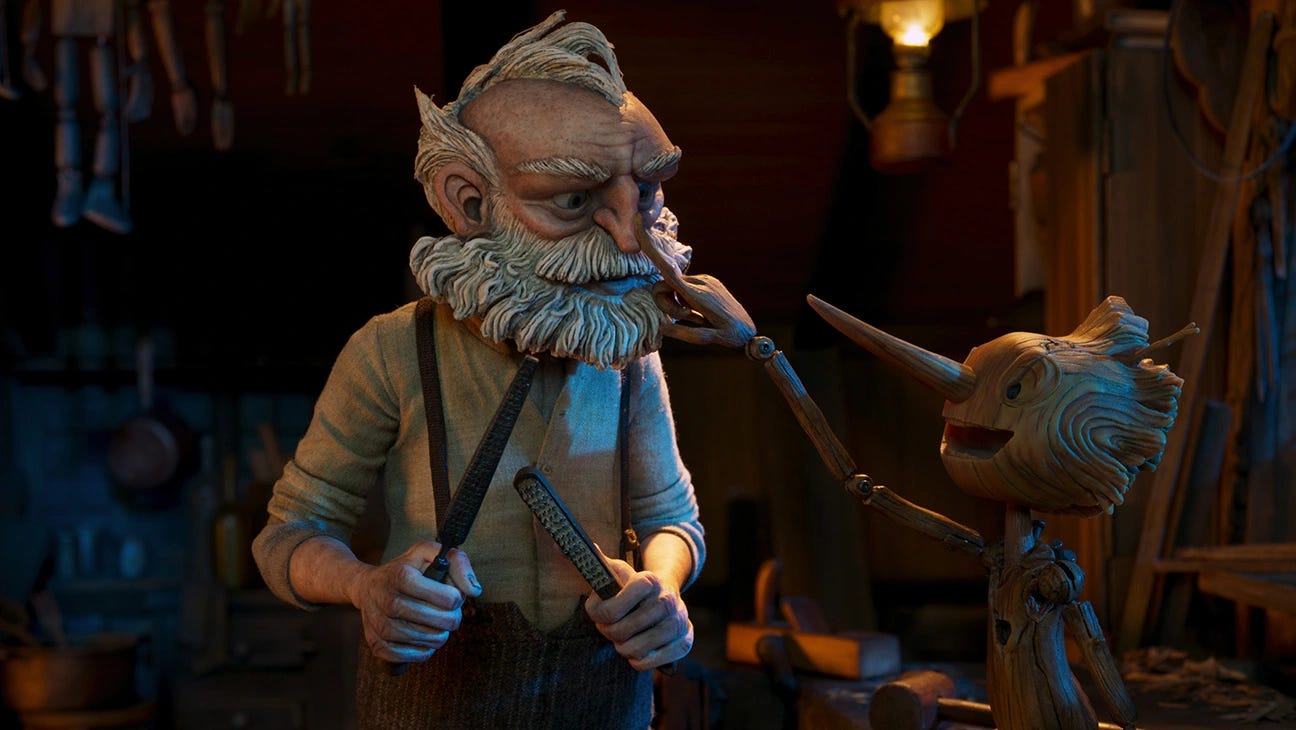
This year we saw Robert Zemeckis’ live-action take on Pinocchio with Tom Hanks as the avuncular Geppetto. That Disney reboot of the 1940 animated classic was a bit wooden and too by the numbers; here del Toro (“Pan’s Labyrinth,” “The Shape of Water,” “Nightmare Alley”) mixes it up. This takes place in World War II Italy with Mussolini as a puppet fan who actually abhor’s Pinocchio’s propaganda puppet show turned into a scat fest. Yup, it’s that much of a change-up. It’s the war that takes Geppetto’s boy from him, and a woodland spirit that imbues a wooden puppet with a child’s spirit. Del Toro’s animated imagining of Pinocchio (voiced by Gregory Mann) is inspired – he’s more the raw wood incarnation than the Disney versions. (The name in Italian roughly means “pine eye.”) The vast voice talents on del Toro’s version include Cate Blanchett as a sphinx-like creature named Spazzatura (“garbage” in Italian), David Bradley as Geppetto, Ewan McGregor in full-on Scottish Brogue as Sebastian J. Cricket and Finn Wolfhard and del Toro regular Ron Perlman as the bad actors trying to ply and exploit the wooden boy. At one point an agent of Mussolini even debates weaponizing Pinocchio. As gonzo as that may sound, the narrative ultimately falls into line. The new ripples are interesting, and there’s more life in this one that in Zemeckis’, but I still want to know how the grandfatherly Geppetto sired a child at such an advanced age.

RRR (2022)

S.S. Rajamouli’s three-hour-plus epic is a bold, outrageous spectacle, peppered with thrills, jaw-dropping stunt work, breakouts into Bollywood dance and a poke in the Western eye about the evils of colonialism. The Indian production takes place in the 1920s, when the country was under British rule. Our bigger-than-life heroes come in the form of Raju (the highly charismatic Ram Charan Teja), an Indian soldier under British command, and Bheem (N.T. Rama Rao Jr.), a can-do villager and mechanic whose daughter has been abducted by the British governor (Ray Stevenson). The governor’s so hyperbolically nefarious they could have just called him Snidely Whiplash and been done with it, and his wife (Alison Doody) is nearly as nasty; at one point she supplies a torturer with a barbed whip. We meet each protagonist separately, each performing Herculean feats: Raju battling through a throng of hundreds, who hammer and pound him, to apprehend a suspect; Bheem outrunning a wolf and, bare-chested, shouting down a tiger. (The CGI is pretty low budget, but it hardly matters.) Later the two team up to save a boy above a flaming river, but even later in the epic run time find themselves at odds because of Raju’s allegiance and Bheem’s ceaseless quest to regain his daughter from Raju’s higher-up. “RRR” (for “Rise, Roar, Revolt”) is astonishingly energetic from start to finish, tongue-in-cheek craziness that sometimes strains but never breaks the wild turning and dropping ride.

The Menu

18 Nov

Chef has a taste for the wicked

Tom Meek, Thursday, November 17, 2022

Penning this feels somewhat ironic, in that I, a food reviewer and film editor, am about to slice into a film that’s all about haute cuisine and whose plot has at its heart heavy attachments to a heartless food critic. Like a reservation-only, time-slotted, prix fixe once-in-a-lifetime indulgence, “The Menu” is grand in presentation, titillating in its wafts of promise, but in consumption I’m not so sure the endive justifies the moussaka.

The casting and framing of “The Menu” is rich, flavorful and brilliant. The plot, however, is gruel-thin. It has a series of diners paying something like $1,250 a pop to take a boat to an isolated island where a renowned chef (Ralph Fiennes, perfect in the large yet limited role) in an Ikea-spartan chalet with open-window views of the sea (where much of what is eaten is harvested) will serve a multicourse gourmet meal with a crew that’s all in on the chef’s vision, no matter what or how bloody that is. The distinguished guests are not all that distinguished – spoiled and rich, sure (not limited to old white folk, but they’re clearly in the mix), but flops in personality and levity. The ones that stand out are a last-minute date of a regular and one Fiennes’ chef Slowik did not anticipate as a diner (Anya Taylor-Joy, commanding in the part and pretty much carries the film), and the food critic (the great Janet McTeer) who “discovered”  Slowik. The assemblage has something of a “Murder by Death” (1976) sheen to it, but as courses come out and the texture of the film and the meat served becomes darker, it crosses over into “Saw” territory. To say more would be to take a big spoonful of creamy custard flan before dropping it at your table, licked spoon and all.

“The Menu” is a high-concept selection from director Mark Mylod (“Game of Thrones,” “Succession”) that while big-screen in production values and star power, is small-box in plot and composition. Other recent near misses “Amsterdam” and “Glass Onion” fill the same bill; “Menu” feels like an episode of “White Lotus” stretched into a feature film, and because of that format, as enjoyable as it is, it’s a garnish without a meal to go on.

Bardo: False Chronicle of a Handful of Truth

13 Nov

Aa jolting path through a liminal space

By Tom Meek, Friday, November 11, 2022

Bardo: False Chronicle of a Handful of Truths (2022). Daniel Giménez Cacho as Silverio. Cr. Limbo Films, S. De R.L. de C.V. Courtesy of Netflix

Alejandro G. Iñárritu’s last two films, “Birdman or (The Unexpected Virtue of Ignorance)” (2014) and “The Revenant” (2015) hung in that thin, ephemeral space between life and death. That earlier effort had a former action film star (Michael Keaton) trying to reinvent himself as a stage actor while falling into bouts of suicidal depression and delusion; the latter had a New World trapper (Leonardo DiCaprio) mauled by a bear, unable to walk, left to die in the frozen northern plains and hunted by vengeful Native Americans protecting their land and some of his own looking to peddle flesh for profit. Iñárritu’s latest, “Bardo: False Chronicle of a Handful of Truth,” comes replete with a paradoxical subtext to the title and unfurls something of a long, limbo-esque dream that haunts and horrifies as much as it hypnotizes.

In Buddhism, “bardo” is the intermediate or transitional state between death and rebirth. Author George Saunders played deftly with the concept in his novel “Lincoln in the Bardo,” while here Iñárritu, making his the first film back in Mexico in nearly 20 years, leverages it to blur the lines between being and not being. The sense of rooting is never firm, and that’s one of the many pleasures of this handsomely composed vision filled with autobiographical references and meta contemplations.

We center on the life (or death) of Silverio (Daniel Giménez Cacho), a Mexican journalist turned documentary filmmaker with family homes in L.A. and Mexico City. As we catch up with Silverio, he’s up for an award in L.A., but first must make a sojourn south of the border. Along the way we get a sense of grief from Silverio and his wife Lucía (Griselda Siciliani, scene-stealing without stealing the scene) regarding the loss of a child. The pain is still there, and palpably so, though they do have two grown children: Lorenzo (Íker Sánchez Solano) and Camila (Ximena Lamadrid).

One of the first rips in the fabric separating realms comes during a talk show interview, when the host (Francisco Rubio), something of a frenemy from Silverio’s past, hangs Silverio out to dry before a live audience, questioning his integrity and the quality of his work. The audience laughs and the host mockingly cuts deeper, but Silverio just sits there, mute, seemingly unable to respond. It’s like a dream in which you just keep falling with no end in sight. Later, during a graphic act of passion, a small child makes an entrance that’s beyond coitus interruptus, and it’s there that you know you are no longer on the corporeal plane. 

The elegiac sojourn, shot with a slightly distorted wide-angle lens by Darius Khondji (“Se7en,” “Delicatessen,” “Midnight in Paris”) to enhance the sensory-warping aura, plays with themes of colonialism, identity and lived-in authenticity. In some scenes there’s reenactors re-creating the Spanish conquest and Mexican-American War; in others, some of those Mexican liberating forces, in full regalia, simply enter the modern-day drama as if part of the everyday. The disorienting camera effect and absurdist blending feel somewhat Fellini-esque or Kubrick-esque, or more to the point, like the two great visionaries feuding on a remake of Alejandro Jodorowsky’s “El Topo” (1970). Back to those themes, in one early interview Silverio is pushed on his indigenous roots; later, at an LAX checkpoint, he’s detained and questioned by a TSA agent of Mexican origin who harshly refutes Silverio’s claim that L.A. is his “home.” A firestorm erupts between Silverio’s family and the agent, with the agent’s higher-up trying to hold the peace until the Mexican militia charge in.

If there’s a downside to “Bardo” one might cite its overindulgence, but it’s also a deeply personal essay in which the auteur wrestles with his legacy and mortality – would one ever critique a eulogy for a lost parent, spouse or child?

As much as Iñárritu’s meticulous craftsmanship shapes “Bardo,” it doesn’t work without Cacho (“Zama,” “Cronos”) as the director’s committed stand-in. There’s a great weariness to his Silverio, like he needs to atone for something but is unsure of what, and intermittent bouts of bewilderment and bursts of steely resolve. It makes for a full-circle portrait of highs and lows, travails and challenges – some earned, some not – where in between a creator can have a one-on-one with Cortez and huddle on a subway car with an aquarium bag full of axolotls.

The Banshees of Inisherin

29 Oct

Going to extremes to remove the banal, one Irish finger at a time

By Tom Meek Friday, October 28, 2022

What would happen if the principals in Samuel Beckett’s existential “Waiting for Godot” took their uneasy alliance to a grim frenemy high? That’s about what “The Banshees of Inisherin” amounts to, written and directed by Martin McDonagh, who cut his teeth as a playwright (“The Pillowman,” “The Cripple of Inishmaan”), and whose features “In Bruges” (2008), “Seven Psychopaths” (2012) and “Three Billboards Outside Ebbing, Missouri” (2017) have a very much play-to-the-screen feel to them. “Inisherin” included, they’re dialogue and character driven. If you’ve seen a McDonagh effort and walked away wondering what characters’ motivations were, you were clearly napping.

“Inisherin” returns Brendan Gleeson and Colin Farrell from “In Bruges.” In that film they played two assassins wrestling with life choices; here they play Colm and Pádraic, respectively, gents on a small Irish island where there’s nary a tree but plenty of cliffs and stone-enclosed fields. It’s also 100 years ago, with the Irish Civil War near its apex; we see explosions on the mainland a mile or so away and hear occasional gunfire, but life is fairly isolated from the bigger goings-on. Colm and Pádraic meet each day at 2 p.m. for a pint at the local (and only) pub until one day Colm tells Pádraic he no longer wants to be friends, calling him a dull man who jabbers away about his donkey’s poop or dairy cows’ moods. Siobhan (Kerry Condon, so good in “Better Call Saul” and owning her scenes here), Pádraic’s sister, confirms as much, but is sympathetic to her siblings dismay. Each day the crestfallen Pádraic approaches Colm in the pub, until one day Colm says that if Pádraic doesn’t back off, he’ll cut off one finger from his hand for every infraction. It’s a threat taken seriously by all, as Colm is the pub’s fiddle master, and part of his reason for parting with Pádraic is to spend the remainder of his life doing something more significant – composing the ballad of the film’s title.

Things escalate in small strokes that, as you can expect, are bloody and overreactive, though not to the degree of “In Bruges.” At the heart of the film is the search or want for meaning and art and how one’s legacy is remembered, or not. The film’s gorgeously shot by Ben Davis, who’s worked with McDonagh before (“Psychopaths” and “Billboards”) and done a handful of Marvel entries (“Eternals,” “Guardians of the Galaxy” and “Captain Marvel” among ’em), now with almost a doleful lens emblematic of life on the emotionally barren isle. Some comic relief comes in the Sunday arrivals via boat of a priest (David Pearse) who looks hauntingly like Peter Lorre in “M” (1931) in the confessional booth and drops F-bombs when incensed. Adding to the unhappy olio is Barry Keoghan (“The Green Knight,” “The Killing of a Sacred Deer”) as a strange, simple young man interested in Siobhan and Gray Lydon as his abusive father and town constable, who wields his power inappropriately and has it in for Pádraic for sheltering his son.

There’s a grim, gray pale that hangs over “The Banshees of Inisherin,” one that doesn’t have to be there. The characters make fateful choices for seemingly trite reasons. The main reason to see “Inisherin,” besides Davis’ brilliant work, is Gleeson and Farrell. The latter imbues his character with a gruff, steely resolve that clearly says “don’t tinker with”; the former has to evoke baffled curiousness, a shaggy-dog need for affection even after being kicked, and emotional longing. These are great performance that rise above the film’s material and lift the film to the heights of Davis’ lofty lens looking down on an island of lonely people.