A high seas adventure that broke the glass ceiling
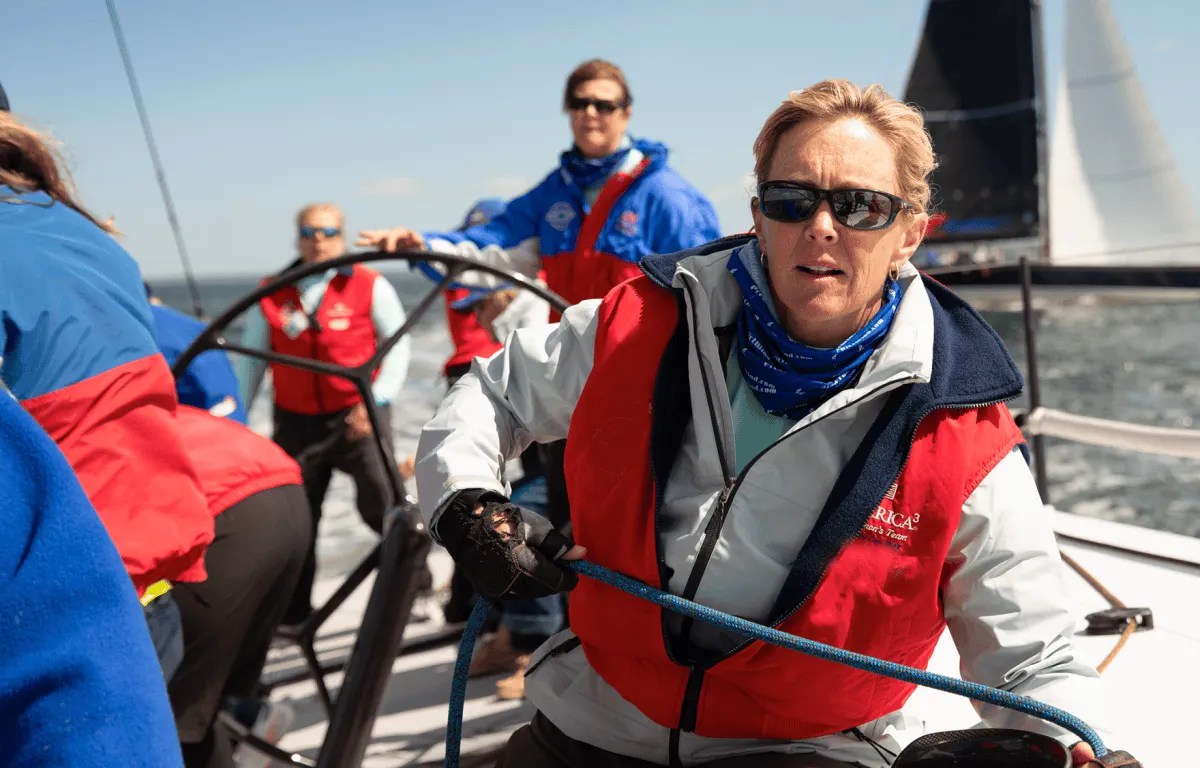
Most of the action in “Mighty Mary,” the new documentary about the first all-woman yachting team to vie for the America’s Cup in 1995, takes place in San Diego, where the women train and race. But the film also has plenty of Cambridge connections. Director and former Olympic rower Mary Mazzio lived in Cambridge in the early 1990s and trained at the Weld Boathouse on the Charles River. So did two of the Mighty Mary crew, 1992 Olympic teammates of Mazzio: Amy Baltzell and Marci Porter Lucier.
“There used to be a national-team training center run out of Weld Boathouse,” Mazzio said in an interview with Cambridge Day. “All of us came from that — birthed, if you will, by Cambridge. Love that dirty water.”
Mazzio, a filmmaker-in-residence at Babson College, was drawn to the story of the all-women’s crew as they trained for the competition to represent the U.S. in the race. “I remember following the story and thinking, ‘Oh my God, how are they going to achieve this?’” Mazzio said. “It seemed daunting, almost a fool’s errand. Then I thought, ‘I know these women. If anybody can do it, it’s them.’”
The story behind the story was that Bill Koch — who had won the 1992 America’s Cup with a nearly all-male crew — wanted to push boundaries with an all-woman crew. Koch believed that with advanced technology and tactical skills, winning the race was no longer just about sheer strength and endurance.
It didn’t hurt that Koch had a Ph.D. from MIT in engineering and was proficient in fluid design. He also had deep reserves — yes, he’s one of the billionaire Koch brothers — to finance the new boat’s design and the team’s assembly. His captain was Dawn Riley, a seasoned sailor and a crewmate of Koch’s from the ‘92 campaign. Koch, however, decided to have no skipper aboard the new America3 and to have the ship sail under a collaborative cooperative — though the management team was mostly white men. The informal rebranding of the boat as the Mighty Mary was a nod to Koch’s mother, who had passed away a few years earlier.
For the documentary, Mazzio got access to Koch’s archives and all footage held by the America’s Cup Partnership — mostly shot by marine cinematographer Phil Uhl, whom Mazzio praises for his meticulous cataloging that saved her time in assembling clips.
The film documents the creation of the team — Koch conceived the idea with roughly a one-year runway to get the boat and team ready — beginning with a cold call for crew members. The winners included former Olympians; a ripped former “American Gladiator” who looks like she stepped right out of the Marvel Universe; and a professional bodybuilder.
Given the boys’-club nature of America’s Cup — more accurately, the billion-boys club; the first races pitted Lord Lipton, the tea guy, against Vanderbilts and J.P. Morgan — sexism was rampant. But the film dials that down to focus on what the women accomplished. Many of the men from the Dennis Connor-led Stars and Stripes (one of the two boats the Mighty Mary was competing against to represent America in the race), who had won three prior America’s Cups in the 1980s, freely admit they were initially dismissive of the all-women’s team but ultimately were awed by the Mighty Mary and her crew.
Mazzio revels in a quote from Stars and Stripes crew member Paul Cayard. “For him to say, ‘We need to move away from what our fathers taught us and lean into what our sons are learning’ — I get chills from that.”
Mazzio wants to train her lens on matters that “can really inspire and motivate people to action — that’s what excites me.” Her initial film, “A Hero for Daisy” (1999), named after her then-infant daughter — now an Olympic rower herself — detailed Olympian Chris Ernst’s fight for equal athletic facilities for women. “I wanted to make something for her, and other people’s daughters, that said ‘you can go out and get ugly and explore your limitations.’” Her 2020 documentary “A Most Beautiful Thing” chronicles the first all-black crew team in the county, made up of gang members from Chicago’s tough West Side. The film poetically and powerfully reunites that 1990s crew team with the police officers who arrested them for a unifying scull race as the Black Lives Matter Movement was cresting.
For “Mighty Mary,” many crew members of the Stars and Stripes and America3 teams gathered for a ceremonial sail for the film. “I’ve got the Super 8 camera, and I’m hanging on for dear life,” said Mazzio, no stranger to the water. “Nobody told me that we were going to go up like 90 degrees. It was unbelievably hair-raising — and also exhilarating and terrifying at the same time.”
From her ‘92 Olympic adventure in Barcelona, Mazzio became friends with Dream Teamer Grant Hill, now a major backer of Mazzio’s films as a financier and producer. Mazzio also elicits A-list talent: Jessica Chastain narrated her 2017 film, “I am Jane Doe”; the artist Common narrated “A Most Beautiful Thing”; and Elizabeth Banks and Hugh Jackman provide the voiceovers for “Mighty Mary.”
Through her 50 Eggs Films production company, Mazzio has a distribution arrangement with AMC theaters to play her social impact films. “Mighty Mary” won’t be playing this side of the Charles, but it will play a short Red Line jaunt away at the AMC Boston Common.


Leave a comment