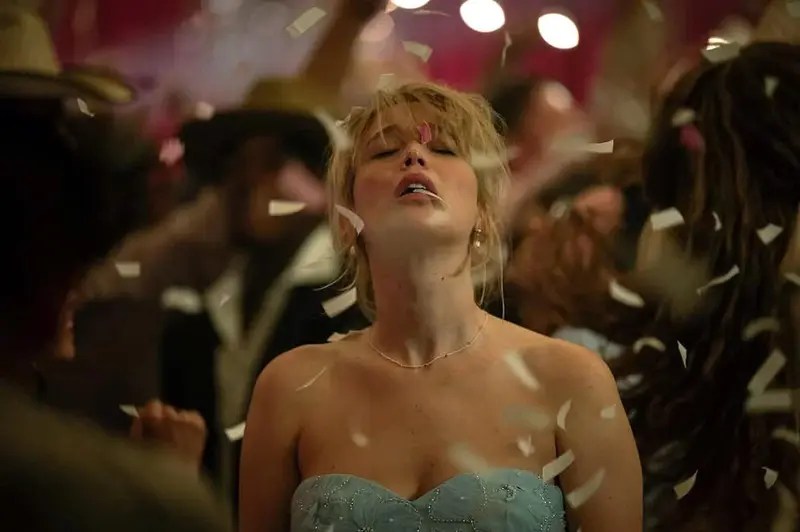
Lynne Ramsay, the Scottish filmmaker behind such macabre psychological chillers as “We Need to Talk About Kevin” (2011) and “You Were Never Really Here” (2017) – the former, about a youth who commits a mass school shooting, the latter with Joaquin Phoenix as a hammer-wielding sociopath-avenger – may be the most convincing female voice in matters of masculinity onscreen since Kathryn Bigelow (“The Hurt Locker,” “A House of Dynamite”). And the company in that elite club may just be a crew of two. Here, going to the more feminine side of things doesn’t make anything less messy, violent or bloody. In fact, it’s more unsettling. No human being dies of a violent act, though animals – a horse and a poorly adjusted dog – don’t fare as well. Jennifer Lawrence is Grace, who has a lot pushing and pulling in her head. She’s a writer who’s moved into the old Montana farmhouse of her partner Jackson (Robert Pattinson) with the intent of sinking into creativity and new motherhood. Neither really happens as Grace becomes less and less rooted in reality and waking delusions take hold. Is Jackson having an affair? Is the menacing presence on a motorcycle (LaKeith Stanfield) also Grace’s moonlight lover in the rickety old barn? Or is it all an illusion cast by an unreliable narrator dealing with postpartum delirium, or something more chronic? Ramsay, working from Ariana Harwicz’s 2013 novel, keeps us in the dreamy, demented dark – when Grace crashes through a sliding glass door, opens the car door to jump or bashes her head into a hotel suite mirror and Jackson underreacts, you don’t know if this is par for the course, the man has no idea what to do and is simply silent and agog, if it’s a disjointed distortion of reality or somewhere in between. There are clues, but teasingly few. Lawrence gives a bold, brave performance, emotionally exposed and often naked, oddly like an antithetical companion piece to her 2023 dark comedy, “No Hard Feelings.” In “Mother!” (2017) the madness around Lawrence’s bearer of life was external and a metaphor for the religious patriarchy; here it’s internal, and troubling to the forces who can’t get a handle on or squash it – a forced commitment in an asylum seems to fix things for a moment, but did it really happen? The tension over what is real is the film’s weakness and appeal, but not enough can be said about Lawrence: She switches on and off, or explodes, or recedes, with seamless perfection. It’s stunning. Ramsay and Lawrence are in tune at every turn and we are lucky to be here for their deftly deliberate dissonance.
Flipping the script, making heroes of villains from two sci-fi series
The latest entry in the “Predator” series isn’t a game changer so much as a change-up, building a better bridge with the “Alien” film series than the comic book-inspired “Alien vs. Predator” did so slackly in 2004, showing a wry humor and, as you might not suspect, making the predator of the tile – replete with that freaky maw – the de facto protagonist.
All that said, the plot’s not that surprising: An undersized predator or Yautja named Dek (Dimitrius Schuster-Koloamatangi, emoting effectively under all the makeup and special effects) is to be offed by his brother to cull the clan of its weakest (sounds like an IBM or Amazon layoff – nothing personal, right?). His brother stands up for him and lets Dek jet off to Genna, aka the Death Planet, to hunt down a Kalisk, secure the creature’s skull as a trophy and ascend into the clan of predator warriors.
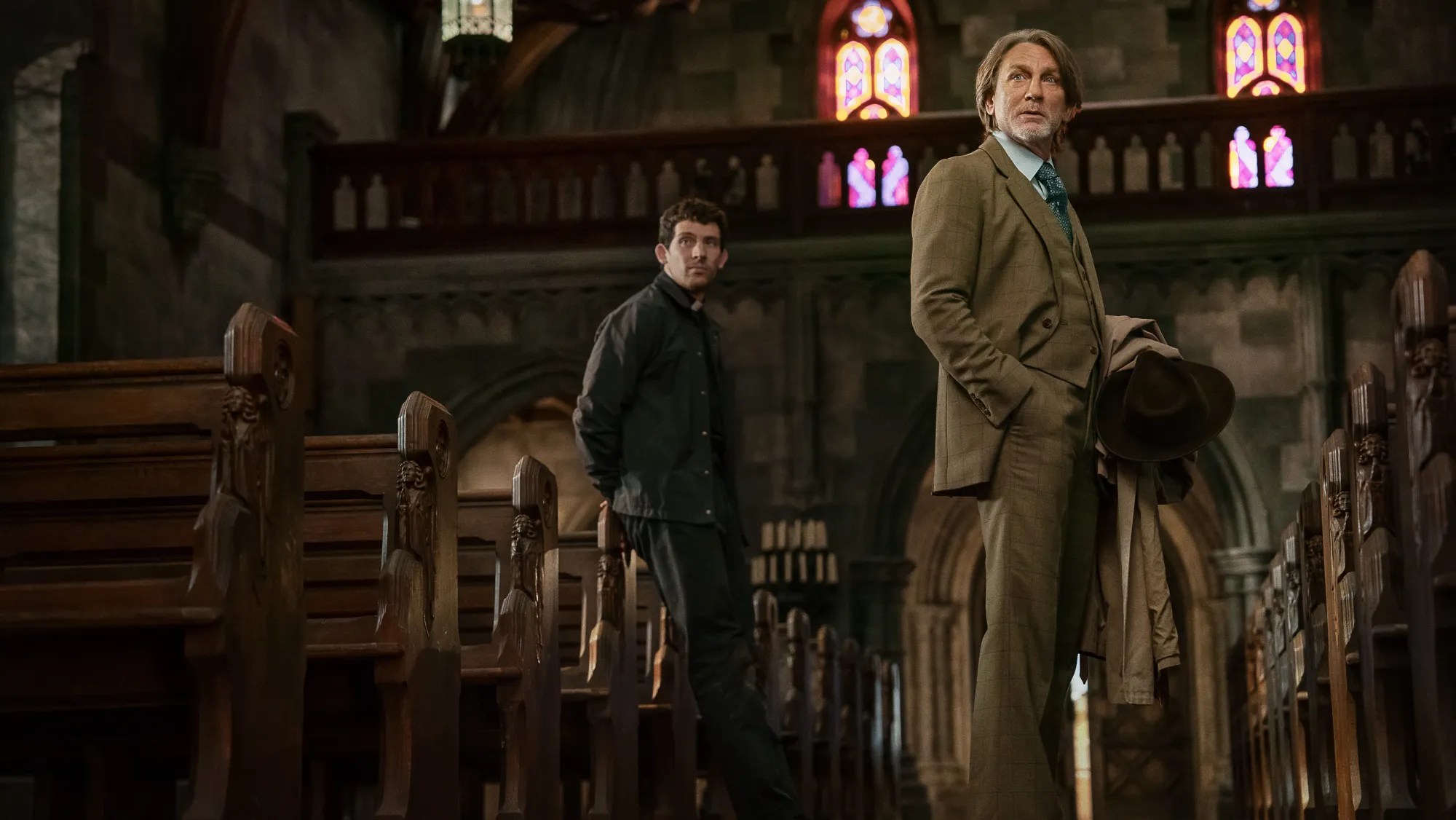
The latest from Guillermo del Toro (“The Shape of Water,” “Nightmare Alley”) is a he-said, they-said kind of a tale that’s fairly faithful to its Mary Shelley roots. In scope and success it’s akin to Kenneth Branagh’s 1994 effort with Robert De Niro as the Creature but won’t make anyone forget Boris Karloff and the 1931 James Whale classic. Del Toro gets his creepy-crawly shivers in early with a smattering of reanimation scenes as Victor Frankenstein (Oscar Isaac) plugs half corpses into a battery and gets them to sputter to life for a board of London scientists who are both wowed and appalled – “Only god can create life,” one shouts, and that was Shelley’s point: Don’t mess with Mother Nature. If you do, the consequences can be boss-level bad. And, in this case, existential and unrelenting. At nearly two and a half hours, the film is told in two chapters, one from Victors’ “he” perspective and one from the Creature’s “they” view – yes, pronouns back then mattered too, but in this case the “they” is a humanization of the Creature versus the “it” used by Victor and others. The Creature is played with empathetic loneliness and rage by Jacob Elordi (“Saltburn,” “Priscilla”). The most touching scenes are with a blind man in the woods (David Bradley, excellently channeling his inner Anthony Hopkins) and with scream-queen “it girl” Mia Goth (“X,” “Infinity Pool”) as Elizabeth, the fiancée of Victor’s brother Willam (Felix Kammerer, “All Quiet on the Western Front”) whom both the Creature and Victor have strong sexual tensions with. Goth also plays Claire Frankenstein, the lads’ mum who dies in birthing William – from bearer of life to love interest, a piquant ponder, right? The rendering of the Creature takes its cues from classic Karloff mashed up with the tall, porcelain-white alien beings in “Prometheus” (2012), who, as that movie had it, created us; it’s here we shall note that the subtitle of Shelley’s tale is “The Modern Prometheus.” Christopher Waltz is in the cast as Harlander, Elizabeth’s uncle and the financier of Victor’s reanimation lab, the tower atop a Scottish seaside cliff designed to pull down that massive bolt of lightning to bring the Creature to life. There’s a lot stitched into de Toro’s vision of Shelley, some a smooth, seamless period horror, other times moving in gangly, awkward leaps in which the timing of events is too overly convenient and implausible. Another round of editing and tightening may have helped, but del Toro’s “Frankenstein” is a wonderment that’s at its best when quiet and internal, or as Elordi rises up and roils in beast mode.
‘Aileen: Queen of the Serial Killers’ (2025)
Emily Turner’s documentary revisits the life and crimes of Aileen Wuornos, America’s first crowned female serial killer. The film doesn’t add much to the 2003 biopic “Monster,” which won Charlize Theron an Oscar for her portrayal of Wuornos, or Nick Broomfield’s docs “Aileen Wuornos: The Selling of a Serial Killer” (1992) and “Aileen: The Life and Death of a Serial Killer” (2003). If anything, it casts a softer light on Wuornos’ adoptive mother, Arlene Pralle, a horse breeder and born-again Christian; her hippie attorney, Steve Glazer; and childhood friend Dawn Botkins, who in Broomfield’s films were opportunists trying to make a buck off their proximity to Aileen. Aileen herself comes off as warm and engaging in her day-before-execution interview with Australian pen pal Jasmine Hirst – a stark contrast to Broomfield’s 2003 final interview. It’s telling too when Wuornos whispers into Hirst’s ear and tells her she’s “going to make millions.” The most interesting spins are the outtakes from “Dateline” investigator Michele Gillen’s interview footage, the testimony of the female judge removed from the case before trial and the brimming political aspirations of god-fearing prosecutor John Tanner. The rewind of a related cop scandal – investigators cut Hollywood deals while the investigation was ongoing – intrigues, as do the late reveals of Aileen’s confessional truth before execution. Both were well covered in Broomfield’s takes, and the latter to different conclusions. It’s not new, but Aileen still rivets, and this will likely send viewers to the archives for Broomfield’s bits and Gillen’s deep delve.
‘Ballad of a Small Player’ (2025)
Edward Berger’s casino drama dazzles in every scene framed by Academy Award-winning cinematographer James Friend (“All Quiet on the Western Front”) – though as a tale, it lacks sense and soul. The true star of the film is Macau, an island causeway south of Hong Kong that has become an international hub of casinos. Amid the bright lights we embed with gambler Lord Doyle (Colin Farrell), a dignified Brit with Bond-esque reserve who lives large but can’t pay for it. His tab at the posh hotel he has holed up in is $350,000, and it’s long past due. The next big hand keeps coming up bust, and soon Doyle’s only drip of credit is from a compassionate senior casino employee named Dao Ming (Fala Chen) who may not be as kind as her eyes present, and may, in fact, be a willful enabler. More mystery wafts in with Tilda Swinton as an investigator of white collar crimes, like Faye Dunaway in “The Thomas Crown Affair” (the 1968 Boston shot version). There are also some questions as to the verisimilitude of Doyle’s lineage. Farrell, recently in “The Banshees of Inisherin” (2022) and “The Penguin” series, keeps proving he’s become an actor willing to go all in for his character, but he’s not given enough here from Rowan Joffe’s adaptation of a Lawrence Osborne novel. Given Joffe’s and Berger’s CVs (“The American” and “Conclave” among them, respectively) it’s a disappointing sojourn of sideways movements that never finds a peak. “Ballad of a Small Player” marks the third successive Netflix project by a major filmmaker – along with “A House of Dynamite” and “Frankenstein” – to get a short theatrical run and mixed critical reactions before being moved to the streaming giant’s platform of plenty.
The first film from indie stalwart Hal Hartley in more than 10 years – a Kickstarter campaign got it off the ground before a Covid pandemic delay – is a loose, autobiographical reflection on the director’s life and body of work like Almodóvar’s deeply personal “Pain and Glory” (2019). At the center is Joseph Fulton (Bill Sage), a lion in winter edging toward 60 and one-time maker of successful romantic comedies who’s taking a break from the director chair to get his last will and testament together. He also has a desire to put his hands in mother earth, and applies for a job as a cemetery groundskeeper. Through a comedy of miscommunication, Joe’s girlfriend, Muriel (Kim Taff), an actor in Season 14 of her “Wonder Woman”-esque TV series, and his niece and assistant, Veronica (Katelyn Sparks) discover an unopened, confidential letter from a hospital and think it all adds up to Joe dying. Adding fuel to the fire is the subplot about a wannabe screenwriter (Jeremy Hendrik) claiming to be Joe’s son. It’s a stoic, reflective affair with some strong writing. The best moment is when a film studies professor (Aida Johannes) challenges Joe with SAT word salad and Rorschach test reasoning about the meaning of his films. It’s blazingly brilliant, but begs the question as to why Joe’s rom-coms are being intellectualized as if they’re “One Battle After Another.” No offense to rom-coms, but it’s apples and oranges – and Joe, a likable sort, doesn’t really emanate the auteur je ne sais quoi that many in the film seem to heap on him. As to the title, the film begins and ends with a Shackleton-esque-esque ship amid rough seas – a clear metaphor for hitting a patch of turbulence late in life and what to do. It works, even if weakly employed. As with most Hartley (or Mamet, for that matter) films, it’s less about the oblique references and more about matters of the heart and struggling soul.
Brothers who direct together don’t always stay together. We know this from the Coens, who after 30-something films went off to do solo projects, and it seems to be the same for the Safdie brothers (“Good Time,” “Uncut Gems”), with Benny breaking out for this biopic about MMA fighting pioneer Mark Kerr (Dwayne Johnson) when the sport was mostly in Europe and Japan. Much of the action takes place there, and it’s an odd sojourn. You can see Safdie, so good at channeling the freneticism of fringe personalities in “Gems” and “Good Time,” constrained here by facts versus fiction and straining to find a character motivation or that challenging event that drives the protagonist. Kerr’s challenges with painkiller addiction and recovery come early in the film, and there are domestic struggles at his Arizona hacienda with significant other Dawn (Emily Blunt), but otherwise no real arc. It’s more a meandering love letter to Kerr and an era, and in some ways has a docudrama feel. Johnson, jacked up to seam-bursting size, acts his pants off. It’s an impressive immersion and a major turn in his career, fusing his WWE roots and aspirations to be taken as more of a serious actor than straight-up action star or Schwarzenegger-ish comedian. Blunt, close in tenor to Amy Adams as the girlfriend in “The Fighter,” is good too but never gets enough breathing space to make Dawn fully formed, and the role comes dangerously close to lapsing into rote hysteria. The one seam Safdie finds is the camaraderie and bonding among the athletes, namely between Kerr and friend-coach-rival Mark Coleman (MMA fighter Ryan Bader, who nearly wrestles the film from Johnson and Blunt). It’s a soulful meander in search of a reason to go to the mat.
There’s little surprising or new in “The Long Walk” despite its pedigree, passion and professionalism. It’s still a compelling and emotionally charged tale primarily because of those three Ps – and the grim prospect of how much further we as a society can fall. It’s based on Stephen King’s first novel, written as a student while at the University of Maine but not published until 1979; even then it went under King’s pen name of Richard Bachman, like “The Running Man.”
In “Walk,” we get dropped into a dystopian America in the late 1960s or ’70s. It takes a while to register, but the unhappy alter reality has the distinct tang of “The Mist” or “The Stand”: The United States has just emerged from a war, but the country is not the portrait of Ozzie and Harriet productivity we’ve all been sold on. Much of what we see in our limited lens is the depressed and the needy. Most of the people we see along the long stroll could use a hot shower, a bowl of hot soup and some new threads.
Ethan Coen and co-writer and wife Tricia Cooke reteam with actor Margaret Qualley for the second of a purported loose lesbian neo-noir trilogy. That first outing, last year’s “Drive-Away Dolls,” was a bit of a rickety start, but through no fault of Qualley, who packed the punchy best of both Thelma and Louise as one of two gal pals who zoom off in a car with various factions of angry patriarchy hot on their tail. It was a concept in search of a story. Here, Coen and Cooke dial up the noir aspect and concoct something more worthy of Qualley’s onscreen allure.
She plays Honey O’Donahue, a private detective working the dusty, depressed streets of Bakersfield, California. There’s trouble right off the bat as an angular French woman (Lera Abova) in leopard-skin tights navigates the scree of a ravine to get to an inverted car, its driver dead or dying. She’s not there to help, but to pluck a signet ring off a finger, and in the next scene Abova’s agent of cold deeds is floating casually full frontal in a nearby quarry pond. An important fashion note: As she clads up, there’s a Garanimals moment as we realize her underwear and bra match her motorbike helmet.
Somerville TheatreSomerville Theatre Crystal Ballroom Movie Trivia nights draw more than 150 people monthly, as seen from the POV of the scorekeeper.
Somerville Theatre Crystal Ballroom Movie Trivia nights are a raucous two hours of competitive film fan fun for self-anointed cinephiles and trivia tricksters looking to flaunt deep stores of knowledge to attain factoid alpha status.
The nights, on the third Tuesday of the month, are hosted by Billy Thegenus, program and outreach coordinator at the Coolidge Corner Theatre in Brookline and Ian Brownell, co-owner of CSB Theaters (with longtime theater manager Ian Judge), which runs the Somerville Theatre.The events have drawn 150-plus people – or 20-ish teams of five to six – to the Crystal Ballroom space. You can show up with your own, ready-to-roll crew or go freelance and hop on with a duo or trio needing a trivia turbo boost.
Zach Cregger’s follow-up to his 2022 surprise art house horror hit “Barbarian” builds just as confidently with mood, moxie and acrid, enigmatic tugs. “Weapons” has you from the get-go as a young child from the fictional town of Maybrook, Pennsylvania, informs in a soft, reflective voice-over how one night 17 children exited their suburban homes at the exact moment of 2:17 a.m. and, holding their arms out like birds about to take flight, ran into the night and vanished. There’s a liberating joyousness to the otherwise ominous exodus. The next day at school, we learn that all were students of a new teacher, Justine Grundy (Julia Garner, “The Assistant,” “Ozark”), so when Justine walks in, the classroom is empty except for one: Alex Lilly (Cary Christopher), a small, quiet boy and the subject of regular bullying.
Parents are understandably upset and want answers. During a town meeting, Justine is blamed and castigated for her inability to provide answers. Later, her car is vandalized with the ominous tag of “witch” in bold red letters.
Crowds jeer in James Gunn’s recently released “Superman.”
James Gunn’s “Superman” swooped into theaters a week ago and knocked it out of the park with more than $125 million at the domestic box office. Not bad for a flat-footed rebrand that’s a long way from “Jaws,” which 50 years ago became the pindrop for the blockbuster, pulling in more than $260 million ($1.5 billion by today’s standards), with the eventual Academy Award winner that year (and No. 2 in box office totals), “One Flew Over the Cuckoo’s Nest,” taking in less than 40 percent of that. With that success, Spielberg’s gambit forever altered filmmaking and the way we see films; producers began seeking ready-made target audiences and the next big onscreen wow that would blow watchers’ minds and create lines to the ticket booth.