Meta is all the rage these days in films about filmmakers and the filmmaking process. Take Richard Linklater’s ode to the French New Wave, “Nouvelle Vague” (available on Netflix), which follows a young Jean-Luc Godard in 1959 Paris seeking to make his first film (“Breathless”), or “Jay Kelly” from Noah Baumbach (“White Noise,” “Squid and the Whale”), in which George Clooney essentially plays George Clooney. Add to that Joachim Trier’s stirring “Sentimental Value,” about the creative tempest of filmmaker Gustav Borg (Stellan Skarsgård), an auteur well into his autumn seeking to achieve one last cinematic masterpiece.
There’s not an ounce of fat in the script, the performances are tight and lived-in and Trier, hailed for his edgy, dramatic simmers “The Worst Person in the World” (2021) and “Oslo, August 31st” (2011), again proves masterful in presenting a slow, ever-mounting, emotionalism, a devilish dark humor and a climax of melancholy and rue. The movie gets to you from the inside out.
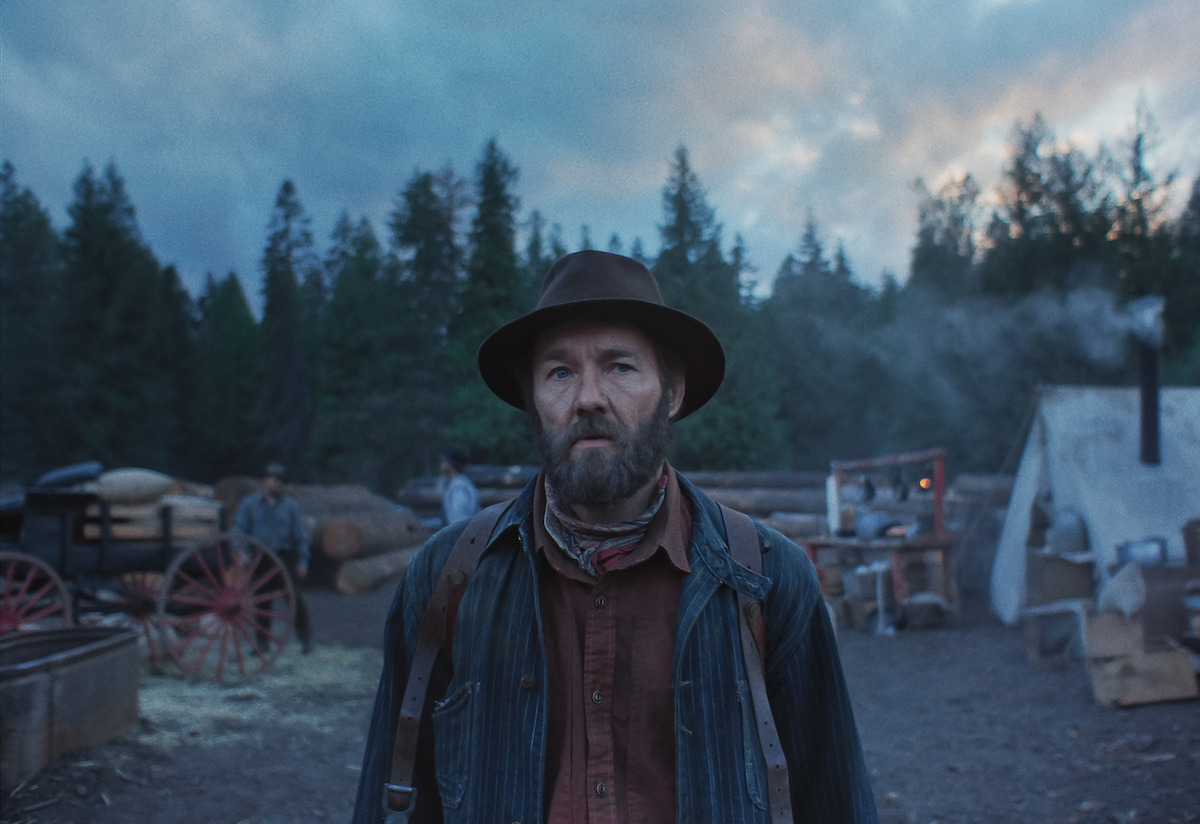
Films crafted around hermits are often peppered with idyllic framings of their lush surroundings and driven by strong, intense performances by the lead, who must, for the most part, connote much of their character’s inner turmoil via facial expressions and the glance of the eye. That was the case with Ben Foster in Debra Granik’s “Leave No Trace” (2018) as well as Daniel Day-Lewis in his recent comeback, “Anemone.” This film, gorgeously shot by Adolpho Veloso, has the trippy, hypnotic aura of a Terrence Malick fever dream, and we get Joel Edgerton in his richest and most robust performance to date. His Robert Grainier, we’re told, never spoke into a phone during a life that ends serenely in 1968. Based on the novella by Denis Johnson and adapted by Clint Bentley and Greg Kwedar – the Oscar-nominated tandem behind “Sing Sing” – “Train Dreams” is pretty much the telling of Grainier’s life in full; orphaned young, unknowing what befell his parents, and, as a quiet young man when we catch up with him, working as a logger and railway hand in the remote reaches of Idaho. His life as a loner and drifter pretty much has him moving from one lumber camp to the next until he meets Gladys (Felicity Jones) at a church in Fry. It’s love at first pleasantry, and with Gladys game for the woods, the two wed, build a bungalow atop the crest of a dell and have a daughter. It’s an enchanting “Little House on the Prairie” existence until a wildfire sweeps through the valley while Grainier happens to be off on one of his logging missions. When he returns, Gladys and his daughter are nowhere to be found. For a good part of the film, Grainier, propelled by guilt and grief, searches nearby towns looking for them or any news of their fate. Ultimately he returns to the woods, where he registers a small degree of comfort taking in an abandoned litter of dogs and rebuilding the cabin on the same perch. The power of guilt and grief creeps in and begins to bend reality, and Grainier struggles to make sense of his existence and the world in large. The acting is top tier, reserved and quietly affecting. Others adding heart and humanity in small, meaty parts are William H. Macy as Arn Peeples, a grumpy coot who likes to use explosives to fell his trees, and Kerry Condon as the first woman to work at a U.S. National Forestry outpost.
The latest from Kevin Macdonald (“Touching the Void,” “Last King of Scotland”), working with Sam Rice-Edwards, delves into the life and times of John Lennon and Yoko Ono in New York City during the tumultuous Richard Nixon and Vietnam War era. It’s a spry, electric rewind with sharp, well-cut footage of the time and, naturally, the music and idealistic political activism of Lennon and Ono. Leaving their massive estate in London post-Beatles breakup, Lennon and Ono came to America to try to find Kyoko Chan Cox, Ono’s daughter from an earlier marriage to jazz musician Anthony Cox, who defied a court order and hid her from Ono. Lennon and Ono, in alignment with their ideology, opted to live “plainly” in the middle of New York – a decision that would factor into Lennon’s very public murder in 1980. The focus of the film is the “One to One” concert Lennon and Ono put on at Madison Square Garden in 1972 to benefit the children of the Willowbrook State School on Staten Island, shut down in 1987 but at the time the largest institution in the country caring for children with Trisomy 21 and other developmental disabilities. The concert was a reaction to an exposé by Geraldo Rivera of the inhumane, overcrowded conditions – there was one caregiver for every 30 children (the concert’s title offers a better ratio), living in squalor on cold cement. What’s shown is horrific (think Frederick Wiseman’s “Titicut Follies”). Filling out the frame of this conflict-rich time capsule are the shenanigans of Nixon, the bravery of Shirley Chisholm and the kindness she extended to a wounded George Wallace, a jazzed-up Jerry Rubin, poet and defiant pacifist Allen Ginsberg and Bob Dylan and his controversial “garbologist,” A.J. Weberman. It’s a wild olio that captures the chaotic time with Lennon and Ono at the fore, on point and putting themselves out there in every sense of the word. You have to admire their cool, calm and rapier-sharp responses, especially Ono, fighting to see her daughter and often tagged “an ugly J*#!, who broke up the Beatles.” There’s a bit about Cambridge too, with Ono as a speaker at the First International Feminist Conference held at Harvard University. If you’re not left verklempt by the end sequence, of kids from Willowbrook in daylight, beaming, cross-cut with Lennon and Ono performing classics such as “Imagine” and “Come Together” with Stevie Wonder and Roberta Flack, you need to get to the doctor to see if you have a heartbeat.
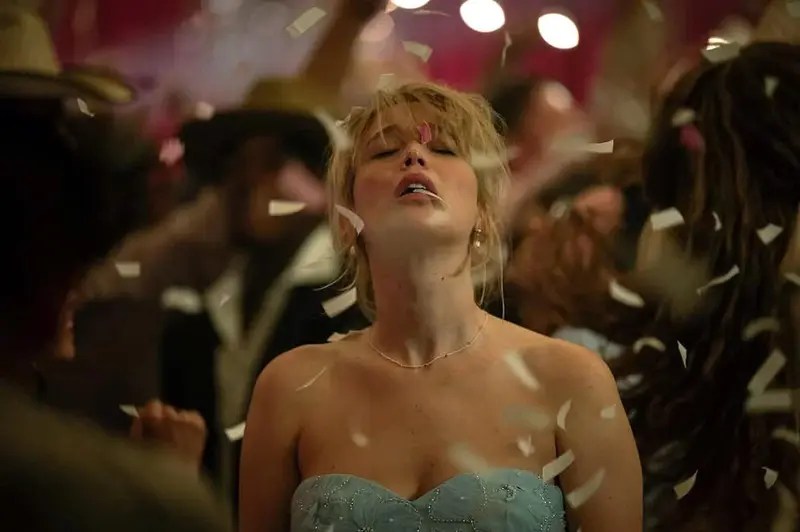
Lynne Ramsay, the Scottish filmmaker behind such macabre psychological chillers as “We Need to Talk About Kevin” (2011) and “You Were Never Really Here” (2017) – the former, about a youth who commits a mass school shooting, the latter with Joaquin Phoenix as a hammer-wielding sociopath-avenger – may be the most convincing female voice in matters of masculinity onscreen since Kathryn Bigelow (“The Hurt Locker,” “A House of Dynamite”). And the company in that elite club may just be a crew of two. Here, going to the more feminine side of things doesn’t make anything less messy, violent or bloody. In fact, it’s more unsettling. No human being dies of a violent act, though animals – a horse and a poorly adjusted dog – don’t fare as well. Jennifer Lawrence is Grace, who has a lot pushing and pulling in her head. She’s a writer who’s moved into the old Montana farmhouse of her partner Jackson (Robert Pattinson) with the intent of sinking into creativity and new motherhood. Neither really happens as Grace becomes less and less rooted in reality and waking delusions take hold. Is Jackson having an affair? Is the menacing presence on a motorcycle (LaKeith Stanfield) also Grace’s moonlight lover in the rickety old barn? Or is it all an illusion cast by an unreliable narrator dealing with postpartum delirium, or something more chronic? Ramsay, working from Ariana Harwicz’s 2013 novel, keeps us in the dreamy, demented dark – when Grace crashes through a sliding glass door, opens the car door to jump or bashes her head into a hotel suite mirror and Jackson underreacts, you don’t know if this is par for the course, the man has no idea what to do and is simply silent and agog, if it’s a disjointed distortion of reality or somewhere in between. There are clues, but teasingly few. Lawrence gives a bold, brave performance, emotionally exposed and often naked, oddly like an antithetical companion piece to her 2023 dark comedy, “No Hard Feelings.” In “Mother!” (2017) the madness around Lawrence’s bearer of life was external and a metaphor for the religious patriarchy; here it’s internal, and troubling to the forces who can’t get a handle on or squash it – a forced commitment in an asylum seems to fix things for a moment, but did it really happen? The tension over what is real is the film’s weakness and appeal, but not enough can be said about Lawrence: She switches on and off, or explodes, or recedes, with seamless perfection. It’s stunning. Ramsay and Lawrence are in tune at every turn and we are lucky to be here for their deftly deliberate dissonance.
Flipping the script, making heroes of villains from two sci-fi series
The latest entry in the “Predator” series isn’t a game changer so much as a change-up, building a better bridge with the “Alien” film series than the comic book-inspired “Alien vs. Predator” did so slackly in 2004, showing a wry humor and, as you might not suspect, making the predator of the tile – replete with that freaky maw – the de facto protagonist.
All that said, the plot’s not that surprising: An undersized predator or Yautja named Dek (Dimitrius Schuster-Koloamatangi, emoting effectively under all the makeup and special effects) is to be offed by his brother to cull the clan of its weakest (sounds like an IBM or Amazon layoff – nothing personal, right?). His brother stands up for him and lets Dek jet off to Genna, aka the Death Planet, to hunt down a Kalisk, secure the creature’s skull as a trophy and ascend into the clan of predator warriors.
The latest from Guillermo del Toro (“The Shape of Water,” “Nightmare Alley”) is a he-said, they-said kind of a tale that’s fairly faithful to its Mary Shelley roots. In scope and success it’s akin to Kenneth Branagh’s 1994 effort with Robert De Niro as the Creature but won’t make anyone forget Boris Karloff and the 1931 James Whale classic. Del Toro gets his creepy-crawly shivers in early with a smattering of reanimation scenes as Victor Frankenstein (Oscar Isaac) plugs half corpses into a battery and gets them to sputter to life for a board of London scientists who are both wowed and appalled – “Only god can create life,” one shouts, and that was Shelley’s point: Don’t mess with Mother Nature. If you do, the consequences can be boss-level bad. And, in this case, existential and unrelenting. At nearly two and a half hours, the film is told in two chapters, one from Victors’ “he” perspective and one from the Creature’s “they” view – yes, pronouns back then mattered too, but in this case the “they” is a humanization of the Creature versus the “it” used by Victor and others. The Creature is played with empathetic loneliness and rage by Jacob Elordi (“Saltburn,” “Priscilla”). The most touching scenes are with a blind man in the woods (David Bradley, excellently channeling his inner Anthony Hopkins) and with scream-queen “it girl” Mia Goth (“X,” “Infinity Pool”) as Elizabeth, the fiancée of Victor’s brother Willam (Felix Kammerer, “All Quiet on the Western Front”) whom both the Creature and Victor have strong sexual tensions with. Goth also plays Claire Frankenstein, the lads’ mum who dies in birthing William – from bearer of life to love interest, a piquant ponder, right? The rendering of the Creature takes its cues from classic Karloff mashed up with the tall, porcelain-white alien beings in “Prometheus” (2012), who, as that movie had it, created us; it’s here we shall note that the subtitle of Shelley’s tale is “The Modern Prometheus.” Christopher Waltz is in the cast as Harlander, Elizabeth’s uncle and the financier of Victor’s reanimation lab, the tower atop a Scottish seaside cliff designed to pull down that massive bolt of lightning to bring the Creature to life. There’s a lot stitched into de Toro’s vision of Shelley, some a smooth, seamless period horror, other times moving in gangly, awkward leaps in which the timing of events is too overly convenient and implausible. Another round of editing and tightening may have helped, but del Toro’s “Frankenstein” is a wonderment that’s at its best when quiet and internal, or as Elordi rises up and roils in beast mode.
‘Aileen: Queen of the Serial Killers’ (2025)
Emily Turner’s documentary revisits the life and crimes of Aileen Wuornos, America’s first crowned female serial killer. The film doesn’t add much to the 2003 biopic “Monster,” which won Charlize Theron an Oscar for her portrayal of Wuornos, or Nick Broomfield’s docs “Aileen Wuornos: The Selling of a Serial Killer” (1992) and “Aileen: The Life and Death of a Serial Killer” (2003). If anything, it casts a softer light on Wuornos’ adoptive mother, Arlene Pralle, a horse breeder and born-again Christian; her hippie attorney, Steve Glazer; and childhood friend Dawn Botkins, who in Broomfield’s films were opportunists trying to make a buck off their proximity to Aileen. Aileen herself comes off as warm and engaging in her day-before-execution interview with Australian pen pal Jasmine Hirst – a stark contrast to Broomfield’s 2003 final interview. It’s telling too when Wuornos whispers into Hirst’s ear and tells her she’s “going to make millions.” The most interesting spins are the outtakes from “Dateline” investigator Michele Gillen’s interview footage, the testimony of the female judge removed from the case before trial and the brimming political aspirations of god-fearing prosecutor John Tanner. The rewind of a related cop scandal – investigators cut Hollywood deals while the investigation was ongoing – intrigues, as do the late reveals of Aileen’s confessional truth before execution. Both were well covered in Broomfield’s takes, and the latter to different conclusions. It’s not new, but Aileen still rivets, and this will likely send viewers to the archives for Broomfield’s bits and Gillen’s deep delve.
‘Ballad of a Small Player’ (2025)
Edward Berger’s casino drama dazzles in every scene framed by Academy Award-winning cinematographer James Friend (“All Quiet on the Western Front”) – though as a tale, it lacks sense and soul. The true star of the film is Macau, an island causeway south of Hong Kong that has become an international hub of casinos. Amid the bright lights we embed with gambler Lord Doyle (Colin Farrell), a dignified Brit with Bond-esque reserve who lives large but can’t pay for it. His tab at the posh hotel he has holed up in is $350,000, and it’s long past due. The next big hand keeps coming up bust, and soon Doyle’s only drip of credit is from a compassionate senior casino employee named Dao Ming (Fala Chen) who may not be as kind as her eyes present, and may, in fact, be a willful enabler. More mystery wafts in with Tilda Swinton as an investigator of white collar crimes, like Faye Dunaway in “The Thomas Crown Affair” (the 1968 Boston shot version). There are also some questions as to the verisimilitude of Doyle’s lineage. Farrell, recently in “The Banshees of Inisherin” (2022) and “The Penguin” series, keeps proving he’s become an actor willing to go all in for his character, but he’s not given enough here from Rowan Joffe’s adaptation of a Lawrence Osborne novel. Given Joffe’s and Berger’s CVs (“The American” and “Conclave” among them, respectively) it’s a disappointing sojourn of sideways movements that never finds a peak. “Ballad of a Small Player” marks the third successive Netflix project by a major filmmaker – along with “A House of Dynamite” and “Frankenstein” – to get a short theatrical run and mixed critical reactions before being moved to the streaming giant’s platform of plenty.
The lates from Lanthimos imagines a CEO as a threat to humanity, but what’s the the weird part?
If you like your Yorgos Lanthimos films outré and boundary-pushing like “Poor Things” (2023) as opposed to something more rooted in the simmering edginess of the day-to-day – say, “The Killing of a Sacred Deer” (2017) or last year’s underappreciated “Kinds of Kindness” – “Bugonia” is your cup of crazy chai.
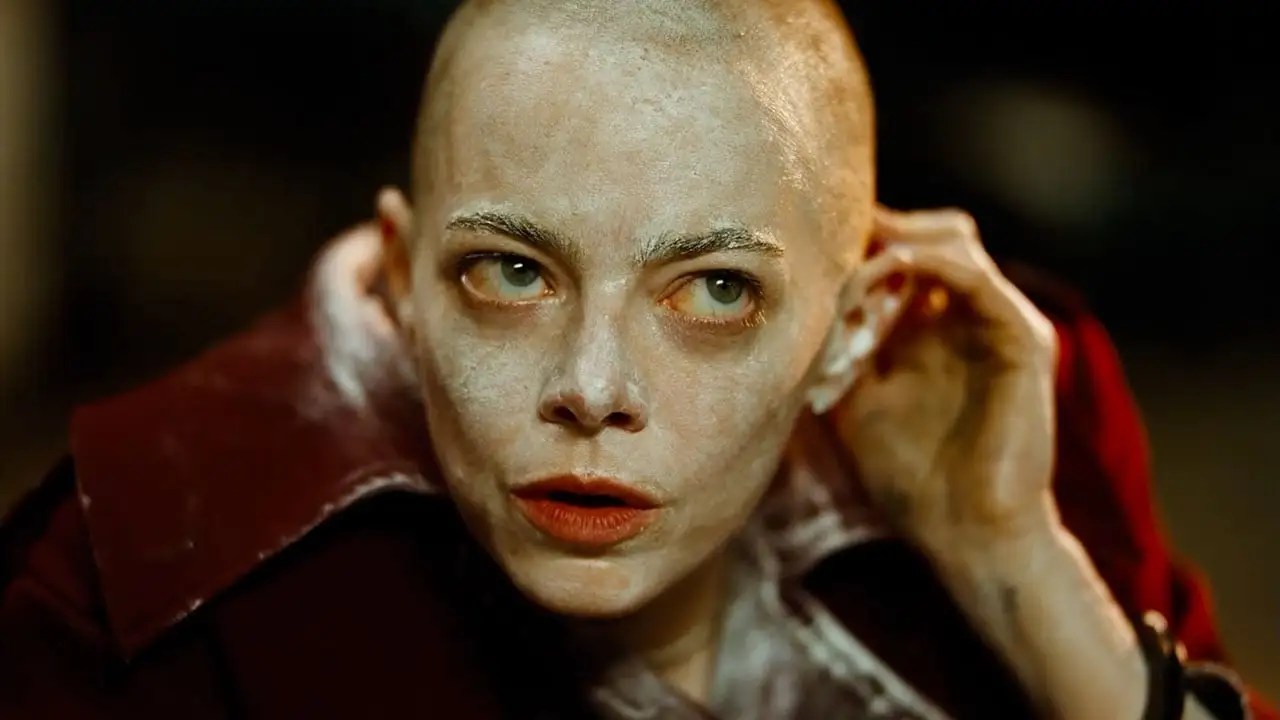
Lanthimos’ muse for his past four features, Emma Stone (she won gold for her portrait of a female Frankenstein’s monster discovering the power and pleasure of sex in “Poor Things”) stars as Michelle, the chief executive of Auxolith, a boffo biotech company outside Atlanta. We first meet Michelle making corporate messaging videos about diversity and workers’ rights. After one fumbled miscue and a retake, it’s abundantly clear that Michelle’s not a woke woman trying to raise others up, but doing a performative ass-covering for lawsuit prevention – “you can go home at 5:30 if you want,” she tells one employee, and then another, “but if you still have work to do …”
Keanu is the chain-smoking angel who flies away with this class comedy
Aziz Ansari, the shaggy-dog comedian (“Master of None”) known for his casual demeanor and biting social barbs, makes his directorial debut with this comedy about fate, happiness and how much the rich – and AI – are eating those further down the social ladder. “Good Fortune” is a devilish mix of light and dark that takes a good long time to reveal just how dark things can get, despite focusing on people sleeping in their cars because they can’t put a roof over their heads no matter how many jobs they work.
Even with the billing of Ansari and fellow comedy mainstay Seth Rogen, it’s Keanu Reeves who marches off with the film. It’s mostly the actor’s innate warmth and humanity that do the trick, but there’s also that dash of goofball vacancy that made the “Bill & Ted” movies so indelible and endearing that gives the film agency and air – a project that, in hindsight, might have otherwise floundered.
The first film from indie stalwart Hal Hartley in more than 10 years – a Kickstarter campaign got it off the ground before a Covid pandemic delay – is a loose, autobiographical reflection on the director’s life and body of work like Almodóvar’s deeply personal “Pain and Glory” (2019). At the center is Joseph Fulton (Bill Sage), a lion in winter edging toward 60 and one-time maker of successful romantic comedies who’s taking a break from the director chair to get his last will and testament together. He also has a desire to put his hands in mother earth, and applies for a job as a cemetery groundskeeper. Through a comedy of miscommunication, Joe’s girlfriend, Muriel (Kim Taff), an actor in Season 14 of her “Wonder Woman”-esque TV series, and his niece and assistant, Veronica (Katelyn Sparks) discover an unopened, confidential letter from a hospital and think it all adds up to Joe dying. Adding fuel to the fire is the subplot about a wannabe screenwriter (Jeremy Hendrik) claiming to be Joe’s son. It’s a stoic, reflective affair with some strong writing. The best moment is when a film studies professor (Aida Johannes) challenges Joe with SAT word salad and Rorschach test reasoning about the meaning of his films. It’s blazingly brilliant, but begs the question as to why Joe’s rom-coms are being intellectualized as if they’re “One Battle After Another.” No offense to rom-coms, but it’s apples and oranges – and Joe, a likable sort, doesn’t really emanate the auteur je ne sais quoi that many in the film seem to heap on him. As to the title, the film begins and ends with a Shackleton-esque-esque ship amid rough seas – a clear metaphor for hitting a patch of turbulence late in life and what to do. It works, even if weakly employed. As with most Hartley (or Mamet, for that matter) films, it’s less about the oblique references and more about matters of the heart and struggling soul.
Luca Guadagnino’s films have always included edgy, provocative sexual situations. Take “Call Me By Your Name” (2017), “Challengers” (2024) or “Queer” (2024). Even his ventures into the strange – “Suspiria” (2018) or “Bones and All” (2022) – are driven by primal lusts filmed in a way that can border on erotica. Guadagnino’s latest, “After the Hunt,” deals with the politics of sex and ethical morality in higher education.
The film opens with a holiday party at the cozy apartment of a tenured Yale English professor (Julia Roberts). The camera meanders from the warmth of the fireplace and into the stately den where faculty and grad students engage in boozy intellectual debate. Robert’s Alma is the clear queen of the ball (it’s her house). Her suck-ups include fellow lit prof Hank (Andrew Garfield, “The Social Network”) and doctoral candidate Maggie (Dorchester’s Ayo Edebiri, “The Bear”). Hank’s waiting to hear if he’s been awarded tenure; Maggie comes from an uber rich family that has given generously to the school. It’s all a raucous who’s-smarter-than-who fun time until Hank walks Maggie home and accusations of sexual misconduct are leveled.