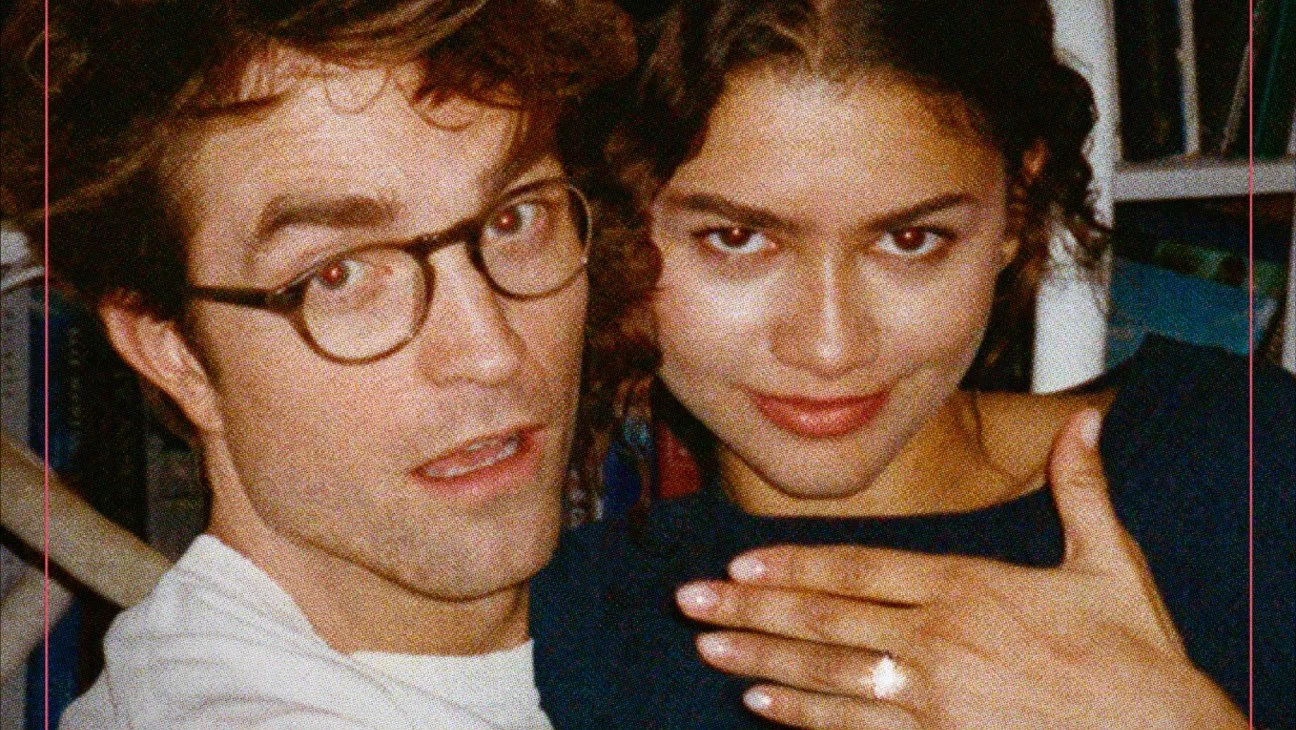
The latest from off-kilter impresario Kristoffer Borgli is a dark, sardonic rom-com with a sharp morality barb — one so pointed and polarizing that it will repel many viewers. Others will be provoked, but still hop on board with Borgli’s go-for-broke vision. Of course, the real reason we’re all on tenterhooks about “The Drama,” starring hot properties Zendaya and Robert Pattinson as an engaged couple, is because the movie was shot here in Cambridge and Boston, with a pivotal scene playing out at Porter Square stalwart Andy’s Diner.
The one thing “The Drama” is not: predictable. It’s also surprisingly funny in awkward, uncomfortable ways. As with “Dream Scenario” (2023), Borgli plants his biggest twists in small, mundane scenes. Things begin innocuously as Pattinson’s Charlie eyes Zendaya’s Emma at a Back Bay Tatte, where she’s reading a novel (it’s fictional fiction, although it shares the name as real novel by Caitlin Wahrer). He’s instantly smitten, looks up the book online, and pretends to have read it for his goofy, gawky overture. Emma ignores him. It’s not a classic cold shoulder, though: An earbud blasts beats in one of her ears, concealed by hair, and the other is deaf — the why of it, revealed later, packs a twist worthy of a Wes Anderson film.
A historic wall in Harvard Square may be up against it, as business owners and city officials are banging their heads against the problem of how to fix it.
The stone wall was built more than 200 years ago, mostly hidden behind Charlie’s Beer Garden, was erected in the late 1700s and early 1800s to channel the spring-fed Town Creek to the Charles River. The project made Winthrop Square — then a knoll and the heart of Harvard Square — a more stable and level gathering spot by protecting it from a creek winding toward the Charles River.
The wall might also have been intended for a more ambitious project: a wharf on Eliot Street, said Charles Sullivan, executive director of the Cambridge Historical Commission. Like the West End in Boston, some parts of Cambridge near the Charles River were previously underwater and later filled in.
The wall partially collapsed in 2020 and was never repaired. Scarce funding and complicated jurisdiction left it crumbling, and rats — lots of rats — moved in. Last year, Denise Jillson, the Harvard Square Business Association’s executive director, asked public health experts in Cambridge and at Harvard University for help analyzing the problem.
“That site is akin to a prairie dog village … but with rats,” said Richard J. Pollack, Harvard’s senior environmental public health officer.
In March, Jillson issued a release calling on the community and stakeholders to “together to find a solution to the complex challenge of preserving this historical relic that sits on private property.” The release included an illustrated comic about the wall and its history created by Caro Taylor, a Cambridge resident and a junior at the Commonwealth School in Boston who was an intern at the HSBA last summer.
The “Old Stone Wall” runs from Winthrop Street, through Charlie’s Beer Garden, and out to Eliot Street. The better-preserved section, which divides Charlie’s and the former Red House restaurant (soon to be relaunched as the Cox Hicks Club), is an impressive 8- to 10-foot high structure, still intact. The collapsed section of the wall — adjacent to Eliot Street, tucked behind the IHOP — is not publicly visible except through a small alley. Here the wall is 4 or 5 feet tall.
A combination of factors likely contributed to its deterioration, according to the city and the Harvard Square Business Association: age, erosion, weather, ongoing disturbances from area construction, and rats.
A relatively intact section of a historic wall in the Harvard Square alleyway between the former Red House and Charlie’s Kitchen.
The wall was built with large fieldstones laid in a battered profile that lean inward — a technique used in early retaining walls to release pressure. The rocks were dry-laid to allow water to pass through the wall rather than build up behind it. The stones are local: Roxbury Puddingstone from that neighborhood’s Parker Hill and granite from quarries on the Boston Harbor Islands.
“It’s not the only stone wall in Harvard Square, but it is by far the largest and most significant,” Sullivan said.
The wall is located within the Harvard Square Conservation District, which means work requiring a building permit generally requires review by the historical commission. However, the commission’s jurisdiction applies only to features visible from a public way. Portions of the wall are located behind buildings on private property and cannot be seen from the street, limiting the commission’s authority over those sections.
Given the wall’s historic value, the city appropriated $200,000 in Community Preservation Act (CPA) funds in 2021 to shore up the Eliot Street section of the wall. The estimated cost was about $400,000, however, and since it is on private property Sullivan asked commercial property owners to contribute the additional $200,000.
Of the property owners, only Paul Overgaag, who owns 98 Winthrop Street (previously home to The Red House) and also Charlie’s Kitchen at 10 Eliot Street, agreed to contribute. Raj Dhanda, owner of the Crimson Galeria building and the property at 96 Winthrop Street (formerly the House of Blues, now The Boiling Crab), expressed concerns about the scope of the project and the financial burden. The project stalled, and in 2024, the city reallocated the CPA funds.
In a recent phone interview, Dhanda said he believed the city should have paid more of the project’s cost. He also disputed the $400,000 price tag. At the time, his own contractor estimated that the work would cost less than $200,000.
Rat traps line a dilapidated segment of a historic wall in the Harvard Square alleyway between the former Red House and the IHOP, parallel to Eliot Street.
One of the primary concerns has been the growing rat population in the alley near the wall. As the wall continues to deteriorate, it might create even more hiding and nesting pockets for rats, Jillson said. The imminent public health risks from rats — and their recent surge in Cambridge — have been well documented. At a public meeting last year, Cambridge City Manager Yi-An Huang said, “These rodents are, as I understand it, reproducing faster than we can possibly catch up.”
Jillson also fears that the burrowing rats might also be destabilizing the soil and thus contributing to the wall’s deterioration. “That wall is basically infested with rodents, and it’s compromising the integrity of the soil,” she said.
The alleyway behind the Too Hot Sichuan restaurant and IHOP is a hotbed of rat activity in the square, Pollack said. Had the restoration moved ahead, it would have included implementing a cement backing to the wall. That would have helped secure the stones and abate erosion. It would also have effectively blocked the rats from burrowing.
Jillson hopes her press release spurs action. The economic climate, however, is significantly different.
Weir’s self-published first novel was hailed for its deep scientific detail and accuracy but “Hail Mary” trades hard science for a more fantastical plot.
⭐⭐⭐Rating: 3 out of 4.
Fans of Andy Weir’s “The Martian” — and Ridley Scott’s 2015 film adaptation starring Matt Damon — will find familiar bones in this deep space drama with a side of buddy comedy based on Weir’s third novel, “Project Hail Mary.” Weir’s self-published first novel was hailed for its deep scientific detail and accuracy but “Hail Mary” trades hard science for a more fantastical plot. As in Christopher Nolan’s weighty “Interstellar” (2014), we learn early on that the Earth is dying — here, because an alien microorganism called “Astrophage” is eating away the sun. Without adequate sunlight, famine will arrive in 20 to 30 years; the wars triggered by the diminishing food supply will crack civilization far sooner.
It’s not just an Earth problem, either. The ravenous Astrophage are devouring nearly all the stars in the galactic neighborhood — except one, some 12 light-years away. A team of astronauts has been sent to study this star, find out why it is resilient, and return to Earth with the solution. The caveat: The ship has only enough fuel for a one-way trip. The astronauts will send the solution back to Earth via probe, while they drift around for a few more years with various forms of painless euthanasia at their disposal. It’s not exactly something most people would raise their hand for. But the alternative is slow starvation — or worse — before your newly refinanced mortgage is paid off.
After six long years, the Harvard-Renty controversy came to a close last week when 15 daguerreotypes of Renty Taylor, his daughter Delia and five other enslaved people were transferred to the International African American Museum in South Carolina. The court case – Lanier vs. President & Fellows of Harvard College – had Renty’s great-great-great granddaughter, Tamara Lanier, suing Harvard for possession of the 176-year-old depictions, which were commissioned by Harvard biologist Louis Agassiz in 1850 as evidence for his racist polygenic theory that whites were intellectually superior to Blacks. Its conclusion in May came after many turns and twists. (Harvard has said it cannot confirm that Lanier is related to Renty.)
What stands out is that just after Lanier initiated the case in 2019, Harvard launched the Committee on Harvard & the Legacy of Slavery. That committee’s 2022 report showed that Harvard had enslaved 70 or more people and benefited financially and otherwise from their enslavement. It prompted Harvard to create a $100 million initiative to support descendant communities and educational initiatives tied to that legacy.
Yet it was during that time that Harvard fought Lanier’s claim, citing she lacked property rights – seeming antithetical to a mission to document and atone. To observers the question became: Was Harvard operating out of different ideological silos, or simply talking out of both sides of its mouth?
A spiritual journey through the Sahara, a violent, alien transformer, and a NYC man who may have strayed in the wrong direction.
“Sirât”
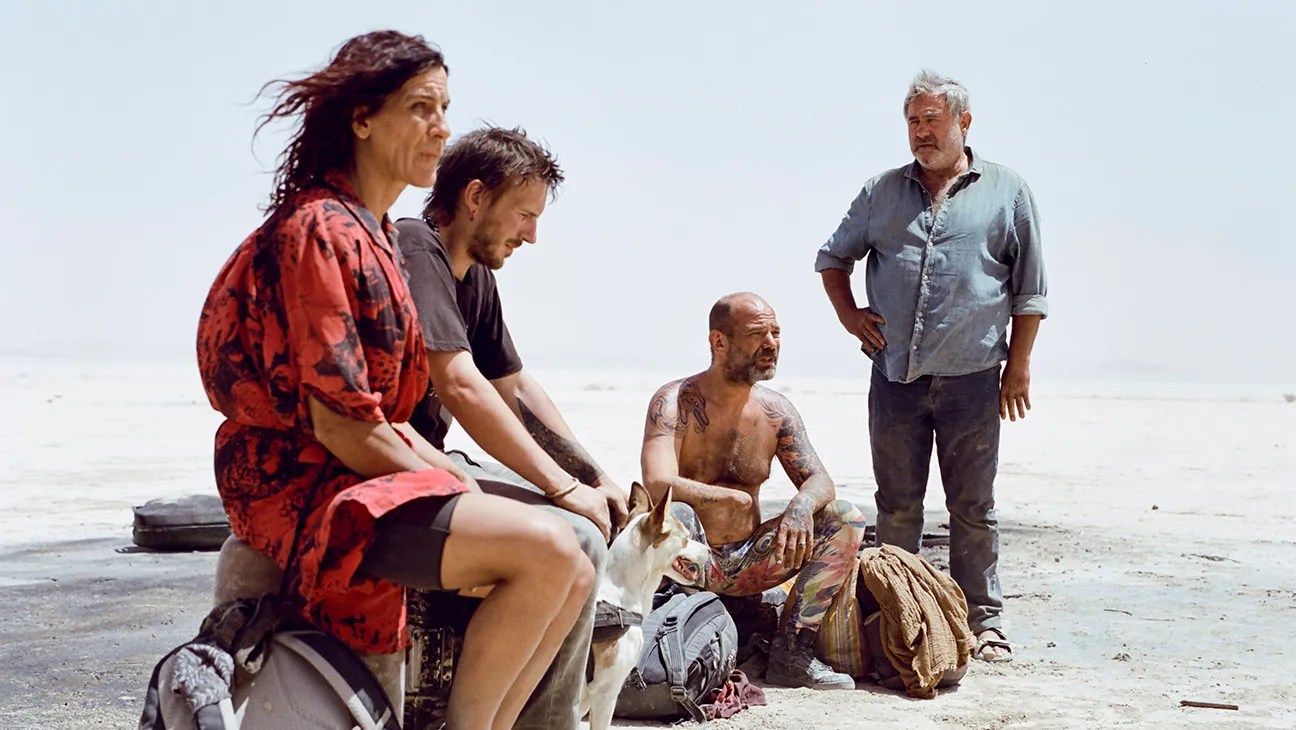
This sprawling wonderment from director Óliver Laxe unfolds as a stark meditation on faith, displacement, and moral endurance. Set in the harsh, borderless landscape of the endless Moroccan Sahara — and its precipitous mountains — a father and son go looking for their missing daughter/sister who’s last been seen embedded with a nomadic rave collective partying its way through the vast, arid nowhere. The film’s spiritual journey is shaped as much by silence and ritual (the rave parties are transfixing) as by events that often startle and shock. Laxe frames fate and belief not as certainty but as friction between devotion and doubt, discipline and compassion, and isolation and responsibility. Beneath its austere beauty, “Sirât” (loosely meaning the path to spiritual enlightenment or paradise) engages quietly but pointedly with contemporary political tensions, touching on migration, gender identity, radicalization, and the fragile line separating faith from ideology.
Driven by a pulsating techno score from David Letellier, known professionally as Kangding Ray, “Sirât” resists easy allegory while allowing meaning to emerge through gesture and repetition. The ensemble’s nuanced performances are restrained and inward, grounding the film’s metaphysical inquiry in palpable human vulnerability. \
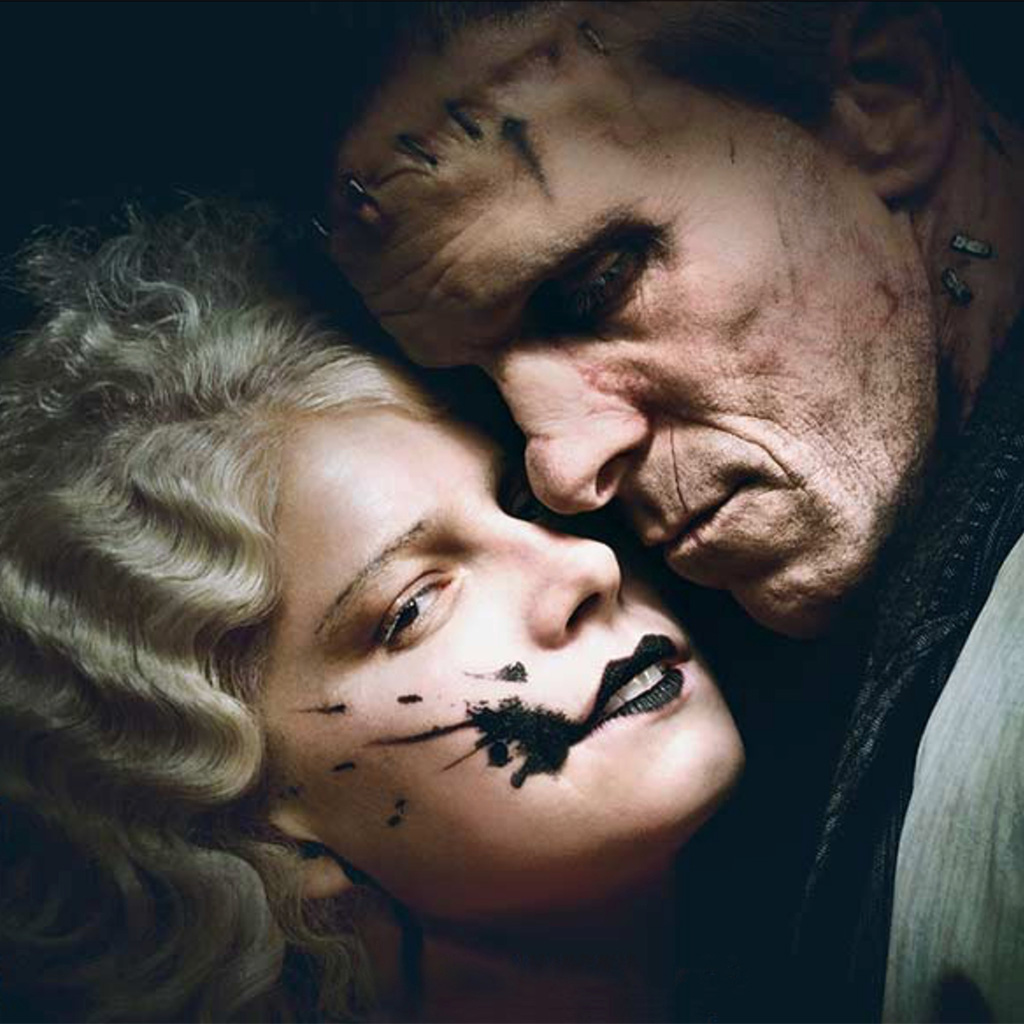
Jessie Buckley and Christian Bale in Maggie Gyllenhaal’s “The Bride!”
Right now cinemagoers can double their Frankenstein pleasure with “The Bride!” and Guillermo del Toro’s “Frankenstein,” up for the Best Picture Oscar this Sunday. Sure, “Frankenstein” is streaming on Netflix – it’s practically left theaters – but it is one of those films best seen on the big screen, as is Maggie Gyllenhaal’s newly opened grand spectacle. They play like bookends to the original story by Mary Shelley, just 18 at the time she wrote her 1818 novel subtitled “The Modern Prometheus.”
In the book, The Bride was promised but never made. It’s in the 1935 James Whale-directed sequel to “Frankenstein” (1931) and Gyllenhaal’s “The Bride!” that we get the realization of the corpse bride via very different narratives. Wedding crashers in the genre are “Frankenstein: The True Story” (1973), starring Jane Seymour and David McCallum of the “Man from U.N.C.L.E.,” and an emotionally inert 1985 version of “The Bride” pairing Jennifer Beals (“Flashdance”) with Sting, in which the rendering of The Bride was defined by the performer’s comely, magazine-cover self.
The narrative flip from the book’s Gothic Europe to post-Prohibition Chicago is a kitschy and vibrant reimagining.
Maggie Gyllenhaal’s “The Bride!” is a hot mess — both the title character and the film. It’s a wildly ambitious project with a distinctive female lens, and while it’s rife with social commentary, those themes often feel stitched on — and at times, carelessly so. The film flounders despite a killer cast, including Gyllenhaal’s husband, Peter Sarsgaard, and her brother, Jake, who appear in supporting roles. But the main reason to see the film is the bravura headline by Jessie Buckley, who’s been nominated for a best actress Oscar for her deeply emotional portrait of grief in “Hamnet” (2025).
Buckley can do no wrong in “The Bride!” She previously partnered with Gyllenhaal for her critically acclaimed directorial debut “The Lost Daughter” (2021), for which Buckley received a best supporting actress nod. Here she carries the film’s heaviest load, both as the shadowy visage of “Frankenstein” author Mary Shelley hurling barbs of foreboding from a dark dreamscape, and as Ida, a brash flapper-era Chicagoan party girl whose demise leads to her reincarnation — or “reinvigoration” in the film — as the bride.
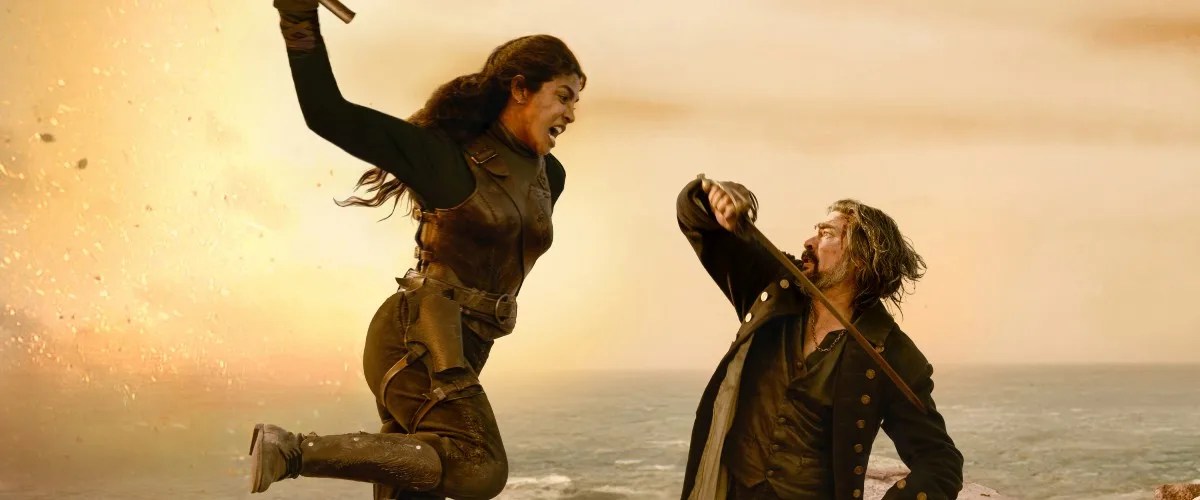
This silly and inane movie is a star vehicle for Priyanka Chopra Jonas (the wife of singer Nick Jonas). She plays Ercel, a housewife of the Caribbean married to a seafarer (Ismael Cruz Córdova) who is off on a mission. Ercel is caring for their son Issac (Vedanten Naidoo) and her much younger sister-in-law Elizabeth (Safia Oakley-Green, “Anemone,” “Out of the Darkness”) on Cayman Brac. Their idyllic tropical paradise is suddenly visited by a posse of unsavories demanding a stash of gold.
Turns out Ercel was previously “Bloody Mary,” a cutthroat pirate captain of the high seas. She toggles to Caribbean kick-ass queen and dispatches the first wave of henchmen, leading to a showdown with Mary/Ercel’s former running mate, Captain Connor (Karl Urban), who has taken her husband hostage.
Director Frank E. Flowers (“Haven”) then sends Jonas, dressed up ninja-style, through a disjointed montage of action sequences. She slices up baddies, or blows them up in various creative ways (the use of explosives is one of the more innovative aspects of the film) as her charges and betrothed sit haplessly by. ”The Bluff”’s title comes from the broad cliffside — or brac — of the island, where Mary has weapons stashed throughout a maze of booby-trapped tunnels. Flowers, who is from the Caymans, allegedly concocted the story from historical happenings and local lore. It’s half-baked, hackneyed mid-1800s high seas mush. Jonas most certainly deserved a better wing-spreader and Urban, who brings some of his cheeky, gruff machismo from “The Boys” to the part, isn’t enough to right the ship. Paging Jack Sparrow.
Alain Kassanda‘s documentaries take personal stories and make them confront and reframe history, exploring matters of identity, race and power. Kassanda‘s films will show at Harvard University this weekend, part of his residency as this year’s McMillan-Stewart Fellow in Distinguished Filmmaking. The fellowship, jointly hosted by the Harvard Film Archive and Harvard’s Film Study Center, brings internationally recognized filmmakers to campus for screenings, classroom visits and public conversations. He spoke with Cambridge Day at the beginning of his residency.
His first feature, “Trouble Sleep,” (2020), showed Friday. His second film, “Colette and Justin” (2022), shows tonight at 7 p.m. at the Harvard Film Archive. His most recent, “Coconut Head Generation” (2023), will screen Monday.
The works together trace a line from European colonial rule in Central Africa to modern protest movements shaped by globalization and economic extraction. Though Kassanda’s scope spans Congo, France and Nigeria, his starting point is personal. Born in Kinshasa, at 11 he left the Democratic Republic of Congo for France. In Congo he felt he was seen as French and in France as Congolese — a duality that would become the emotional engine of his filmmaking.
As a longtime cinephile, Kassanda’s path to filmmaking began when he worked selecting movies to show at a small theater outside Paris. “I became a film programmer by accident — out of love for films,” he said. These were films being released in France. What struck him were how people of color were portrayed as stereotypes, “as a Black French man, I couldn’t see myself in French films. The stories I wanted to see simply were not being made.”
“Colette and Justin,” his first hour-plus film, was driven by the loss of his mother at 12 and his dual identity. He began interviewing his grandparents about their life in the Congo in the 1950s and 1960s. That became “Colette and Justin” (his grandparents’ first names). “Making the film began with acknowledging my own ignorance about my family and my country,” he said. “The film was also a way of learning who I am.”
Bart Layton’s neo-noir crime drama has a killer cast draped in a B-movie sheen. The aloof antihero is Mike Davis (Chris Hemsworth), who executes precise jewelry heists. Mike knows every detail of the courier or shop he’s knocking over and every job is done within a mile of LA’s 101 freeway, hence the name, shared with Don Winslow’s novella from which the movie is adapted.
Layton seamlessly weaves divergent threads that might otherwise have meandered. We meet Lou Lubesnick (Mark Ruffalo), a detective who vexes his department head by pursuing justice and truth instead of closing cases, and Sharon Combs (Halle Berry), an insurance investigator who also is up against it with her corporate hierarchy. Berry could have given her character the pop, sizzle and verve of Vicki Anderson (Fay Dunaway) in the brilliant 1968 version of “The Thomas Crown Affair.” Berry instead plays Sharon as a woman who was once all that but has been worn down by sexism, misogyny and promises broken.
Still, she’s good at her job. So is Mike. Astute at assessing risk, he turns down the next job from his handler (Nick Nolte), who pitches it to Orman (Barry Keoghan), a punkish up-and-comer whose methods are far different from Mike’s. The things bad bosses do to good employees will have you wishing Mike, Lou and Sharon had an HR department to lodge a complaint with.
The taut script gives the ensemble rich material, shaping characters more deeply than seems possible in their brief time on screen. Hemsworth is especially good as Mike, switching from socially awkward to debonair as the job demands it. His troubled past bubbles up as he starts to date a young publicist (Monica Barbaro, who steals a few scenes). Layton and crew tie things up neatly, but the ending is where the movie is least compelling. The gems in “Crime 101” are stashed along the road.







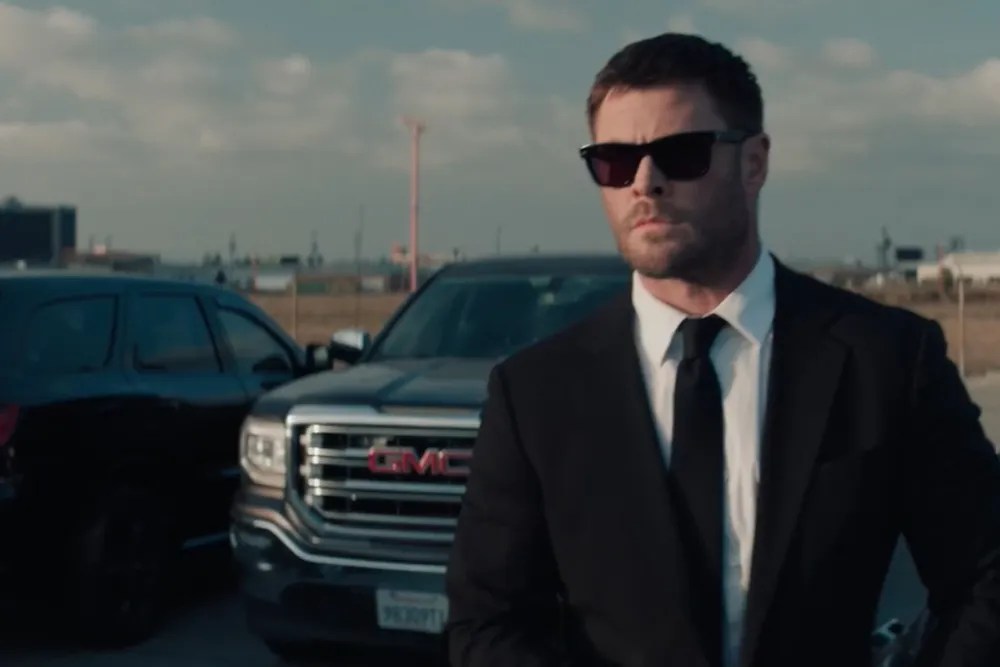
 Bart Layton’s neo-noir crime drama has a killer cast draped in a B-movie sheen. The aloof antihero is Mike Davis (Chris Hemsworth), who executes precise jewelry heists. Mike knows every detail of the courier or shop he’s knocking over and every job is done within a mile of LA’s 101 freeway, hence the name, shared with Don Winslow’s novella from which the movie is adapted.
 For What it's Worth