Archive | Article RSS feed for this section

Of Lanes and Games

7 Mar

City will miss cycling safety law’s May 1 deadline on changes to traffic through Porter Square area

By Tom Meek and Marc Levy Saturday, March 5, 2022

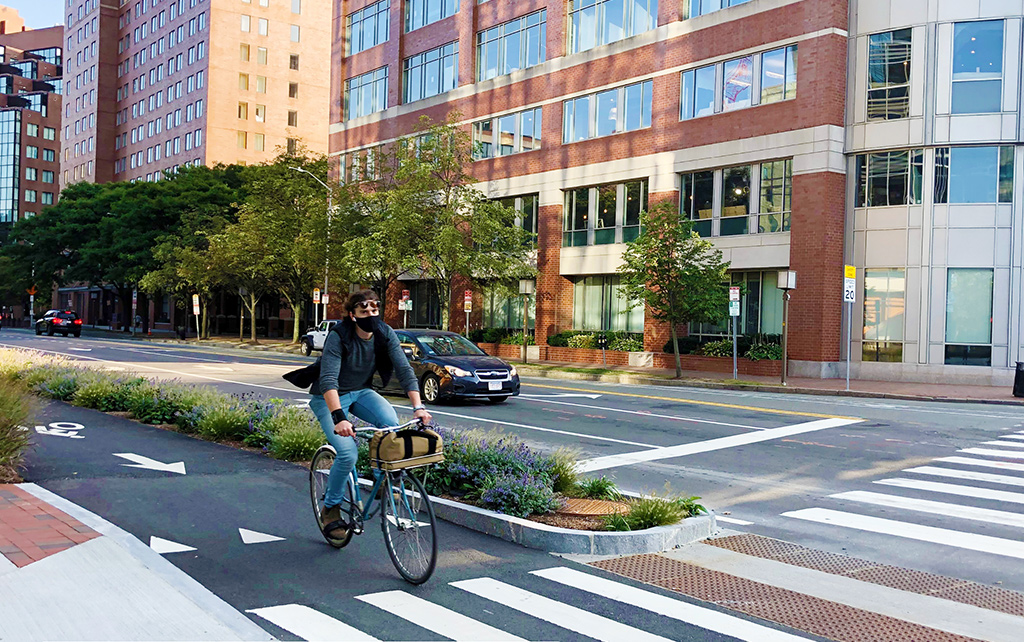
A bicyclist rides south through Porter Square on Jan. 25. (Photo: Marc Levy)

The city will miss its May 1 deadline to install quick-build separated bicycle lanes on Massachusetts Avenue through Porter Square, the city manager will tell the City Council on Monday.

Community engagement requirements, the need for more time to develop and install infrastructure to make up for the loss of current parking spaces and complications in scheduling contractors combine to make it impossible to meet the demands set by the city’s Cycling Safety Ordinance, City Manager Louis A. DePasquale said. The letter was included Thursday in the agenda packet for the next council meeting.

The bike lanes between Beech Street and Roseland Street are to be done in quick-build fashion using road paint and plastic flex-posts, with parking meters and loading zones moved to side streets to make up for some loss of spaces on Massachusetts Avenue. But a quick-build bus-and-bike project in November that cost parking spaces, angering businesses west of Porter Square, forced a reconsideration of how the Traffic, Parking & Transportation Department moved ahead with community engagement and mitigation efforts.

Continue reading →

Proposals for taking down trolley wire system then ‘partial-build’ bike lanes nudge forward

23 Feb

Bike Lane Games

By Tom Meek Friday, February 18, 2022

A sign taped to a municipal meeting notice warns that the city plans to “give away” Porter Square with quick-build bike lanes. Unlike with many websites, the URL on the flyer works only when https:// precedes it. (Photo: Marc Levy)

Transportation officials are moving toward removing overhead trolley wires that will allow an approach to building bike lanes that keeps more parking along Massachusetts Avenue in the northern parts of the city, representatives for the city and state said in two community meetings this week.

The MBTA held an information session virtually Tuesday on bus electrification and the North Cambridge depot redesign, drawing more than 150 attendees. Scott Hamwey, the MBTA’s director of bus modernization, said the state planned to de-electrify overhead catenary wires and switch to battery electric buses beginning in mid-March, removing the wires sometime in late 2023 or 2024. The North Cambridge depot would shut down for two years as it was turned into a bus-charging station; construction would start within the next year, Hamwey said. While just 3 percent of the fleet is electric now, the agency plans to make it fully electric by 2040.

Many in the audience argued that the current, wired buses were cleaner than the BEBs, which would be equipped with a small diesel engine cycling on and off to add warmth for riders on days cold enough that the buses’ electric heat is inadequate. The rebuilt depot would include a 5,000-gallon diesel tank on the north side of the site.

Only a small amount of the bus fleet use the overhead wires, which are deployed in only a small part of MBTA territory, and the system and buses that use it are aging and will require significant cost to upgrade and maintain, said Hamwey and senior director of vehicle engineering Bill Wolfgang.

Planning for Porter

The city showed “partial” bike-lane constructions options as part of a Wednesday presentation.

Continue reading →

House of Gucci

27 Nov

‘House of Gucci’: The styles clash in family drama

By Tom Meek Friday, November 26, 202

Ridley Scott’s “House of Gucci” unfurls like an epic crime saga – think “The Godfather” (1972) by way of the hit streaming series “Succession.” It’s got devious parlor games, backroom corporate jockeying, bloody agendas and plenty of unintentional camp, which is both good and bad. 

We’re talking the Italian fashion industry in the 1970s, when old-school Gucci lions Rodolfo (Jeremy Irons) and Aldo (Pacino) prided themselves on the lineage of special cows used to make super soft, artisanal loafers and handbags that cost most people’s annual salary. Aldo wants to kick the business into the more modern world with innovations such as malls in Japan; Rodolfo resists. But the real focus of “Gucci” is the fatal relationship between Lady Gaga’s uncompromising Patrizia and Rodolfo’s bookish son, Maurizio (Adam Driver). By now, you’ve probably read about the steamy sex scene between Gaga and Driver, and while it is steamy, it’s more a physical, crash-bang-boom event than an erotic interlude, befitting Patrizia’s driven woman: She works in her family’s trucking business until she’s successfully stalking Maurizio in a bookstore and getting that big ring, then pushing Maurizio into the family business with a pinch of Lady Macbeth mania.

The narrative of “Gucci” may be driven by the above- and below-board dealings of the fashion empire, but what Scott’s assembled here is a potpourri of characters that pop off the screen with a capital P. As Aldo, Pacino serves up a Thanksgiving ham with a big, viscous side of pineapple sauce, somewhere between his over-the-top take on Jimmy Hoffa in Martin Scorsese’s “The Irishman” (2019) and his “Hoo-ah!” hokum in “Scent of a Woman’’ (1992). Besides Gaga – more on that in a bit – the real scene-stealer is Jared Leto, unrecognizable under bad hair, potbelly and a prosthetic nose like Tom Cruise in “Tropic Thunder” as Aldo’s attention-seeking son Paolo, the Guccis’ own Fredo Corleone sad sack, full of ambition and always biting his tail. Iron’s ailing Rodolfo is gaunt and wan in the extreme, looking like the undernourished version of Gary Oldman’s Count Dracula in Francis Ford Coppola’s 1992 spin on Bram Stoker’s novel. (Irons is one of the only actors in the impressive ensemble who doesn’t attempt an Italian accent, which is both disconcerting and a blessing.) Driver’s his fine, likable self as Maurizio in a film in which not many of the characters are.

The film clearly belongs to Gaga, giving a big, bold performance that proves what we knew when she was Oscar-nominated in 2018 for her pop-star-in-the-making turn in “A Star is Born”: The woman can act and is a force onscreen. She carries the film through silly and serious, and even though it’s a big performance, it never spins into spectacle like some of her castmates’ do.

Scott, who recently lambasted superhero films, has had a long line of critical success – I’ll cite “Alien” (1979), “Blade Runner” (1982) and “Black Hawk Down” (2000) among the many– but takes a bit of a stumble here. It’s a whirlwind of concepts, stylization, allegories and an incredible cast all getting their big solos (did I mention that Salma Hayek plays Patrizia’s brassy tarot card reader?) without gelling at the core. At more than two and a half hours, “House of Gucci” is highly entertaining and the use of pop tunes from Donna Summer, Blondie and George Michael, to name a few, anchors the era with perfect aural nostalgia. But for all its build, bluster and pomp, in the end “Gucci” gets sewn up and sold like a cheap knockoff pump in the secondary market.

Wheel Good People, Part Deux

23 Oct

More wheel good people: Bicyclist help goes on, including an Oct. 24 Halloween party in The Port

By Tom MeekThursday, October 14, 2021

Lonnell Wells in his CambridgeSide mall Bike Give Back space with an organization intern. (Photo: Tom Meek )

A year ago we cast the spotlight on efforts by bicyclists to help those at risk from Covid-19 and to confront racism. Those ills persist, but so does the work by the Bike Delivery Program and the tight-knit team behind the Cambridge Bike Give Back initiative. Each mission has been sustained by the toil and generosity of volunteers, but now could use a lending hand.

The Cambridge Bike Give Back initiative, which takes old and unwanted bikes and retools them for those in need, was launched in August 2020 by Lonnell Wells and friends in reaction to the murder of George Floyd. It gives bicycles to kids who might not otherwise have one to ride with friends, or a person just out of prison needing an inexpensive way to get around in their reentry to society, Wells said. The program now has a storefront in the Cambridgeside mall parking garage. Vice mayor Alanna Mallon and former mayor Anthony Galluccio helped broker the arrangement, Wells said, and his sources for steel steeds has grown too. He’s reached out to municipal and collegiate police forces for unclaimed bikes and forged a partnership with Bikes Not Bombs, the original bike-driven social activist group down in Jamaica Plain. 

The Give Back program has provided more than 350 bikes since its founding last year, Wells said, in addition to hosting community barbecues and sponsoring a Black Lives Matter ride around Cambridge.

The program plans a family-themed Halloween party from 1 to 4 p.m. Oct. 24 at the Greene-Rose Heritage Park in The Port neighborhood. There will be a costume contest, games and candy for kids, free food for all and a raffle; bikes will be given away, and bike tuneups offered. (Organizers are looking for able bike mechanics to help on Sunday. If you have a bike you want to unload, they could use that, too. Email cambridgikegiveback@gmail.com.)

Continue reading →

Of Bike Lanes and Politics

4 Oct

With the installation of protected bike lanes comes a fast-moving issue for council race

By Tom Meek Friday, October 1, 2021

A bicyclist travels in a quick-build protected bike lane in Central Square. (Photo: MassAve4 Impacts Analysis)

A springtime study about bike lanes replacing on-street parking continues to send out shock waves, and is now playing a role in November’s elections.

Citizens groups have been formed, petitions are circulating and candidates are getting endorsements around the MassAve4 Impact Analysis report and other issues relating to the city’s Cycling Safety Ordinance. Passed by the City Council in 2019 and updated in October 2020, it calls for around 25 miles of protected bike lanes to be installed throughout Cambridge within five to seven years.

When released in April, the MassAve4 report triggered panic among business owners and residents who feared that nearly all on-street parking spaces would be removed in favor of quick-build protected bike lanes along Massachusetts Avenue from Harvard Square to Dudley Street, including Porter Square. The city quickly assured that it was only studying the effects of achieving the ordinance’s goals with quick-build options such as flex posts, signs and road markings rather than curb cuts, sidewalk and road surface alterations that would demand more planning, cost and resources and be less likely to meet the law’s timeline.

The city has not released a plan, but by May the city manager expects to identify where quick-build bike lanes will work and get City Council approval for a timeline on installing other kinds of bike infrastructure, according to the MassAve4 project page. Outreach and community engagement will be part of the process. If the city fails to have a plan approved in 2023, quick-build lanes along the corridor will be mandated by the ordinance.

Continue reading →

Asian Food Aid

31 Jul

Project Restore Us adds 150 families to its work delivering culturally appropriate food support

By Tom Meek Thursday, July 29, 2021

Project Restore Us, launched last year by restaurateurs Tracy Chang of Pagu and Irene Li of Mei Mei Restaurant of Boston, and others to help keep their businesses afloat while feeding the community, has expanded by partnering with the Asian American Resource Workshop and Vietnamese American Initiative for Development. On Sunday, working out of Mâe Asian Eatery storefront in Cambridge, 30 volunteers will cart groceries to an additional 150-plus families in need.

Instead of serving its enticing fusion of Thai, Chinese and Vietnamese, Mâe closes on Sundays – and this is when, Chang, Li and the Project Restore Us team perform their work of kindness.

Mâe is at 781 Main St., in The Port neighborhood between Central and Kendall squares.

One of the concepts behind the project was to provide people with nutritional and culturally appropriate food, replacing the random produce and low-nutrition processed fare that comes from most food pantries. The new partnerships allow Project Restore Us to more strategically deliver culturally germane groceries to area Vietnamese and Latinx families affected by Covid – bolstering the communities and hunger awareness in the face of a troubling uptick of hate crimes against Asians.

“The spike in acute anti-Asian violence has highlighted the importance of our work in combating the persistent violence of immigration and food insecurity that wearies and disempowers our Asian American and other immigrant community members,” said Marena Lin, one of the project’s co-founders with Chang, Li and Lily Huang, director of Massachusetts Jobs with Justice.

Chang adds that violence toward Asians is not new. “It’s just become more newsworthy during Covid because of the incidents in Atlanta. For instance, my grandparents owned a restaurant in Cambridge (Tokyo Restaurant) from 1988-2000. Multiple times, they were the target of hate crimes. They had a molotov cocktail thrown into their establishment. They were tied up, beaten and robbed on multiple occasions in their homes in Lexington and Winchester,” she said.

The project estimates it has delivered more than 300 tons of food to more than 8,000 households marginalized by the pandemic since May 2020. It plans to send two waves of groceries each month, or as funds dictate. Information is here.

Empowerment Mural Coming to the Square

25 Jun

Thaxton’s ‘Beauty of Everyday Living’ mural brightens Harvard Square kiosk construction

By Tom Meek Tuesday, June 22, 2021

Patricia Thaxton’s “The Beauty of Everyday Living” mural sections will beautify a Harvard Square construction site. (Photo: Greg Cook)

The ongoing construction around the old Out of Town News kiosk in Harvard Square will be brightened this week, with unsightly fencing and Jersey barriers wrapped in a vinyl scrim of artist Patricia Thaxton’s “The Beauty of Everyday Living,” a mural imbued with themes of Black joy and empowerment. The design honors Black Harvard students, is peppered with Harvard Square “Easter eggs” and weaves in nods to Cambridge community festivals and recent Black Lives Matter protests.

The mural, commissioned by the city, will expand as work by WES Construction expands in the fall. When the expected two years of construction ends, the renovated public space will have a community focus and is open to use by city-sponsored operators. Requests for proposals are ongoing throughout the rebuild.

A public event introducing the art awaits a clearer schedule from the construction contractor and coordination with the city’s reopening plans, Cambridge Arts’ Greg Cook said.

This is the first public art project for Thaxton, a Stoughton resident who grew up in Dorchester and taught home economics in Boston Public Schools until retiring in 2009. In her art career since, she has focused on mixed media works in which she said “no material is off limits.”

“I love the freedom I have with mixed media collage. Along my journey, I discovered the elements that fascinate me: texture, color and depth connect each work of art in my collection. Several pieces were inspired by images I’ve collected from newspapers, ads, magazines and photos that I’ve taken through the ages. I enjoy capturing the culture within and around our daily lives,” she said.

The Somerville Theatre will be back

25 Jun

Somerville Theatre will bring Davis more music with Crystal Ballroom replacing upstairs screens

By Tom Meek Sunday, June 20, 2021

Frame One is building the Crystal Ballroom at Somerville Theatre in Davis Square. (Photo: Tom Meek)

The pandemic had its own victims in the film business, with the ShowPlace Icon and the ArcLight – luxe theaters that opened just before the pandemic in the Boston area – shuttered for good. On the upside, the Coolidge Corner Theatre just announced an expansion that includes two new screening rooms and a community space, and all Cambridge theaters have reopened or are about to. So what’s going on with the Somerville Theatre in Davis Square? The Capitol Theatre in Arlington, also owned and run by Frame One Theatres, has been up and running for a few weeks, but the Somerville cine, host to screenings and live performances since 1914, remains ominously dark.

“We’re undergoing renovations and a changeover,” theater manager and newly minted creative director Ian Judge said during a recent visit to the iconic structure. The lobby is in the middle of a refurbishing; the bar is now set back, and the concession and merchandise area has been expanded. That far too “homey” bathroom just off the lobby is getting a much needed makeover. The biggest change is upstairs, where two movie houses are being returned to their original ballroom format.

Ian Judge will oversee the Somerville Theatre cinema and its new performance space. (Photo: Tom Meek)

What that means is that the theater will now host a nearly 500-person-capacity performance hall dedicated to live music, special events and private engagements such as weddings and corporate gatherings. “We had remodeled the downstairs theaters and knew we had to do something with the upstairs,” Judge said. With the pandemic and six screens in Arlington (and potentially two more coming in Harvard Square), Frame One decided it could fill different needs.

The new/old hall has an airy amphitheater-like vibe and a space that could be turned into a cozy bar in the back, with a coatroom to boot. Judge said the room could also be used for special screenings, which is good news for Independent Film Festival Boston, but likely never would be opened as just a public bar. (“I could see us doing something like trivia nights,” Judge said.) The main focus will be booking music acts, something Davis Square has lagged in since the amps went silent at Johnny D’s back in 2016. The space, which was known as the Hobbs Crystal Ballroom back in the day – it’s in the Hobbs Building – will now be the Crystal Ballroom at Somerville Theatre. Its capacity will be far greater than the 300-plus that Johnny D’s seated, just short of the 525-person hall The Sinclair offers in Harvard Square. The main downstairs theater, which has a capacity of almost 900, will continue its mixed-use operation as a cinema and live performance venue. The new configuration will have two entrances for each space.

The Somerville Theatre lobby is getting a touchup as well. (Photo: Tom Meek)

Judge, who had been furloughed for a year, will oversee the cinema and the new ballroom, while longtime staffer Peter Mattchen will take on day-to-day general manager duties. The Crystal Ballroom is expected to open in the early fall; opening for the three movie screens should be mid- to late summer with, Judge said, a new ability to show 4K films and a re-honed focus on 70mm exhibition; the Somerville and Coolidge are two of few theaters in the United States equipped to exhibit the classic, grand format. Frame One’s involvement in a plan for two Harvard Square movie houses (replacing a cinema that went dark in 2012) continues, though the project is stalled.

Bike Lane Impact Report Sends Ripples

22 May

Study of bike lanes showing parking loss alarms, but even bicyclists reject most extreme options

By Tom MeekFriday, May 21, 2021

A bicyclist travels in a protected bike lane in Kendall Square in an image from the city’s MassAve4 Impacts Analysis.

Fallout from a report about quick-build separated bike lanes continued Thursday at a virtual meeting of the Porter Square Neighborhood Association, with concerns from residents and business owners that parking would be eliminated along Massachusetts Avenue north of Cambridge Common.

“The city dropped the worse-case scenario,” said Ruth Ryals, president of the association.

No one at the meeting, bicyclists included, supported the most extreme options from the MassAve4 Impacts Analysis Report that would sacrifice significant amounts of parking along the avenue.

The report, released just in time to beat a May 1 deadline, is a byproduct of the 2020 Cycling Safety Ordinance, which calls for 25 miles of protected bike lanes to be built over the next five to seven years. Massachusetts Avenue is targeted for them as a major route through the city.

The ordinance acknowledges that quick-build bike lanes (defined mainly by flex posts and paint, but still relocating parking spaces, as happened with Cambridge Street) are easier to achieve than construction that involves adding concrete medians and shifting bus wires, which could force changes to the timeline to accommodate logistical challenges.

The city has said the report is not a protected bike-lane proposal, but about their potential effect on parking, but that’s a distinction some found hard to discern in the text. “I read the report and panicked,” Ryals said in her opening comments.

Bicyclists and business owners

Several members of the Cambridge Bicycle Safety Group, the local activist organization that pushed for the ordinance, spoke Thursday, including Rebecca Neuman, Sam Feigenbaum and cofounder Nathanael Fillmore. The positive community and environmental impacts of cyclists and cycling was stressed by Neuman, organizer of a Cambridge Bike Delivery initiative that engages volunteers to deliver food pantry items to community refrigerators in Cambridge and Somerville and to people with limited mobility. Others highlighted cycling deaths in areas with deficient cycling infrastructure – including Amanda Phillips in Inman Square; Bernard “Joe” Lavins in Porter Square; and Darryl Willis in Harvard Square – and shared city-gathered survey results showing that only 20 percent of those responding felt comfortable biking without a protected or separated bike lanes; 70 percent said the lanes would make them feel safer and more likely to take to the street by bike. Feigenbaum, a Harvard Law student, walked the audience through the details of the ordinance.

Fillmore summed up, saying what was illustrated in the report “was too extreme and not necessary,” and walked thorough some possible protected bike lane solutions that would not eliminate parking along the northern stretch of the avenue.

Business owners expressed concern for cyclists’ safety – and began their comments by stating their own use of bicycles and mass transit – but also fear for the economic impact resulting from the study’s findings. “Elimination of parking would be disastrous,” said Jeanne Oster, of the family-run Guitar Stop, opened by her father in the 1960s. Steven Beaucher, of Ward Maps, said if he had no way for people to come in and pick up large maps and the heavy transit signs sold by the store, he’d have to take his business online. He also conceded that losing some parking could be for the greater good.

More agreement than disagreement

Theodora Skeadas, executive director of the Cambridge Local First small-business group, attended the meeting. City councillor Dennis Carlone joined briefly to share his sympathy and concerns for cyclists and local business owners, and pointed out that while the council approves policy such as the cycling ordinance, it does not approve roadway and traffic changes. That work is handled by the city manager and his staff.

The evening meeting showed no signs of the battling among cyclists, residents and business owners seen over bike lane proposals after an initial rapid rollout in 2017. All groups wanted the others to succeed and be safe, and an improved quality of street life and amenities along the avenue. A “road diet” was discussed that including removing some stretches of Massachusetts Avenue median to make room for bike lanes; having the median was called something of a “religious” adherence by long-time residents, but ultimately people at the meeting didn’t consider it vital. Ryals said the avenue still has “that highway feel to it.”

“I came away from the meeting feeling quite positive, since from the discussion it sounded like there are broad areas of alignment between business owners, Porter Square neighbors and bicycle safety advocates – much more agreement than disagreement, in fact,” Fillmore said. He was optimistic roadway changes could be made “in a responsible and technically feasible way that will improve rather than detract from the ability of small businesses to thrive.”

City staff said the next steps would be to determine if quick build lanes are possible, and to provide protected bike lane options for review by the public.

Weed & Wine

17 May

Comparing cultures in her doc ‘Weed & Wine,’ Cambridgeport’s Cohen found the relationship

By Tom MeekThursday, May 13, 2021

Cambridgeport director and producer Rebecca Richman Cohen presents her documentary “Weed & Wine” on Saturday as part of the Independent Film Festival Boston. (Photo: Weed & Wine)

The bridge between law and documentary filmmaking has strong precedent in the Boston area. Cantabrigian Frederick Wiseman, whose filmmaking style is pretty much the embodiment of cinéma vérité, was teaching law at Boston University when he set off to make “Titicut Follies” in 1967; Mary Mazzio was working as an attorney at Boston’s Brown Rudnick when she decided to go to film school and make socially conscious films (“A Most Beautiful Thing,” “Ten9Eight: Shoot for the Moon”). This week, the virtual run of Independent Film Festival Boston brings focus to Cambridgeport filmmaker Rebecca Richman Cohen, who graduated Harvard Law School and now lectures there. On Saturday, the IFFB will screen her third documentary “Weed & Wine.”

Cohen, like Wiseman and Mazzio, is driven by the human side of her subjects. The continent-spanning film that details two families, the land they work, the challenges they face and the tradition of agriculture across generations began as a late-night conversation about terroir in a Parisian wine bar. Cohen describes the French-originated concept of terroir as “the way the land expresses itself in agricultural produce and the history and tradition of that land.” On the rooting of the project, Cohen says, “I woke up the next morning and still thought it was a great idea.”

One of the challenges in making the film was finding a French vigneron family to partake; many found the juxtaposition of wine grape growing and cannabis agriculture off-putting. “People kept telling me I was comparing apples and oranges,” Cohen said via Zoom, “but in the end, it was about family.” Ultimately Cohen gathered with the Jodreys in Humboldt County, California, and the Thibons of France’s Rhone Valley. The patriarch of that Californian cannabis farm, Kev Jodrey, is a New England transplant (you can hear a trace of it in his accent) and has been growing his product outside legal boundaries for years. The Thibons, on the other hand, have been tending to the same vineyards for hundred of years.

Cohen fell into filmmaking by happenstance while attending Brown University. “I got a job as an assistant editor when I was studying aboard in college, because I couldn’t figure out what else to do. Then I got hooked. After college, I worked for Michael Moore as an assistant editor on ‘Fahrenheit 9/11.’” Cohen’s other documentary features include “War Don Don” (2010), which puts the Serra Leone justice system under a microscope, and “The Code of the West” (2012), which looks at medical marijuana growers in Montana as regulations and policies are reevaluated.

French vintner Hélène Thibon in “Weed & Wine.”

Cannabis farmer Kevin Jodrey in “Weed & Wine.”

Before making “War Don Don,” Cohen had been in Serra Leone using her legal knowledge in a humanitarian capacity. “I’m not an attorney,” Cohen points out quickly. “I’ve never taken the bar.” The subjects she lectures on, human rights and humanitarianism as told through the lens of documentary films, and using video and media as evidence and advocacy, seem to meld seamlessly with her social focus behind the camera.

It took nearly five years to make “Weed & Wine” since Cohen imbibed the idea in that wine bar. One of the realizations the filmmaker had along the way was that her thesis about land focus shifted some, becoming more about those using the land and their kinship to it and each other. Cohen said that sense of family and community became increasingly meaningful to her because during the filmmaking process she became pregnant and had a child. “A total pandemic child,” she says of her 15-month-old.

Covid delayed the release of “Weed & Wine” for nearly a year. Cohen had imagined that the Jodreys and Thibons would meet in person at the premiere or a festival screening; instead that happened by Zoom, Cohen says with a tang of sadness. “But the funny thing is,” she says, “is what do you think was the first thing they talked about? The weather. What else do farmers talk about?”

One of Cohen’s key cinematic influences is “Fast, Cheap & Out of Control,” Cambridge filmmaker Errol Morris’ 1997 documentary about a lion tamer, a robotics expert, a topiary gardener and a specialist in naked mole rats. Interestingly too, one could argue that Morris has a link to law; before coming to filmmaking he was a private investigator, a skill that helped mightily when digging into the gunning down of a Texas police office in “The Thin Blue Line” (1988), a film that helped get an innocent man out of jail. What resonated with Cohen about Morris’ film was the juxtaposition of diverse endeavors and the common themes that linked the subjects. “It’s kind of a bit like what we did with ‘Weed & Wine,’” Cohen says.

Cohen wants to next examine mass incarceration in conjunction with such social movements as Black Lives Matter and #MeToo. One thing Cohen was adamant about during our interview was that film is a collaborative process, mentioning that the film would not have been possible without her committed team of producers and crew – and the final product is impressive in terms of production values and synergy. Screenings of “Weed & Wine” will be accompanied by a prerecorded Q&A.