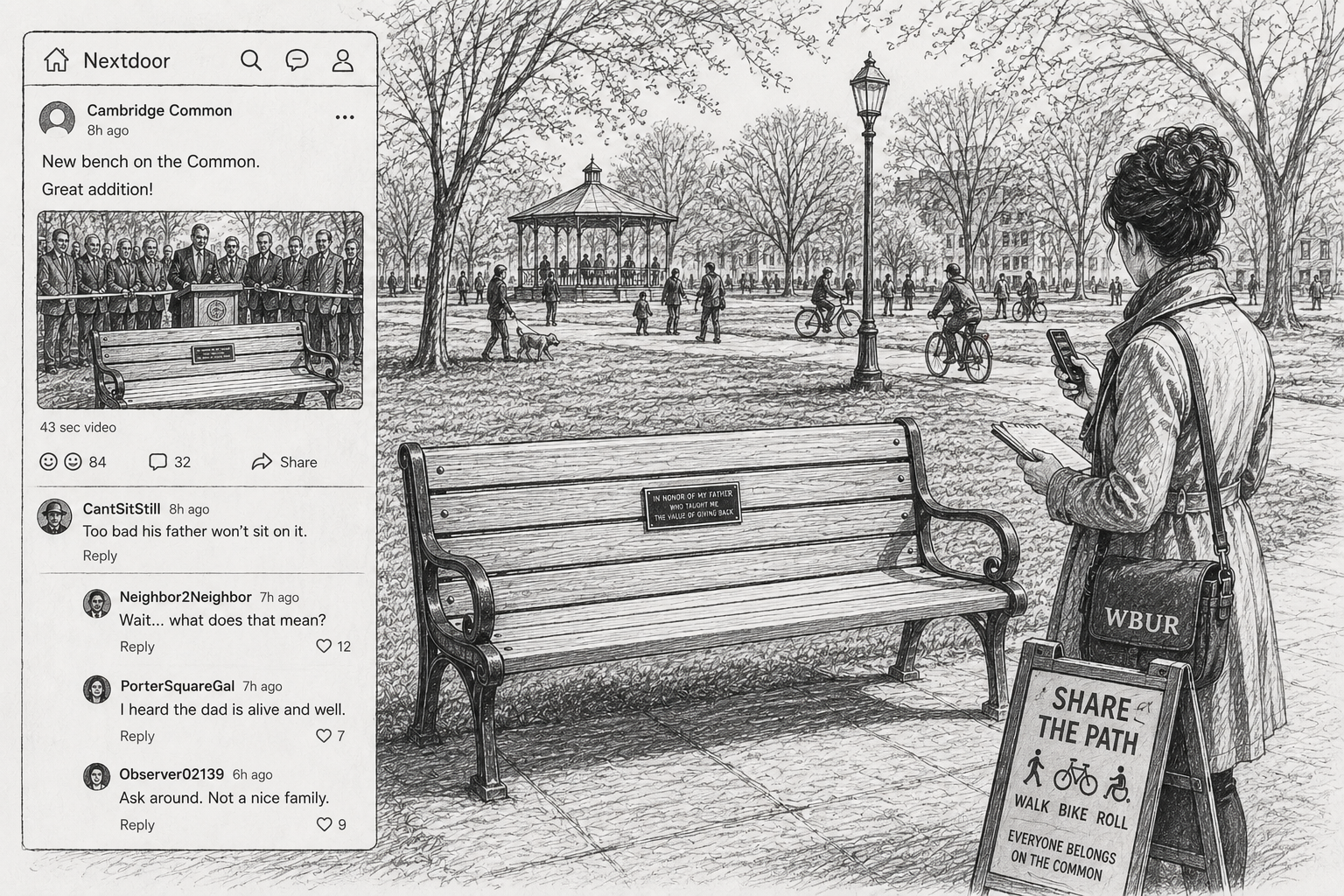
The Bench
By nine o’clock the video had been viewed more than nine thousand times.
It wasn’t much to look at. Forty-three seconds of shaky cell phone footage posted to Nextdoor. A ribbon fluttering in the breeze. A city councilor applauding. A bronze plaque catching the afternoon sun. Somewhere off-camera, a child let out a sing-song whine about ice cream.
The title read simply: “That new bench on the Common.”
The first dozen comments were predictable.
“Beautiful addition.”
“Nice to see people giving back.”
“Great, but needs shade trees.”
Then, at 8:17 p.m., CantSitStill, an anonymous account that no one seemed to recognize, joined the conversation. “Too bad his father won’t sit on it,” was all they said, and nothing more.
By morning, the post had turned into an online trial.
Victor Haskell refreshed the thread every thirty seconds. He half-expected the dedication to earn a polite newspaper brief and perhaps get a well-framed photograph for the annual report of the Haskell Foundation. Instead, strangers were debating his childhood, his marriage, his taxes, his politics and, most bafflingly, his father.
“Isn’t his dad dead?”
“No, just saw him at Whole Foods.”
“T heard they’re estranged.”
“My cousin worked for Victor. He can be difficult. Believe the comment.”
“Believe what?”
“Believe what you see is not reality. Wealth comes easily to those who have not earned it.” CantSitStill responded and then went silent in the wake of the tidal wave of follow-up questions.
Victor had paid nearly forty thousand dollars for the bench —fine, marbled New Hampshire granite, reclaimed ash and a custom bronze plaque honoring his father:
IN HONOR OF MY FATHER, RICHARD HASKELL, WHO TAUGHT ME THE VALUE OF GIVING BACK.
He had agonized over the wording. Now no one was discussing the bench, they were talking about him and his motives.
Over lunch, he called the Public Parks Department. “Can the comments be turned off on Nextdoor?”
The woman paused. ”…Sir, we don’t run Nextdoor.”
By afternoon, someone had posted a screenshot of the thread on Reddit. The screenshot then migrated to a local Facebook group concerned about community and public spaces.
That evening, one prominent poster asked if such public philanthropy was genuine generosity or self-branding.
Victor typed three different replies before deleting them all. His wife, Ellen, looked over her reading glasses as he backspaced, typed, and backspaced again.
“You know,” she said, “normal people don’t spend their anniversary reading comments from strangers.”
“They’re lying.”
“They don’t know you.”
“They’re acting like they do.”
“They always act like they do. Ignore it. Get off social media, it’s going to make you crazy. And by the way, we have a reservation at Giulia at 6.”
He wanted to tell her she didn’t understand. That this was about his dad. Instead, he refreshed the page and dug in deeper.
A week later, he returned to the Common wearing a Red Sox cap and wide-framed sunglasses. The bench was occupied, but not with the tourists admiring the plaque or families eating lunch as he had imagined. No, a tan elderly man, wisened by the sun, wearing paint-splashed work boots, sat alone, shredding the remains of a bagel for the flock of gathering pigeons.
Victor hung back and observed from a comfortable distance. The pigeons made short work of the crumbs and pecked at the man’s boots, demanding more.
The man ignored their plea, stood, stretched, and walked away as the birds fluttered up around him.
Staring at the empty bench from his vantage point, Victor realized that it looked like any other bench along the pathway. His just had a fresher coat of paint and the plaque that reflected the sun with purposeful intensity.
From the opposite direction a young woman in conversation with an older woman walking a golden retriever approached the bench.
Victor straightened his jacket.
The young woman’s hair was piled high in a feathery updo, and the conversation seemed unusually formal. At times, the younger woman gestured toward the bench as if discussing it. She also appeared to be recording the exchange on her smartphone, though Victor couldn’t be certain. He hated those things. They robbed people of the moment. Besides, he couldn’t hear a word of what they were saying. As unobtrusively as he could, he drifted closer, but just as he neared the pair, the young woman slipped her phone into her pocket, shook the older woman’s hand, gave the dog a perfunctory pat on the head, and the two parted ways.
Staring at his computer screen that evening, he saw that the thread had surpassed nine hundred comments.
People who Victor had never heard of said they had worked for his dad. One even said they were a former classmate.
There were others, too, that claimed to know people who knew. Everyone possessed a fragment of something, but no one had the whole story.
Late the following afternoon, Victor drove out to Belmont.
His father was fast asleep ina chair beside the window when the nurse led him into the room.
The old man opened his eyes. For a moment Victor thought there was recognition.
Instead, his father smiled politely. “Have we met?”
Victor nodded. “I built something for you,” he said.
His father looked out the window. “The birds are here early.”
Victor wanted to tell him they had been there a while and were getting ready to roost, but just smiled. He stayed another hour, but never mentioned the bench.
Driving home in the dying light as the shifting shadows and glints played with his sensibilities, he remembered being ten years old, riding beside his father in an old pickup. They had passed a weathered wooden bench outside a country church.
His father slowed the truck. “See that?”
Victor nodded.
“Been there forever. That’s where your mom used to put your booties on before going inside. You used to make such a racket. Wailing and red-faced as a beet. And then, after she tied the last lace, you’d become so quiet and still. Like a little angel. A good bench serves.”
He hadn’t thought about those words in forty years.
The following Saturday he returned to the Common just after sunrise.
The bronze plaque was gone. The outline remained along with four empty bolt holes that caught the early morning light at obtuse angles.
At first, Victor thought someone from the Parks Department removed it for a polishing, but it was just installed. That made no sense.
A young couple sat down with a loaded coffee cup carrier between them. A passing cyclist dismounted and used the other end of the bench to tie his shoe.
Victor watched life unfold. A woman in scrubs ate a pink- glazed donut and scrolled away on her cell phone while a father read to his daughter seated in a shaded stroller. The memory of his father was nowhere in the scene, but people were appreciating his gift.
Victor felt a pang of hunger and wanted one of the warm yeasty bagels he had come to enjoy at the newly opened bagel shop in Harvard Square. As he approached the arched gateway to the Common across from the golden horseshoe path commemorating Paul Revere’s historic ride, he saw the young woman with the updo. She was speaking quietly into her phone.
“…yeah, I think we have enough,” she said. “No, I’m not naming the account. That’s not the story.”
She listened and then sighed.
“T know. But it’s just a bench.”
She hung up and turned to face Victor, who was staring at her with fixated intensity. “Hello, can I help you?” she said calmly.
“Uhbhhh…” Victor fumbled. “Are you talking about the new bench in the park?”
“Yes, why? I’m a reporter. My name is Grace Chen, I work for WBUR,” she extended a hand, “and you are?”
“Victor, Victor Haskell.”
Grace’s face lit up. “I called your office a few times,” Grace said, “I’ve been trying to talk to you, but the woman I spoke with said you were off for the week and wouldn’t be checking your email. She also said you don’t have a cell phone.”
Victor smiled. “I lived without one, so far so good, why go changing? What can I do to help you?”
“We are trying to determine why there is such a viral tidal wave about the bench you donated to the park. At first it was mysterious and then we reached out to the poster— CantSitStill.”
“Who is it?” Victor interrupted.
Grace smiled demurely. “Tm sorry, I can’t disclose that,” she said. “But I can say it is a misunderstanding by someone from your father’s past who wasn’t aware of his current condition.”
Victor stood there, dumbstruck.
“Here,” she said, “here is my card.”
Victor took the card sheepishly and watched Grace walk off towards the subway station.
Two days later, Victor returned to the Common. Two young girls in pink taffeta dresses bounced Ken and Barbie dolls along the bench as their mothers hovered nearby, engaged in an ever- morphing, rapid-fire conversation.
“Did you see the piece on the stalker who harassed the guy who donated this bench?”
“Something about the stalker’s dad having worked for the donor’s dad and there was some bad blood over a real estate deal or something like that?”
“Yeah, and the reporter discovered that the whole deal was sabotaged by another party, and that the stalker had no idea that the father was in a memory care facility.”
“People are so silly,” the taller of the two said, shielding her from the sun that glinted off the sign Victor had so lovingly created.


Leave a Reply