A myth reconsidered in this grim but powerfully told version of a life that might not have been heroic.

Revisionism is a powerful dispeller of myth. Consider how Oliver Stone, Francis Ford Coppola, and Stanley Kubrick reframed the public understanding of the Vietnam War. Or how Sergio Leone, Sam Peckinpah, and Clint Eastwood cut the morally righteous reins on the American Western.
What about Robin Hood, the legend who stole from the rich and gave to the poor? A regular champion of the poor, like Mother Teresa, and a candidate for a Nobel prize? Not so much in Michael Sarnoski‘s dark reckoning, where Mr. Hood is looking for atonement before his book closes on his not-so-noble reputation. He’s played by
Hugh Jackman with world-weary gravitas, conveying sadness in his eyes and the simmer of rage in his heart.
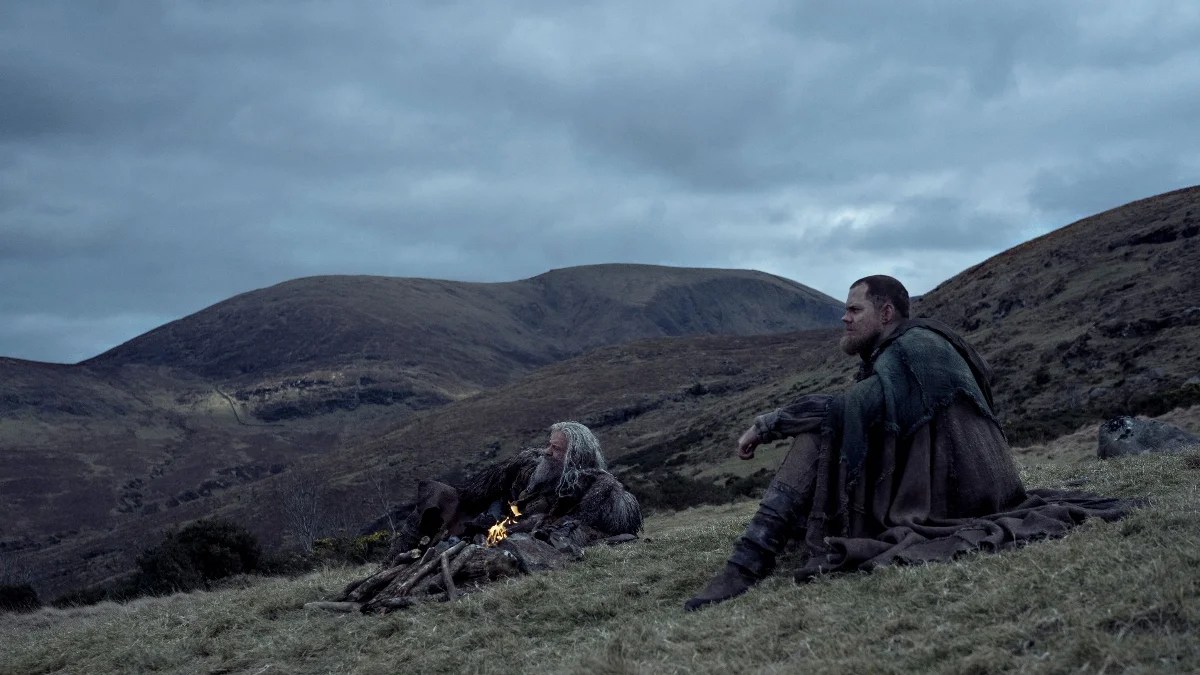
The film is gorgeously shot by Paul Scola, who worked with Sarnoski previously on “Pig” (2021) — then again, the bare north mountains of Ireland do a lot of this movie’s heavy lifting. We learn early on that this is not Errol Flynn’s swashbuckling Robin Hood. Our Robin has been enmeshed in the cycle of violence all his life, hunted by the kin of those he killed. He’s adroit at bloodshed. There’s no flashback to show us whether the younger Robin’s deeds were derring-do or thuggish savagery.
Somoski keeps us in the moment as the reticent Robin gives fireside space and food to a starving fellow wanderer. The traveler mentions Robin Hood and his lore — throughout much of the movie, Robin obfuscates his identity — and Robin solemnly retorts that the legend is “lies upon lies.” The traveler, like Robin, is elusive, and the scene sets the tone for how Jackman and Sarnoski have decided to deconstruct the outlaw.
The legend of Robin Hood has been rewritten over the centuries. In early medieval ballads, he was a mercurial bandit and cautionary tale; later, during the Peasants’ Revolt of 1381, he became the bawdy bardish bad boy with his band of merry men who brought laughter and goodness to all — except the serf overlords they stole from. Of his eventual companions — Little John, Maid Marian, and Friar Tuck — only John makes it into this redux. Played by Bill Skarsgård (“Barbarian,” and Pennywise in “It”), he goes by his real name, Edward. He’s now married with a family and a farm compound, but after he’s outed as John, and a band of those formerly wronged seize the farm and hold his family hostage, John appeals to Robin to break out the bow and cold steel to help free his family. The siege is a long, bloody, and muddy affair akin to the signature grit and gore of Robert Eggers’s “The Northman” (2022).
It feels like the movie crests too early, but that’s by design. The film shifts gears as the gravely wounded Robin wakes up in the care of Sister Brigid (Jodie Comer, “The Bikeriders”) at a priory situated on a small island. It’s here, as Robin heals and helps supply the priory’s flock of orphans with trapped game, he becomes deeply reflective and self-critical — Sarnoski is more interested in truth and atonement than redemption. Sister Brigid augments Robin’s recovery with good, old-fashioned bloodletting, while a nameless leper (Murray Bartlett) tends to his spiritual wounds. Instantly recognizing Robin’s true identity, the leper forms a bond with the aging outlaw and becomes an unlikely source of enlightenment.
Sarnoski’s film is not the first to imagine an older, darker Robin Hood. In 1976, Sean Connery took up the mantle in “Robin and Marian,” opposite an impressive slate of co-stars that included Audrey Hepburn, Robert Shaw, and Richard Harris. Ironically, that film was originally going to be called “The Death of Robin Hood,” but the studio thought the title too grim. Not Sarnoski, whose film teems with grimness.
Cinematically, both flavors of Robin can coexist. Consider it a Robin-verse. Next up, I’d love to see a modern-day, Errol Flynn-amped Robin and his merry band of AI-replaced unemployed take on Elon Musk and the tranche of trillionaires.


Leave a Reply