Archive | 2020

Racism hits local restaurant

23 Nov

Urban Hearth’s outdoor John Lewis mural vandalized Monday in ‘obvious hate crime’

By Tom Meek
Tuesday, November 17, 2020

It’s been tough for restaurants recently with shortened hours, colder temperatures and perhaps another shutdown looming. Adding to the woes for Urban Hearth, the young nouvelle can-do north of Porter Square on Massachusetts Avenue, was an act of vandalism Monday that owner and chef Erin Miller described as “an obvious hate crime.”

“I’m absolutely gutted,” Miller said. The eatery’s cozy sidewalk pavilion, which I visited for a meal in August, had been since adorned by a mural enshrining recently passed civil rights icon and longtime Georgian lawmaker John Lewis, the subject of the 2020 documentary “Good Trouble.” The full-length alfresco design by local artist Rocky Cotard, commissioned by Miller and finished in early October, was marred by black spray paint in the middle of the night. To get to the images, the vandals had to get past dense pilings of furniture.

“Do not turn away from this … It is a violation of all that is decent, good and hopeful in our world,”Miller said online.

Miller said the police were beginning an investigation; it was unclear if there were cameras nearby that might have video helpful in the matter.

On Wednesday, police said several businesses in the 2200-2300 block of Massachusetts Avenue had been vandalized late Monday or early Tuesday, suggesting the vandalism was not exclusively targeted at the mural. Detectives are following up and looking for video evidence, said Jeremy Warnick, director of communications and media relations for Cambridge police.

While the Hearth has shut down the patio temporarily, the restaurant remains open for takeout.

The Climb

17 Nov

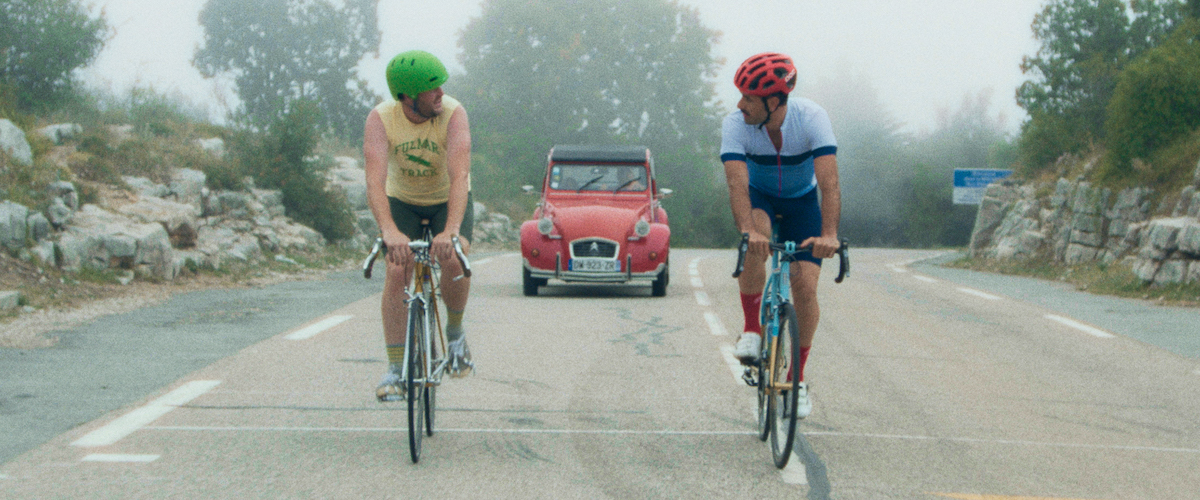
‘The Climb’: Clever twists along trail of bike ride where soon-to-married bud really feels the burn

By Tom Meek
Thursday, November 12, 2020

If “The Climb” were a pop song, it would be a spin on Lady Gaga’s “Bad Romance”; call it “Bad Bromance.” The dark, witty indie gem begins with the event of the title, a long bike climb through the hills of France as one buddy Mike (director, co-writer Michael Angelo Covino) gives climb and cadence instructions to bestie Kyle (co-writer Kyle Marvin) as they ascend the seeming endless rise. Between the wheezing and puffing we learn that Kyle’s about to be married, and the endurance undertaking is the bachelor bonding event du jour. Then Mike lets out the sucker punch that he’s slept with Kyle’s fiancee – multiple times. “I’m going to kill you!” Kyle huffs, unable to catch up to the object of his ire. “I know; that’s why I told you on a hill,” retorts Mike without care or fear.

With friends like that, who needs enemies, right? Mike and Kyle end up in a French hospital for reasons other than what you’d imagine, where Kyle’s to-be shows up and things really get skewed. Like the cagey recent thriller “Let Him Go” there’s a sudden pivot to a major life event. You expect it to be a funeral or a wedding (I’m not going to tell you which), but you drop into the opposite. “The Climb,” which begins with a masterful long shot by cinematographer Zach Kuperstein, feels contained in location and time, but then the action goes stateside – Upstate New York, to be exact – and spans years. Mike’s something of an alcoholic mess, while nice guy Kyle has moved on and found another mate to marry (Gayle Rankin, also quite good in “Blow the Man Down”). It’s Kyle’s meddlesome mom (Talia Balsam, while George Wendt of “Cheers” plays dad) who draws Mike back into the fold, and sure enough, with another fiancee in the wings, history looks to repeat itself.

There’s not a lot of action in “The Climb.” It’s a character study of just how far one friend can push another. Remember just how much fun it was to wince and smile at the insanely descriptive tactics of Thomas Hayden Church in “Sideways” (2004)? Same here. We never even really find out what Mike or Kyle do for a living – it’s besides the point. The film’s competently made and droll; you can tell these two spent many a nights penning and rehearsing the material together, and given the names are what they are, you wonder where the characters begin and the real Mike and Kyle leave off. “The Climb” is a quick, nasty burn with some clever twists. Some might even find it life-affirming. I’m not sure I did, but I’m curious to see what this tandem comes up with next. 

Ammonite

17 Nov

‘Ammonite’: Paleontologist dig on the coast turns up something bigger that’s been buried

By Tom Meek
Thursday, November 12, 2020

Period pieces are often slow builds of quiet, repressed inner turmoil, in which women find themselves subjugated to dour social mores that hold them tamped conveniently down, simmering and waiting to explode. Many erupt in the form of a sexual awakening (mostly taboo) with participants fighting through bloomers, long johns and other impediments to reach their communal ecstasy – there’s so much to get through one has to wonder if the task of unwrapping is not a killjoy.

Can one imagine a slower build or anything less sexy than a paleontological expedition to ignite one’s rebellion and passion? That’s what lies at the heart of Francis Lee’s “Ammonite,” a tale of two real-life souls, not knowing it at first, but in desperate need of a human connection. The main is Mary Anning, played by Kate Winslet, an amateur scientist who became a world-renowned paleontologist for her discovery of a complete ichthyosaur skeleton in the Jurassic-rich seaside cliffs of Lyme Regis, England, in the mid 1800s. Mary, sooty and a scowl ever etched upon her face, lives with her curmudgeonly mother (Gemma Jones), who seems void of any form of a matronly bone. It’s not the happiest of existences, but Mary has her cliffs, her picks and brushes, and late-night dates dusting her way to her next big discovery.

Her notoriety elicits the attentions of  Roderick Murchison (James McArdle), a well-off businessman, geologist and dinosaur enthusiast who wants to, for a good fee, shadow Mary on her daily treks and afternoon scratching-and-classification sessions. In tow is his young bride, Charlotte (Saoirse Ronan), recently traumatized by a miscarriage. Roderick is hardly there at all when he announces bigger matters require him overseas, but that the sea air should be good for Charlotte. He checks her into a swank seaside hotel before departing. The coast of county Dorset is impressive, but, as shown, it’s forever shrouded in gray mist, hardly the place to educe joy from a depressed soul. Mary, in countenance and demeanor, is a reflection of the landscape she scours. Charlotte tags along some with Mary. In one scene Mary pulls up her bloomers, urinates and, barely wiping her hands, breaks off a piece from a loaf of bread and offers it to Charlotte.

This is late in the film, and by this time one might wonder where this is all going. Charlotte, after saltwater exposure, gets deathly ill, and it’s Mary who takes on the task of nurturing her back. It’s a long road, and there’s little connection between the women at first except the sisterhood of living in a chauvinistic world; but as Charlotte begins her climb out, other connections and human needs bloom. Lee, who made his mark with “God’s Own Country” (2017) about men in love, knows how to navigate this territory carefully, and when the two finally give in, it’s raw, primal and edgily erotic.  

The key to Lee’s success here, however, is his casting. These are two of the most interesting actresses of our time. Between them they have 10 Best Actress Oscar nods. Winslet has had long-running success from “Sense and Sensibility” (1995) to “Titanic” (1997) and later “Eternal Sunshine of the Spotless Mind” (2004) and “The Reader” (2008, an Oscar win), while Ronan, who burst onto the scene in “Atonement” (2007), has also compiled a diverse CV with such varied works as playing Greta Gerwig’s alter ego in “Lady Bird” (2017) and as a genetically engineered military weapon in “Hanna” (2011). “Ammonite” undoubtedly will garner comparisons to Céline Sciamma’s “Portrait of a Lay on Fire” (2019) and rightly so – same loose time, geographical area and restrictive social collars on women, where their happiness is not a dinner table conversation. No, for the passionate and the brave, it happens in the shadows. How that concludes in Lee’s rendering leaves fodder for pondering, and will likely send you to Google to learn more about Ms. Anning and Mrs. Murchison.

Let Him Go

12 Nov

‘Let Him Go’: The grandparents have concerns, and the weaponry needed to see them through

By Tom Meek
Friday, November 6, 2020

Writer-director Thomas Bezucha rekindles the essence of a B-noir potboiler with the fast, efficient and lean in execution “Let Him Go,” based on Larry Watson’s novel, which gets a big boost from some knockout performances – in the end, the main reason to see the film.

Those smart castings include Diane Lane and Kevin Costner as Margaret and George Blackledge, salt of the earth souls running a horse farm in 1960s Montana. The actors were paired before as Clark Kent’s earthbound parents in “Man of Steel” (2013), and were about the best thing in Zach Snyder’s Superman reboot. Here they’re just as good, and in good company. Costner’s George is a former lawman, and the golden-age couple live an idyllic existence until their son (Ryan Bruce) dies in an accident, leaving behind his wife Lorna (Kayli Carter) and their infant grandson, Jimmy. Lorna shortly thereafter remarries a handsome outsider named Donnie Weboy (Will Brittain); one day passing through the center of town, Margaret spies the young man slapping Lorna and the boy around. The next day the young couple and child have vanished, leading Margaret to implore George to use his connections to locate their vulnerable grandchild.

All roads lead to North Dakota, where Donnie, Lorna and Jimmy have settled in with the Weboy clan (laugh all you want about the name, this group is no laughing matter) under the iron rule of Blanche (Leslie Manville), a fierce momma grizzly lording over Donnie and his three brothers. “The Big Valley” this is not. Manville, so good and Oscar nominated for her turn in Paul Thomas Anderson’s “Phantom Thread” (2017), is even more malevolent and imposing here. The sideways invite to the Weboy ranch for pork chops and the creepy car ride out there puts Margaret on edge, and eating those chops with Donnie’s hyena-faced brothers (including one played by Jeffrey Donovan, another standout in a small part) is an uncomfortable affair. The Blackledges get to see little Jimmy for only five minutes. Not to give too much away, but tensions escalate, wicked Blanche fosters a call to arms and things get bloody. The local law – clearly Weboy-owned – won’t help, and so Margaret and George, beaten down and outgunned, dig deep to extricate their boy’s boy from an abusive environment. Think of the siege in “Straw Dogs” (1974), with two strong matriarchs going at it. There’s nothing surprising; just same damn fine acting and the fear of god Manville’s Blanche leaves ingrained in the viewer’s mind.

City Hall

5 Nov

Cambridge documentarian Frederick Wiseman turns his camera on Boston for a sprawling four-hour immersive portrait of the city.

Tom Meek for the Patriot Ledger
November 3, 20202

For his 45th documentary feature Frederick Wiseman trains his lens on his native Boston to record all things municipal unfolding in the cement encased corridors of Gerhard Kallmann’s infamous Brutalist facade. The retrospective of how we operate and function in the Hub is an engrossing four-and-half-hour watch (yes, you heard that right) that amazingly goes by in a blip and serves as something of an eerie — and taunting — time capsule. Shot during 2018 and 2019, one segment has Mayor Marty Walsh and authorities preparing for the Wold Champion Red Sox Duck Boat celebration. Later we see fans chanting “Mookie, Mookie, Mookie.” Betts famously left us in 2019 and recently performed his heroics in the 2020 World Series for that team we vanquished in 2018 (the L.A. Dodgers), and all that Wiseman’s camera captures, strangely feels from another era as the city bustles in pre-COVID normalcy — one can only imagine what a 2020-2021 version of “City Hall” might look like.

The Government Center delve unfolds in a series of chapter-esque meanders between the micro and macro with plenty of shots of Boston’s iconic skyline and landmarks to root you. The rendering should make plenty of Beantowners proud and Walsh, seemingly ever aware of the camera, comes off crisp, progressive and inclusive — a shining illumination that may pose something of an extra hurdle for upcoming challenger Michelle Wu and others. In Wiseman’s classic observant, cinema verite style (fly-on-the-wall) there are several long takes of municipal proceedings such as the budget review where presenters effusively tout the investment in infrastructure as a win-win because it not only betters the community, but also makes the city’s debt more appealing to bond investors. It’s a cut-and-dry matter that under Wiseman’s eye is more interesting and accessible than it sounds, but “City Hall’ is most affecting when following the day-to-day operations of front liners, namely the 311 help center workers trying to iron out neighborhood issues or city magistrates mitigating parking tickets — an anxious expecting father who parked in front of a hydrant and an incredulous old-schooler who didn’t know there was resident parking along Congress Street — and then there are those out in the community removing trash and providing subsidized veterinary care.

What’s truly amazing to note too is that Wiseman, at the age of 90, is still cranking out documentaries on a near annual basis and does all the editing to boot. For those not familiar with the works of the Academy Award honored documentarian, a law professor at BU and Brandeis before picking up the camera, they’re slice of life exposés that quietly drink in their subjects without question, preface or prod the way you might get from a Michael Moore (“Roger & Me,” or “Fahrenheit 9/11″) or Morgan Spurlock (“Super Size Me”). The result conjures an uncanny sense of intimacy; there’s no barrier, you are organically and viscerally part of the scene. “City Hall” in scope and focus feels like a natural addition to the the director’s unofficial community series that began with “Aspen” (1991) and includes “Belfast, Maine” (1999)” and “Jackson Heights” (2015). Must see Wiseman films in my not-so-humble opinion are “Boxing Gym” (2010) and his controversial first film, “Titicut Follies” (1967) about the Bridgewater State Hospital for the Criminally Insane, which, because of its graphic nature, was banned from being shown in Massachusetts until the early 1990s.

The most moving and telling scenes in “City Hall” are those steeped in earnest reveals and communal conflict. Talking to veterans afflicted by addiction and PTSD, Walsh shares candidly his dark days as an alcoholic. The connection both onscreen and in the room is immediate and palpable, something that doesn’t quite register as much when Walsh underscores his Irish heritage as a bridge to a Latino community. Then there’s the Thanksgiving feast for those challenged by Down syndrome and similar arresting disorders where Walsh and crew dutifully serve expectant diners and cap it all off with dancing. Wiseman never lets his lens sway you, but if you don’t have a bittersweet bump inside you, you probably didn’t flinch when Old Yeller died. The big rub in the film comes during a community outreach meeting run by a predominately Asian coalition of businessmen seeking to institute a recreational cannabis facility in a predominately Black and brown section of Dorchester. The two sides talk at each other, the rhetoric’s tinged with the annoyance of not being heard and there’s the clear fear of being taken advantage of, with the city and the Massachusetts Cannabis Control Commission — who are not in the room — taking the brunt of the shots. It’s a telling back and forth that raises the question of equitable economic development and how to earnestly empower a community in the process without gutting them.

One of the things that makes Wiseman’s films so captivating is the sense of cadence and human rhythm he imbues them with. “Boxing Gym” and his 2009 ballet troupe portrait “La danse” are driven by repetition and pursuit of form. In “City Hall” there are mesmerizing long takes of mattresses and barbecue grills being obliterated and compacted by a garbage truck’s compressor and long spindly tree limbs are methodically pulled in and consumed by a restless wood shredder — activities quite mundane and everyday, that in Wiseman’s purview magically become hypnotic wonderments. Also too, Wiseman’s longtime collaborator, cinematographer John Davey artfully finds Escher-esque motifs and reflections within reflections amid our familiar facades. His upward angled framings cut aesthetic portraits of old Scollay Square and the bland Saltonstall building in ways one might not have imagined possible. “City Hall” in the end, is a dutiful reflection of who we are, where we came from and a piquant insider look into the vast municipal neural net that keeps us humming as a community.

I am Greta

25 Oct

‘I Am Greta’: Young environmentalist speaks; Whether we listen lies beyond director’s lens

By Tom Meek
Friday, October 23, 2020

The documentary “I Am Greta,” about teen environmentalist Greta Thunberg and the lengths she goes to spotlight the climate crisis, is a testament to commitment and passion. It’s also a film that feels like it only scratches the surface about its subject, her family and, more so, her cause.

The film centers on Thunberg’s Atlantic crossing in a carbon neutral yacht to give a speech to the United Nations’ climate summit in New York. She won’t fly “because of the enormous climate impact of aviation.” Filmmaker Nathan Grossman tags along, but first sets us up with some of Thunberg’s grassroots activism, including sitting on streets with signs calling out global plunder by carbon-consuming corporations and world powers. We also get a smattering of barbs from Trump, other globally positioned strongmen and climate change deniers – whose pockets Thunberg would say are lined by big carbon – disparaging the young activist. One talking head even digs in on Thunberg’s Asperger’s, tagging it as a flaw and dismissing her as a young girl with a weakness. Thunberg says the neurological condition allows her to “see through the static,” and seems to handle the pressure pretty well. She’s also a kid, and there are plenty of scenes with her and her father (the mother remains largely offscreen), who accompanies her to most of her speaking engagements. Grossman has quite intimate access to their interactions, even when Thunberg, in a dour mood, won’t get out of bed at her dad’s behest.

What will probably most enlighten the audience is Thunberg’s fiery eloquence. Half of it’s in her native Swedish, but when Thunberg gets up before the UN speaking in English, it’s sharp, well-honed rat-a-tat rhetoric: “I want you to panic, I want you to act as if the house is on fire” and “humanity sees nature as bottomless bag of candy” and some generation shaming (“You’ve stolen my dreams and my future, how dare you!”). It’s there finally that the film does something to take up Thunberg’s cause, serving up the hard reflection of one generation putting the next in jeopardy.

Grossman’s style for the most is Frederick Wiseman-like, fly-on-the-wall. It’s captivating to let Thunberg be herself and us observe quietly, but from an insight and understanding perspective there remains a frustrating remove. It’s Thunberg in the end in the end who punches through. She’s heard, but did the world listen?

Bountiful Kitchen

22 Oct

Bountiful Kitchen, sprung from a pandemic, nurtured into a healthy meal delivery service

By Tom Meek
Tuesday, October 20, 2020

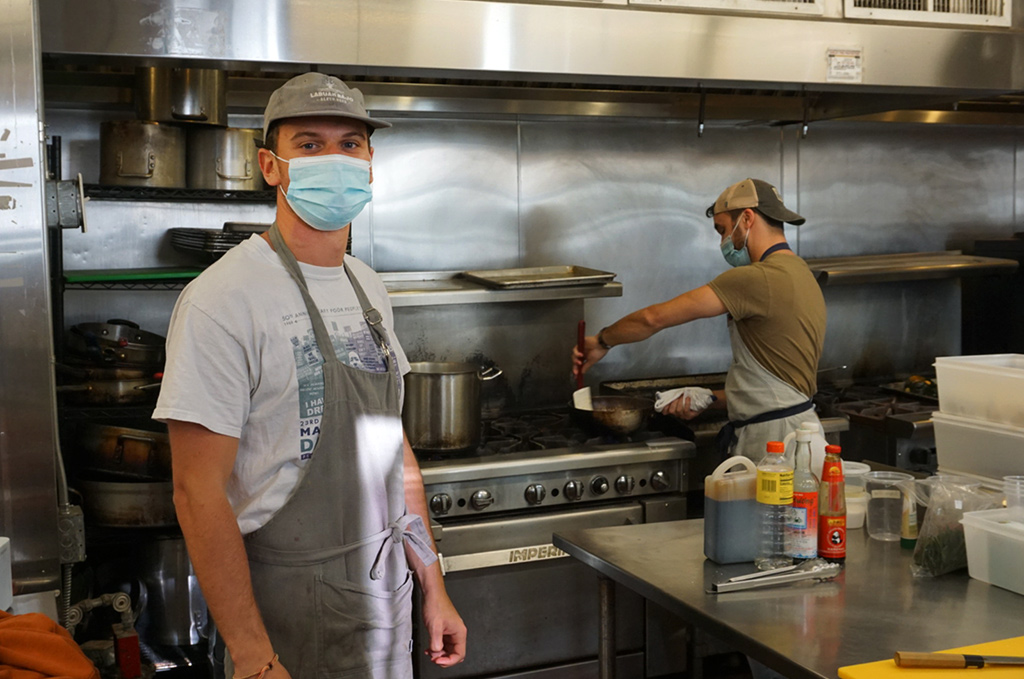
Julian Cohen and executive chef Keenan Goodwin prepare meals for Bountiful Kitchen at Foundation Kitchen in Somerville. (Photo: Tom Meek)

Covid’s done much to fracture the restaurant business. There’s been a slew of permanent closings (Cuchi Cuchi, Flat Top Johnny’s, Bergamot and Inman Square’s Bukowski Tavern, among many) and with winter hibernations coming and Covid-19 infection rates on the uptick, silver linings are slim. But they do exist. During the spring, the Day reported on early business pivots by Pagu and Season to Taste as well as the launch of Bountiful Kitchen, a home delivery meal service. In April, Bountiful founder Julian Cohen was cooking out of a home kitchen and delivering hot meals to a boutique clientele in his Porter Square neighborhood, but taken the business to the next level, expanding his menu and delivery routes to include all of Cambridge, Somerville, Arlington and select Boston neighborhoods. He’s also hired executive chef Keenan Goodwin, formerly of Fat Hen in Somerville, and moved to a formal commercial kitchen facility at the Foundation Kitchen on Washington Street, on the way to Sullivan Square.

Foundation Kitchen is a rentable shared space – a food startup incubator. Husband and wife owners Ciaran Nagle and Tara Novak have two locations (the bigger facility is in Union Square) and a third in the works for Charlestown that will have a food and drink hall. The facilities gives people who want to enter the food business an easy leg up without having the huge financial burden of a storefront, a long-term lease and sunk equipment costs, Nagle said.

Bountiful Kitchen’s BBQ Turkey Breast with Old Bay Potato Salad. (Photo: Julian Cohen)

That makes sense for a scrappy business such as Bountiful. Cohen, a former barista and food preparer at Hi-Rise Bread Co., started the service on a whim after being laid off, while Goodwin was left out of the rotation when a slimmer Fat Hen reopened.

They’ve since evolved the menu at Bountiful toward a more symphonic complement of foods and flavors, Cohen said, as opposed to the early scramble, when things were assembled based on what was on hand. There’s now more collaboration and planning between owner and chef, and the two try to source all their foods locally.

Recent and current Bountiful Kitchen offerings in the $15 to $25 range include beef bolognese, crab-stuffed squash, brown sugar crusted salmon, lemon grass and coconut chicken stew, yellowfin tuna loins and roasted pork loin. There’s always a vegetarian option and sides, such as butternut squash soup and parmesan roasted Brussels sprouts. Like other delivery/to-go food services these days such as Hi-Rise and Pagu, Bountiful has pantry offerings; it also has wine pairings, which come through a partnership with The Wine Press. The wine comes with your meal. Delivery happens between 6 to 7 p.m. and the menu rotates daily.

Cohen and Goodwin do more than 120 meals a week – up from around 80 when Cohen launched – and plan to keep expanding. If you’re not on their delivery heat map, you and some neighbors can fill out a form to be added; Cohen said he is deeply customer driven. Most of his weekly queue are regulars who keep coming back.

“The food’s always cooked to perfection,” said Rachel Joffe, a Bountiful regular. “Delivery is pleasant, they give you advance notice, and the delivery persons are nice. They have accommodated my need/request to have the food delivered on the early side, and I appreciate their flexibility.”

Bountiful Kitchen has a weekly newsletter to let subscribers know each week’s offerings. The menu is also updated on a website with easy ordering.

Borat Subsequent Moviefilm

22 Oct

‘Borat Subsequent Moviefilm’: Updated antics Make Benefit Once Glorious Nation of America

By Tom Meek
Wednesday, October 21, 2020

People thinking back to Sacha Baron Cohen’s gonzo 2006 mock-doc “Borat” will certainly remember that pud-padded, shoulder-looped green G-string, but may have forgotten how the bold and experimental film pulled the mask off bigotry and entitlement in the United States. With “Borat Subsequent Moviefilm,” Baron Cohen’s back with more of the same, but this one’s more targeted, loaded and timely. It doesn’t pack quite the same zany eye-pop – that bud’s bloomed – but it is the first film in my mind to tackle both Donald Trump’s divisive presidency and the Covid pandemic.

The setup is fairly simple, though the execution is not: In Borat’s native Kazakhstan, just out of a gulag, the overly zealous (and clueless) journalist is tasked by authorities with delivering a gift to the Trump administration so Kazakhstan can gain favor among other strongman countries of the world – Russia, Syria and so on. The film’s extended title is: “Delivery of Prodigious Bribe to American Regime for Make Benefit Once Glorious Nation of Kazakhstan.” The bribe? National treasure Jonny the Monkey is to be delivered to “No. 1 ladies’ man” Michael Pence – aka “the vice pussy grabber.” Jonny, a well dressed chimp, doesn’t quite make it to America, so Borat rolls with Plan B, which is to offer up his 15-year-old daughter Tutar (relative newcomer Maria Bakalova) as a child bride.

If you’re somehow not familiar with Baron Cohen’s “Borat” schtick, the major growl in his irreverence engine is the punking of everyday people – whom you’d think would see it coming a mile away, but 14 years is a long time and most targets are xenophobic types south of the Mason-Dixon Line where the name “Borat” might suggest cured meat or a cold soup from an enigmatic and heretical religious sect. In a bakery, Borat asks the counterperson to put the inscription “Jews will not replace us,” on a newly purchased confection. Later, at a debutant ball (how did he even get in there?) Borat and his daughter perform something of an Eastern Bloc jig with the daughter’s dress unfurling for a visible jaw dropper among the well-heeled upper crust. Getting closer to his mark, Borat takes the stage at a right wing rally, crashes a Pence speech and dons Klan robes and a Trump costume. The real grabber is Tutar, dressed up and looking eerily like Ivanka Trump, interviewing Rudy Giuliani and ultimately coaxing him into a compromising situation that not only raises eyebrows and questions of ethnics, but likely will fry what’s left of the former New York City mayor’s reputation.

The film was shot during the spring and summer as Covid raged across the country – Giuliani at one point says Trump saved a million lives because the Democrats would never have acted. Throughout the course of the film, use of masks increase and the disease quietly and slowly becomes a key player. The reveals of a divided America hopefully are nothing new to viewers, but the comic reframing is a healthy reminder with the election on tap. The real revelation here is Bakalova as Borat’s daughter, seamless in her audacious pranking. With Baron Cohen there’s always a puckish nod and wink in his eye; with Bakalova, it’s smooth and natural, with nothing contrived. As a result, the darkness of the candid camera moments is deeper and more visceral. “Subsequent Moviefilm” pokes us all in the eyes and exposes us to a new talent.

Honest Thief

18 Oct

‘Honest Thief’: There’s no particular set of skills on display in tale of Boston burglar done wrong

By Tom Meek
Thursday, October 15, 2020

For the past decade Liam Neeson has made nonstop B-level actioners, with the “Taken” series as the defining cornerstone; now we have “Honest Thief,” which feels like a B-minus version of a “Taken” entry. What’s more, it takes place here and adds to the string of recent Boston duds alongside “Ava” with Jessica Chastain unbelievable as a Charlize Theron-esque hitwoman, and Adam Sandler’s “Hubie’s Halloween,” set in Salem. They all make for good locale watching, but can the Hub please get a plot worthy of our time?

Here Neeson plays Tom Dolan, a debonair former military operative turned cat burglar. Despite the name and location, he’s no Thomas Crown. Dubbed “the In and Out Burglar” by Boston’s FBI bureau – a label he deeply despises – Tom has yet to tell his girlfriend Annie (Kate Walsh, “Grey’s Anatomy”) about his trade. His plan for coming clean? Confess to the authorities, cut a deal, get out early and marry his betrothed. 

What can go wrong, right? Well for starters, the FBI thinks he’s a crank caller, and a double-dealing agent (Jai Courtney, “Terminator Genisys”) and his conflicted partner (Anthony Ramos, “Hamilton”) want Tom’s stash and figure to frame him for a murder. 

Naturally things get ugly, and Annie gets caught in the middle. That’s when things get truly painful as Neeson, so far from his turns in “Schindler’s List” (1993) and even Martin Scorsese’s “Silence” (2016), uses his stately Irish baritone to mansplain violence. The dialogue feels mostly like screenwriting workshop leftovers. In one scene Annie, now aware of what Tom’s up to, reacts with, “The first surprise was ‘Let’s get a cute house in Newton’ and the second surprise is that you’re a bank robber?” Honestly?

The film disappoint too because it’s from Mark Williams, co-creator of the Emmy-winning Netflix series “Ozark.” There Williams helped cook up a genuinely dark crime drama imbued with character and nuance. If only some of that smartness had made it to Massachusetts.

Rebecca

18 Oct

‘Rebecca’: Much like the new Mrs. de Winter, gorgeous retake is haunted by earlier version

By Tom Meek
Friday, October 16, 2020

Ben Wheatley, the mind behind such dark endeavors as “High-Rise” (2015) and “Kill List” (2011), has said this “Rebecca” is not a remake of Alfred Hitchcock’s 1940 Academy Award winner (Hitchcock’s first Hollywood film) but instead a new envisioning of the gothic novel by Daphne du Maurier. The casting here is a tad off; in Hitch’s version the venerable Laurence Olivier played Max de Winter as a brooding yet debonair depressive, while in Wheatley’s re-spin we get a hunky Armie Hammer (“The Social Network,” “Call Me By Your Name”), who doesn’t seem quite as much in the throes of grief about his perished wife of the title. No, Wheatley fires this up as a stately love affair between two physically blessed people: Hammer’s widower and Lily James (“Cinderella”) as the new Mrs. de Winter. The two meet in Monte Carlo, Max just getting back into circulation after the death of his wife and James an American semi-stranded abroad. Sparks fly instantly, and Wheatley and his stars spend some time steaming up the screen before moving on to the psychological and mystery components of du Maurier’s work that Hitchcock and crew mastered so effortlessly.

For those unfamiliar with the work, once nestled at Max’s lush, seaside Cornish estate Manderley – cinema’s other big sweeping iconic manse, along with Tara from “Gone With the Wind” – the new Mrs. de Winter becomes haunted by the specter of the former Mrs. de Winter through Max’s aloofness, her own psychological delusions and the bitingly barbed politeness of the head caretaker, Mrs. Danvers (Kristin Scott Thomas). There’s also a revisiting of what really happened to Rebecca. Wheatley, adroit at dread and a master of dark, atmospheric effect, applies these talents to awkward effect here, with some working seamlessly and others lifting you out of the tale. It’s shot gorgeously by Laurie Rose, who’s worked on most of Wheatley’s other films and makes the most of the bigger budget and palette here. Hammer and James are fine, no matter how deeply handicapped they are by living in the shadow of Olivier and Joan Fontaine; but the film really perks up when Mrs. Danvers is on screen, with Thomas worthy to follow Judith Anderson, who earned an Oscar nod for the part in Hitch’s production. Also notable is Sam Riley (“Control”) as the devious Jack Favell, who had connections to Rebecca and an acrimonious relationship with Max. 

You have to admire Wheatley for taking on such a mantle. It’s a heavy one, and there was Gus Van Sant’s 1998, frame-by-frame remake of Hitchcock’s “Psycho” (1960) out there to warn him off. Right, it’s not a remake, but the comparisons are inevitable and the expectations sky high.