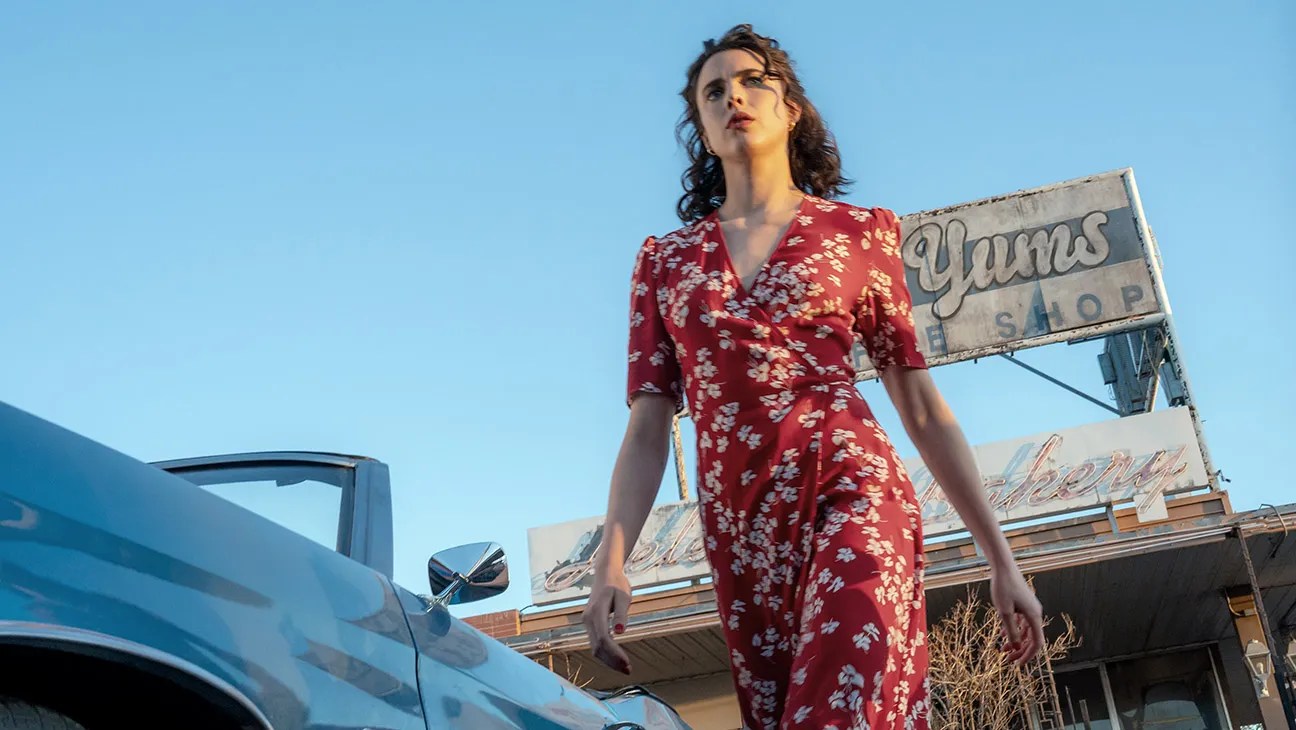
Ethan Coen and co-writer and wife Tricia Cooke reteam with actor Margaret Qualley for the second of a purported loose lesbian neo-noir trilogy. That first outing, last year’s “Drive-Away Dolls,” was a bit of a rickety start, but through no fault of Qualley, who packed the punchy best of both Thelma and Louise as one of two gal pals who zoom off in a car with various factions of angry patriarchy hot on their tail. It was a concept in search of a story. Here, Coen and Cooke dial up the noir aspect and concoct something more worthy of Qualley’s onscreen allure.
She plays Honey O’Donahue, a private detective working the dusty, depressed streets of Bakersfield, California. There’s trouble right off the bat as an angular French woman (Lera Abova) in leopard-skin tights navigates the scree of a ravine to get to an inverted car, its driver dead or dying. She’s not there to help, but to pluck a signet ring off a finger, and in the next scene Abova’s agent of cold deeds is floating casually full frontal in a nearby quarry pond. An important fashion note: As she clads up, there’s a Garanimals moment as we realize her underwear and bra match her motorbike helmet.
As far as gonzo art-house horror goes, “The Substance,” certain to make a stir as it drops into theaters this week, is an ineffable, WTF spectacle that’ll cement Coralie Fargeat as one of the rising new wave of auteurs of the outré. Her ghoulish company includes the likes of Julia Ducournau (“Titaine”), Ari Aster (“Midsommer”) and Brandon Cronenberg (“Infinity Pool”) among others – a youth movement taking the reins from Brandon’s dear dad David (“Rabid,” “Crimes of the Future”) and the other David of nightmarish bad trips, David Lynch.
The inspired casting of Demi Moore and Margaret Qualley as the same ego/persona is nothing short of a lightning strike. Moore plays aging fitness queen Elisabeth Sparkle, who at one point was an Oscar darling (Jane Fonda, anyone?). When we meet Elisabeth taping a segment of her TV show “Sparkle Your Life with Elisabeth,” we learn she’s 50ish, though looks 15 years younger; the real shocker is that Moore in real life is 10 years older than Ms. Sparkle. The producer of the show, a snaky ball of smarmy insincerity with the moniker of just Harvey (played with infectious hambone glee by Dennis Quaid, who can now let go of his recent “Reagan” biopic flop) wants a younger, more nubile centerpiece that will light up the stage, appeal to the younger generation and titillate the studio’s white-haired board.
Given all that (the name, the old-boy network), the #MeToo allusions are hard to ignore, but “The Substance” is a lot closer to “All About Eve” (1950) by way of the “Elephant Man” (1980) and “Carrie” (1976) than the criminal fall of the swaggering dick who built Miramax. Elisabeth, distraught at the realization her days are numbered, gets into a violent car accident that lands her in the hospital. The attending assistant, a taut-faced young man with piercing eyes, does a gentle, yet firm probing of the spine and mutteringly remarks that Elizabeth would make a “good candidate.” Though he retracts the statement and sends Elisabeth on her way, Elisabeth later finds in her coat pocket a drive with the label “The Substance” printed on it in big bold letters. What’s on the drive isn’t too far off from Cronenberg’s “Videodrome” (1983) – both films about the evils of big media and the prospect of rebirth (the “new flesh”) that come with consequence. The long and short is that Elisabeth can attain “a newer, better” her by taking a series of injections. The catch is that you have to reverse the process every seven days. Without exception. Or else.
The trashy alleyway locker where Elisabeth gets her renewal kit feel weirdly familiar; wafts of the dumpster scene in Lynch’s “Mulholland Drive” (2001) drift subtly through your mind, and the strange process of getting into the brain of John Malkovich in “Being John Malkovich” (1999). Fargeat holds the fringe masters in high regard and layers in clear references to De Palma (the aforementioned “Carrie”) and Kubrick, whose “The Shining” (1980) gets multiple references. To a lesser degree but perhaps with greater stylistic impact, “2001: A Space Odyssey” (1968) does as well. Some references go over the top and feel forced, but some are apt and effective homages. For cinephiles the film is a gleeful Easter egg hunt.
Much of the transformation process takes place in a cavernous white-tiled bathroom of Elisabeth’s upscale high-rise (akin to the serene purgatory in which Dave winds up at the end of “2001”) – and always in the buff. The first injection triggers an immediate seizure that leaves Elisabeth on the ground writhing and convulsing. Just like a scene out of an “Alien” flick, her spine splits open and a slimy, porcelain other slithers out. That other, simply known as Sue (Qualley), following the renewal kit instructions, stitches up Elisabeth’s back and heads down to the studio to audition to be Elisabeth’s replacement, leaving the comatose husk on the bathroom floor hooked up to an IV or the like for sustenance.
Considering the fantastic cast and punchy setup, this is a bit of a toe stub for Ethan Coen in his second outing (his other being the 2022 rock-doc “Jerry Lee Lewis: Trouble in Mind”) since splitting in 2019 with his brother Joel from a partnership that generated some of the most revered films of the recent cinematic past – “Fargo” (1996) and “No Country for Old Men” (2007) among them. These drive-away dolls are lesbians on a road trip to hell (well, Florida) to deliver a car and visit one’s nana. The car contains wanted cargo (a MacGuffin with shades of “Repo Man” that doesn’t have the greatest of payoffs) with a bunch of shady goons in hot pursuit. The lines between the sexually liberated Jamie (Margaret Qualley) and demure bestie Marian (Geraldine Viswanathan) are drawn starkly in nearly every scene; along the way Jamie brings hookups back to their various motel rooms as the bookish Marian heads to the lobby to read Henry James during playtime. It’s a buddy movie with romantic possibilities – a soccer club spin-the-bottle makeout session forces the issue. Coen and his co-writer, wife Tricia Cooke, who edited projects such as “O Brother, Where Art Thou?” (2000) and “The Big Lebowski” (1998), borrow too much from their shared canon, namely C.J. Wilson and Joey Slotnick as idiosyncratic goons (and that is literally how the are referred to in the credits) whose opposite approaches to dealing with an escalating situation feel ripped slackly from “Fargo.” Qualley, so good in “Once Upon a Time in Hollywood” (2019) and last year’s “Sanctuary,” furthers her blossoming CV with an energetic, scene-pushing presence bolstered by an affable southern twang, and Viswanathan makes for a good offset. The chemistry between the two carries the uneven mishmash as it stumbles early and struggles to regain its quirky vibe. Also in the mix, in small raucous parts, are Matt Damon as a Florida Man, Colman Domingo as the goon handler, Pedro Pascal on ice, Beanie Feldstein (“Booksmart”) as Jamie’s brash law enforcement ex and Bill Camp as the car dispatcher no one listens to. At least this not-quite-fully-baked road comedy with a prize dildo set gone missing is a fast 84 minutes.



 For What it's Worth