Tag Archives: Mad Max

Furiosa: A Mad Max Saga

25 May

Series put in reverse to fill in the gaps on a map of dangerous ground
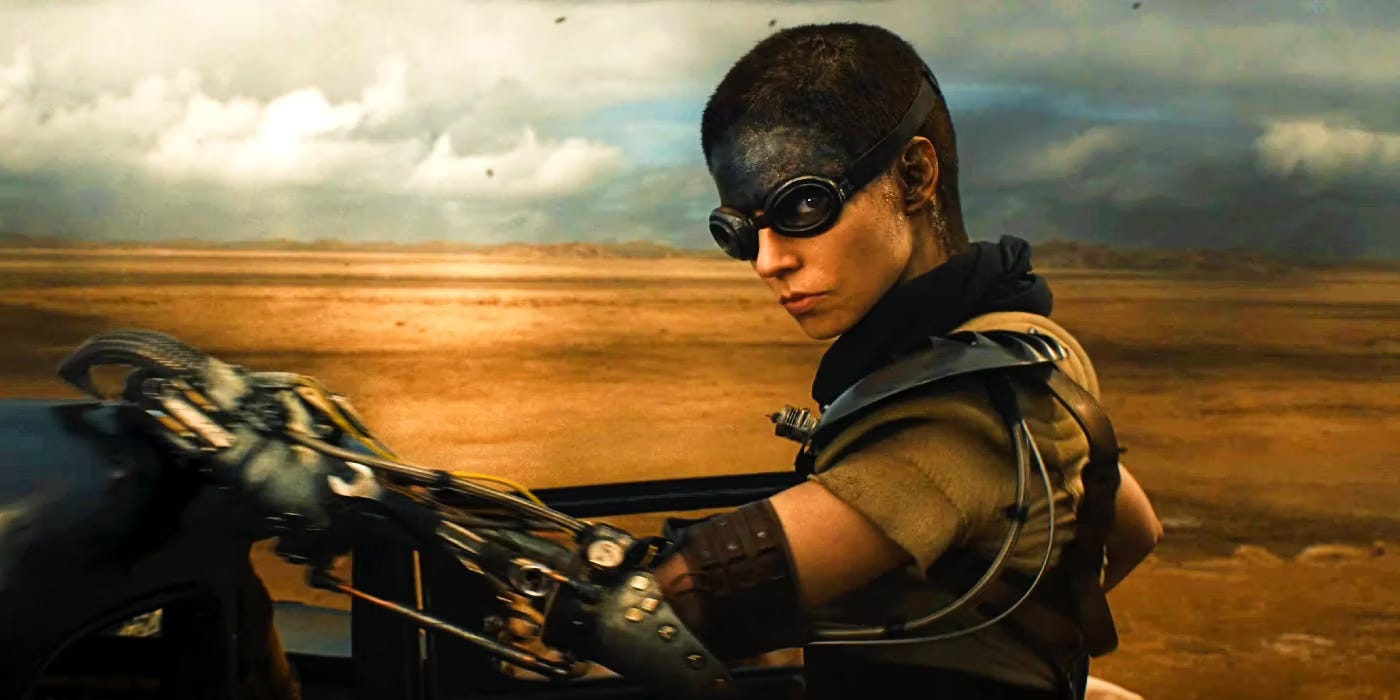

Hard to believe it’s been nearly 10 years since George Miller punched us all in the face with “Fury Road,” his amped-up reenvisioning of the post-apocalyptic “Mad Max” universe. A phenomenal cast and action scenes that arguably topped the original trilogy’s signature episode, “The Road Warrior” (1981), made that spectacle of a lawless world taken over by marauding tribal factions a reboot like no other. “Furiosa: A Mad Max Saga,” the new nitro-injected prequel to that 2015 desert storm, is a high-energy affair, to be certain. It doesn’t move the needle, but it is game to try to keep pace.

One of the perverse pleasures of those late 1970 and 1980s films (“Mad Max” and “Beyond Thunderdome” bookending “Road Warrior”) was Miller’s minimal backstory or world building. In voiceover we’re told only that fuel become scarce, nations went to war over it and nukes happened – leaning in on catastrophic climate change before COP 21 was even a glimmer in the U.N.’s eye. Then again, global nuclear warfare pretty much leapfrogs an environmental crisis. 

As always, scarce resources are the crux of conflict in “Furiosa” and the reason for the rise of ’roid-rage tyrants such as the Morlock-ish Immortan Joe or our new dispenser of wasteland sadism, Dr. Dementus (Chris Hemsworth), whose MO is drawing and quartering by motorcycle after a bit of “Squid Game” fun. (This younger Immortan Joe is played by Lachy Hulme, replacing Hugh Keays-Byrne from the 2015 film. Keays-Byrne, also indelible as Toecutter in the original “Mad Max” in 1979, died in 2020.) As we know from “Fury Road,” young, fertile women are worth warring over as well, or more so to be hoarded away in chastity belts with the intent to propagate legacies Genghis Kahn style. 

Miller and his longtime co-scribe Nick Lathouris, had a small part in the 1979 film, do a yeoman’s job of fleshing out the chaotic, dust-choked universe conjured up in “Fury Road.” In this chapter we actually get to go to the Bullet Farm and Gas Town, fortified encampments that loomed across the desert but were never visited or sieged by Immortan Joe’s pasty white phalanx of War Boys. “Furiosa” also becomes the first “Max” flick to play significantly off plot developments from another chapter (though to belie the title, while there is a Max stand-in, there is no one named Max). The film’s five segments begin in the Green Place of Many Mothers where “Fury” essentially ends, as a young Furiosa (Alyla Browne) is kidnapped by the minions of Dementus. Her mother (Charlee Fraser), a hell of a shot with a rifle, follows along in a pursuit. It’s long-simmering scene with the potent poetry of the grueling desert march from “Lawrence of Arabia” (1962). Jumping forward in time, an older Furiosa played by Anya Taylor-Joy (“The Queen’s Gambit,” “The Witch”) has been traded from Dementus to Joe to stave off a war and later, through near-death happenstance, goes incognito in Joe’s mountain cliff complex known as the Citadel. 

Given that what much of what goes down in wasteland has to do with dick waving (I mean, we have characters called Rictus Erectus, Scrotus and Pissboy) and prison-yard, alpha-male domination, the uneasy peace and trade accords with Gas Town and the Bullet Farm begin to fray, with Furiosa and her own agenda in play as war looms. This is also the first “Mad Max” to have hordes of equally matched factions go at it, not the haplessly underarmed and helplessly outnumbered stranded and beset in their own personal “Rio Bravo” (1959). And despite the outwardly mean, masculine veneer, like “Fury Road,” “Furiosa” is decidedly female in its humanist gaze and nurturing of hope for a better tomorrow. 

Taylor-Joy is seamless as the can-do, younger version of what Charlize Theron brought to the screen nine years ago. Equally superb is Browne as the adolescent Furiosa, and not enough can be said about Fraser’s mad mom, who may be the most formidable wasteland warrior of all. Hemsworth tries, but he’s no Lord Humungous, and his bawdy bad-ass retorts have a bit too much “Thor” jokiness to them. The other near miss is Tom Burke (Orson Welles in “Mank”) as Praetorian Jack, a weak-tea distillation of Mel Gibson’s morally ambiguous roamer from the initial films who lacks the harrowed, frying-pan-into-the-fire immediacy of Tom Hardy in the last go-round; a relationship dynamic between Jack and Furiosa that Miller aims for as they ride out into the wasteland in the requisite fortified tanker never really takes hold, because Taylor-Joy’s grease-smeared avenger is so much more fully baked and fire-breathing. 

“Furiosa,” as gorgeous as it is to take in, is long, and Miller and Lathouris unwisely rehash moments from past films (Gyro Captain ultra-lights, a botched Molotov catching fire on the legs of a hapless combatant and the whole “You want to get out of here, you talk to me” swagger line, among the many) as homage, which just weakens them. You can’t fault the film’s furious pacing, jaw-dropping action sequences and dutiful connecting of dots, but is it needed? “Fury Road” was a mic drop; “Furiosa” is a victory lap, the “Silmarillion” of the series. 

Three Thousand Years of Longing

27 Aug

Spectacle with an unfulfilled wish for narrative harmony

By Tom Meek Thursday, August 25, 2022

The latest from George Miller, the man known primarily as the force behind the innovative “Mad Max” film franchise (though let’s not forget he also helmed such diverse fare as “The Witches of Eastwick” and “Happy Feet”), is an opulently rendered tale about two bereft souls who find each other through happenstance and blossom as a result. Part of the film’s charm is Miller’s ability to go big, something put on glorious display in his last, “Mad Max: Fury Road” back in 2015, and again here in “Three Thousand Years of Longing” in re-creating a mid-B.C. visit between the Queen of Sheba and King Solomon amid Ottoman empire buildings. The film’s other charm is its leads: Tilda Swinton, as a set-in-her-ways scholar and Idris Elba – whom you can also catch in theaters this week in the “Jaws”-with-claws thriller “Beast” – as the genie she uncorks while on an academic retreat in Istanbul.

Much of what unfolds in this adaptation of the novella by A.S. Byatt (“Possession”) takes place in a hotel suite. Not just any hotel suite, but the one in which Agatha Christie wrote “Murder on the Orient Express.” It’s something of a dark pajama party, with Swinton’s Alithea and Elba’s Djinn (as he’s called by Alithea) in bathrobes; she’s just out of the shower when wrangling with the hand-blown bauble picked up in a marketplace, and he, after initially being room-fillingly large and vaporous, dons terry cloth in his more human assumed form. The two trade tales: Back in the day, he was Sheba’s lover and Solomon trapped him in a jar and tossed him in the sea. Not to be outdone about a love gone wrong, Alithea recounts her marriage to a fellow academic, intellectually and sexually fulfilling until he ran off with a student. There’s also the matter of three wishes, and the long, inglorious history of unintended circumstances that have come back to bite greedy wishers. Alithea, an expert on narrative structure, the history of storytelling and lore, is wise to the perils and wonders if The Djinn is in fact trying to trick her – to gain his freedom from the bottle and mortal servitude, he needs to grant a mortal three wishes. Alithea holds out, and just like the Major and Barbara Eden in “I Dream of Jeannie,” mortal and magical begin a relationship with sexual undercurrents raging and rife at every turn. 

Miller’s vision has some big, spectacular set pieces, especially as it riffles back to the ancient times of The Djinn’s long-lived existence, and the actors, both talented and clearly up for the game – Swinton ethereal, wise and ever probing, while Elba, so commanding as Bloodsport in “The Suicide Squad” last year, casts a majestic yet troubled, somber aura – are captivating to behold with all their soul-baring. And yet somehow, something feels amiss. Something’s not there. Their sudden, deep romantic bond feels like a quick Gorilla Glue fix applied during script revision triage, and what of the rules of those wishes? There’s some stuff about unfulfilled third wishes (the wisher died after No. 2) requiring closure that never seem to get addressed. Several times Alithea says, “I wish …,” but what happens, or not, never fully makes sense. The two do finally get out of the hotel suite and travel back to London, where Alithea, tired of her xenophobic neighbors, has Djinn help her deliver exotic midday snacks to the biddies who spend their days doing little more than othering. I wish the film had more moments like that. There’s much to admire in the craft all around, but for all its grand gestures, “Three Thousand Years” feels not quite fully formed. It’s a novel concept about parched beings thirsting for soul-slaking water, as was the case for the masses in “Fury Road.” In Miller’s impressive “Max” revisit, in the end, the water flowed in torrents. Here, it’s as if someone forgot to pay the water bill. 

Long Shot

3 May

‘Long Shot’: She’s testing a run for president, he’s that strange bedfellow you hear about


Image result for long shot

Without Charlize Theron, “Long Shot” would likely have no shot. The capable and statuesque actress has time and time again demonstrated her versatility, bouncing seamlessly from action (“Atomic Blonde”and “Mad Max: Fury Road”) to comedy (“Young Adult”) and of course, dark drama, namely playing serial killer Aileen Wuornos in “Monster” (2003), for which she won Oscar gold. Here she’s in rom-com mode as Secretary of State Charlotte Field looking to push a green initiative worldwide and launch a run for the Oval Office.

Before you say Hillary Clinton, “Long Shot” is set against a different political climate than the one we find ourselves in today – not that it doesn’t parody and poke at it. In this parallel political universe, the sitting president (Bob Odenkirk) is a former actor who has let it quietly be known he isn’t going to seek reelection because he’s got a series (Netflix, Amazon?), which triggers Field’s ambition. Along her test-the-waters tour there’s an early stop at a swanky Manhattan cocktail party where Boyz II Men happen to be the centerpiece of the all-white event. It’s there in the haughty suffocating stuffiness that she recognizes Seth Rogen’s Fred Flarsky, not because he’s in an electric blue windbreaker at a black tie event – one of many long running gags that goes on perhaps a bit too long – but because she babysat him when he was in his pre-teens, ending in an awkward moment when the young Flarsky winds up sporting a very visible erection.

Yes, that’s how “Long Shot” rolls. The script by Liz Hannah and Dan Sterling has the uproarious irreverence of “Something About Mary” (1998) and some sharp political spoofs too, especially Andy Serkis as the Rupert Murdoch-styled tycoon who just fired Flarsky’s ultra critical journalist (penning pieces such as “Why the Two-Party System Can Suck a Dick”) or Alexander Skarsgård as the Justin Trudeau-esque Canadian prime minister being pushed by handlers, the diplomatically community at large and the press on Charlotte as a romantic possibility.The saucy send-ups of Fox News and CNN are bitingly hysterical, and sadly spot-on.

Plot-wise, Flarsky gets brought aboard as Charlotte’s speechwriter, and romantic seeds begin to take hold along a trip through Europe. That’s also when “Long Shot” becomes its least effective. Theron registers her best when Charlotte’s charming a room with her confidence and style or talking about the limitations of being a woman in politics: “If I am angry, I’m hysterical. If I raise my voice, I’m a bitch.” Not enough can be said about Theron’s presence and poise, and director Jonathan Levine seems to be well aware of the fact, as nearly every frame hangs from his star’s gravitational pull. Comedy star June Diane Raphael adds to the potpourri, playing it straight and sassy as Charlotte’s senior staffer, but the real big winner in this Theron tour de force (as well as carrying the film, she’s also devilishly funny) is O’Shea Jackson Jr., so good in “Straight Outta Compton” (2015, where he played his father, Ice Cube) and “Ingrid Goes West” (2017), and even more scene-grabbing here as Flasky’s bestie, a closeted GOP pragmatist. For O’Shea the future should be rife with opportunity, for Theron, there are no limits.

Fury Road

15 May

Ka-chunk, ka-chunk, ka-chunck, back in 1985, the “Mad Max” trilogy unceremoniously sputtered to an anticlimactic halt rather than going out on a furious, nitro-boosted blast. That tepid finale, “Beyond Thunderdome,” would become the post-apocalyptic Outback series’ weak link, an unsatisfactory follow up to its crowning production. That film, “The Road Warrior” (1981), not only elevated Mel Gibson to bankable star status in Hollywood, it seamlessly spun together an odd olio of diverse genres without faltering into camp and boasted some of the greatest real-action car stunts recorded on film. What director George Miller and Gibson revved up was an instant cult classic, a box office smash (it covered its budget in the U.S. in one week) and a can-do mashup from Down Under that would become a model that many would try to copy, but few could emulate. With “Mad Max: Fury Road,”(released May 15) the series is back on track, and boldly so. It took decades to get here, but it’s well worth the wait, something well oiled in lineage and ready to sear into the minds of a new generation of thrill-injected converts.

Continue reading