Tag Archives: Documentary

Short Takes: “Will & Harper” and “Wolfs”

6 Oct

‘Will & Harper’ (2024)
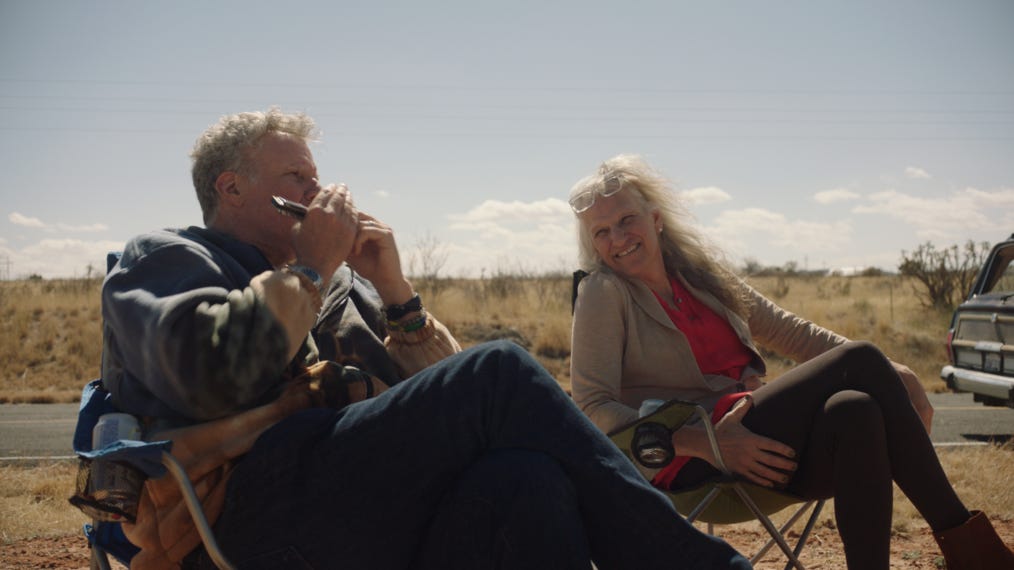
The Will of the title in Josh Greenbaum’s documentary is “Saturday Night alum” and Ricky Bobby portrayer Will Ferrell; the Harper is a longtime Ferrell pal and former SNL writer who has transitioned at the age of 61. One of the things Harper loved to do as a man was driving across the United States, stopping along the way to drink in various different quarts of Americana in their raw and organic state. The fear is that as a trans woman that might not be as possible. Ferrell, to support his friend, packs two collapsible lawn chairs into a classic old Jeep Wagoner and together they set off. Their conversations are candid, and Harper is incredibly forthcoming with information on the whys of transitioning later in life and the fears that come with it. That said, these two are funny together and know how to play to the camera. Ferrell’s celebrity brings unintended consequences when they go to a Texas steakhouse so Ferrell can try to down a famous 72-ounce steak (that looks like a grim, oily brick) that’s free if you can eat it in under an hour. He strides in with great pomp, dressed as Sherlock Holmes, which draws social media posts by those at the packed steakhouse – which mostly viciously target Harper. The gives pause not only because of the hatred on display, but because the film pushes matters where it feels unwise and even unnecessary. In quieter, more intimate moments, the relationship between Ferrell and Harper is endearing, as is Harper’s journey. It’s clear Harper is in a better, more comfortable place and had a solid support system to make the transition. Whether that translates for others is not explored by the film. Still, “Will & Harper” illuminates challenges, and it warms earnestly. Because of the stars’ comedic origins, there are some pretty well-earned grins to boot. 


‘Wolfs’ (2024)
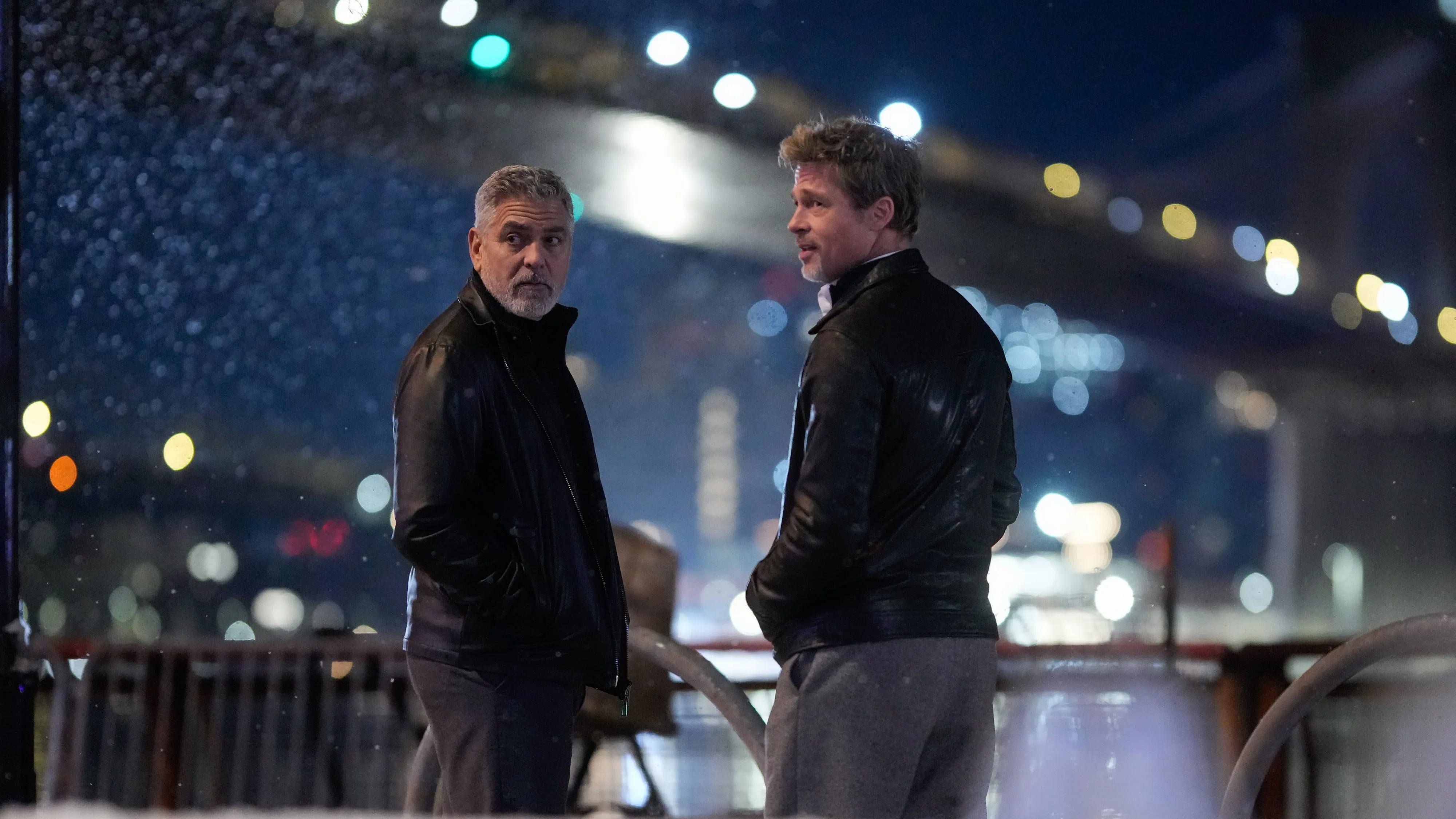
The charismatic Brad Pitt and George Clooney have teamed up multiple times onscreen, as co-stars in those quirky “Ocean’s” heist capers to Pitt’s minor role in Clooney’s 2002 directorial debut “Confessions of a Dangerous Mind” and voicing animated characters in the movie “IF” this year. Here, in a reference to Harvey Keitel’s character Winston Wolf in “Pulp Fiction” (1994), they play cleaners hired by different agents to remove a body from an uber-posh New York City hotel penthouse. The MacGuffin that drives the film is a well-respected district attorney, Margaret (Amy Ryan), on her way home to her family one night who, for whatever reason, decides to stop for a drink that turns into a tryst with a young, college-aged kid. There’s barely foreplay when the fling-thing winds up dead on the bedroom floor of a suite that likely costs $10,000 a night. In a panic, Margaret calls a number a fixer-connection gave her and summons Clooney’s cleaner (listed in the credits as “Margaret’s man”). Minutes later Pitt’s grease jobber  keys in even though Margaret tells the knock at the door she’s all set, because he’s employed by the hotel (listed as “Pam’s man,” because Pam, voiced by Frances McDormand, runs the hotel) and it turns out there are cameras everywhere. After much back and forth about who’s going to clean the room (lone wolves like to work alone) Pam insists that the two pair up and just get it done. Job No. 1 is to get Margaret out of her bloody clothes and on her way home to hubby and family. That’s the easy part. Then there’s the body and the matter of four bricks of high-test drugs. The two are dragged out in the dark winter night to chase down a loose end and get the drugs to their owner, keeping the DA and the hotel out of the equation. There’s more gunplay as the film builds, though first comes one long and wild foot chase in which the two pursue a target clad in just briefs and socks through the snow-dusted night. At its core, “Wolfs” is a reluctant buddy flick that’s best when Pitt and Clooney are playing off each other through dialogue and one-upmanship. That works well in the beginning, before the film – directed by Jon Watts (of the recent “Spider-Man” films) – forms into an increasingly pat actioner with some unlikely twists. It’s a neat pairing of talent that could have used more bite. 
Moonage Daydream

17 Sep

There’s a starman waiting on the screen

By Tom Meek Thursday, September 15, 2022

Brett Morgen’s tribute to the life and immeasurable cultural contribution of musical icon David Bowie is not your typical rock-doc, but a sensual blast of imagery and sound – an enigmatic veneration, if you will, that delves into the heart and soul of all things Ziggy Stardust and beyond sans pedagogy.

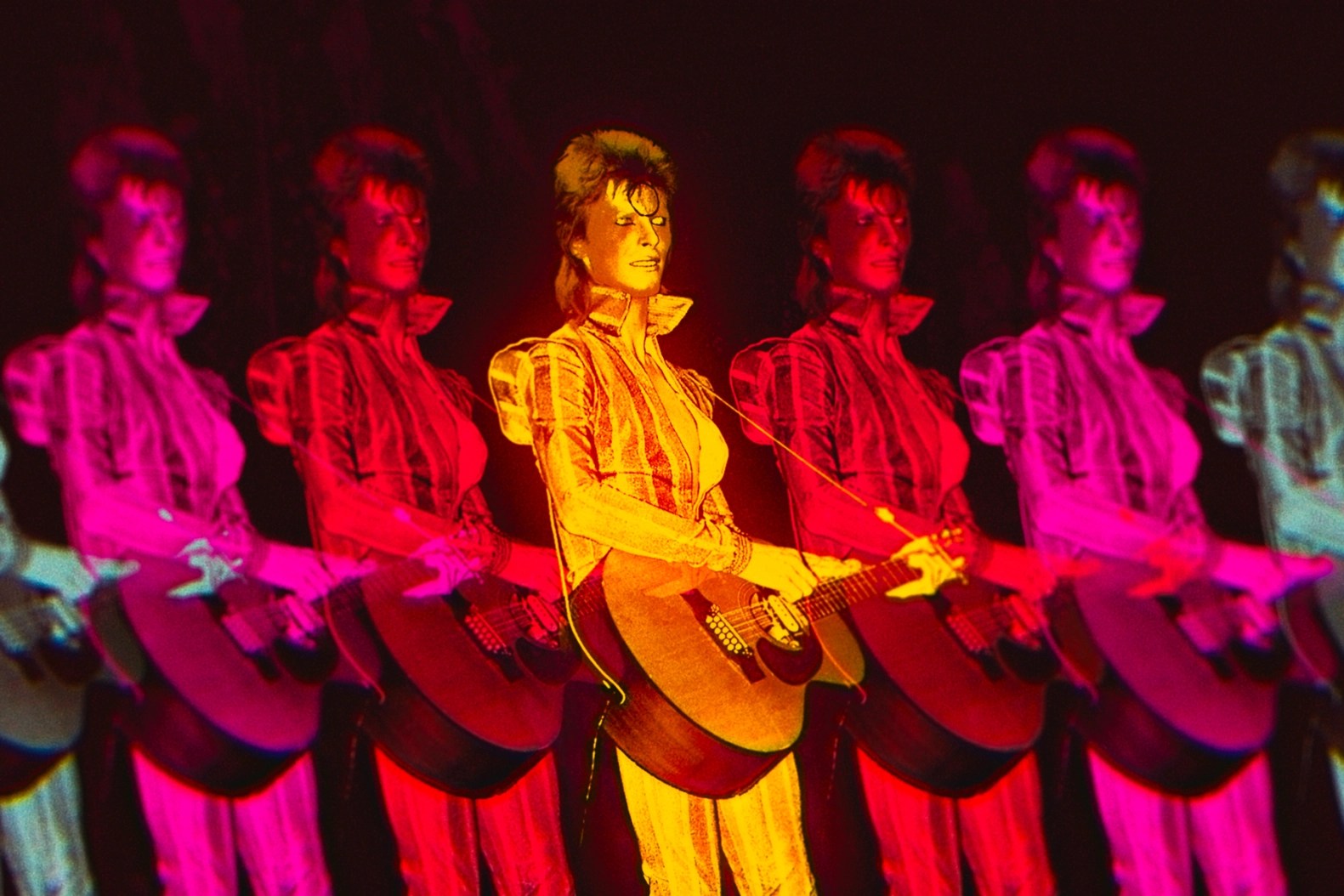
Bordering on the experimental, “Moonage Daydream” blasts off with effusively edited, quick-cut razzmatazz, bouncing from the handsomely androgynous Ziggy on stage to esoteric silent film clips while orbiting space music chirps. Then we get a last line whispered by Rutger Hauer’s replicant in “Blade Runner” as Bowie is framed in infinite day-glo, duplicated as if he were a Max or Warhol painting. Then we settle in on the charismatic space alien doing a impassioned rendition of “All the Young Dudes,” the song he wrote for Mott the Hoople. It’s a kinetic kick in the kisser and the promise of something more: a Bowie immersion for fans and a 101 for the curious and uninformed.

At nearly two and a half hours, Morgen’s film maintains the power surge of riveting wonderment for a calisthenic 60 minutes; the films ebbs as we move from the big-screen culmination of Ziggy in Nicolas Roeg’s “The Man Who Fell to Earth” (1976) to the Thin White Duke stage of his career. It’s in these later frames we hear more from Bowie reflecting back on his family and early challenges, the influence his brother had on him (he exposed him to Kerouac’s “On the Road” and Fats Domino, and was later put away in a sanatorium), his constant fear of mental illness and his aloof, estranged relationship with his mother. There’s plenty of ’60s and ’70s interview footage with Bowie pushing bisexuality and cross-dressing with buttoned-down, nonchalant panache. Missing however is Angie (his first wife that Jagger crooned about), and there’s just a wispy air kiss to Iman and no “Putting Out Fires.”

What Morgen concocts is a kaleidoscopic montage without a traditional narrative, though much of what you see is in pat chronological order. Morgen owes much to the late D.A. Pennebaker (“The War Room,” “Bob Dylan: Don’t Look Back”), who shot several early Bowie concert films including “David Bowie: Ziggy Stardust” (1973), as well as to the camera folk who tailed Bowie during the making of “Man Who Fell to Earth” and his wistful exile to Berlin in the early ’80s. In the film you get a clear sense of the iconoclast’s commitment to his art and desire to morph and try different mediums (he was the first rock star to do a Broadway show, starring in “The Elephant Man” in 1980), but you never really get a full sense of Bowie the man. Does he remain aloof because he needs his distance to create, or is he a practical poser, or perhaps even a misanthrope? Hard to tell, but you do see the glimmer of a wry character in there who’s an innocent searcher, a bit of a raconteur and a puppet master, quick with a terse retort to those asking about his mask du jour.

One note (make that two) about the production: The Bowie estate sanctioned the film, which means Morgen, whose past reflections on intriguing personas include “The Kid Stays in the Picture” (2002) detailing the manic up and downs of New Hollywood producer Robert Evans; “Jane” (2017), a strong portrait of primatologist Jane Goodall; and “Cobain: Montage of Heck,” the 2015 look back at Nirvana frontman Kurt Cobain, has access to Bowie’s film archive, artwork (he was an impressive painter) and music. That, especially the music, is a big win when you consider the flaccid 2020 biopic “Stardust” hobbled by its inability to play Bowie tunes.

In the late ’90s director Todd Haynes (“Carol,” “Poison”) wanted to produce an adoration of Bowie and a nostalgic kiss to glam rock. Bowie turned him down, and Haynes went a different route, resulting in the underappreciated “Velvet Goldmine” (1998) in which he invents a fictional ’70s glam rocker named Brian Slade (played with perfect pomp and pouf by Jonathan Rhys Meyers) who was, for all intents and purposes, Ziggy/Bowie. For the film, Haynes and crew recorded new glam-styled tunes and borrowed a few from Brian Eno, who appears several times in Morgen’s doc, credited as a creative influence on Bowie throughout the years. The other wild thing about the film’s journey to the screen is that when Bowie’s estate gave Morgen the green light, he had a heart attack and went into a coma. The film almost didn’t get made.

It’s a passion project, to be sure, that will sing to those who miss Bowie, especially those who embrace all stages of his meteoric and variegated career. Given the redundancy of some philosophies expressed and imagery reused, the film could have done with another round of edits, but it’s an exquisite composition with unlimited access and, like its subject, a shining wonderment that tantalizes and holds you at arm’s length.

Roadrunner: A Film About Anthony Bourdain

18 Jul

‘Roadrunner: A Film About Anthony Bourdain’ provides a tasting menu of takes on the late chef

By Tom Meek Thursday, July 15, 2021

Anthony Bourdain stars in Morgan Neville’s documentary, ROADRUNNER, a Focus Features release. Courtesy of CNN / Focus Features

It’s uncanny how alive Anthony Bourdain appears in Morgan Neville’s documentary about the celebrity chef, raconteur and intrepid traveler, “Roadrunner: A Film About Anthony Bourdain.” Not because it’s good to see his familiar, avuncular mug grabbing at life with zest and glee, but because of his self-reflective inner probing that feels as if he’s chiming in on his own life and death in the present – something that’s impossible, as Bourdain committed suicide in 2018. Still, his input is eerily prescient.

Neville steers carefully around much of that headline-grabbing act and in doing so raises more questions than answers, which is certain to leave those seeking closure unsatisfied.

With credits including “Won’t You Be My Neighbor?” (2018) and the Oscar-winning “20 Feet from Stardom” (2013), Neville does a yeoman’s job of getting us the fast what-to-knows: Bourdain was a heroin addict who early on labored in P-town seafood shacks and rose to fame at the age of 43 with “Kitchen Confidential” (published in 2000), an insider’s tell-all about sex, drugs and egos in the go-go New York City restaurant biz. He struck TV fame with “A Cook’s Tour,” “No Reservations” and finally “Parts Unknown,” culinary travelogues with the ever-curious Bourdain digging into the culture and politics of destinations close and far away. What many might not know is that Bourdain hardly traveled at all until doing those shows, and later became agoraphobic.

Neville employs a tight fist in curating who chimes in with reflections. Those giving us glimmers include Bourdain’s TV producers, fellow celebrity chefs Éric Ripert, who was with Bourdain in Strasbourg when he died, and a very emotional David Chang. Also in the mix of close friends are artist David Choe and musicians John Lurie and Josh Homme, of Queens of the Stone Age. Then there’s Bourdain’s past relationships. His second wife, Ottavia Busia Bourdain, gets plenty of screen time but offers little to deepen our understanding. Strangely absent is Bourdain’s first wife, Nancy Putkoski, to whom Bourdain was married for 20 years. Asia Argento, Bourdain’s paramour during his final years, appears only in archival footage. As Neville and several talking heads paint it, the Italian actress and filmmaker was a force of chaos on the set of “Parts Unknown” when Bourdain brought in her and renowned cinematographer Christopher Boyle to shoot a few episodes. The film also sets up Argento as the catalyst for his suicide – the Courtney to his Kurt, if you will. While many chime in that Anthony killed Anthony, others say Bourdain was addicted to Argento, and there’s a front page tabloid splash right before his final act revealing Argento holding hands with another man. All of the above is told in a mere whisper, and you wish Argento was given the lens to share her side of the story.

Also missing from the film is Bourdain’s sense of epicurean love and wonderment. The film is slickly crafted and propelled by music, namely the title track by Boston-based Jonathan Richman and the Modern Lovers and some cool ditties by Lurie and Homme. It’s a celebration of life that leaves many parts of its enigmatic subject unknown.

Weed & Wine

17 May

Comparing cultures in her doc ‘Weed & Wine,’ Cambridgeport’s Cohen found the relationship

By Tom MeekThursday, May 13, 2021

Cambridgeport director and producer Rebecca Richman Cohen presents her documentary “Weed & Wine” on Saturday as part of the Independent Film Festival Boston. (Photo: Weed & Wine)

The bridge between law and documentary filmmaking has strong precedent in the Boston area. Cantabrigian Frederick Wiseman, whose filmmaking style is pretty much the embodiment of cinéma vérité, was teaching law at Boston University when he set off to make “Titicut Follies” in 1967; Mary Mazzio was working as an attorney at Boston’s Brown Rudnick when she decided to go to film school and make socially conscious films (“A Most Beautiful Thing,” “Ten9Eight: Shoot for the Moon”). This week, the virtual run of Independent Film Festival Boston brings focus to Cambridgeport filmmaker Rebecca Richman Cohen, who graduated Harvard Law School and now lectures there. On Saturday, the IFFB will screen her third documentary “Weed & Wine.”

Cohen, like Wiseman and Mazzio, is driven by the human side of her subjects. The continent-spanning film that details two families, the land they work, the challenges they face and the tradition of agriculture across generations began as a late-night conversation about terroir in a Parisian wine bar. Cohen describes the French-originated concept of terroir as “the way the land expresses itself in agricultural produce and the history and tradition of that land.” On the rooting of the project, Cohen says, “I woke up the next morning and still thought it was a great idea.”

One of the challenges in making the film was finding a French vigneron family to partake; many found the juxtaposition of wine grape growing and cannabis agriculture off-putting. “People kept telling me I was comparing apples and oranges,” Cohen said via Zoom, “but in the end, it was about family.” Ultimately Cohen gathered with the Jodreys in Humboldt County, California, and the Thibons of France’s Rhone Valley. The patriarch of that Californian cannabis farm, Kev Jodrey, is a New England transplant (you can hear a trace of it in his accent) and has been growing his product outside legal boundaries for years. The Thibons, on the other hand, have been tending to the same vineyards for hundred of years.

Cohen fell into filmmaking by happenstance while attending Brown University. “I got a job as an assistant editor when I was studying aboard in college, because I couldn’t figure out what else to do. Then I got hooked. After college, I worked for Michael Moore as an assistant editor on ‘Fahrenheit 9/11.’” Cohen’s other documentary features include “War Don Don” (2010), which puts the Serra Leone justice system under a microscope, and “The Code of the West” (2012), which looks at medical marijuana growers in Montana as regulations and policies are reevaluated.

French vintner Hélène Thibon in “Weed & Wine.”

Cannabis farmer Kevin Jodrey in “Weed & Wine.”

Before making “War Don Don,” Cohen had been in Serra Leone using her legal knowledge in a humanitarian capacity. “I’m not an attorney,” Cohen points out quickly. “I’ve never taken the bar.” The subjects she lectures on, human rights and humanitarianism as told through the lens of documentary films, and using video and media as evidence and advocacy, seem to meld seamlessly with her social focus behind the camera.

It took nearly five years to make “Weed & Wine” since Cohen imbibed the idea in that wine bar. One of the realizations the filmmaker had along the way was that her thesis about land focus shifted some, becoming more about those using the land and their kinship to it and each other. Cohen said that sense of family and community became increasingly meaningful to her because during the filmmaking process she became pregnant and had a child. “A total pandemic child,” she says of her 15-month-old.

Covid delayed the release of “Weed & Wine” for nearly a year. Cohen had imagined that the Jodreys and Thibons would meet in person at the premiere or a festival screening; instead that happened by Zoom, Cohen says with a tang of sadness. “But the funny thing is,” she says, “is what do you think was the first thing they talked about? The weather. What else do farmers talk about?”

One of Cohen’s key cinematic influences is “Fast, Cheap & Out of Control,” Cambridge filmmaker Errol Morris’ 1997 documentary about a lion tamer, a robotics expert, a topiary gardener and a specialist in naked mole rats. Interestingly too, one could argue that Morris has a link to law; before coming to filmmaking he was a private investigator, a skill that helped mightily when digging into the gunning down of a Texas police office in “The Thin Blue Line” (1988), a film that helped get an innocent man out of jail. What resonated with Cohen about Morris’ film was the juxtaposition of diverse endeavors and the common themes that linked the subjects. “It’s kind of a bit like what we did with ‘Weed & Wine,’” Cohen says.

Cohen wants to next examine mass incarceration in conjunction with such social movements as Black Lives Matter and #MeToo. One thing Cohen was adamant about during our interview was that film is a collaborative process, mentioning that the film would not have been possible without her committed team of producers and crew – and the final product is impressive in terms of production values and synergy. Screenings of “Weed & Wine” will be accompanied by a prerecorded Q&A.

Gunda

9 May

‘Gunda’: Intimate portrait of a pig on a farm, lingering images you’ll never want to leave

By Tom MeekFriday, May 7, 2021

Viktor Kosakovskiy might be one of the most engrossing filmmakers you’ve never heard of. Part of that’s likely because he’s a documentary filmmaker – and those documentaries are about unassuming subjects such as water, or a sow on a Norwegian farm. That 2018 work about humans’ dance with water, “Aquarela,” was a stunning achievement in “how did they get those shots” videography, made even more compelling by deft editing and a driving score. His latest, about the pig named in the title “Gunda,” is equally captivating, even if the perilous power of Mother Nature’s wrath doesn’t loom in every scene.

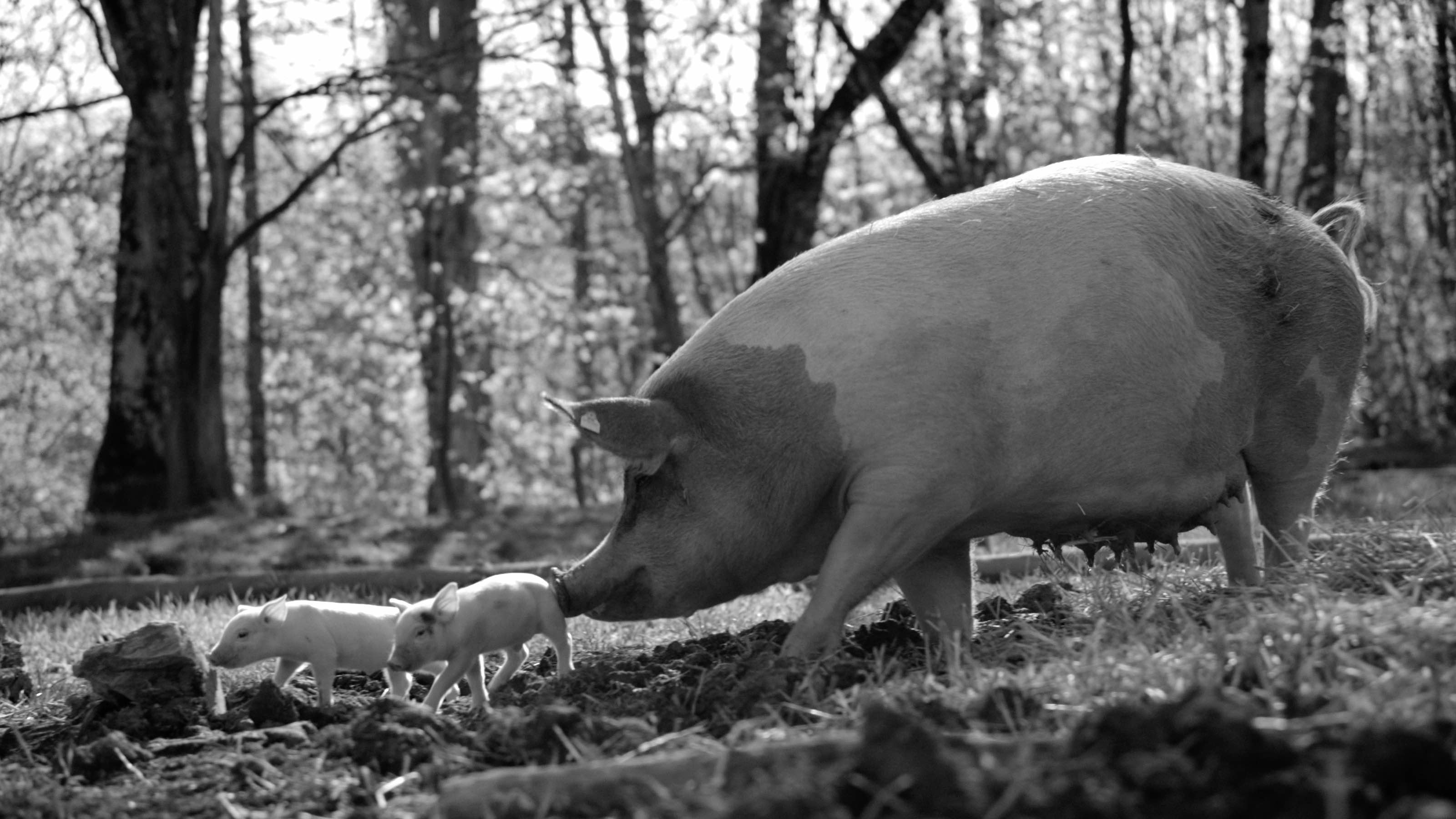
Shot in deeply layered black and white, “Gunda” follows the seasonal cycle of a sow on a farm, birthing a liter of piglets and rearing them from pink (I know it’s black and white, but bear with me) and squirming, endlessly suckling little oinkers. Throughout the film, shot in long, lingering takes that turn the mundane into a riveting, can’t-turn-away event, we never see a farmer – or any human, for that matter. We see the wheels of a tractor, but for the most part it’s just Gunda and her brood, who seem to have free range of the farm and surrounding forest; we occasionally meet some barnyard friends in Mr. Duck, Mrs. Moo, her bestie, and a one-legged chicken, among the many. It’s “Charlotte’s Web” or “Babe” (1995) sans the anthropomorphic cuteness.

How Kosakovskiy gets at the heart of his subject and makes us feel – and we do feel, if not take on Gunda’s maternal instincts as if we were there caring for her cute brood – clearly has much to do with patience and composition. No one would equate the Russian-born auteur to the great Frederick Wiseman, whose hands-off, fly-on-the-wall style is pretty much the definition of cinéma vérité; but the long takes and observation of rhythms and beats of life, drunk in and deeply felt, are poetically similar, even though the filmmakers’ subjects and effect remain vastly different. “Gunda,” like “Aquarela,” is best seen on the big screen for its masterful cinematography’s attention to framing, depth of field and shadows.

How “Gunda” moves in the final act will come as no surprise, but should give you a bit more pause the next time you’re debating soy or pork bacon for your BLT.

City Hall

5 Nov

Cambridge documentarian Frederick Wiseman turns his camera on Boston for a sprawling four-hour immersive portrait of the city.

Tom Meek for the Patriot Ledger
November 3, 20202

For his 45th documentary feature Frederick Wiseman trains his lens on his native Boston to record all things municipal unfolding in the cement encased corridors of Gerhard Kallmann’s infamous Brutalist facade. The retrospective of how we operate and function in the Hub is an engrossing four-and-half-hour watch (yes, you heard that right) that amazingly goes by in a blip and serves as something of an eerie — and taunting — time capsule. Shot during 2018 and 2019, one segment has Mayor Marty Walsh and authorities preparing for the Wold Champion Red Sox Duck Boat celebration. Later we see fans chanting “Mookie, Mookie, Mookie.” Betts famously left us in 2019 and recently performed his heroics in the 2020 World Series for that team we vanquished in 2018 (the L.A. Dodgers), and all that Wiseman’s camera captures, strangely feels from another era as the city bustles in pre-COVID normalcy — one can only imagine what a 2020-2021 version of “City Hall” might look like.

The Government Center delve unfolds in a series of chapter-esque meanders between the micro and macro with plenty of shots of Boston’s iconic skyline and landmarks to root you. The rendering should make plenty of Beantowners proud and Walsh, seemingly ever aware of the camera, comes off crisp, progressive and inclusive — a shining illumination that may pose something of an extra hurdle for upcoming challenger Michelle Wu and others. In Wiseman’s classic observant, cinema verite style (fly-on-the-wall) there are several long takes of municipal proceedings such as the budget review where presenters effusively tout the investment in infrastructure as a win-win because it not only betters the community, but also makes the city’s debt more appealing to bond investors. It’s a cut-and-dry matter that under Wiseman’s eye is more interesting and accessible than it sounds, but “City Hall’ is most affecting when following the day-to-day operations of front liners, namely the 311 help center workers trying to iron out neighborhood issues or city magistrates mitigating parking tickets — an anxious expecting father who parked in front of a hydrant and an incredulous old-schooler who didn’t know there was resident parking along Congress Street — and then there are those out in the community removing trash and providing subsidized veterinary care.

What’s truly amazing to note too is that Wiseman, at the age of 90, is still cranking out documentaries on a near annual basis and does all the editing to boot. For those not familiar with the works of the Academy Award honored documentarian, a law professor at BU and Brandeis before picking up the camera, they’re slice of life exposés that quietly drink in their subjects without question, preface or prod the way you might get from a Michael Moore (“Roger & Me,” or “Fahrenheit 9/11″) or Morgan Spurlock (“Super Size Me”). The result conjures an uncanny sense of intimacy; there’s no barrier, you are organically and viscerally part of the scene. “City Hall” in scope and focus feels like a natural addition to the the director’s unofficial community series that began with “Aspen” (1991) and includes “Belfast, Maine” (1999)” and “Jackson Heights” (2015). Must see Wiseman films in my not-so-humble opinion are “Boxing Gym” (2010) and his controversial first film, “Titicut Follies” (1967) about the Bridgewater State Hospital for the Criminally Insane, which, because of its graphic nature, was banned from being shown in Massachusetts until the early 1990s.

The most moving and telling scenes in “City Hall” are those steeped in earnest reveals and communal conflict. Talking to veterans afflicted by addiction and PTSD, Walsh shares candidly his dark days as an alcoholic. The connection both onscreen and in the room is immediate and palpable, something that doesn’t quite register as much when Walsh underscores his Irish heritage as a bridge to a Latino community. Then there’s the Thanksgiving feast for those challenged by Down syndrome and similar arresting disorders where Walsh and crew dutifully serve expectant diners and cap it all off with dancing. Wiseman never lets his lens sway you, but if you don’t have a bittersweet bump inside you, you probably didn’t flinch when Old Yeller died. The big rub in the film comes during a community outreach meeting run by a predominately Asian coalition of businessmen seeking to institute a recreational cannabis facility in a predominately Black and brown section of Dorchester. The two sides talk at each other, the rhetoric’s tinged with the annoyance of not being heard and there’s the clear fear of being taken advantage of, with the city and the Massachusetts Cannabis Control Commission — who are not in the room — taking the brunt of the shots. It’s a telling back and forth that raises the question of equitable economic development and how to earnestly empower a community in the process without gutting them.

One of the things that makes Wiseman’s films so captivating is the sense of cadence and human rhythm he imbues them with. “Boxing Gym” and his 2009 ballet troupe portrait “La danse” are driven by repetition and pursuit of form. In “City Hall” there are mesmerizing long takes of mattresses and barbecue grills being obliterated and compacted by a garbage truck’s compressor and long spindly tree limbs are methodically pulled in and consumed by a restless wood shredder — activities quite mundane and everyday, that in Wiseman’s purview magically become hypnotic wonderments. Also too, Wiseman’s longtime collaborator, cinematographer John Davey artfully finds Escher-esque motifs and reflections within reflections amid our familiar facades. His upward angled framings cut aesthetic portraits of old Scollay Square and the bland Saltonstall building in ways one might not have imagined possible. “City Hall” in the end, is a dutiful reflection of who we are, where we came from and a piquant insider look into the vast municipal neural net that keeps us humming as a community.

I am Greta

25 Oct

‘I Am Greta’: Young environmentalist speaks; Whether we listen lies beyond director’s lens

By Tom Meek
Friday, October 23, 2020

The documentary “I Am Greta,” about teen environmentalist Greta Thunberg and the lengths she goes to spotlight the climate crisis, is a testament to commitment and passion. It’s also a film that feels like it only scratches the surface about its subject, her family and, more so, her cause.

The film centers on Thunberg’s Atlantic crossing in a carbon neutral yacht to give a speech to the United Nations’ climate summit in New York. She won’t fly “because of the enormous climate impact of aviation.” Filmmaker Nathan Grossman tags along, but first sets us up with some of Thunberg’s grassroots activism, including sitting on streets with signs calling out global plunder by carbon-consuming corporations and world powers. We also get a smattering of barbs from Trump, other globally positioned strongmen and climate change deniers – whose pockets Thunberg would say are lined by big carbon – disparaging the young activist. One talking head even digs in on Thunberg’s Asperger’s, tagging it as a flaw and dismissing her as a young girl with a weakness. Thunberg says the neurological condition allows her to “see through the static,” and seems to handle the pressure pretty well. She’s also a kid, and there are plenty of scenes with her and her father (the mother remains largely offscreen), who accompanies her to most of her speaking engagements. Grossman has quite intimate access to their interactions, even when Thunberg, in a dour mood, won’t get out of bed at her dad’s behest.

What will probably most enlighten the audience is Thunberg’s fiery eloquence. Half of it’s in her native Swedish, but when Thunberg gets up before the UN speaking in English, it’s sharp, well-honed rat-a-tat rhetoric: “I want you to panic, I want you to act as if the house is on fire” and “humanity sees nature as bottomless bag of candy” and some generation shaming (“You’ve stolen my dreams and my future, how dare you!”). It’s there finally that the film does something to take up Thunberg’s cause, serving up the hard reflection of one generation putting the next in jeopardy.

Grossman’s style for the most is Frederick Wiseman-like, fly-on-the-wall. It’s captivating to let Thunberg be herself and us observe quietly, but from an insight and understanding perspective there remains a frustrating remove. It’s Thunberg in the end in the end who punches through. She’s heard, but did the world listen?

Desert One

23 Aug

‘Desert One’: Rescue attempt in Iran was daring, but risk and repercussion dig in with Eagle Claw

By Tom Meek

Barbara Kopple’s meticulous dissection of the failed Operation Eagle Claw mission, launched in 1980 to rescue Iranian hostages, serves as a gripping connect-the-dots weave of history, harrowing personal testimony and world-shaping events. Without much judgment the film dials back to the 1950s when Iran was the hot, oil-rich country Western powers jockeyed to get in on. Later the CIA helped topple a brief nationalist government in a coup d’état and reinstall a shah, and Kopple’s doc delivering a montage of him in chummy photo ops with every president from Truman onward. The doc also subtly metes out snippets of the shah’s abysmal, brutal human rights record. Then comes the defining moment of the overthrow, the extreme hatred for America and the takeover of the U.S. embassy – that final event told by several staffers and military personnel who would become hostages, recalling the chaotic mayhem of angry Iranians scaling the gates and storming the building.

The now infamous Iranian hostage crisis would become a 444-day ordeal. That extraction mission – the first Delta Force operation – was green-lit by then President Jimmy Carter, and its failure, as the film has it, was the key to him being swept out of office by Ronald Reagan. Carter and his VP, Walter Mondale, appear in the film, as do several of the commandos who recall the surreal scene in the desert outside of Tehran where several Sikorsky Sea Stallions that couldn’t handle the sandstorms failed, leading to the ultimate decision to abort. The evacuation, for those who don’t recall, would go horribly awry, and eight military personnel would wind up burnt alive. Before that, when the Delta Forces arrived at the remote location, a busload of civilians happened bizarrely upon them in the middle of the night and had to be taken hostage by the commandos. Then several other vehicles arrived; there was confusion, a skirmish and a massive explosion. I don’t want to give aways all the details, but Kopple does a great job of stitching together a thrilling narrative with archival footage, personal accounts from those who were there in the desert (one marine, tough and on point, breaks down on camera; one of those Iranian citizens from the bus recalls his own experience of being held without knowing why) and to re-create the drama in the desert, Kopple smartly opts to use animation much as Ari Folman did with “Waltz with Bashir” (2008) and Randall Christopher did with “The Driver is Red” (2017) – the former about an Israeli incursion into Lebanon and the latter about the hunt for Adolf Eichmann in Argentina. In all three cases, animation creates a provocative abstraction to put you on the scene more viscerally than a dramatic recreation might. It’s a brilliant mix of media forms that seamlessly deepens the global and human context of what transpired. Kopple won Oscars for her first two documentaries, “Harlan County U. S. A.” (1976) and “American Dream” (1990), both depicting labor disputes in middle America. Since then Kopple’s lens has been trained on such diverse and unique topics as Woody Allen and his union with Soon-Yi Previn in “Wild Man Blues” (1997) and the Dixie Chicks’ media battle over statements opposing then President George W. Bush in “Shut Up & Sing” (2006). Kopple’s latest is something new and powerful, not just because of the implied what-ifs, but because of the heroism, sacrifice and personal tales of survival.

Represent

14 Aug

‘Represent’: Embedded with three campaigns, women from all over the hard-to-navigate map

By Tom Meek


Another politically themed doc this week (along with “Boys State”), “Represent” looks at women running for political office in the Midwest. Under the observance of Hillary Bachelder’s lens, Myya Jones, a 22-year-old, tries to spark a youth movement by running for mayor of Detroit; Bryn Bird, a farmer and working mother in small town Ohio, seeks a township trustee post; while Julie Cho, a Korean immigrant, runs as a Republican candidate for state representative in a liberal Chicago suburb. The timelines aren’t all that linear, but most interesting is Cho, who, ostensibly because she is not a typical GOP candidate (“rich, white male”) is abandoned by the party during her campaign but also takes veiled racial pokes (she’s in an interracial marriage) from the liberal opposition – “Why don’t you go run in the Korean neighborhood?” To which she notes to the camera that only the left gets away with that kind of racism these days. Her idealism to embed and change the party feels like the right quest, but lack of support and the attacks she faces on the trail take their toll. Her frustration and weariness are palpable, and yet she remarkably soldiers on. We catch up with Bird already in office and making policy, some of which is not popular, and in one telling scene she remarks on how one of her jobs affects the other when formerly loyal customers, rankled by her policies and communal decisions, walk by her stand at a farmers market without a hello. What’s remarkable about Bachelder’s doc is the degree of access and trust she gains from her subjects. You could call it “Girls State: The Real World Edition.”

“Represent” shows as part of the the Brattle Theatre’s Virtual Screening Room.

Boys State

14 Aug

‘Boys State’: Re-creating America in miniature, dominated by right whites (then comes a twist)

By Tom Meek

Directors Amanda McBaine and Jesse Moss’ immersion into the Girls and Boys State mock political programs, which have for decades turned out leaders of tomorrow such as Bill Clinton, Ann Richards and Dick Cheney, is both an eye-opener and a reason for pause. For “Boys State” the documentarians embedded in 2017 with the Texas chapter, where 1,100 17-year-olds assemble for a fortnight in the capital, divide into two parties (Nationalist and Federalists), develop platforms and elect a governor – the highest official rank to be reached, and the final act of the educational event sponsored by the American Legion.

Sounds pretty wholesome and promising, right? And it is, on one hand (the passion for politics and democracy, a clear win), but at times the hooting, testosterone-amped crowd of mostly white lads (“I’ve never seen so many white people ever,” one African American attendee reflects) eerily calls to mind the tiki torch marchers in Charlottesville. The agendas too feel skewed to the right – pro-gun, pro-life (“if there’s a rape, we don’t punish the child, we find the rapist and castrate him!”) and “back the blue.” Given the lack of color, it’s refreshing to see a son of undocumented parents rise to run for governor, bolstered by a somber, reflective approach rather than shouted platitudes such as “freedom!” and “a vote for me is a vote for all!” The use of Instagram and other social media is impressive, though it’s often mean, personal and racist. Drinking in “Boys State” instills a sense of hope, and dread. It’s a slice of America if lived on a landlocked “Lord of the Flies” isle, where you know boys will be boys.