Tag Archives: Comedy

Good Fortune

21 Oct

Keanu is the chain-smoking angel who flies away with this class comedy

Aziz Ansari, the shaggy-dog comedian (“Master of None”) known for his casual demeanor and biting social barbs, makes his directorial debut with this comedy about fate, happiness and how much the rich – and AI – are eating those further down the social ladder. “Good Fortune” is a devilish mix of light and dark that takes a good long time to reveal just how dark things can get, despite focusing on people sleeping in their cars because they can’t put a roof over their heads no matter how many jobs they work.

Even with the billing of Ansari and fellow comedy mainstay Seth Rogen, it’s Keanu Reeves who marches off with the film. It’s mostly the actor’s innate warmth and humanity that do the trick, but there’s also that dash of goofball vacancy that made the “Bill & Ted” movies so indelible and endearing that gives the film agency and air – a project that, in hindsight, might have otherwise floundered. 

Continue reading

Film Clips

27 Apr

Of Beavers and Boys, reviewed: ‘Hundreds of Beavers’ and ‘Boy Kills World’

Cult camp is an odd genre bucket that collects a vast variety of films dumped there for varying reasons. Some (“El Topo,” “Barbarella” and even the recently released “Sasquatch Sunset”) end up there by design; others (“Showgirls,” “Mommy Dearest”) wind up there because they’re unintended, rubbernecking-worthy spectacles. Two films from this week’s roundup land there with mixed results: “Hundreds of Beavers,” which had a held-over-by-popular-demand extended run at the Somerville Theatre this year and is now available on streaming platforms, and “Boy Kills World,” which played as part of the Boston Underground Film Festival at The Brattle Theatre and opens at Apple Cinemas Fresh Pond on Friday. Two different films with distinctly different outcomes.

‘Hundreds of Beavers’ (2022)

“Beavers,” co-written by director Mike Cheslik and star Ryland Brickson Cole Tews, shoots for something new and markedly left of center. What the pair has concocted is slapstick, silent-era comedy mixed with loopy Looney Tunes animation and modern-day special effects. Made for a mere $150,000, the film has a premise that feels affectionately borrowed from Chaplin or Keaton: A 19th-century applejack seller named Jean Kayak (Tews), perpetually hopped up on his own hooch, gets into a skirmish with an army of beavers in the frozen wilds of the northern Midwest – think “Jeremiah Johnson” (1972) by way of “The Gold Rush” (1925). The beavers aren’t cute CGI creations, but dudes in suits with ginormous buckteeth. There’s something to do with a fur trader (Doug Mancheski) and his winsome daughter (Olivia Graves) whom Jean fancies, but it’s mostly Jean versus the bevy of beavers with cartoonish boinks and bams and some fairly taxing physical comedy performed by Tews as he hops from one log to another in a sawmill and slip-slides his way across the ice as a legion of angry beavers chases after him. No dialogue is spoken, and it’s shot in black and white. The experience (did I mention the daughter is pretty good at disemboweling beavers with a knife?) gets a bit repetitious, but Cheslik and Tews, all in on the hijinks, save some zaniness for the last go-round.

whitespace

‘Boy Kills World’ (2023)

“Boy Kills World” jumps out of the gate with promise; in the near dystopian future the aristocracy keep the masses in check with an annual lottery/purge called the “Culling.” What the film is, however, is a fairly pat, years-in-waiting revenge drama centered on a warrior known just as Boy (Bill Skarsgård, “Barbarian”) under the tutelage of a sensei (Yayan Ruhian, from the “Raid” films and “John Wick: Chapter 3 – Parabellum”) to beef up and exact revenge on Hilda Van Der Koy (Famke Janssen), the elitist who sanctioned the execution of his parents when he was an adolescent. The gimmick is that Boy can’t talk, yet the whole movie is narrated by him in voiceover. That’s done by H. Jon Benjamin (the voice of “Archer”), who makes Boy sound something like a cross between the gruff growl of Christian Bale’s caped crusader in Christopher Nolan’s “Batman” trilogy with the wily witticisms of Bruce Campbell in any of the Sam Raimi “Evil Dead” flicks. That is somewhat fitting, as Raimi serves as executive producer here, and though directed by Moritz Mohr, “Boy Kills World” has plenty of Raimi influences. The plot of rebel forces fighting an aristocratic tyranny means comparisons to films such as “V for Vendetta” (2005) are sure to drop, but the lesser, forgotten 1992 Mick Jagger vehicle “Freejack” is the more apt comparison, as the fun of watching Skarsgård the avenger’s parkour-propelled takedown of legions of baddies ultimately palls. Skarsgård, almost as jacked as older bro Alexander was in “The Northman” (2022), makes for an impressive onscreen presence, as does Jessica Rothe as the skilled assassin known as June27 equipped with a neat combat helmet that’s a cerebral message board of sorts. It’s too bad the narrative arc they ride isn’t as sleek and mean

No Hard Feelings

22 Jun

‘A boy will become a man and a woman will get a Buick Regal

By Tom Meek

We’ve seen it all from Jennifer Lawrence: gritty, hard-bitten drama (“Winter’s Bone”), culturally critical satire (“Don’t Look Up,” “American Hustle”), spy thriller (“Red Sparrow”), a YA franchise (“The Hunger Games”), even a foray into the superhero ’verse (the “X-Men” series reboot), but a rom-com or straight-up comedy? “Silver Linings Playbook” (2012) kinda fit that bill (though it’s a dark one, as it deals with loss and mental illness) and Lawrence would win an Oscar for her part as a grieving widow looking for release and a way to move on. But in “No Hard Feelings,”  Gene Stupnitsky’s not-quite-a-rom-com, Lawrence gets to open up and be free in a way she’s never done – think Cameron Diaz in “Bad Teacher” (2011) or Charlize Theron in “Long Shot” (2019). The thing that will be made the most of is Lawrence’s birthday suit scene. It is an eye popper, but not in the (racy, smutty) way you may think – it’s a punctuation mark in triplicate in a film that otherwise charms on its comedic merits and moments of humanity.

Lawrence’s Maddie lives in swank Montauk, Long Island, but is not one of the living-large summer weekenders looking to escape the dog days of Manhattan; she’s a townie living in the modest one-story bungalow in which she grew up. Mom died not so long ago, and the house is about to be taken away for back taxes. Maddie gets by gig-economy style bartending at the marina to those wealthy sorts and by giving Uber rides – that is, until her car is repossessed. No car, no house, no cash, what’s a youngish single woman to do?

Plan B comes in the form of a Craigslist ad posted by a wealthy couple (a dutiful Laura Benanti and Matthew Broderick, rocking a Rasputin ’do) who want a 20-ish woman to help instill confidence in their Princeton-bound son, Percy (Andrew Barth Feldman, on leave from Harvard for the filming). What that translates into: Make our son a man (take his virginity) and we’ll give you a Buick and enough cash to handle the back taxes. Percy is unaware of the plot, and the task for Maddie – who is in her early 30s and barely passes the mom-and-dad interview – becomes more complicated than expected.

Maddie’s a hot mess, and endearingly self-deprecating. She’s also vulnerable, up against it and has can-do resolve. There’s a whole backstory about her dad and plenty of attempts to get Percy to Buick land. Stupnitsky, a veteran of “The Office” TV series pulling double duty as writer, does a nice job with the comedic timing and plots changeups. Lawrence, believe it or not, is adroit as a physical comedian, be it her Maddie trying to rob her car back from a tow truck, or that buck-naked throwdown on a beach that involves crotch shots (both punches and sightings of) and sleeper holds. Maddie and Feldman’s geeky, sensitive Percy also score some truly tender moments. It’s evocative of “Risky Business” (1982) and “Booksmart” (2019) without being derivative. it’s also refreshing to see Lawrence take a chance, and Stupnitsky does a nice job of playing with the have-and-have-not dynamic the way “One Crazy Summer” (1986) and “Caddyshack” (1980) did, but more affectingly and subtly.

Cocaine Bear

25 Feb

This gory romp with a CGI beast should have audiences lining up for a good time

(from left, back to camera) Eddie (Alden Ehrenreich) and Stache (Aaron Holliday) in Cocaine Bear, directed by Elizabeth Banks.

When in college during the big ’80s we’d cross the Florida peninsula at night to partake in spring break mayhem in Fort Lauderdale and Miami – gonzo road trips for a wee bit of fun. To do so we took a route through the Everglades known as Alligator Alley and were warned by locals never to stop, or at least not to dally. Why? Alligators for sure, but more so, drug dealers and other illicit types collecting bales of marijuana and duffel bags full of cocaine kicked out of prop planes to dealers camped out to retrieve them and sell to those spring breakers. Tony Montana it wasn’t, and often, as I was told, dumps were lost or intercepted by other shady sorts or the ever-prowling authorities. About the only things I ever ran into along Alligator Alley were swarms of mosquitoes and some really godawful, low-grade tequila one of my college mates insisted on drinking as pregame petrol for all in the van not taking wheel duty.

That said, such a real-life drug drop from above is the loose inspiration for “Cocaine Bear,” a devilish little diamond in the rough with cult aspirations that isn’t far off in tenor and production values from the 1990 surprise “Tremors,” starring Kevin Bacon. The drug drop is supposed to take place over Tennessee but goes awry when the plane malfunctions and starts to go down. Most of the coke lands in the Chattahoochee National Forest in Georgia, where a few kilos are snorted up by a 500-pound mama bear (we learn that the pronouns are “she/her” when she passes out on a random drug dealer who can then identify her because – well, now you get a feel for the film’s cheeky, campy edge). The bear wants more, and will kill for it, be you a wayward hiker with a little accidental dust on your leg, a drug dealer seeking to retrieve the stash because your Colombian supplier will come for you, a law enforcer trying to intercept the former or an amorous ranger with designs on the park’s goofball naturalist. There’s a potpourri of personalities and agendas swirling around this very dangerous, coked-up beast.

Directed by Pittsfield native and more often actor Elizabeth Banks (“The Hunger Games” and “Pitch Perfect” series) making a nice rebound from her 2019 failed reboot of “Charlie’s Angels,”“Cocaine Bear” packs a lot into 90-ish minutes and hits some hilarious highs. It’s also pretty gruesome and the CGI bear is, to be kind, B-rate, which only adds to the winning camp factor. It’s a go-for-broke concept played to the wire by Banks and bolstered by a cast of deft character actors and stars outside their normal wheelhouse: Keri Russell as the mom trying to find her wayward daughter (Brooklynn Prince), who’s lost in the woods; “Modern Family” guy Jesse Tyler Ferguson; Ice Cube’s kid O’Shea Jackson Jr., so good in “Long Shot” (2019) and pretty spot on here as drug dealer’s gopher; the ever-affable Isiah Whitlock Jr. as the maverick cop out of his jurisdiction and having to deal with a pampered lap dog; Margo Martindale as the park ranger quick on the trigger; Alden Ehrenreich (“Solo”) as the dealer’s son, in tow to help retrieve the coke; Russell’s “Americans” costar Matthew Rhys in a cameo as the coke-snorting aviator who kicks the whole mess off; and the late Ray Liotta as the head heavy not looking forward to answering to his Escobar sources.

How much of it is true? Very little that we know of. In 1985 a load of coke did get lost in Tennessee, never to be recovered, and a 175-pound black bear was found dead of an overdose across the border in Georgia. That’s it – the rest is a gift from Banks and writer Jimmy Warden during the time of year studios dump their failed projects in theaters and on streaming platforms as the movie industry gears up for the Oscars and big-screen spring seasons. Due to an illness I had to scrap my plans to attend a press screening in Boston and instead caught the early Thursday show at the Somerville Theater’s large auditorium, which was a true, relaxing pleasure – navigating evening press screenings, to which media outlets and PR firms often give away promo passes to the public, can be teeming gantlets (a bear, dare I say?). I was in no mood and double happy to stay local. 

The Lost City

28 Mar

Romancing the same

By Tom Meek

Swashbuckling rom-coms tend to work (“Romancing the Stone”) or not so much (“Jungle Cruise”) based on the chemistry between the leads, the cheekiness of the supporting cast and some deft plot twists. “The Lost City” has plenty of the above, even if it runs out before the end. The set-up has reclusive romance novelist Loretta Sage (Sandra Bullock) – don’t call her Danielle Steel – tired of churning out product and even more so of doing publicity tours with hunky cover model Dash (Channing Tatum, whom you can call Fabio; he’s riffed as such, replete with flowing blonde locks). The rub with the latest book comes when Loretta, bored with the process and grieving the death of her husband, gets kidnapped by an eccentric billionaire with the benevolent-sounding name Abigail Fairfax (Daniel Radcliffe, excellent in the mercurial fop role) to decode ancient hieroglyphics so he can obtain the unobtainable: an ancient crown of jewels in the buried enclave of the film’s title.

The whole shebang’s pretty much a McGuffin so Tatum and Bullock can engage in a rom-com romp on a tropical island. There’s leech removal from personal parts and a sequined unitard that just won’t die. What’s a real blast is Brad Pitt in a cameo as a zen extraction expert (allegedly the idea came on the set of Pitt’s “Bullet Train” – coming this year – in which Bullock had a cameo, and this was the payback) and Patty Harrison as Loretta’s boozy social media publicist, not to mention Da’Vine Joy Randolph as the stressed-out, brash-talking tour manager and Oscar Nuñez as the the quirky cargo plane pilot who often interprets words a bit too literally.

Tatum and Bullock have solid chemistry, but the film runs out of pomp and verve as plot ends need to be tied up and things become a bit too predictable. Don’t get me wrong, the film has plenty of “didn’t see that coming” moments – it’s just they’re front loaded. No matter. “The Lost City” will serve as a nice studio-produced calling card for the brotherly directing team of Adam and Aaron Nee, who until now have mostly toiled together acting, writing and directing indie fare such as “Band of Robbers” (2015) and “The Last Romantic” (2006). Next up for the Nees is more action and adventure with the big-screen take on He-Man, “Masters of the Universe.” Pro tip for “Lost City”: Be sure to sit through the credits.

Borat Subsequent Moviefilm

22 Oct

‘Borat Subsequent Moviefilm’: Updated antics Make Benefit Once Glorious Nation of America

By Tom Meek
Wednesday, October 21, 2020

People thinking back to Sacha Baron Cohen’s gonzo 2006 mock-doc “Borat” will certainly remember that pud-padded, shoulder-looped green G-string, but may have forgotten how the bold and experimental film pulled the mask off bigotry and entitlement in the United States. With “Borat Subsequent Moviefilm,” Baron Cohen’s back with more of the same, but this one’s more targeted, loaded and timely. It doesn’t pack quite the same zany eye-pop – that bud’s bloomed – but it is the first film in my mind to tackle both Donald Trump’s divisive presidency and the Covid pandemic.

The setup is fairly simple, though the execution is not: In Borat’s native Kazakhstan, just out of a gulag, the overly zealous (and clueless) journalist is tasked by authorities with delivering a gift to the Trump administration so Kazakhstan can gain favor among other strongman countries of the world – Russia, Syria and so on. The film’s extended title is: “Delivery of Prodigious Bribe to American Regime for Make Benefit Once Glorious Nation of Kazakhstan.” The bribe? National treasure Jonny the Monkey is to be delivered to “No. 1 ladies’ man” Michael Pence – aka “the vice pussy grabber.” Jonny, a well dressed chimp, doesn’t quite make it to America, so Borat rolls with Plan B, which is to offer up his 15-year-old daughter Tutar (relative newcomer Maria Bakalova) as a child bride.

If you’re somehow not familiar with Baron Cohen’s “Borat” schtick, the major growl in his irreverence engine is the punking of everyday people – whom you’d think would see it coming a mile away, but 14 years is a long time and most targets are xenophobic types south of the Mason-Dixon Line where the name “Borat” might suggest cured meat or a cold soup from an enigmatic and heretical religious sect. In a bakery, Borat asks the counterperson to put the inscription “Jews will not replace us,” on a newly purchased confection. Later, at a debutant ball (how did he even get in there?) Borat and his daughter perform something of an Eastern Bloc jig with the daughter’s dress unfurling for a visible jaw dropper among the well-heeled upper crust. Getting closer to his mark, Borat takes the stage at a right wing rally, crashes a Pence speech and dons Klan robes and a Trump costume. The real grabber is Tutar, dressed up and looking eerily like Ivanka Trump, interviewing Rudy Giuliani and ultimately coaxing him into a compromising situation that not only raises eyebrows and questions of ethnics, but likely will fry what’s left of the former New York City mayor’s reputation.

The film was shot during the spring and summer as Covid raged across the country – Giuliani at one point says Trump saved a million lives because the Democrats would never have acted. Throughout the course of the film, use of masks increase and the disease quietly and slowly becomes a key player. The reveals of a divided America hopefully are nothing new to viewers, but the comic reframing is a healthy reminder with the election on tap. The real revelation here is Bakalova as Borat’s daughter, seamless in her audacious pranking. With Baron Cohen there’s always a puckish nod and wink in his eye; with Bakalova, it’s smooth and natural, with nothing contrived. As a result, the darkness of the candid camera moments is deeper and more visceral. “Subsequent Moviefilm” pokes us all in the eyes and exposes us to a new talent.

Bill & Ted Face the Music

2 Sep

‘Bill & Ted Face the Music’: Passage of real time adds wives and daughters to dudes’ partying on

By Tom Meek

As AMC and other theaters begin to slowly reopen (none in Camberville except for Landmark’s Kendall Square Cinemas, which opened stealthily Friday) studios are hedging their bets by releasing in theaters and on streaming platforms. “Mulan” is coming to you next week from Disney for nearly $30 plus the cost of a Disney+ subscription, and if that feels eye-popping, consider that you can show it to the whole family. In this racket we normally have press screenings in a theater or the studio sends us a screening link, but for “Bill & Ted Face the Music” I missed the boat and so went the path we all must go, shelling out $20 to rent the third installment of this dude-ly trilogy.

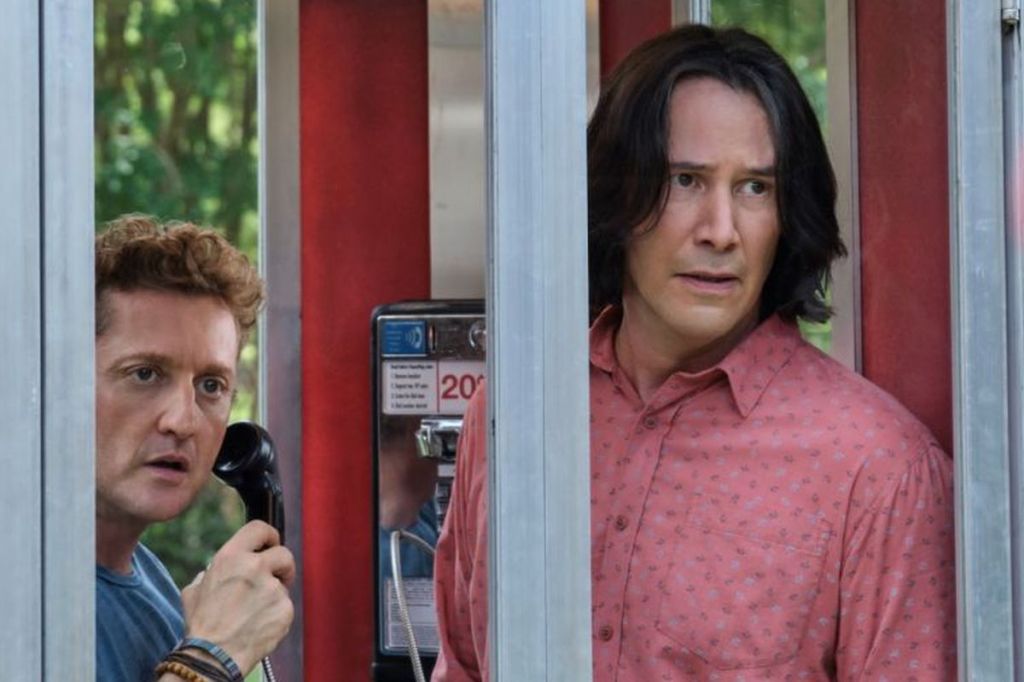
Written by the original’s screenwriters, Chris Matheson and Ed Solomon, and directed by Dean Parisot (“Galaxy Quest’’), time has not been all that kind to Bill Preston (Alex Winter) and Ted “Theodore’’ Logan (Keanu Reeves). They married and have daughters, but their dreams of being big-time rock stars have fallen by the wayside. Something of an abandoned strip mall overgrown with weeds, is how one might describe it after drinking in their performance at a wedding party. So how do the lads – er, dads – get back into the time-hopping phone booth? Someone called The Great Leader (Holland Taylor) in the future sends back her daughter (Kristen Schaal) to give them a wakeup call, and for good measure, there’s a freaky ’bot (Anthony Carrigan) who’s something of a cross between the Terminator and Tin Man. The quest this time around is to come up with the one song that can unite the planet – a quest that would seem like a platitude if it were not for the time – and ultimately save the universe. Dave Grohl of the Foo Fighters, Jimi Hendrix (DazMann Still) and Louis Armstrong (Jeremiah Craft) work their way into the plot, but the best is when Bill and Ted run into past and future versions of themselves, with the best being the version of themselves inside a prison yard. The wives (Erinn Hayes and Jayma Mays) are off in their own phone booth on their own adventure (the couples therapy scene is droll and hilarious) as are the daughters, Billie (Brigette Lundy-Paine) and Thea (Samara Weaving). George Carlin makes a digital appearance and the ageless William Sadler is back as the Grim Reaper. Yes, a trip to Hell is mandatory.

Is seeing the first two chapters – “Bill & Ted’s Excellent Adventure (1989) and “Bill & Ted’s Bogus Journey” (1991) – a requirement? No, “Face the Music” works on its own well enough, with just a few references and gags that may be lost without the homework. Reeves and Winters do an effective job of remaining excitably dude-ish while being dad-ly. The nice revelation here are Lundy-Paine and Weaving as the dudes’ daughters; in mannerism and inflection, even style and attire, they’re chips off the old block. You can tell they’ve watched the two prior episodes forward and back ad infinitum. If this is the end of the dudes’ run, you can see them picking up the reins and having their own dudette adventures. As for paying $20 (you can own it for $25) it’s a coin toss for me as a solo watcher. Now, if I was doing a series watchathon with family or friends, and enjoying a beer or two? Most Excellent!

The King of Staten Island

12 Jun

KingofStatten

Funny guy filmmaker Judd Apatow directs funny guy Pete Davidson is “The King of Staten Island,” a semi-autobiographical account of arrested development on the urban isle of the film’s title. Apatow, known for punchy comedic hits such as “The 40-Year-Old Virgin” (2005) and “Knocked Up” (2007), and Davidson, whose wide-eyed edginess shines on “Saturday Night Live,” dial up one long “finding yourself” dramedy (almost two and a half hours) that’s unfortunately a tad slight on the laughs and way too long on the melodrama.

Davidson plays a version of himself as Scott, a 24-year-old tattoo artist living with mom (Marisa Tomei) and in a friends-with-benefits relationship with his sister’s best friend, Claire (Bel Powley). He won’t be seen in public with her and she wants something more – but slack, stunted dudes always think they have more in their hands than they do. Mostly Scott hangs out with a posse of the similarly rudderless (Ricky Velez, Lou Wilson and Moises Arias) who get high, complain about their stagnant situations with passive zeal and occasionally crack a funny joke. Then one day Scott offers to give a 9-year-old kid named Harold (Luke David Blumm) a tat. The kid taps out at the first squiggle of ink and later that day shows up with his dad (Bill Burr), who wants Scott or his mom to pay for the removal or he’ll call the cops.

Turns out Burr’s Ray is a firefighter (with a “big thick [fill in the blank]” as we’re told by his ex) who knew Scott’s father – a firefighter who died in the line of duty on 911 – and starts to date Scott’s mom. There’s a lot of relationship turns in “The King of Staten Island,” which becomes tedious after the umpteenth miscommunication and overreaction. Davidson’s not as razor like or effective as he is in his short jabs on SNL. Tomei and Burr, however, are quite excellent. Tomei, vulnerable and warm while digging in her heels, and Burr, casting shadows of John Voigt’s macho prison escapee in “Runaway Train,” is affable and complex beyond the script. Powley, so amazing in “The Diary of a Teenage Girl,” also doesn’t get a lot to work with, but you notice her when she’s onscreen. Apatow’s daughter Maude plays Scott’s antagonistic sister, and real-life firefighter turned “Reservoir Dogs” actor Steve Buscemi plays one of the hose draggers down at Ray’s station.

The Bellmen

10 May

The Bellmen': This fancy resort has everything, but especially slob comedy  and hand sanitizer - Cambridge Day

“The Bellmen” is the kind of weak-kneed, cheeky comedy David Spade or Rob Schneider might have made a decade or so ago. It’s a lo-fi romp about a posse of misfit bellhops at a fancy Arizona resort that plays its thin premise loose and fast for sophomoric laughs; what deepens it are the inadvertently topical plot developments that involve hand sanitizer and a white person hijacking another’s heritage for their own gain.
The film centers on a boisterous, posturing hunk named Steve (Adam Ray), something of a throwback to the blow-dried salad days of Scott Baio and John Travolta. Steve’s proud and boastful of his station as bell captain, and a professed bellhop for life. His main ambitions besides quality service and landing a big tip are Kelly (Kelen Coleman, of “Big Little Lies”), the cute head concierge, and his frat boy hazing of new bellhops – if only Jerry Lewis could apply. People check in and people go, as the ribald bellmen bite their knuckles over statuesque check-ins while barely maintaining professional standards. Then there’s the big weekend where the hotel is filled with folks teeming to see a self-help spiritual guru named Gunther (Thomas Lennon, “Reno 911!”), who plays up his mystic Indian roots and arrives with a pair of comely attachés in bikinis who administer hand sanitizer liberally and regularly to a cult of wide-eyed worshipers. That hand cleanser, it turns out, does more than just sanitize: It opens your mind to the power of suggestion and loosens your purse strings. Steve smells something amiss, but he’s waived off as a goofball control freak to those slathered in the stuff.

Written and directed by Cameron Fife, extending a 2017 TV short, “Bellmen” runs freely with its shaggy dog underbelly of paradise concept, a genre for which “Caddyshack” (1980) remains the gold standard. The slack comedy notches its laughs mostly from Lennon’s slippery guru, who has an answer for everything from under a knowing, raised eyebrow, and his slinky twosome as they mind – and libido – control the masses with ease. The core story about Steve and Kelly’s budding romance never fully grabs, but Ray does get a solid opportunity to spread his comedic wings when his despondent Steve goes on a tequila bender south of the border. He’s holed up in one of those spare adobe dwellings you’d find in a Sergio Leone film, an unwanted houseguest of a señorita and her son who take pity on him but are also deeply annoyed by his drunken babbling and chest-beating bravado – which the language barrier serves only to deepen.

One can’t image Fife was tapped into the whole Covid-19 hand-sanitizer hoarding spectacle at the time of writing and filming. The timelines just don’t marry, which makes “Bellmen” both oddly timed and timely. It’s trite, innocuous fun. Just ring the bell and forget your bags.

Love is Not Love

16 Feb

Looking for Love in all the wrong places, or a walk on metaphysical side

tmp-;ove2

Stephen Keep Mills, a character actor for decades, now in his spry early 70s, makes his feature directorial debut with this tres meta contemplation about love, desire and the actualization of. Shot in stark black and white, Mills’s satire “Love is Not Love” rambles through the streets of New York as we drop in on dicey shards of dialogue ranging from the weird, “He wants to lick my arm pit,” to the provocative, “I could love more than one man at the same time. Even the same day, no problem!” and as one might expect, the sophomoric, “Dude, jacking off is not cardio.”

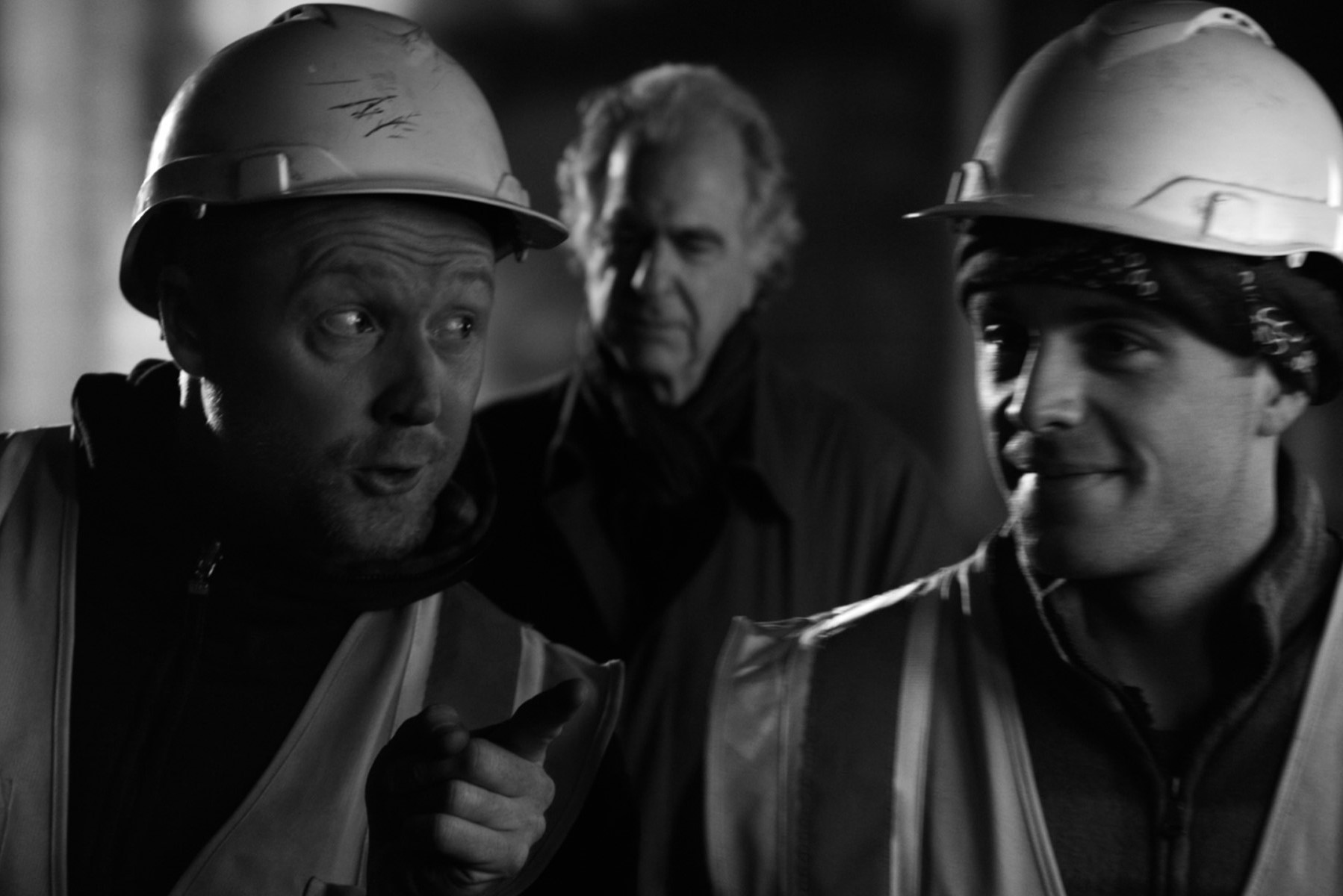
Yes, Mills is looking to give us a kick in shins and he does so effectively until we settle in with Frank (Mills) our protagonist, a silver maned lion with sad eyes, well past his prime and no longer king of a pride. We follow him along somberly as he lags behind two Irish construction workers debating the merits of women and Thomas Mallory’s seminal work, “Tristan and Isolde.” Frank seems invisible to the two like Bruno Gantz’s rueful angel in “Wings of Desire.” Interestingly too, “Love is Not Love” is rendered in a similar lush, matted black and white texture, a mood accentuating signature of Wim Wenders’s international masterpiece. Wenders shot as much of his 1987 film on location as the East Germans would allow him (Germany was not united at the time and shooting scenes at the Berlin Wall was denied and required sets). Mills on the other hand, shot his New York story on a sound stage in Los Angeles using old rear-screen projection for the backdrop imagery that for all its antiquated gimmickry provides tremendous field of depth and virtuosity. The lo-fi effect’s not only impressive, it’s aesthetically mesmerizing. Continue reading