F9: The Fast Saga

25 Jun

‘F9: The Fast Saga’ blasts seat-rattling overload with downshifts to a star-studded family drama
Less is more, except when it comes to vaccinations, your bank account and movies about jacked dudes driving muscle cars. Hard to believe this living-on-longer-than-it-should franchise about car jockeys doubling as covert agents has made it to “F9: The Fast Saga,” a cheekily oxymoronic title for a series taking on the endurance aspects of Le Mans. It also proves false, as more and more characters and famous mugs are folded into the mix and others are resurrected from chapters that barely made the grade (hello, “Tokyo Drift”). It’s a long drag, lasting more than two hours, that with all its world-hopping feels like the checkered flag is always around the next bend. Even the seat-rattling sensory overload of jittery dash-cam footage, hyperkinetic cutting and all the crash-booms that litter the screen tend to weaken over time. As we should know by now, much of the magic and mayhem is done on green screen, given whoosh and life by an army of CGI coders in Canada, and the ease of turning a key so effortlessly to produce car crash wonderment feels like a cheat. One laments losing the gritty authenticity of old-school stunt work and keen editing of Willam Friedkin’s “The French Connection” (1971) and his day-glo neo-noir “To Live and Die in LA” (1985), real-time car chase capers that will never be replicated – though “Drive” (2011) made a respectable go at it.

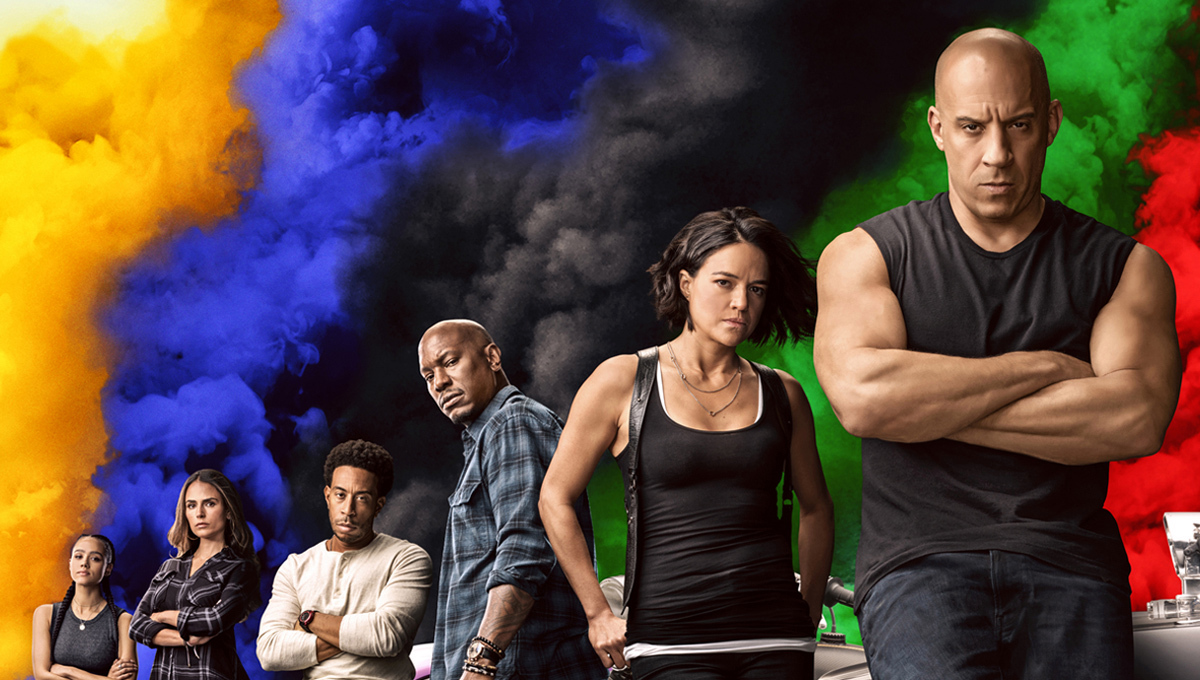
It’s not that I had a bad time at “F9,” which puts original “F&F” director Justin Lin back in the driver’s seat, or harbor a serious distaste for the series. I just wish it could be a notch sharper and more entertaining. (And can we please banish the line “Let’s do this” and the like?) The whole ka-bang, kaboom is driven by a MacGuffin: a DNA-coded device called “Aries” that allows its possessor to access and control all computer code in the universe. Russian trolls and Bond villains would literally die for it; here it’s a foppish Euro psycho named Otto (Thue Ersted Rasmussen) and an army of faceless commandos in helmets and black Kevlar suits. On the side of good are heroes such as Dom (Vin Diesel) and Lefty (Michelle Rodriguez), tearing up the streets of old world Europe with retrofitted American classics – being inconspicuous ain’t a thing – to stop Aries from morphing into the mother of all computer viruses.

Diesel’s swagger and Rodriguez’s simmer have always been – and still are – the engine of the franchise, and Diesel’s brooding Dom has a massively clichéd yet winning “Rocky” thing going for him, the secret sauce to solid hack filmmaking. But it’s a perk that Helen Mirren, Kurt Russell and Charlize Theron, who had small yet entertaining parts in past episodes, pop up in small bits (Theron, sporting a modish bowl cut, gets to get her vamp on with a dose of camp), while local guy and WWE sensation John Cena shows up as Dom’s baby bro with a dark past, seemingly revving his engine for the opposite side of justice. On paper, the brotherly rivalry has the trappings of a Shakespearean tragedy; in execution, no matter how hard the filmmakers and actors try, the pathos feels like another green screen trick of the light.

Reaching for new highs, the stunts and FX often lurch into hyperbole – there’s a Pontiac Fiero with a jet rocket strapped to its roof – but that becomes one of the charms of “F9,” which doesn’t take itself too seriously. (That scene in the Fiero with Tyrese Gibson and Ludacris is a good example.) Challenging Lin’s pacing is the ton of backstories that need to be told, the most interesting of which is that of young Dom (Vinnie Bennett, impressive) and his brother’s early woes. The film, however, only really moves at two speeds, and it’s a bit unsettling to go from a quiet reveal to Michael Bay-esque barrages of bombast without any shifting of gears. To that end, “F9,” like a Bay flick, is perfectly packaged box office bait, joyous popcorn junk that should drive folks back to theaters after long Covid shutdowns

Empowerment Mural Coming to the Square

25 Jun

Thaxton’s ‘Beauty of Everyday Living’ mural brightens Harvard Square kiosk construction

By Tom Meek Tuesday, June 22, 2021

Patricia Thaxton’s “The Beauty of Everyday Living” mural sections will beautify a Harvard Square construction site. (Photo: Greg Cook)

The ongoing construction around the old Out of Town News kiosk in Harvard Square will be brightened this week, with unsightly fencing and Jersey barriers wrapped in a vinyl scrim of artist Patricia Thaxton’s “The Beauty of Everyday Living,” a mural imbued with themes of Black joy and empowerment. The design honors Black Harvard students, is peppered with Harvard Square “Easter eggs” and weaves in nods to Cambridge community festivals and recent Black Lives Matter protests.

The mural, commissioned by the city, will expand as work by WES Construction expands in the fall. When the expected two years of construction ends, the renovated public space will have a community focus and is open to use by city-sponsored operators. Requests for proposals are ongoing throughout the rebuild.

A public event introducing the art awaits a clearer schedule from the construction contractor and coordination with the city’s reopening plans, Cambridge Arts’ Greg Cook said.

This is the first public art project for Thaxton, a Stoughton resident who grew up in Dorchester and taught home economics in Boston Public Schools until retiring in 2009. In her art career since, she has focused on mixed media works in which she said “no material is off limits.”

“I love the freedom I have with mixed media collage. Along my journey, I discovered the elements that fascinate me: texture, color and depth connect each work of art in my collection. Several pieces were inspired by images I’ve collected from newspapers, ads, magazines and photos that I’ve taken through the ages. I enjoy capturing the culture within and around our daily lives,” she said.

The Somerville Theatre will be back

25 Jun

Somerville Theatre will bring Davis more music with Crystal Ballroom replacing upstairs screens

By Tom Meek Sunday, June 20, 2021

Frame One is building the Crystal Ballroom at Somerville Theatre in Davis Square. (Photo: Tom Meek)

The pandemic had its own victims in the film business, with the ShowPlace Icon and the ArcLight – luxe theaters that opened just before the pandemic in the Boston area – shuttered for good. On the upside, the Coolidge Corner Theatre just announced an expansion that includes two new screening rooms and a community space, and all Cambridge theaters have reopened or are about to. So what’s going on with the Somerville Theatre in Davis Square? The Capitol Theatre in Arlington, also owned and run by Frame One Theatres, has been up and running for a few weeks, but the Somerville cine, host to screenings and live performances since 1914, remains ominously dark.

“We’re undergoing renovations and a changeover,” theater manager and newly minted creative director Ian Judge said during a recent visit to the iconic structure. The lobby is in the middle of a refurbishing; the bar is now set back, and the concession and merchandise area has been expanded. That far too “homey” bathroom just off the lobby is getting a much needed makeover. The biggest change is upstairs, where two movie houses are being returned to their original ballroom format.

Ian Judge will oversee the Somerville Theatre cinema and its new performance space. (Photo: Tom Meek)

What that means is that the theater will now host a nearly 500-person-capacity performance hall dedicated to live music, special events and private engagements such as weddings and corporate gatherings. “We had remodeled the downstairs theaters and knew we had to do something with the upstairs,” Judge said. With the pandemic and six screens in Arlington (and potentially two more coming in Harvard Square), Frame One decided it could fill different needs.

The new/old hall has an airy amphitheater-like vibe and a space that could be turned into a cozy bar in the back, with a coatroom to boot. Judge said the room could also be used for special screenings, which is good news for Independent Film Festival Boston, but likely never would be opened as just a public bar. (“I could see us doing something like trivia nights,” Judge said.) The main focus will be booking music acts, something Davis Square has lagged in since the amps went silent at Johnny D’s back in 2016. The space, which was known as the Hobbs Crystal Ballroom back in the day – it’s in the Hobbs Building – will now be the Crystal Ballroom at Somerville Theatre. Its capacity will be far greater than the 300-plus that Johnny D’s seated, just short of the 525-person hall The Sinclair offers in Harvard Square. The main downstairs theater, which has a capacity of almost 900, will continue its mixed-use operation as a cinema and live performance venue. The new configuration will have two entrances for each space.

The Somerville Theatre lobby is getting a touchup as well. (Photo: Tom Meek)

Judge, who had been furloughed for a year, will oversee the cinema and the new ballroom, while longtime staffer Peter Mattchen will take on day-to-day general manager duties. The Crystal Ballroom is expected to open in the early fall; opening for the three movie screens should be mid- to late summer with, Judge said, a new ability to show 4K films and a re-honed focus on 70mm exhibition; the Somerville and Coolidge are two of few theaters in the United States equipped to exhibit the classic, grand format. Frame One’s involvement in a plan for two Harvard Square movie houses (replacing a cinema that went dark in 2012) continues, though the project is stalled.

In the Heights

12 Jun

‘In the Heights’: Movie with a song in its heart

By Tom Meek

Before there was “Hamilton,” the hottest ticket on Broadway in decades, there was “In the Heights,” the musical by “Hamilton” creator Lin Manuel Miranda and Quiara Alegría Hudes about a hot summer tear through the streets of Washington Heights, where music and dreams drive the pulse of the multifaceted Latinx community. Here in the hands of “Crazy Rich Asians” (2018) director John M. Chu, that Tony Award-winning play takes on a kinetic yet intimate feel as crowds break into song or have dance or rap-offs.

The script, written by Hudes (the stage musical was based on her book), homes in on two young couples or couples-to-be, or not. Usnavi (Anthony Ramos, “Hamilton” and “A Star Is Born”) runs a bodega called Little Dream and has a crush on regular Vanessa (Melissa Barrera, Showtime’s “Vida”), but is apprehensive about making a move on her, as she’s in the process of quitting her beauty salon job to move uptown and become a fashion designer. Usnavi’s Greek chorus of regulars and friends egg him on or console him in the wake of each romantic misfire. More complicated and germane is Nina (Leslie Grace) back home from Stanford, which her dad (Jimmy Smits), a car service repair shop owner, sacrificed so much to send her to. She doesn’t want to return – to tell why would ruin the story, but the reason ushers in a conversation about race and dreamers – and has a burgeoning relationship with Benny (Corey Hawkins, “Straight Outta Compton” and “BlacKKKlansman”), a radio dispatcher at dad’s shop.

For the most part “In the Heights” is a whirlwind of music, dance and emotional undulations, in which dashed opportunities are always left with a modicum of hope. Chu keeps it all clicking along with the snappiness of a “La La Land” (2016), yet the quiet pauses with Nina and her dad and Usnavi (played on stage by Miranda) and his posse have their own interior pulse and reverberations. Zesty and light, yet deep and meaningful, Miranda’s love letter to an immigrant-based community is heartfelt; and with Chu at the controls and a talented cast whose dancing, acting and singing is pitch-perfect all the way through, “in the Heights” is going to move you.

A Quiet Place Part II

31 May

‘A Quiet Place Part II’: After an explosive start, back to a world of even more menacing silence

By Tom MeekFriday, May 28, 2021

Maybe the long-delayed release of John Krasinski’s sequel to his surprise 2018 horror flick hit “A Quiet Place” wasn’t such a bad thing (but yes, Covid, terrible). It gave us more time to distance ourselves from the novelty of human-mauling aliens who can home in on a target only by sound. They were formidable and terrifying then, and are again. “A Quiet Place Part II” opens before the last film did, giving us the cataclysmic landing of the aliens – an ominous, fiery streak across the sky before the first batlike incarnation with a maw full of needlelike teeth chows down on the first denizen of a sleepy upstate enclave. We see familiar faces (Krasinski’s dad, Emily Blunt’s mom and Millicent Simmonds’ daughter) hurrying for shelter and an existence in total silence – one branch crack or a sudden sneeze and you could be lunchmeat.

“Part II” is just as taut and lean as its predecessor. It covers a lot of ground in 90-plus minutes. After a sudden alien invasion that triggers the fall of civilization as we know it, we jump forward to Day 474 since that fireball hit as the Abbotts, or what’s left of them – Evelyn (Blunt), her children Regan (Simmonds) and Marcus (Noah Jupe), and a newborn baby – are still holed up in an old farmstead. At night, they send up a fire signal that is eventually answered. From there, as in most post-apocalyptic films in which death can strike from a dozen angles, it becomes the duplicitous agendas of lawless people that becomes as lethal as the voracious raptors that lurk, waiting for a too-loud footfall to be an impromptu dinner bell.

There are some nice new additions here: Cillian Murphy as Abbott family friend Emmett (we catch him at a Little League game in that preamble), a grizzled, hirsute loner who’s lost much, and Djimon Hounsou as a fierce father and one of the rare bastions of human compassion. In this chapter too, the kids move to the fore, undertaking quests and protector roles that ease the burden on mom some. The film splits into multiple threads, and a few feel unnecessary, but Krasinski and his team of editors keep it tight and adrenaline-pumping. In a world where silence is more than golden, it’s the only means of life,  big roles are played by elements such as a bear trap, a first-aid kit just out of reach, a vial of much needed antibiotics and a safe room that needs to be opened every five minutes to avoid oxygen starvation. Water and boats do too, but to tell you much more would be to ruin the fun. Simmonds, so good in the last film, again makes the case for future work; and of course Murphy, with those liquid blue eyes piercing through the dirt streaks and matted hair, brings a conflicted soulfulness to his grieving father. As the film ends you know for sure there’s a “Part III” coming. You can almost see it opening with Day 500

Cruella

30 May

‘Cruella’: Villain’s high-fashion origin story proves character isn’t all black-and-white

By Tom MeekWednesday, May 26, 2021

The backstory on Cruella de Vil, the villainess so indelible (that hair!) in Disney’s 60-year-old “One Hundred and One Dalmatians” franchise, is a dark one in the new “Cruella,” a bit more over the line than that of the studio’s “Maleficent” (2014). You could even say that its moody atmosphere and use of raucous era pop makes it feel more like “Joker” (2019) than a family friendly product from the Walt-O-Sphere.

Directed by Craig Gillespie, whose previous – and more dramatic – efforts such as “I, Tonya” (2017) or “The Finest Hours” (2016) don’t really feel like a pathway to a Disney go, competently rekindles a series opportunity here. The original 1961 adaptation of the Dodie Smith tale was the 17th animated film by the then burgeoning Disney empire; later (in the 1990s) there was a live-action take with Glenn Close as the yin-and-yang tressed dog-snatcher. In this prequel, we get a young Cruella/Estella, whose mom is harried by a trio of vicious Dalmatians on the grounds of a grand British estate (something up high and oceanside, akin to Manderley in “Rebecca”) and falls off a cliff, leaving Estella to fend for herself. Down on her luck and short on opportunity, the orphaned Estella falls in with a gang of street kids, grafting and scrapping to get by. Then, poof, some 15 years later in the ’60s/’70s (That soundtrack! The Clash, Supertramp, The Doors and ELO) she’s a cleaning lady (now played by Emma Stone, “La La Land” and “Birdman”) scrubbing the loo at a high-end designer’s boutique studio with the deep-seated goal of making trendy dresses herself. “Cruella,” it turns out, is more about haute fashion than Dalmatians.

The real fun to “Cruella” kicks in when Emma Thompson shows up as a brassy incarnation known as The Baroness, the Anna Wintour of British high society and fashion – anyone arriving at one of her galas with a more eye-grabbing dress than her is promptly escorted off the premises, and none too gently. After an accidental glimmer of Estelle’s talents (a boozy night of ambition rage sets it up) The Baroness rescues Estella from toilet duty and gives her the opportunity to design and create. It’s a happy working union for a moment, until Estella begins to learn of The Baroness’ sordid past and its possible impact on her childhood. To get at the truth, Estella hatches her Cruella alter-ego, with electric black and white shocks embossed by a vampy, Michelle Pfeiffer-esque Catwoman sass-itude. By day, the dour Estella toils under The Baroness’ demands; at night Cruella hosts flash mob fashion shows that steal The Baroness’ thunder, scoring all the critical high-fashion praise in the papers the next day.

It’s here that the game of catty cat-and-mouse between the two (or is that three?) becomes a bit overplayed. The film for the most part is imbued with a kind of dark, Tim Burton fairytale sprightliness, but it gets lost in the back-and-forth and the film sags some where it feels like there should be lift. Stone and Thompson bite deep into their roles and both succeed – especially Thompson – but the kitschy snazziness of caricature is mostly what registers. The film, written by committee, is clearly looking to turn Cruella the villain into something more heroic (which didn’t happen in the “Joker”) and it accomplishes that, if underwhelmingly. One of my favorite touches besides that soundtrack (some may see it as an unnecessary detraction; I didn’t) was Cruella’s pop-up fashion show band riffing Iggy Pop’s “I Want to be Your Dog.”

Bike Lane Impact Report Sends Ripples

22 May

Study of bike lanes showing parking loss alarms, but even bicyclists reject most extreme options

By Tom MeekFriday, May 21, 2021

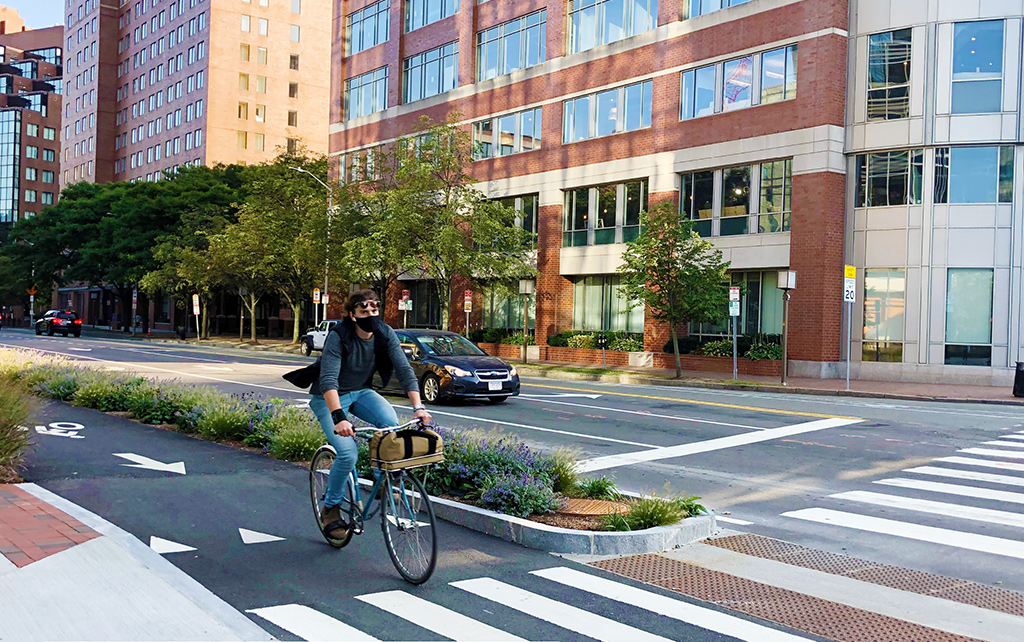
A bicyclist travels in a protected bike lane in Kendall Square in an image from the city’s MassAve4 Impacts Analysis.

Fallout from a report about quick-build separated bike lanes continued Thursday at a virtual meeting of the Porter Square Neighborhood Association, with concerns from residents and business owners that parking would be eliminated along Massachusetts Avenue north of Cambridge Common.

“The city dropped the worse-case scenario,” said Ruth Ryals, president of the association.

No one at the meeting, bicyclists included, supported the most extreme options from the MassAve4 Impacts Analysis Report that would sacrifice significant amounts of parking along the avenue.

The report, released just in time to beat a May 1 deadline, is a byproduct of the 2020 Cycling Safety Ordinance, which calls for 25 miles of protected bike lanes to be built over the next five to seven years. Massachusetts Avenue is targeted for them as a major route through the city.

The ordinance acknowledges that quick-build bike lanes (defined mainly by flex posts and paint, but still relocating parking spaces, as happened with Cambridge Street) are easier to achieve than construction that involves adding concrete medians and shifting bus wires, which could force changes to the timeline to accommodate logistical challenges.

The city has said the report is not a protected bike-lane proposal, but about their potential effect on parking, but that’s a distinction some found hard to discern in the text. “I read the report and panicked,” Ryals said in her opening comments.

Bicyclists and business owners

Several members of the Cambridge Bicycle Safety Group, the local activist organization that pushed for the ordinance, spoke Thursday, including Rebecca Neuman, Sam Feigenbaum and cofounder Nathanael Fillmore. The positive community and environmental impacts of cyclists and cycling was stressed by Neuman, organizer of a Cambridge Bike Delivery initiative that engages volunteers to deliver food pantry items to community refrigerators in Cambridge and Somerville and to people with limited mobility. Others highlighted cycling deaths in areas with deficient cycling infrastructure – including Amanda Phillips in Inman Square; Bernard “Joe” Lavins in Porter Square; and Darryl Willis in Harvard Square – and shared city-gathered survey results showing that only 20 percent of those responding felt comfortable biking without a protected or separated bike lanes; 70 percent said the lanes would make them feel safer and more likely to take to the street by bike. Feigenbaum, a Harvard Law student, walked the audience through the details of the ordinance.

Fillmore summed up, saying what was illustrated in the report “was too extreme and not necessary,” and walked thorough some possible protected bike lane solutions that would not eliminate parking along the northern stretch of the avenue.

Business owners expressed concern for cyclists’ safety – and began their comments by stating their own use of bicycles and mass transit – but also fear for the economic impact resulting from the study’s findings. “Elimination of parking would be disastrous,” said Jeanne Oster, of the family-run Guitar Stop, opened by her father in the 1960s. Steven Beaucher, of Ward Maps, said if he had no way for people to come in and pick up large maps and the heavy transit signs sold by the store, he’d have to take his business online. He also conceded that losing some parking could be for the greater good.

More agreement than disagreement

Theodora Skeadas, executive director of the Cambridge Local First small-business group, attended the meeting. City councillor Dennis Carlone joined briefly to share his sympathy and concerns for cyclists and local business owners, and pointed out that while the council approves policy such as the cycling ordinance, it does not approve roadway and traffic changes. That work is handled by the city manager and his staff.

The evening meeting showed no signs of the battling among cyclists, residents and business owners seen over bike lane proposals after an initial rapid rollout in 2017. All groups wanted the others to succeed and be safe, and an improved quality of street life and amenities along the avenue. A “road diet” was discussed that including removing some stretches of Massachusetts Avenue median to make room for bike lanes; having the median was called something of a “religious” adherence by long-time residents, but ultimately people at the meeting didn’t consider it vital. Ryals said the avenue still has “that highway feel to it.”

“I came away from the meeting feeling quite positive, since from the discussion it sounded like there are broad areas of alignment between business owners, Porter Square neighbors and bicycle safety advocates – much more agreement than disagreement, in fact,” Fillmore said. He was optimistic roadway changes could be made “in a responsible and technically feasible way that will improve rather than detract from the ability of small businesses to thrive.”

City staff said the next steps would be to determine if quick build lanes are possible, and to provide protected bike lane options for review by the public.

Army of the Dead

17 May

‘Army of the Dead’: We’re off to a Las Vegas heist, but technically it’s impossible to make a killing

By Tom Meek Thursday, May 13, 2021

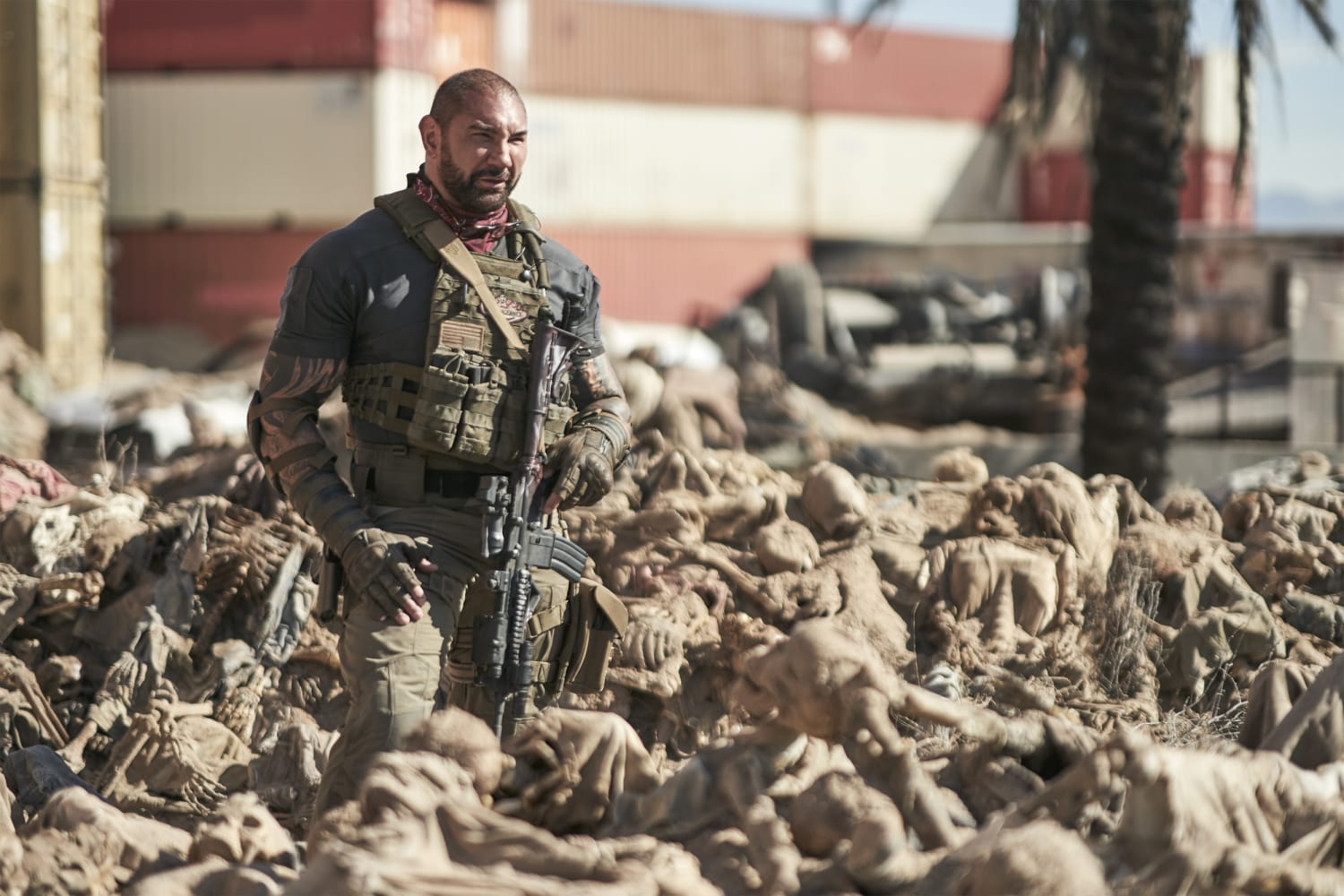
Netflix's 'Army of the Dead' will make you root for the zombies. Their  lines are better.

Zach Snyder, the man behind the cinematic resurrection of Superman and the launch of the “Justice League” franchise, cut his teeth on zombie fare with the 2004 remake of George Romero’s “Dawn of the Dead.” One of the eye-popping twists in that update was that the undead weren’t your typical shamblers – they could move at superhuman speed, and had agility and much greater strength than the sagging bags of carrion in films that came before. In his new “Army of the Dead,” Snyder delves back into that bag of tricks, and in the process turns the Vegas strip into a hive of hidden horrors akin to the hellacious labyrinths plumbed in the “Resident Evil” series.

The film opens with a military convoy taking an asset to a secret location in the Nevada desert. As happenstance and an act of fellatio have it, the package – an alien-zombie incarnation that seems like an escapee from John Carpenter’s 2001 “Ghosts of Mars” – gets loose and turns Sin City into a zombie colony. Though it’s walled off by the U.S. Army, efforts to clean and reclaim the Strip fail and nuking it gets a stamp of approval. In that week before the drop, a wealthy mogul named Tanaka (Hiroyuki Sanada) approaches former military ops hero Ward (Dave Bautista), now slinging burgers, to assemble a team for a mission to fetch $200 million sitting in a vault that only Tanaka has the blueprints for. Ward is doubly invested in the grab and go, as his daughter, Kate (Ella Purnell), is working at a camp outside Vegas where people assumed to be infected live in military-monitored migrant camps. 

From there “Army of the Dead” proceeds in a pretty straight-up fashion: Navigate the flesh-chomping hordes, a zombified Siegfried & Roy tiger and the zombie king (that alien) and his queen, get the cash, grab Kate and chopper out before the area becomes a mushroom cloud. Kinda like a video game, and likewise solid if predictable genre fun. 

Of the colorful recruits, the standouts are mostly Omari Hardwick (“Sorry to Bother You”) as the heady Vanderohe and Tig Notaro, bringing a dash of Jane Lynch comedic relief to the mayhem as the capable chopper pilot. The film’s best parts are that opening scene and the elongated credit sequence chronicling the fall of Vegas as a quirky cover version of “Viva Las Vegas” plays. I’m not sure if Snyder was reaching for something deeper with a zombie king and queen and the seeming foundation of a zombie civilization – they do seem to communicate and have lawful order. It adds a dash of intrigue and of course allows for the assemblage of the entity of the title. In it all, you know there’s a few hidden agendas (think “Alien”) and aptly at one point, The Cranberries’ “Zombie” rolls; it feels like a too obvious choice, like “Viva Las Vegas,” but they both fit poetically as flesh is ripped from bone by tenacious cannibalistic maws.

Weed & Wine

17 May

Comparing cultures in her doc ‘Weed & Wine,’ Cambridgeport’s Cohen found the relationship

By Tom MeekThursday, May 13, 2021

Cambridgeport director and producer Rebecca Richman Cohen presents her documentary “Weed & Wine” on Saturday as part of the Independent Film Festival Boston. (Photo: Weed & Wine)

The bridge between law and documentary filmmaking has strong precedent in the Boston area. Cantabrigian Frederick Wiseman, whose filmmaking style is pretty much the embodiment of cinéma vérité, was teaching law at Boston University when he set off to make “Titicut Follies” in 1967; Mary Mazzio was working as an attorney at Boston’s Brown Rudnick when she decided to go to film school and make socially conscious films (“A Most Beautiful Thing,” “Ten9Eight: Shoot for the Moon”). This week, the virtual run of Independent Film Festival Boston brings focus to Cambridgeport filmmaker Rebecca Richman Cohen, who graduated Harvard Law School and now lectures there. On Saturday, the IFFB will screen her third documentary “Weed & Wine.”

Cohen, like Wiseman and Mazzio, is driven by the human side of her subjects. The continent-spanning film that details two families, the land they work, the challenges they face and the tradition of agriculture across generations began as a late-night conversation about terroir in a Parisian wine bar. Cohen describes the French-originated concept of terroir as “the way the land expresses itself in agricultural produce and the history and tradition of that land.” On the rooting of the project, Cohen says, “I woke up the next morning and still thought it was a great idea.”

One of the challenges in making the film was finding a French vigneron family to partake; many found the juxtaposition of wine grape growing and cannabis agriculture off-putting. “People kept telling me I was comparing apples and oranges,” Cohen said via Zoom, “but in the end, it was about family.” Ultimately Cohen gathered with the Jodreys in Humboldt County, California, and the Thibons of France’s Rhone Valley. The patriarch of that Californian cannabis farm, Kev Jodrey, is a New England transplant (you can hear a trace of it in his accent) and has been growing his product outside legal boundaries for years. The Thibons, on the other hand, have been tending to the same vineyards for hundred of years.

Cohen fell into filmmaking by happenstance while attending Brown University. “I got a job as an assistant editor when I was studying aboard in college, because I couldn’t figure out what else to do. Then I got hooked. After college, I worked for Michael Moore as an assistant editor on ‘Fahrenheit 9/11.’” Cohen’s other documentary features include “War Don Don” (2010), which puts the Serra Leone justice system under a microscope, and “The Code of the West” (2012), which looks at medical marijuana growers in Montana as regulations and policies are reevaluated.

French vintner Hélène Thibon in “Weed & Wine.”

Cannabis farmer Kevin Jodrey in “Weed & Wine.”

Before making “War Don Don,” Cohen had been in Serra Leone using her legal knowledge in a humanitarian capacity. “I’m not an attorney,” Cohen points out quickly. “I’ve never taken the bar.” The subjects she lectures on, human rights and humanitarianism as told through the lens of documentary films, and using video and media as evidence and advocacy, seem to meld seamlessly with her social focus behind the camera.

It took nearly five years to make “Weed & Wine” since Cohen imbibed the idea in that wine bar. One of the realizations the filmmaker had along the way was that her thesis about land focus shifted some, becoming more about those using the land and their kinship to it and each other. Cohen said that sense of family and community became increasingly meaningful to her because during the filmmaking process she became pregnant and had a child. “A total pandemic child,” she says of her 15-month-old.

Covid delayed the release of “Weed & Wine” for nearly a year. Cohen had imagined that the Jodreys and Thibons would meet in person at the premiere or a festival screening; instead that happened by Zoom, Cohen says with a tang of sadness. “But the funny thing is,” she says, “is what do you think was the first thing they talked about? The weather. What else do farmers talk about?”

One of Cohen’s key cinematic influences is “Fast, Cheap & Out of Control,” Cambridge filmmaker Errol Morris’ 1997 documentary about a lion tamer, a robotics expert, a topiary gardener and a specialist in naked mole rats. Interestingly too, one could argue that Morris has a link to law; before coming to filmmaking he was a private investigator, a skill that helped mightily when digging into the gunning down of a Texas police office in “The Thin Blue Line” (1988), a film that helped get an innocent man out of jail. What resonated with Cohen about Morris’ film was the juxtaposition of diverse endeavors and the common themes that linked the subjects. “It’s kind of a bit like what we did with ‘Weed & Wine,’” Cohen says.

Cohen wants to next examine mass incarceration in conjunction with such social movements as Black Lives Matter and #MeToo. One thing Cohen was adamant about during our interview was that film is a collaborative process, mentioning that the film would not have been possible without her committed team of producers and crew – and the final product is impressive in terms of production values and synergy. Screenings of “Weed & Wine” will be accompanied by a prerecorded Q&A.

Wrath of Man

9 May

‘Wrath of Man’: Ritchie and Statham reunited, heist with their own petard and angry about it

Guy Ritchie launched a lot of careers back in 1998 when he churned out the quirky crime drama “Lock, Stock and Two Smoking Barrels,” one being his own as an auteur of hyper-stylized violence in 3D slo-mo – something the Wachowskis would seize upon and elevate to an art form the following year with “The Matrix.” Menacing footballer turned actor Vinnie Jones is another; taciturn can-do strongman Jason Statham may have cut the biggest swath. Ritchie and Statham haven’t worked together since 2005’s “Revolver”: In between Statham had his hit “Transporter” series and joined the “Fast & Furious” franchise, while Ritchie made the live-action “Aladdin” (2019) and the tepid Sherlock films with Robert Downey Jr. Last year’s release of “The Gentlemen” signaled something of a return to form for Ritchie, even if the film couldn’t rise above its own self-aggrandizing cheekiness.

The pair’s latest collaboration is more of a straight-ahead Statham revenge flick like “Parker” or “Homefront” (both 2013) than an amped-up Guy Ritchie production – and that’s not necessarily a bad thing. Here in “Wrath of Man,” Statham plays H, a mysterious sort who barely shoots or drives well enough to make it as a guard with an armored car company that’s been targeted by a ring of thieves. What Ritchie and his phalanx of writers have cooked up is something like Steven Soderbergh’s “The Underneath” or Michael Mann’s indelibly furious “Heat,” both made in 1995 and about armored car heists.

To be certain, “Wrath of Man” is not on par with either. It’s not even close. But it does have its merits. The back-and-forth narrative between a heist in the recent past and one about to go down deepens the intrigue, as does a “Rashomon,” multi-angle view of a singular event, and there’s a score by Christopher Benstead that bristles with a sense of foreboding and goes far in defining the atmosphere and driving the action. The main reason to see “Wrath of Man,” however, is to see Statham’s enigmatic antihero with a hidden agenda do what he does best, and that’s pick apart those evading justice with cold, calculating efficiency. If you’re here for anything else, that’s on you. Also in the vast cast we get Holt McCallany, so good in David Fincher’s “Mindhunter” series, as Bullet, H’s higher-up; Josh Hartnett in an odd turn as Boy Sweat Dave, the armored car company’s big mouth who shuts down under fire; Ritchie regular Eddie Marsan as the company bean counter; and Scott Eastwood and Jeffrey Donovan as well-organized jarheads on the opposite side of the bulletproof glass from H.

“Wrath of Man” gets better as it goes on, something that can’t be said for “Tom Clancy’s Without Remorse,” a similarly straight-up revenge flick released last week. It’s doesn’t have the big production values of that Michael B. Jordan vehicle, but it does have Statham’s no-nonsense avenger, and that’s good enough to make it the better choice to waste two hours of your day on.