“Barbarian” is an innovative shot of horror from writer-director Zach Cregger (“The Whitest Kids U’Know”) that plays gleefully with tropes and viewer expectations. It’s impressively crafted and makes for a riveting and genuinely chilling edge-of-your-seat experience. The setup’s pretty basic: Tess (Georgina Campbell) is in Detroit for an interview to be an assistant to a documentary filmmaker who champions social causes and the arts. In the middle of a major thunderstorm, Tess rolls up to the cute little house she’s rented on Airbnb and finds it already occupied by a dude named Keith (Bill Skarsgård). What to do? Keith’s a little sketchy, but on invite Tess comes in so she can get out of the rain and call the owner. Natch, there’s no answer and no response to email. Keith offers to take the couch, and Tess agrees reluctantly to stay. After Keith lets on he’s seen the director’s films, the two end up bonding over a bottle of wine. You feel certain there’s something devious and dark something going on, but Tess gets through the night and to the interview. What’s troubling in the morning, however, is the realization that the house is the only maintained residence on the street – as far as the eye can see, there’s nothing but dilapidated, bombed-out shacks, husks of Reagan’s 1980s economic boom. When Tess returns to the house, circumstance has her venture down into the basement where Cregger, like Ti West in “X” last year (and likely too with the film’s follow-up, “Pearl,” opening next weekend), pays homage to the classic gore-ror of the 1970s from Tobe Hooper, Wes Craven and more while employing some crafty bait-and-switch and breaking new ground.
It’s hard to say more about “Barbarian” – the curious title reflects the street name, Barbar – without ruining the film’s deftly ingrained, devilish wit. Strange as it may sound, there’s a #MeToo subplot about an L.A. actor (Justin Long, the Mac guy) whose career goes down the toilet and a flashback to Barber Street during the prosperous 1980s. The performances by relative newcomer Campbell and Skarsgard (Pennywise in the recent “It” films) are nuanced, robust and deep in character. “Barbarian” is not quite on par with Jordan Peele’s acerbic social redirect “Get Out” (2017), but it’s in the ballpark’s parking lot. Speaking of Peele and his latest, “Nope,” that’s the exact word in the exact context Peele intended that falls from Tess’ mouth when she discovers an antechamber. Since the films were released in the same year, it’s hard to imagine Cregger playing on it; the serendipitous prospect is equally as neat. For all its little dekes and tweaks on old tricks, “Barbarian” falls more and more toward the pedestrian as it ties up loose ends and subplots. It’s still a taut, worthy ride and one that should allow Cregger, whose directorial CV is slim, to come back with more.
In 1966, when Harry Harrison penned his dystopian thriller Make Room! Make Room!, which began life as a serial in Impulse magazine, he predicted that by the future year of 1999, there would be more than 7 billion people on earth, and a robust 35 million in New York City alone. The 1973 film adaptation of Harrison’s novel, Soylent Green, altered several aspects of Harrison’s novel, including the year in which the thriller is set: 2022.
Now that we’re there (and decades past 1999), it’s worth asking: how well did Soylent Green director Richard Fleischer and his writer, Stanley R. Greenberg, get things right? When Harrison penned his serial, inspired in part by the Malthusian hysteria of the ecological movement, the world population was just over 3 billion, with the five boroughs of New York City checking in at 15 million. In 1999, those numbers were 6 billion and 17.5 million respectively. Today, we’ve passed Harrison’s prediction of 7 billion worldwide, but New York City, at 19 million, is still less than half of the 40 million that the film foresaw for our current year.
For What It’s Worth Newsletter is a reader-supported publication. To receive new posts and support my work, consider becoming a free or paid subscriber.
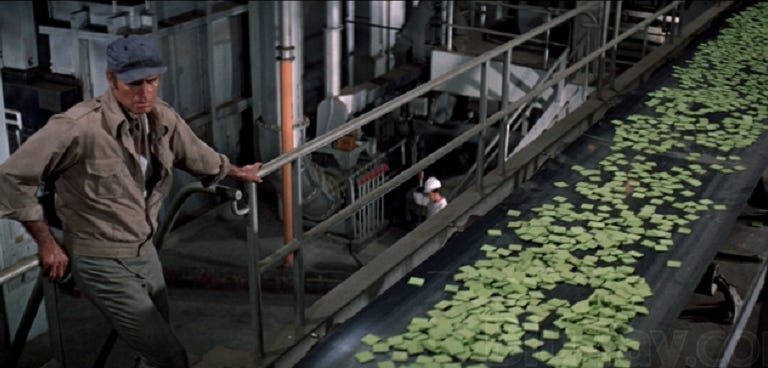
Fleischer, whose list of credits includes 20,000 Leagues Under the Sea (1954), Doctor Doolittle (1967), Mandingo (1975) and Conan the Destroyer (1984), does a journeyman’s job of establishing the apocalyptic future at hand, giving us a sprightly montage of newsreel footage that rifles through cresting heaps of trash, cars locked in traffic jams as far as the eye can see, industrial waste belched upwards into the darkening sky and spewed out into debris-choked streams. It’s climate-change-on-crack, if you will. Look on my works, ye mighty, and despair!
Gone are the posh, coddled streets of Manhattan; now we find an impromptu tent city , with people living in rusted-out husks of abandoned automobiles. To get to his brownstone walk-up apartment, our protagonist, NYPD Detective Robert Thorn (played by Charleston Heston), has to navigate a writhing throng of homeless sleeping in the stairwell. At the top of those stairs there’s an armed guard to ensure none of the downtrodden gets too far up. It’s a metaphor for the society he lives in — get it?
As a comfortably employed member of the establishment (unemployment in the city is over 50 percent) you’d think Thorn might have decent digs. As is, he shares a cramped half-flat with an amiable old codger named Sol Roth (played by Edward G. Robinson, who died before the film was released), a retired academic and police investigator who every now and then hops on a stationary bike to power their humble TV.
In this austere future, the truly elite live well in modernistic lux domes, fenced off and tucked away from the hordes. Such grand enclaves come with bodyguards, a house manager and what’s referred to as “furniture,” i.e. one or more young women assigned to provide servitude and pleasure. When one such upper-cruster is murdered (the mystery Thorn is investigating) and the abode sold, the “furniture” (Leigh Taylor-Young) becomes part of the asset transfer.
Clearly, neither Make Room! Make Room! nor Soylent Green anticipated the dramatic upheavals in gender relations of the late-twentieth and early twenty-first centuries, brought about by feminism in general and the #MeToo awakening most recently. But they were pretty spot-on in forecasting the widening wealth gap and expanding corporate influence (the Soylent Corp., the all-powerful provider of foods and services, is eerily akin to Amazon today), and the dystopic subjugation of women seems like further biting commentary against a society run by the strong and wealthy few.
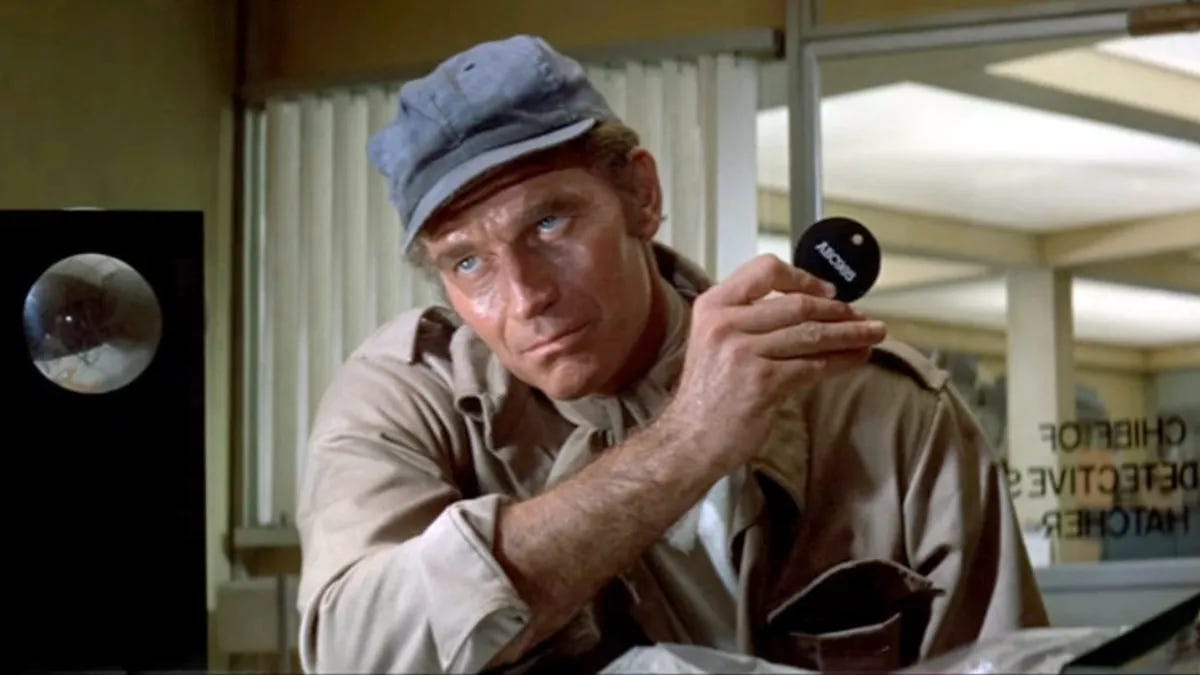
There’s a bit that’s comically dated , such as the film’s sense of future fashion and its rendering of the modern police force. As a law enforcement official, Thorn is hard to take seriously, garbed in a rumpled pastel cap and matching neckerchief and a cheesy Members Only jacket. The getup looks like Bogie’s skipper outfit in The African Queen, updated for the Eighties nightclub. Cops wear lacrosse helmets as riot gear, and their crowd-control vehicles are essentially garbage trucks equipped with a scoop to pick up and toss the disobedient hungry into their cavernous bins.
Make Room! Make Room! and Soylent Green also whiff in the technological sphere. There is no evidence in either book or movie of the stunning advances we’ve really made in computers, the internet, AI and social media. That said, both the novel and the film keenly foresee our current agitation over the control and diffusion of information and misinformation. Whereas we have “fake news” and troll farms, the 2022 of Soylent Green plays out a Fahrenheit 451-style future, showing how the ruling class, through the decimation of paper literature , pretty much holds the masses in an uninformed, complacent stasis. Not too far off, really, from the ignorant distraction provided by the digital cosmos of today.
Back to that mysterious food company. Because the cataclysmic side effects of global warming have essentially left the land and the seas barren, the Soylent Corporation — whose flagship product is an amalgam of “soy” and “lentil” — has become the de facto food provider to the world. Beef still exists, but only as a super scarce black-market luxury item. A jar of strawberry jam costs $150. What folks feast on instead are “Soylent Yellow” and “Soylent Red,” high-energy vegetable concentrates that come in wafer form. The corporation then releases the new “Soylent Green” version, which a television pundit informs us is sourced from plankton.
Today, back in the real world , we have lab-engineered plant-based “meat substitutes” like “Beyond” and “Impossible” meats, which cost about as much as their beef or pork antecedents. There’s even a company called Soylent, founded in 2012 by overworked Silicon Valley workers looking for a quick, nutritious meal to get them through their high-tech grind. The company, named as an homage to Harrison’s novel, produces 400-calorie plant-based power-drinks that provide the nutrients of a complete meal. There are myriad flavors — vanilla, banana, chocolate and so on — to choose from. A twelve-pack delivered to your door will cost you just north of forty dollars.
The narrative twist introduced by the film — spoiler alert — concerns the source of the titular sustenance, Soylent Green. Surprise: it’s not plankton after all (as it really was in the book), but human remains. The public is unaware of this unpalatable truth until the final frames of the movie, when a wounded Thorn, just captured by the bad guys , shouts out that indelible line to the crowd around him: “Soylent Green is people!” It’s a sharp, demonic twist: the conundrum of overpopulation and decimated food sources is solved by clandestine cannibalism.
The government mandates the “retirement” of seniors through a spa-like process, where the to-be-euthanized get to choose their favorite color (in the case of Sol, orange), music (classical), and visual surroundings (a medley of fields, streams and fauna that no longer exist) for their tranquil fade-out. I’d liken it to going under for surgery, or that brief and pleasantly groggy state after a full-body massage. It seems like a relatively easy way to go, for those who have to go, though with the unseemly risk of grandson chowing down on grandpa when Tuesday’s portions are meted out.
While we’re not quite living out the fullness of Fleischer’s grim forecast for year 2022, red lights are flashing. The race for clean energy, reduced carbon emissions and sustainable food has been slow out of the gate. Yes, there are still fish in the sea, and deer still frolic in bucolic glens. But whereas in the Nixon-era 1970s, the dark, self-invoked damnation of Soylent Green felt like something from the pages of H.G. Wells — fantastical, and generations off — today one can envision the film’s desolate rendering over the not-too-distant hills uncomfortably clearly.
The latest from George Miller, the man known primarily as the force behind the innovative “Mad Max” film franchise (though let’s not forget he also helmed such diverse fare as “The Witches of Eastwick” and “Happy Feet”), is an opulently rendered tale about two bereft souls who find each other through happenstance and blossom as a result. Part of the film’s charm is Miller’s ability to go big, something put on glorious display in his last, “Mad Max: Fury Road” back in 2015, and again here in “Three Thousand Years of Longing” in re-creating a mid-B.C. visit between the Queen of Sheba and King Solomon amid Ottoman empire buildings. The film’s other charm is its leads: Tilda Swinton, as a set-in-her-ways scholar and Idris Elba – whom you can also catch in theaters this week in the “Jaws”-with-claws thriller “Beast” – as the genie she uncorks while on an academic retreat in Istanbul.
Much of what unfolds in this adaptation of the novella by A.S. Byatt (“Possession”) takes place in a hotel suite. Not just any hotel suite, but the one in which Agatha Christie wrote “Murder on the Orient Express.” It’s something of a dark pajama party, with Swinton’s Alithea and Elba’s Djinn (as he’s called by Alithea) in bathrobes; she’s just out of the shower when wrangling with the hand-blown bauble picked up in a marketplace, and he, after initially being room-fillingly large and vaporous, dons terry cloth in his more human assumed form. The two trade tales: Back in the day, he was Sheba’s lover and Solomon trapped him in a jar and tossed him in the sea. Not to be outdone about a love gone wrong, Alithea recounts her marriage to a fellow academic, intellectually and sexually fulfilling until he ran off with a student. There’s also the matter of three wishes, and the long, inglorious history of unintended circumstances that have come back to bite greedy wishers. Alithea, an expert on narrative structure, the history of storytelling and lore, is wise to the perils and wonders if The Djinn is in fact trying to trick her – to gain his freedom from the bottle and mortal servitude, he needs to grant a mortal three wishes. Alithea holds out, and just like the Major and Barbara Eden in “I Dream of Jeannie,” mortal and magical begin a relationship with sexual undercurrents raging and rife at every turn.
Miller’s vision has some big, spectacular set pieces, especially as it riffles back to the ancient times of The Djinn’s long-lived existence, and the actors, both talented and clearly up for the game – Swinton ethereal, wise and ever probing, while Elba, so commanding as Bloodsport in “The Suicide Squad” last year, casts a majestic yet troubled, somber aura – are captivating to behold with all their soul-baring. And yet somehow, something feels amiss. Something’s not there. Their sudden, deep romantic bond feels like a quick Gorilla Glue fix applied during script revision triage, and what of the rules of those wishes? There’s some stuff about unfulfilled third wishes (the wisher died after No. 2) requiring closure that never seem to get addressed. Several times Alithea says, “I wish …,” but what happens, or not, never fully makes sense. The two do finally get out of the hotel suite and travel back to London, where Alithea, tired of her xenophobic neighbors, has Djinn help her deliver exotic midday snacks to the biddies who spend their days doing little more than othering. I wish the film had more moments like that. There’s much to admire in the craft all around, but for all its grand gestures, “Three Thousand Years” feels not quite fully formed. It’s a novel concept about parched beings thirsting for soul-slaking water, as was the case for the masses in “Fury Road.” In Miller’s impressive “Max” revisit, in the end, the water flowed in torrents. Here, it’s as if someone forgot to pay the water bill.
A mobile traffic sign in Somerville promotes the “Dutch Reach” technique for bicyclist safety. (Photo: The Dutch Reach Project via Twitter)
Bicyclists are calling urgently for Somerville to install more protected bike lanes since the Aug. 12 death of Stephen Conley, 72, from a dooring on Broadway near Teele Square.
“Protected bike lanes prevent this kind of crash,” said George Schneeloch, a member of the Somerville Bike Safety group. “The city must work urgently to prevent future fatal crashes like this one by installing protected bike lanes in both directions on Broadway, so that bicyclists are kept clear of car doors.”
Somerville Mayor Katjana Ballantyne has committed to immediate safety changes, but not to a timeline for bike lanes, Schneeloch said. The commitment was reported Aug. 16 by StreetsblogMass.
There’s another solution that could have prevented the Conley crash, though, and doesn’t rely on potentially expensive infrastructure changes: the Dutch Reach, a method of opening a car door using the farthest hand from it.
The Dutch Reach prevents swinging a car door open fully and forces drivers’ heads to turn and see more of the surrounding conditions, said Michael Charney on Monday.
Michael Charney in a screen capture from “All Things Bike with Fred Thomas” in October 2019.
Charney, 76 and still getting around mostly by bike, is a retired physician and bicycling safety advocate who lives in Cambridge just outside Somerville’s Union Square – and credited as the originator of the term “Dutch Reach” and vital in getting adopted worldwide.
A dooring is when a driver opens a car door without looking and a cyclist crashes into it, often getting thrown into traffic. Massachusetts law says, “No person shall open a door on a motor vehicle unless it is reasonably safe to do so without interfering with the movement of other traffic, including bicyclists and pedestrians.” The fine for such a violation is up to $100.
Doorings account for 20 percent of bike crashes in Cambridge, according to city development officials. Jeremy Warnick, director of communications and media relations for Cambridge police, noted in a Tuesday email that July saw three doorings in Cambridge, and a severe dooring in Kendall Square in April that led to riders on a tandem bike being taken to a hospital after first aid was applied by officers on site.
The number of Cambridge bicycle crashes involving a “dooring” in 2020 was six, or 9 percent of the 66 total bicycle crashes reported to Cambridge police, but the number of citations issued for opening a door when unsafe that year was 58, Warnick said. In 2021, those figures were nine (or 12 percent of the 76 total bicycle crashes reported to police) and 50, respectively. Police see the pandemic as a cause for the drop from the typical 20 percent, Warnick said.
But data collection is complicated for doorings, said Charney and Galen Mock, executive director of the Massachusetts Bicycle Coalition. There are arguably accidents where near-doorings result in a fatality when the rider swerves into a traffic lane and is hit by a passing motor vehicle, but a dooring would likely not be recorded as a factor in the crash. A pending state Act to Reduce Traffic Fatalities would standardize how bike crash data is captured and categorized, Mock said in a Monday email.
Coining a term, starting a movement
The Dutch Reach, while an invention of the Netherlands, was introduced in this country by Charney after he was shaken by the dooring death of cyclist Amanda Phillips in Inman Square in June 2016. Charney launched the Dutch Reach Project by sending a series of “Dutch Reach haikus” to the Cambridge and Somerville police departments – and it was Somerville that took the haikus to heart and placed mobile traffic signs with Charney’s poems flashing on them. Charney’s work helped convince Massachusetts to include the Dutch Reach in its driver’s ed programs starting in 2017. Charney said he has gone on to speak via Zoom with cycling safety organizations as far away as Malaysia and India.
“I practically fell off the chair realizing that this is such a simple solution,” Charney said on the Maine-based “All Things Bike with Fred Thomas” in October 2019. “Dutch reach was my coinage, and it worked out very well for various reasons – one is ‘teach the reach,’ ‘preach the reach.’ What wasn’t appreciated by me at the time that I coined it was that there’s a whole string of [other phrases such as] ‘Dutch treat,’ ‘Dutch uncle,’ also there’s a thing ‘Dutch ding-dong’ that have outré connotations and create a buzz among millennials … Though there’s nothing dirty about the Dutch Reach. It just saves lives.”
Other paths to safety
Charney also endorsed the concept of a “road hierarchy” that places less legal onus on the most vulnerable on the road, starting with pedestrians, then cyclists, motorcycles and scooters, cars, SUVs and vans and, as the most dangerous, trucks and buses.
Another safety measure Charney suggested where there are “door zone bike lanes,” meaning those separated from parked cars only by paint on the road: Cyclists can “take the lane.” Riding in front of cars can be intimidating for cyclists, as motorists tend to get frustrated with slower-moving traffic and might honk or harass them, especially if there’s a bike lane available. But in Massachusetts a cyclist has the right to assume a full traffic lane on nearly all municipally maintained streets, Charney said.
Charney calls his solutions no-cost but partial, as he feels there’s no single cure-all for road safety, but many baby steps to safer roads – including that “motor vehicle technology, sensors, cameras and computers, keep getting smarter and will be another partial solution to greater road safety.” But always check your mirrors, use the Dutch Reach and slowly, and look for fellow road users, he said.
Lesley University soccer players participate in a Saturday cleanup around Porter Square. (Photo: Audrey Calhoun/Lesley University)
It was near 90 degrees and blistering Saturday when a hodgepodge volunteer crew of nearly 50 set to work cleaning up the Porter Square T Station plaza as well as the stretch of Massachusetts Avenue north and south of it. “I think this is our tenth year,” said organizer Ruth Ryals, head of the Porter Square Neighbors Association.
Over the course of four midday hours the rotating team picked up trash, weeded sidewalks and did other basic beautification at the Porter Square Shopping Center, the storefronts opposite it and the Lesley building and sidewalks down toward the intersection with Linnaean Street. Given the heat, Ryals said, “I’m super impressed.” Half the volunteers were the returning Lesley women’s soccer team. “Normally Harvard joins us too, but they’re not back yet.”
Fresh fruit, cases of water, brown landfill compost bags, brooms and weeding tools were supplied to volunteers, many of who wore safety vests as they toiled.
Ryals, who ran the check-in and handout station on the MBTA plaza, thanked the Department of Public Works for trash removal and power washing; Star Market in the Porter Square Shopping Center for the water; Lesley, or “the young people anxious to give back,” as Ryals referred to them; Junior’s Automotive & Gas and volunteer Jim Cornie, who not only delivered tools to the plaza but continued to weed and mulch after the event ended; and the office of state Rep. Marjorie Decker.
Cleanup volunteer Jean Krulic and Porter Square Neighbors Association leader Ruth Ryals on Saturday in Porter Square. (Photo: Tom Meek)
While Lesley has several community service initiatives, the effort was a direct coordination between Ryals and Lesley soccer coach Paul Vasconcelos. “Our Lesley University women’s soccer team has been participating in the Porter Square/Mass Ave cleanup for the last few years. It’s something our student athletes look forward to every year and a great way for them to get acclimated, as they are from all over the country,” Vasconcelos said in an email.
Several volunteers expressed satisfaction in the before and after of claiming a tree basin or stretch of sidewalk, taking trowel to root and ridding the area of unsightly crabgrass. Many also thought it would be great if the MBTA, Lesley and area storefront owners followed by watering and beautification measures such as planters.
Aubrey Plaza may just be indie film’s “it” human of the moment. With accolades for performances in critically noted, smaller fare such as “Black Bear” (2020), “Ingrid Goes West” (2017) and this slide from millennial slog into crime – a Sundance hit – Plaza’s proven capable and clearly on the edge of a breakout. Directed by John Patton Ford, pulling from his experience of cracking under the weight of student loan debt, “Emily the Criminal” concocts a narrative that’s just as much character study and social commentary as it is a crime drama.
Plaza stars as the titular Emily, out of school, talented but unable to land a gig. Part of the problem is that she has a record. The publishing/graphic design industry she wants to break also into requires a demurring personality and the ability to work an internship for six-months-plus for free. Emily’s a quietly take-no-shit kind of person, but she also needs money, which leads to the occupation of the title. Shlepping as a caterer, trying to get a real job and pay off mounting bills, Emily gets hooked up through a friend with a dicey yet amiable character named Youcef (Theo Rossi), an immigrant with hopes of realizing the American Dream who’s running a credit card scam to achieve it. Emily, living the American Nightmare, gets in on it, tangentially at first. Then she and Youcef find they have more in common, including dealing with his troublesome brother who is threatening the side biz and its mounting pile of cash. We find out later about Emily’s past transgression – and god forbid if you cross her; the payback is X-Acto knife justice for a shady couple who get onto her scheme. Then there’s her interview for that coveted publishing gig (with Gina Gershon!) that’s almost as captivatingly fiery as Matt Damon’s high-rise job interview in “Good Will Hunting” (1997).
“Emily the Criminal” clicks because of Plaza. No Plaza, no clicking. Gershon and Rossi are great accoutrements who have seamless chemistry with Plaza, knowing how to play off her without deferring to her. It’s a confluence of smart casting, lived-in performances and directing by a person who understands his performers and their characters deeply. Still, Plaza: Not enough can be said about her subtlety, or how much she does with a sneer or a shift of her large, luminous eyes. It’s a filmmaking turn. After seeing “Emily” you’ll want more of her, both streaming (the above cited films are worthy) and in the future. My only (selfish) hope is that she doesn’t go commercial and get lost, the way Brie Larson (“Room”) did (“Captain Marvel”).
Jordan Peele’s third horror installment would make a good double bill with Quentin Tarantino’s “Once Upon a Time … in Hollywood” (2019), as both take place in dusty Western shanty towns north of L.A. with ties to the film industry. Good portions of Tarantino’s “Once,” starring Leonardo DiCaprio as a 1950s western TV actor whose glory days are behind him, are situated in a Hollywood stage strip town and the Spahn Ranch where followers of Charles Manson have set up camp. In Peele’s “Nope” – the terse title a take on audiences reaction to horror films when a potential victim does something unwise – nearly all the action takes place at the Haywood’s Hollywood Horses ranch and neighboring Wild West theme park, Jupiter’s Claim.
Peele is one to settle into the everyday and root audiences so deeply in his characters that when things go bump in the night, it takes a little while to catch onto the oddities. The same is true here; the atmospheric buildup is masterful. Though I hate to say it, I’m not sure the payoff is as worthy as his first two efforts, “Get Out” (2017) and “Us” (2019). We catch up with Pa Haywood (David Keith, in it far too little) and his son OJ (Daniel Kaluuya, working with Peele again after “Get Out”) moseying around their vast, barren ranch when what seems like bullets start to pepper the area around them. Is there a sniper in the hills? Nope, just a freak aviation mishap that takes Pa’s life – or so that’s what the authorities say happened. Strapped for cash and unable to keep the biz clicking like Pa, OJ sells some of his horses to that Wild West show run by former child TV star Ricky “Jupe” Park (Steven Yeun, “Minari”). One night OJ and his fiery kid sister Emerald (Keke Palmer) witness cultlike gatherings at Jupiter’s Claim and freaky stuff starts to happen. The electricity goes out, horses go wild, there’s an upward vortex scouring the valley, and something dark and big streaks through the sky.
Sensing something otherworldly and wanting cash, Emerald and OJ decide to capture the phenomenon on film so they can score their “Oprah moment.” Part of the plan leads them to Best Buy knockoff where they reluctantly enlist the resident Geek Squad dude named Angel Torres (a bleach-blond-streaked Brandon Perea) to set up security cams to capture the phenom. Angel’s a bit of a UFO nerd to boot, and looking at early footage notices a cloud that hasn’t moved in days, hmmmm. When the entity dampens electricity by battery or otherwise, the trio turn to veteran Hollywood cinematographer Antlers Holst (character actor Michael Wincott, whose gravelly voice is an attraction in its own right) and his old-school, crank-operated cam.
The rise to the crest is slow and steady, and a great character study with some super neat backstories, but once we get to the what and why of the goings-on at Jupiter’s Claim, “Nope” shifts gears and becomes something akin to a Spielberg alien encounter flick – “War of the Worlds” (2005) or “Close Encounters of the Third Kind” (1977). Some of the bait and switch in trying to ferret out the entity also has some of the seagoing fun of “Jaws” (1975), with players at different posts reacting to unfolding events differently, though given the dusty, spare terrain it reminds me more of the quirky 1990s cult hit “Tremors.”
Some of the basic rules about encountering the visitor don’t always hold true; OJ learns that if you avoid eye contact and look down, you’re in a safe place. It works for him, but not so much for others. The film’s told in chapters, mostly with names of animals the Haywoods train or the TV-family-adopted chimp Gordy, from one of the hit shows Jupe was part of as a boy. It’s a dark, alluring chapter that has little to do with what’s going on in the present, but a phenomenal – and let me add, grim – segment, worthy perhaps of a bigger piece on its own. Then there’s the Haywoods’ history: The first moving picture shot by Eadweard Muybridge, a clip called “The Horse in Motion” from 1878, featured a black jockey riding a lithe, muscular stallion, which Emerald proudly tells prospective employers was their great, great-grandad.
As far as sociopolitical commentary goes, there’s nothing as prominent here as in “Get Out.” Perhaps a comment about territoriality and land rights, or inciting an entity that holds lethal authority? More so “Nope” is a solid summer pleaser, a sci-fi thriller with some very deep characters, incredible performances – the laconic Kaluuya does so much with those eyes, and Palmer is just a firecracker in every scene – and a thinking person’s pacing. It isn’t perfect, but it powers through with an ensemble performance that’s near unbeatable.
Beyond “Squid Games,” Netflix just can’t buy a hit. “Red Notice” (2021), the spy comedy starring Ryan Reynolds, Dwayne Johnson and “Wonder Woman” herself, Gal Gadot, had an A-list cast and big budget ($160 million) but a tepid script about a thingamajig of no consequence. “The Gray Man,” ambitious and eye-grabbing on paper, is sadly more of that, with a bigger budget ($200 million) and more star power – this time helmed by the Russo brothers, Anthony and Joe, who rocked the box office with two “Captain America” installments as well as Avenger closeouts “Infinity War” (2018) and “Endgame” (2019).
Based on Mark Greaney’s bestselling 2009 espionage novel, the setup has a man known as just Six (Ryan Gosling) let loose from prison to serve the CIA as a “gray man” operative doing the dirty work for higher-ups. His mentor and main handler, Fitzroy (Billy Bob Thornton, lost in the mayhem), puts him to work as an assassin, and at one point as a house guard to look after his cardiac-afflicted niece (Julia Butters, who reduced Leonardo DiCaprio’s fading cowboy TV star to tears in “Once Upon a Time … in Hollywood”). Flash forward a few years (the film hops around some in time, to little effect) and Six is tasked by a suave new handler (Regé-Jean Page) with assassinating a target and retrieving a data chip. At the last moment he has a crisis of conscience and himself becomes a target of the agency, with a relentless private contractor by the TV soap drama name of Lloyd Hansen (Chris Evans, with a deadly, dastardly mustache that steals every scene) on his tail. What ensues is two alpha males circling and parrying each other at far-flung points around the globe (Vienna, Berlin and Bangkok among the many locales) with that chip and vulnerable niece as stakes. In the mix is an underutilized Ana de Armas, who strutted her spy thriller stuff more engagingly in that last Bond flick, “No Time to Die” (2021), and paired with Gosling in “Blade Runner 2049” (2017), as a sympathetic fellow CIA agent dragged into the not-so-cloaked and explosive-dagger conflicts erupting in crowded European squares.
The action sequences are fairly well done, but they also feel done before. “Gray Man” is more in the ilk of Jason Bourne than a Bond flick, due partly to Gosling’s cool, laconic presence and the fact that he’s similarly on the run from the agency that indoctrinated him. That quietness worked well in Nicolas Winding Refn’s day-glo neo-noir “Drive” (2011) and even “Blade Runner 2049”; here there’s just wisps about who Six is and was, and because the film’s all action and espionage mumbo-jumbo, Six comes off hollow and vacuous and would be nearly unsympathetic if it weren’t for the halo hoisted about his head when rescuing that imperiled girl time and time again. Evans gets an arch-Bond-villain part tossed his way and bites in deep, with shark-frenzy glee. The performance almost saves the film – but then again, who is this guy other than an overeducated linguist with a cheesy, sub-mullet haircut and a ’stache, jabbering about the definition of SAT words such as “preternatural” before pulling out his blade and getting down to business? The parts and the production values are in place, but without a well-devised thread or emotional soul binding them, that makes for a dull and drab affair.
Delia Owens’ bestselling novel, “Where the Crawdads Sing,” gets spun into a feature film by Olivia Newman (Paul’s daughter, whose directing has been mostly on TV such as “Chicago Fire”) from a script by Lucy Alibar (whose only other major credit is the stage play that inspired the 2012 indie dystopian hit “Beasts of the Southern Wild”). The result’s highly watchable, even if it feels like Southern-fried Nick Sparks pablum. The drive is the mysterious death of a coastal Carolina town’s golden boy, Chase Andrews (British actor Harris Dickinson, “The King’s Man”) who fell from an observation tower in the middle of a marsh far from any eye, where only the crawdads and marsh rats venture. There’s no tracks at the site, coming or going, and a trapdoor in the tower is left unlocked and open. Foul play is assumed. Kya Clark (Daisy Edgar Jones, “Normal Life”), known around town as “Marsh Girl” because she lives alone in a hut in the swampy remotes, becomes the primary suspect not only because she’s strange and othered, but because she was the covert lover of said it guy.
Natch, we get a backup and rewind to Kya growing up in that shanty with a father (Garret Dillahunt, surprisingly compelling in a one-note part) who’s perpetually boozed up and beating his wife and brood. Over the years, all but Kya leave and one day Pa just ups and goes too, leaving 6-year-old Kya (Jojo Regina) to fend for herself. Hard to believe Ma (Ahna O’Reilly) would walk out on at-risk kids, or that the older sibs would too, but sure enough Kya learns how to cope with the monster and after he’s gone gets looked after by an effusively compassionate and gentle African American couple (Michael Hyatt and Sterling Macer Jr., likable in egregiously stereotypical depictions) who run the dockside general store down the meander. Little Kya evades most adults and makes her way around in a ratty Boston Whaler. Later, as a young woman, she’s roundly shunned as an untamed creature of the reeds, yet young men such as Chase and Tate (Taylor John Smith) take to her enigmatic, feral charms – though neither will be seen with her in public. Once that’s all square, the film settles into a “To Kill as Mockingbird”-like trial with David Strathairn (“Nomadland”) playing the part of Atticus Finch as Kya’s solemn yet gentlemanly defender in Tom Wolfe attire.
The ebb and flow of the courtroom proceedings intrigue for a while, but as holes are filled in with more flashbacks, plausibility starts to go out the window. Don’t get me wrong, Strathairn and Jones put in solid turns; it’s just that their subtly strong, inward performances deserve material that is interested in those efforts, not this forced heartstring-tugging and these strained plot twists. The project has strong allies in Reese Witherspoon, who embraced Owens’ book and serves as a producer, and pop star Taylor Swift, who provides the film’s apt theme song, “Carolina.” The real eye-grabber is the fact that Owens’ novel was her first fiction at the age of nearly 70 – and that her stepson and husband are implicated in an unsolved murder of curious circumstance that took place in Africa nearly a decade ago. Inspiration? If you’re up on the deets, the film’s final frames take on an eerily different tone than what’s on screen.
Iranian filmmaker Panah Panahi’s debut is right in line with the films of his father, Jafar, whose great dissident-leaning works include “The Circle” (2000), “Offside” (2006) and “The White Balloon” (1995), all in their own way measured jabs at Iran’s theocratic oppression of women. The Iranian government has the ability to review scripts and the work of films in progress and squash them along the way, or ban them, if they feel the final cut demeans or could trigger any kind of political action against the establishment. “The Circle,” about a group of women in jail for what we would consider jaywalking, was banned in Iran yet played arthouse venues everywhere else. Jafar Panahi was placed under house arrest in 2010 and prohibited from making films for 20 years, yet in 2011 we got “This Is Not a Film,” shot mostly on an iPhone from his apartment in Tehran. The document of his imprisonment starring a lethargic iguana was allegedly smuggled out of the country on a flash drive inside a cake.
Panah Panahi too cooks up something politically barbed in “Hit the Road,” though it takes a while to get where “Hit the Road” is heading. We begin with a semi-joyous car ride across relatively barren terrain where a not-quite-nuclear family partakes in raucous car karaoke. In the back seat, dad (Hasan Majuni) has a broken leg. Back there with him is his highly animated, highly mercurial 5-year-old son (Rayan Sarlak), with the older brother (Amin Simiar) up front clutching the wheel of the lux SUV and looking dour despite the seemingly festive mood. Mom (Pantea Panahiha) is up front too, perched in the passenger seat, trying to hold order as much as she can when younger brother flies off into one of his many impish snits.
We never get names, and in addition to the older brother’s defeated look there are small cracks of something bigger going on – that broken leg, a random SIM card, a sick dog in the way, way back and the revelation that the SUV was borrowed in desperate haste. Clearly this is not a fun-seeking family excursion or a bonding getaway to some desired destination, but a mission, if not a fleeing. To say more would be to ruin the mesmerizing enigma of a poignant and provocative existential odyssey that would make a great double bill with Kelly Reichardt’s “Meek’s Cutoff” (2010; and yes, the name refers to an ancestor of mine).
The cinematic renderings of the wind-sculpted landscape by Amin Jafari, who worked with Jafar Panahi on “3 Faces” in 2018, stun. The key to the film’s triumph, however, is the soulful performances by the all-in cast. Majuni casts his compassionate patriarch as a wounded old lion, while Panahiha conveys much with an angular face that has the same kind of ageless grace that has come to define Catherine Deneuve – and boy, can she bounce and hop when the music moves her. And of course the young Sarlak, whose mood swings from hellacious terror to teeming bundle of joy, buoys and underscores the dichotomy of bigger, bittersweet what’s-going-on. With his raw innocence, he doesn’t seem to be in on the what-and-the-why of their hie; he lives in the moment and, for the most, is the only one in the family focused on that dog in the back.





 For What it's Worth