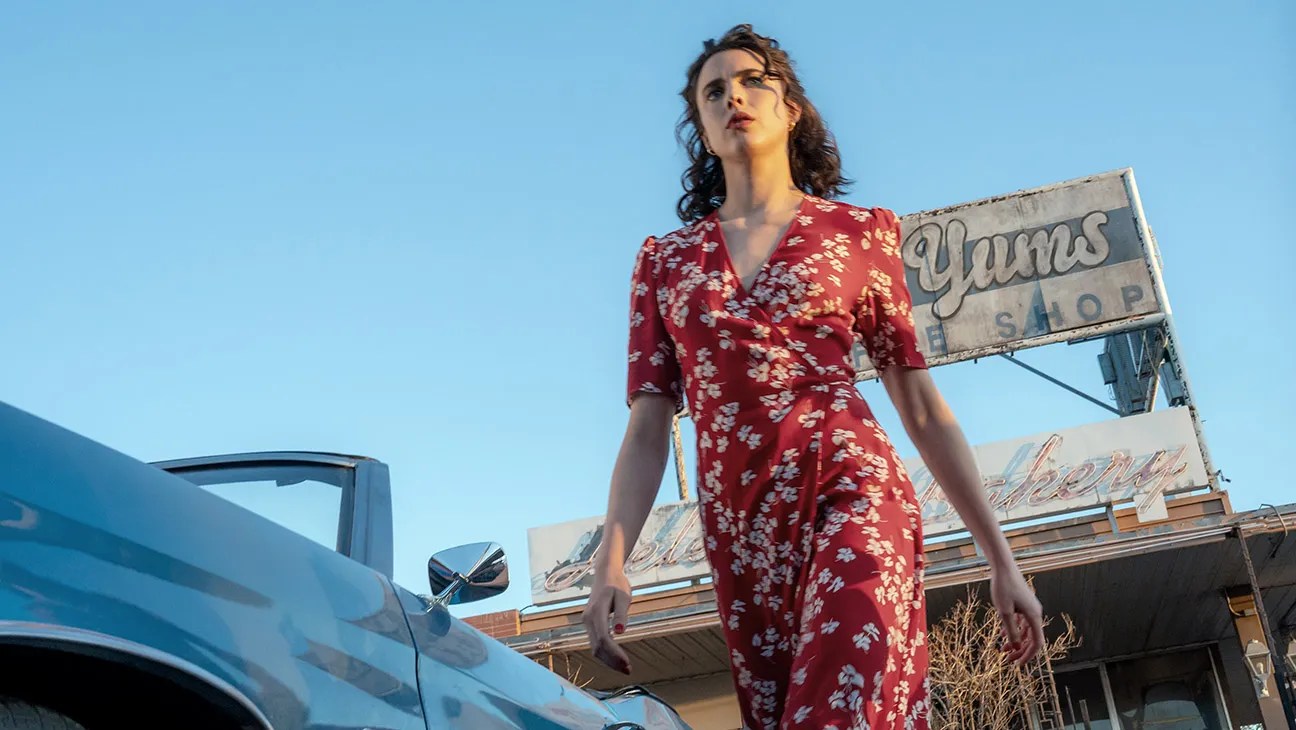
Ethan Coen and co-writer and wife Tricia Cooke reteam with actor Margaret Qualley for the second of a purported loose lesbian neo-noir trilogy. That first outing, last year’s “Drive-Away Dolls,” was a bit of a rickety start, but through no fault of Qualley, who packed the punchy best of both Thelma and Louise as one of two gal pals who zoom off in a car with various factions of angry patriarchy hot on their tail. It was a concept in search of a story. Here, Coen and Cooke dial up the noir aspect and concoct something more worthy of Qualley’s onscreen allure.
She plays Honey O’Donahue, a private detective working the dusty, depressed streets of Bakersfield, California. There’s trouble right off the bat as an angular French woman (Lera Abova) in leopard-skin tights navigates the scree of a ravine to get to an inverted car, its driver dead or dying. She’s not there to help, but to pluck a signet ring off a finger, and in the next scene Abova’s agent of cold deeds is floating casually full frontal in a nearby quarry pond. An important fashion note: As she clads up, there’s a Garanimals moment as we realize her underwear and bra match her motorbike helmet.
The latest Spike Lee Joint might not be the director’s tightest, but it is a passion project as playful as it is nostalgic. New York gets a lot of love, as do Spike’s earlier films – Rosie Perez and Nick Turturro show up in pop-off-the-screen bits – and New York sports teams. The last time Lee adapted a film that was considered an untouchable masterpiece (Park Chan-wook’s “Old Boy”) didn’t go so well; it felt flat, a rote redoing. He’s done better here in reenvisioning Akira Kurosawa’s great 1963 kidnap noir, “High and Low” starring the indelible Toshiro Mifune and adapted from Ed McBain’s novel “King’s Ransom,” flipping a shoe executive whose son is targeted for kidnapping during a corporate merger for a music mogul arguably fashioned after Jay-Z. Denzel Washington reunites with Lee for the first time in 19 years (they have five collaborations, with the previous being “Inside Man”) to play the exec, David King, looking to buy back control of his records label when the kidnapping goes down. The ransom is $17.5 million, which is the money David needs to get his Stackin’ Hits back. But there’s a hitch: Who’s snatched from camp is not David’s son Trey (Aubrey Joseph) but Kyle (Elijah Wright), the son of his loyal chauffeur and right hand man Paul (Jeffery Wright, Elijah’s dad IRL), mistaken for Trey by the kidnapper. It’s here that David has a crisis of conscience when he balks at paying for Kyle, causing a rift between David and Paul and raising questions of character and selfishness from David’s wife (Ilfenesh Hadera, elegant with a capital E) and son.
Somerville TheatreSomerville Theatre Crystal Ballroom Movie Trivia nights draw more than 150 people monthly, as seen from the POV of the scorekeeper.
Somerville Theatre Crystal Ballroom Movie Trivia nights are a raucous two hours of competitive film fan fun for self-anointed cinephiles and trivia tricksters looking to flaunt deep stores of knowledge to attain factoid alpha status.
The nights, on the third Tuesday of the month, are hosted by Billy Thegenus, program and outreach coordinator at the Coolidge Corner Theatre in Brookline and Ian Brownell, co-owner of CSB Theaters (with longtime theater manager Ian Judge), which runs the Somerville Theatre.The events have drawn 150-plus people – or 20-ish teams of five to six – to the Crystal Ballroom space. You can show up with your own, ready-to-roll crew or go freelance and hop on with a duo or trio needing a trivia turbo boost.
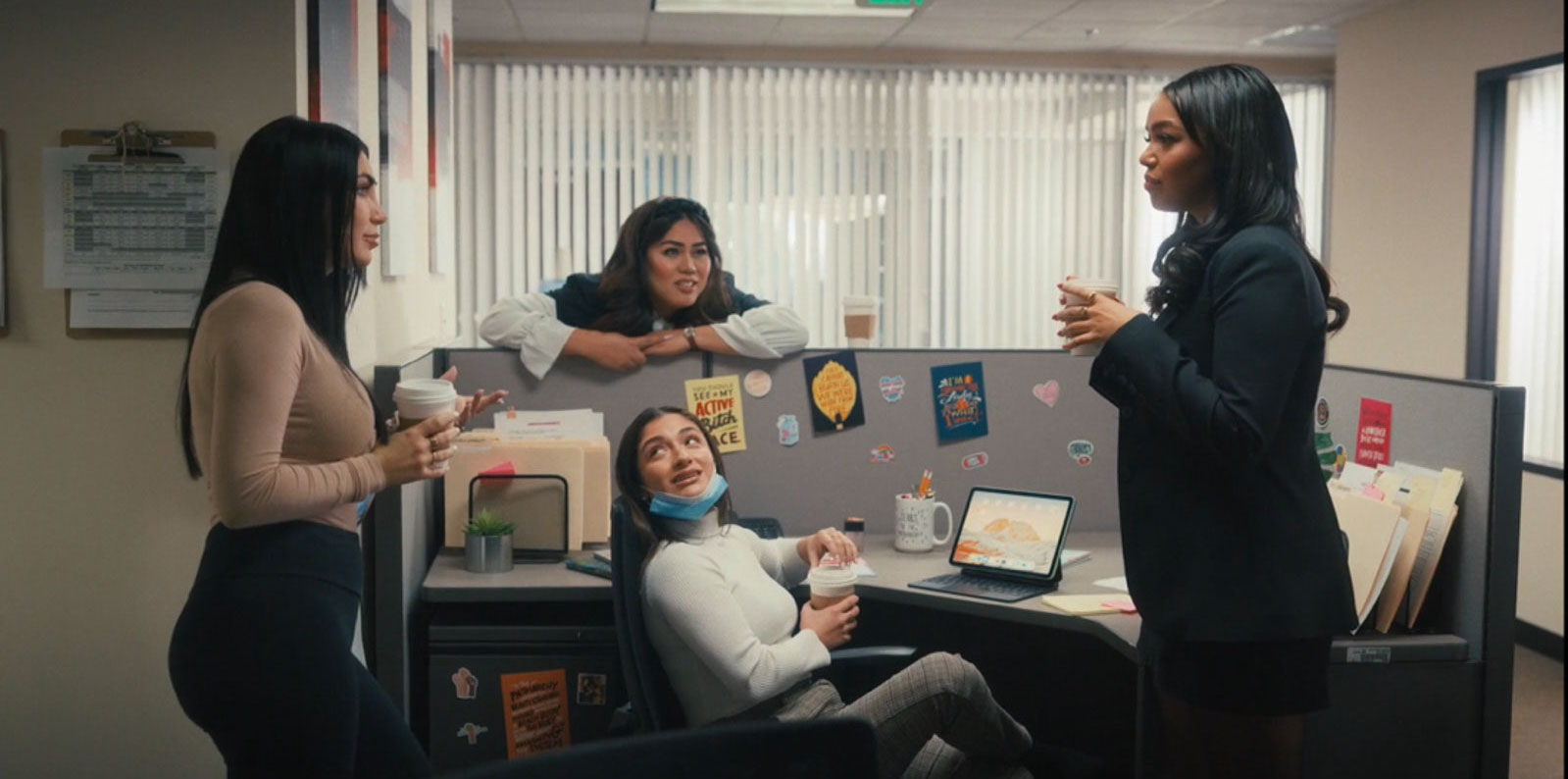
Seeking something different and off the beaten path, I saw that Amazon had just dropped a new version of “War of the Worlds” starring Ice Cube and Eva Longoria. It gave me pause. Didn’t Spielberg and Cruise redo this right back in 2005? Still, I was curious. What I got for my inquisitive sins was the H.G. Wells’ sci-fi classic told lamely through Zoom screens, with a professorial-looking Ice Cube as a defense scientist hooting inanely at a computer screen (“kick their asses!”) as tanks blast away at the wispy robotic walkers of the invading aliens. It’s nearly unwatchable, maybe the worst film of 2025, which is why I turned for relief to Emilio Mauro’s made-in-Boston, lo-fi, corporate culture kick-in-the-pants – something I took a gamble on reluctantly when Mauro reached out to me, but I’m glad I did. The film unfolds over the course of a business day in a generic office space of cubicles and white-slatted blinds, a drab labyrinth of toil and tension known as the fictional Haskin Rogers Corp. Just what Haskin Rogers makes its bank on is smartly never articulated, we just know that there are deals in the works, killer office parties and that the mantle of power has just been passed from papa Haskins (Brian Goodman) to son (Steve Memmolo). The company’s no-nonsense HR director, Tracy (Alexis Knapp, “Pitch Perfect”), serves as the film’s proxy for ferreting out hypocrisy and the isms flowing freely in water cooler byways. It starts from the moment we roll in at 9 a.m., slyly labeled “Time does not heal all wounds,” as a fairly well-ensconced employee is fired for homophobic and anti-Islamic tweets made in high school and college. Much of the film’s success comes from the strong performances of the all-in ensemble, namely Ritchie Coster as Greg, a senior player who wants the company’s lone Black woman (Daphne Blunt) fired because of her racy social media presence and alleged romantic ties to a valued client makes regular, off-the-cuff barbs about the new trans hire. Greg’s back-and forths with Tracy propel the film and underscore the divides. The most recognizable name in the cast is Natasha Henstridge (“Species”) as an enigmatic, outside power broker with the last name of Rogers. Other that shine are Damien Di Paola (“Chappaquiddick”) as a “Goodfellas”-talking task master strong-arming underlings and crossing a few lines himself, and character actor Paul Ben-Victor, who charms as a higher-up cynically sick of the corporate swim. Mauro’s script is airtight, irreverent and pushes the envelop the way Neil LaBute’s “In the Company of Men” edgily did nearly 30 years ago. On the matter of race, the film has a bit of a “Crash” (2004) arc to it. In the opening credits, we’re told that the film’s based on “true events” that happened here a while back and made national headlines; to divulge more would be to do the film and the viewer a disservice. “Another Day in America” played as party of the Boston Independent Film Festival, not to be confused with International Film Festival Boston, and just dropped onto streaming platforms.
Zach Cregger’s follow-up to his 2022 surprise art house horror hit “Barbarian” builds just as confidently with mood, moxie and acrid, enigmatic tugs. “Weapons” has you from the get-go as a young child from the fictional town of Maybrook, Pennsylvania, informs in a soft, reflective voice-over how one night 17 children exited their suburban homes at the exact moment of 2:17 a.m. and, holding their arms out like birds about to take flight, ran into the night and vanished. There’s a liberating joyousness to the otherwise ominous exodus. The next day at school, we learn that all were students of a new teacher, Justine Grundy (Julia Garner, “The Assistant,” “Ozark”), so when Justine walks in, the classroom is empty except for one: Alex Lilly (Cary Christopher), a small, quiet boy and the subject of regular bullying.
Parents are understandably upset and want answers. During a town meeting, Justine is blamed and castigated for her inability to provide answers. Later, her car is vandalized with the ominous tag of “witch” in bold red letters.
This image released by Neon shows Alison Brie, left, and Dave Franco in a scene from “Together.” (Ben King/Neon via AP)
In this claustrophobic, psycho-horror thriller written and directed by first-timer Michael Shanks, there’s much to impress – but it doesn’t, at least to the degree it should, through familiarity; once into it, “Together” plays like an homage to Ari Aster’s art-house horror hits “Heredity” (2018) and “Midsommar” (2019) with a few pages lifted from Brandon Cronenberg’s growing catalog of body-horror and Coralie Fargeat’s gloriously grim “The Substance” (2024). “Together” is conceptually and ideologically about codependence the way “Get Out” (2017) was about racism. We embed with real-life husband and wife Dave Franco and Alison Brie – who together starred in the 2020 Vrbo-from-hell thriller “The Rental” – as Tim and Millie, who move to a remote area for Millie’s new job as a schoolteacher. Tim, a slacker man-boy with only part-time gigs as a guitarist, tags sheepishly along. We know the couple’s got issues, as Millie tells a friend at their going-away party that Tim doesn’t like to “do it” anymore, and when she proposes to him at party, on bent knee with a mimed ring in a jewelry box, he balks. In the quiets near their new woodsy abode, they go for a hike and end up slipping through a sinkhole into a cave with a well seemingly designed by crew from the “Alien” films. “Don’t drink the water,” you shout silently at the screen. But they do, and when they pass out, waiting for the light of day to find a way out, they wake up, joined at the hips – kinda. Some rending, a little bit of pain and a few small tear wounds solve it. Tim writes it off as mildew, but later, back home at night and in bed, Millie’s hair starts to grow down Tim’s throat; when Tim finally gets up his nerve with Millie, he can’t pull out postcoitus. The sticky situations mount, while Millie’s passive-aggressive colleague just down the lane seems to be holding out on critical information. The performances by Brie and Franco, as a capable woman angling for adulthood and cuck in need of a clue, forge seamless onscreen chemistry. What doesn’t quite work is a third act in which revelations fall literally out of the closet with clunky awkwardness. Not worth a long-term commitment.
Nepotism abounds in the surprisingly tight sequel to the one-note 1996 comedy about a failed hockey player with anger issues turned pro golfer with anger issues. The success of that film made former SNLer Adam Sandler a household name and box office force to be reckoned with (and the run since has been long and profitable). Of those family ties, “Happy 2” features Sandler’s wife (Jackie), two daughters (Sunny and Sadie) and mother (Judy) in small parts. Loyal to the calendar, we’re 30 years out, Happy Gilmore (Sandler) is married to golf tour publicist Virginia Venit (Julie Bowen) and now has a brood of four: Hanson-esque hockey hooligan boys and a lone daughter, Vienna (Sunny Sandler), who wants to go to ballet school in Paris. Before we settle in, Virginia exits the picture and Happy, distraught, starts boozing wildly. The slide into financial ruin and derelict dad-dom is meteoric. That said, things are arguably worse for old foe Shooter McGavin (Christopher McDonald, funny and sinister as always), locked up in an insane asylum. Nearly every page from the original gets a nod, including the sadistic opportunist Hal (Ben Stiller, sporting a massive handlebar ’stache) who held Happy’s grandmother under duress as a maniacal nurse at her living facility, and here has moved on to running an AA-adjacent recovery program that Happy is ordered to dry out in. Needless to say, the only way to save the house and send Vienna to pirouette school (he needs $300,000 and then some), is golf. Added is Benny Safdie, co-director of Sandler’s “Uncut Gems” (2019), as the smarmy head of an upstart golf league called Maxi Golf (like Liv Golf on neon-infused crack) who wants to challenge the pro-golf tour, and Haley Joel Osment as the top pro on the tour – and subsequent Maxi Golf defector – who can drive the ball farther than Happy because of a radical hip ligament surgery. Many of today’s top players, including Scottie Scheffler, Rory McIlroy and Bryson DeChambeau, appear in the film, as well as old schoolers Lee Trevino, Fred Couples and legend Jack Nicklaus, who, when asked by a waiter (Travis Kelce, slick and sassy) what he wants to drink, says, lemonade and ice tea. The waiter pauses and asks Nicklaus if he’s not Arnold Palmer (cue rimshot). It’s a shaggy-dog laugh fest that pays astute homage (Sandler and original scribe Tim Herlihy doing a nice stitching job, plotwise) to what came before while expanding it. The best might be party-hearty golfer John Daly with a Santa beard as Happy’s next-door neighbor who’s forever in his PJs and sucking on nips. A surprising and unlikely above-par revelation, this “Happy” beats the cover off the old ball while notching a few new spins and a dizzying array of hip cameos.
Crowds jeer in James Gunn’s recently released “Superman.”
James Gunn’s “Superman” swooped into theaters a week ago and knocked it out of the park with more than $125 million at the domestic box office. Not bad for a flat-footed rebrand that’s a long way from “Jaws,” which 50 years ago became the pindrop for the blockbuster, pulling in more than $260 million ($1.5 billion by today’s standards), with the eventual Academy Award winner that year (and No. 2 in box office totals), “One Flew Over the Cuckoo’s Nest,” taking in less than 40 percent of that. With that success, Spielberg’s gambit forever altered filmmaking and the way we see films; producers began seeking ready-made target audiences and the next big onscreen wow that would blow watchers’ minds and create lines to the ticket booth.
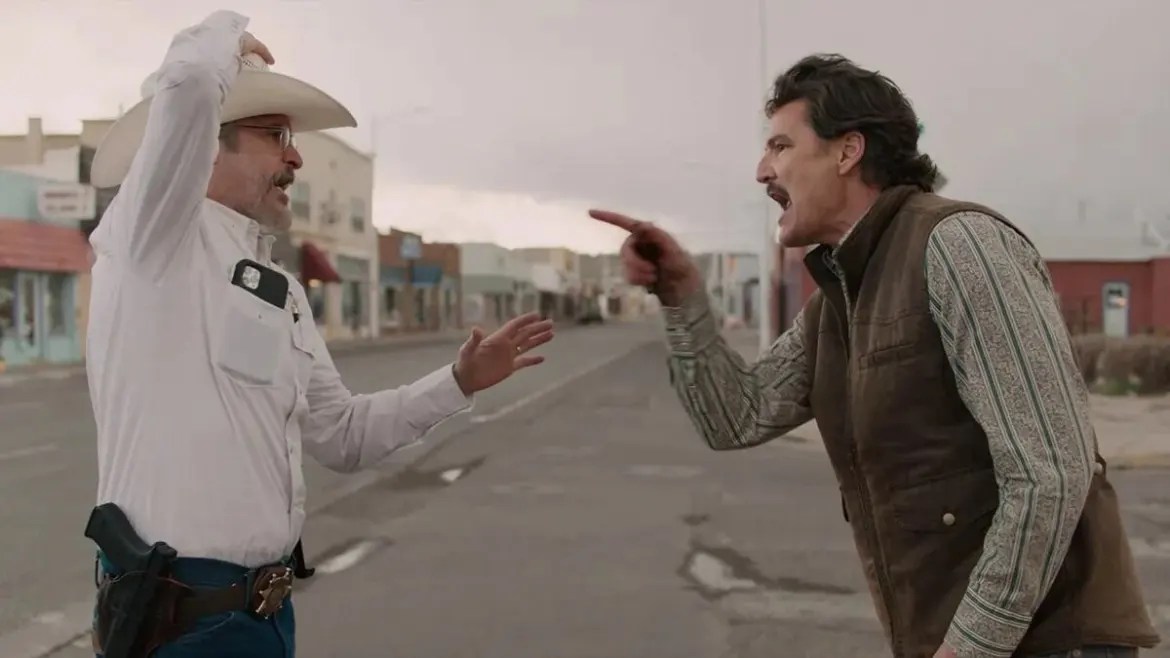
The latest from art house horror darling Ari Aster, like his last outing, “Beau is Afraid” (2023), isn’t quite the occult blood-and-guts fest one has come to expect from an auteur of the macabre (“Hereditary,” “Midsommar”). But it is an American horror story to be certain. Set in the fictional Southwestern town of the title, “Eddington” takes place during the height of the Covid pandemic, with ripple effects of George Floyd’s murder and the Black Lives Matter movement factoring large into the equation. Eddington is a small, financially struggling New Mexican town of 2,000 that abuts a Pueblo Indian reservation. Beau, I mean Joaquin Phoenix, plays Joe Cross, the county sheriff who, despite orders from the governor and mayor (Pedro Pascal, who seems to be popping up everywhere), refuses to wear a mask. He’s not an antivaxxer or Covid denier per se, but close enough – and as a result, decides to challenge Pascal’s smooth and composed Ted Garcia for his mayoral seat.
The pratfalls and ills of social media and social politics drive the film for nearly two-thirds of its two and a half hours. It’s imbued with the shaggy-dog docudrama vibe of a Richard Linklater or Paul Thomas Anderson film, sans the slack, droll wit. Some of the satire on white privilege, however, lands quite cuttingly, especially as one pasty young man (Cameron Mann) shouting from a podium tells reluctant listeners that he’s become an antiracist and is ready to sit down and listen to others, but only after he’s had his time at the mic to “racesplain.” Also in focus is Cross’ Black deputy (Michael Ward) as BLM protesters jam the streets, and the sovereignty of the Pueblo Peoples and their lines of jurisdiction overlap with Cross’ and become a point of contention during a murder investigation. On all pointed matters (social media, race and pandemic policy), both sides get their due without a lean – that’s left to the audience.
They could have called this one “Peacemaker and Bloodsport Run for Office,” as it leverages the great yin-and-yang chemistry that actors John Cena and Idris Elba forged in the hilarious Harley Quinn DC comic reboot, “The Suicide Squad” (2021). Here they play Will Derringer (Cena), a former action movie star elected Potus, and British prime minister Sam Clarke (Elba). Derringer – an obvious and affectionate riff on Arnold Schwarzenegger – is famous for his “Water Cobra” films, whereas Clarke was a career commando before moving into the political realm. There’s a bit of a rift between the two, as it was perceived that Clarke supported Derringer’s rival by having fish and chips with them. Clarke and Derringer meet at a European summit and afterward, for squirrelly reasons, Derringer offers to give Clarke a lift on Air Force One. As Harrison Ford is nowhere nearby, the big jumbo jet is plucked from the sky by an international terrorist ring (led by an ever-menacing Paddy Considine), and Clarke and Derringer have to go off-grid and escape Belarus. While the two are assumed dead, their respective successors seek to dissolve Nato, and the U.S. intelligence network is hijacked by hackers. Fairly generic stuff made pleasantly smirk-worthy by the playful onscreen Frick-and-Frack chemistry of its leads and some nifty pacing and action scene choreography by director Ilya Naishuller (“Nobody”). Adding comic spice and sporty can-do are Jack Quaid (“The Boys”) as a wacky CIA safe house operative and Priyanka Chopra Jonas (“The White Tiger” and “Matrix Resurrections”) as a game British agent who served with Clarke in the military.