‘Don’t Worry, He Won’t Get Far on Foot’: Alcoholic cartoonist was hell on wheels
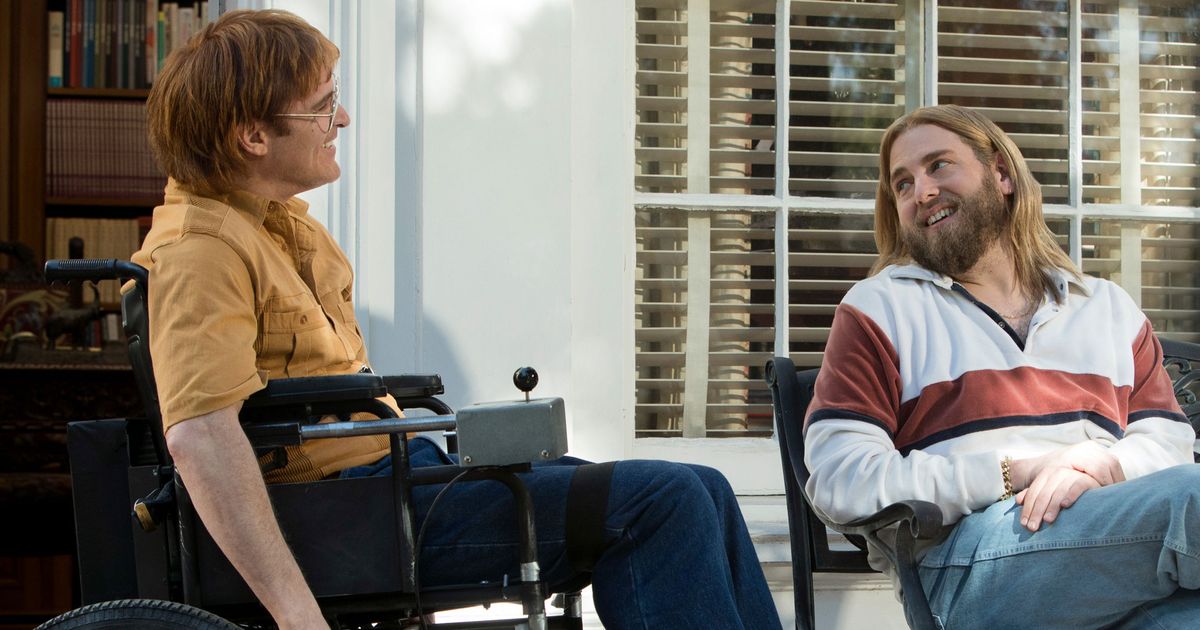
The films of Gus Van Sant, be they the good (“To Die For” or “Drugstore Cowboy”), the total miscue (“Psycho” or “Even Cowgirls Get the Blues”) or even a crowd-pleasingly mainliner (“Good Will Hunting” or “Milk”) have always been embossed by a gritty, streetwise authenticity. That’s Van Sant’s gift – plus, by skill, proximity or both, educing some of the great performances of the past 20 or 30 years from actors the likes of Nicole Kidman, Sean Penn, Matt Dillon, Robin Williams, Matt Damon and River Phoenix, to name a few. Here he’s re-teamed with River’s brother Joaquin, who played one of Kidman’s teen lovers-turned-hubby snuffers in “To Die For” (1995).
 “Don’t Worry, He Won’t Get Far on Foot,” isn’t a topical grabber; it’s a biopic about an esoteric satirist/sketch artist by the name of John Callahan who died in 2010 after spending most of his adult life in a wheelchair, paralyzed from the waist down after a car accident involving a drunken driver. The terrible catch there being that the car was Callahan’s, driven by another (Jack Black) because Callahan was too drunken to drive.
“Don’t Worry,” however, isn’t so much about overcoming physical difficulties and beating the odds, but about confronting one’s demons. As the film has it, Callahan has an angry closet full of ’em. A raging alcoholic from the minute we catch up with him to the alcohol rocket of an evening that ends with Callahan’s VW Bug wrapped around a cement post, the slacker handyman out for the next good time seemingly has little prospects beyond his shaggy good looks and winning smile – and then that too seemingly gets taken from him. Strapped to a hospital gurney in the cold, sterile aftermath, Callahan flirts with his physical therapist (Rooney Mara, impeccable and fetching in the small role) and when peppering his counselor (Rebecca Field) about the functionality of his equipment, she suggests with grave seriousness that he ask the night nurse to sit on his face. Callahan flashes his old smile and accepts the challenge gleefully. Out on his own. Callahan returns to the bottle with self-pitying vehemence. It seems a fast downward spiral, but he also starts drawing acerbic political doodles that get published (“the place that publishes Gary Larson just called”) and elicit strong public reaction. He also checks into an AA group led by Jonah Hill’s ultra-rich gay swami, Donnie, who presides over the flock with the smarmy, manipulative charm of a cocksure charlatan. Callahan takes to Donnie, but keeps boozing on the side with angry-man swagger. All of which makes for a gonzo 12-step ride.
It might be treasonous to say, but Phoenix and Hill don’t have great chemistry. They’re fantastic, mind you, but not in the way Bogie and Bacall or Newman and Redford were, or even Damon and Affleck’s bros in Van Sant’s “Good Will Hunting.” When the two are on screen together the film is undeniably intoxicating in its own quirky right; if you were at a bar with this duo, you’d find it hard to close out your tab before closing time. But they’re just not pouring the same stuff. And sans the bravura performances – self-righteous Hill and self-hating Phoenix – I’m not sure “Don’t Worry” would be that interesting of a film. Cultural icons Kim Gordon, Udo Kier and Carrie Brownstein have small bits and feel plugged in but not necessarily engaged in the presence of the immersed leads. Gordon, best known for her work as a member of edgy ’90s rock band Sonic Youth, also had a small role in Van Sant’s “Last Days” (2006) the last chapter in the filmmaker’s Death Trilogy that reimagined Kurt Cobain’s demise. The other films in that series, “Gerry” (2002) and “Elephant” (2003), a repainting of the Columbine massacre, are similarly fact-based and likewise riveting. “To Die For” (1995) and “Paranoid Park” (2007) too might make apt bookends, and if you added in “Don’t Worry,” an individual alone in a country cabin for a weekend with the ability to stream such a double-triple program might emerge on Sunday depressed, enlightened and oddly invigorated. The most telling and frightening aspect of “Don’t Worry,” however, is its raw and honest depiction of addiction and the grip it has on the ensnared – and the ends they will go to in spinning a false narrative even as the knees of reality betray them.
 For those of you who missed the cornerstone “Ant-Man” a scant few years back in 2015, you don’t need to back up and catch that less interesting flick before diving in. What you do need to know is that “Ant-Man” is part of the whole Marvel Universe run by Disney and that the hero known as Scott Lang (Paul Rudd) sans the suit, is serving the end of a two-year house detention mandated by the FBI for his participation in a fracas over in Germany, seen back in
  Early on, it’s pretty clear Will has military training and suffers form some form of PTSD or a similar condition. He’s a good dad, however, making sure Tom is well-educated (advanced for her age, a social worker later remarks) and he teaches her survival and avoidance skills. They’re good at evading and make occasional forays into the city (he gets his PTSD meds and resells them for cash), but eventually authorities catch up with Will – turns out he’s not the only recluse living in the state forest. As if on cue from our daily newsfeed, the sudden fear that Will and his daughter will be separated fills the screen. They are for a brief period, but thankfully Oregon family services show more compassion than the current regime in Washington and the two are set up in a nice cottage on a farm where Will is given a job. First thing Will does is to put the TV in the closet, and it’s not too long until he and Tom have packed up and headed back into the woods.
 As with all the “Jurassic” flicks, the action begins down in Costa Rica, at the theme park from the last chapter that’s been abandoned and overrun by rampaging dinos. The crisis du jour becomes increasing volcanic activity that threatens to “re-extinct” the “de-extinct” lizards (okay, birds). Congressional debate rages about saving them or not and, blessedly, Jeff Goldblum looms at the epicenter with rapturous logician metababble; then, just like that, the crew from the last “World” – the park overseer (Bryce Dallas Howard) and raptor wrangler (Chris Pratt) – are back as part of a conservation effort to get as many of the dinos as possible off the island and to a “sanctuary.”
 “Hotel Artemis” takes place in the near dystopian future, though it’s hard to get a full register of what that’s really like; similar to Wes Anderson’s
  Set in the near future where driverless cars are the norm and criminals and vagrants roam the littered cityscape, Grey and his wife are beset upon in a vehicle that goes way off course. It doesn’t end well – she’s dead; he might as well be. A few days later Grey’s up, learning to walk again, a super computer chip implanted in his head to help make all connections to the nerves that make him go. He also hears voices in his head: his own personal Siri, that, if Grey grants permission to take control, can use his body in lightning-fast ways. In short, he becomes his own personal “Terminator” on the trail of getting revenge on the posse of vermin who offed his wife.
 The good news is that Schrader’s latest, “First Reformed,” is something of a resurrection for the 71-year-old filmmaker, and an apt one; it revolves around a soul arguably more anguished than Christ or Bickle. The object of the title is a small, upstate New York church on the eve of its 250th anniversary. Tending to its diminishing flock is a reverend by the name of Ernst Toller (played with perfect restraint by Ethan Hawke, delivering his best work since “Training Day”) who’s clearly more lost spiritually than any of his flock. We learn early on that in the near recent past he’s lost his son to the war, and his wife abandoned him in the aftermath. Toller remains composed at the dais, but behind rectory doors he’s washed out, rueful and barely able to find solace at the bottom of a glass of bourbon. Smartly, he keeps the bottle hidden, but higher-ups at the parent parish (played with power and concern by Cedric the Entertainer) ultimately suss him out. How Toller finds redemption comes initially through purpose, when pregnant young parishioner Mary (Amanda Seyfried) asks him to counsel her troubled husband, who spouts eco-terrorism mantras and conspiracy theories – nothing like a drowning man trying to save another going under – and later, in the discovery of a suicide vest.
  At one point in the movie, someone says, “It’s not about you.” It’s an astute observation, as the film is at its thriving best when the screen is filled by the potpourri of personality that orbits the pivotal pilot of the title. The problem with Han (played by Alden Ehrenreich) as a character here is that he’s just not all that interesting of a dude, or in the least close to what was hinted at by Ford’s wisecracking incarnation. Also too, and I hate to say it, Ehrenreich is no Ford – not even a shadow. He tries, but you spend more time searching for vestiges and mannerisms of the Han you know than you are transported to the then and there.
  Moll lives with her controlling mother (an icy-cold Geraldine James), who stalks her progeny and questions her every whereabouts despite the fact Moll’s a mature woman with a full-time job (as a tour bus guide). Given mum’s iron glove, moving out would be a good idea, but there’s that troubled/damaged thing. Can Moll truly be on her own, or does she need constant monitoring? We get the answer to that quickly as Moll goes clubbing one night into the wee hours with a scruffy drifter/handyman by the name of Pascal (Johnny Flynn). Elsewhere, news blips on the TV tell us there’s been a recent murder of a girl nearby, and another girl is missing. The short list of suspects the film and police pursue includes Moll – she had a violent incident back in high school that haunts her – and Pascal. Moll may be somewhat lost and misunderstood, but there’s always deep down inside an ember of hopeful ebullience, and she becomes spirited at the prospect that she and Pascal might hie away together for happier destinations. Darker matters beyond legal suspicion cloud the notion, such as nightmarish incursions that come in the middle of the night or Moll’s ill-conceived insistence on showing up at one of the victim’s funerals. Ultimately “Beast” becomes a tug of war between hope and despair, with an ever-shifting emotional landscape.
