Archive | Article RSS feed for this section

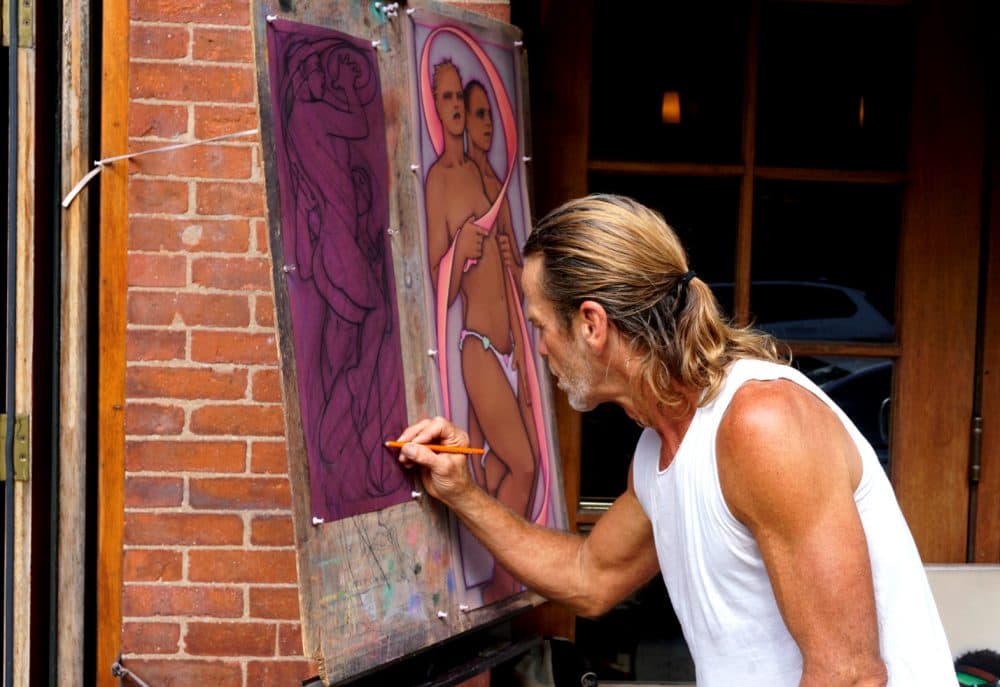
A Sidewalk Picasso — Artist Eric Kluin Makes Newbury Street His Studio

3 Oct

Published in the WBUR ARTery

Artist Eric Kluin outside the Newbury Street restaurant Sonsie. (Tom Meek for WBUR)

If you’ve ever been by Sonsie on Newbury Street on a bright sunny day in the past 20-plus years (since the restaurant’s opening back in 1993), you’ve probably seen Eric Kluin — the surfer-esque painter with six-pack abs — busily at work on his easel perched just outside the establishment’s welcoming French windows that open out onto the sidewalk.

A shirtless fixture that’s hard to miss, Kluin’s something of a curio. Does he have a license to secure that spot? Is this some entitled ploy to pick up women? These are questions you might ask yourself as you pass by. Reasonable questions for the intrigued, but the answers might surprise you.

Kluin, a pretty laid back individual, moved to Boston in the late ’80s after working at a halfway house in Arizona where he had formerly been a resident. He’s been a recovering alcoholic for 22 years, and ironically, it was a bar that gave him his shot at a sustained recovery.

He began consuming alcohol abusively at the University of Michigan where he studied art, and didn’t stop until he was scraped off the floor of his flat in Boston by a concerned friend and tossed into rehab — twice. He admittedly describes himself as a “classic alcoholic who would drink himself to death if given the opportunity.”  Continue reading

Almost up a creek while paddling the waters of Disney

15 Sep

Published in the Boston Globe


Signs warn of alligators and snakes near Seven Seas Lagoon.

Signs warn of alligators and snakes near Seven Seas Lagoon.

By Tom Meek GLOBE CORRESPONDENT SEPTEMBER 09, 2016
Vacation resorts — those destinations you leverage your life savings for so the family can relax and have fun without sweating the pressures of daily life — include safety and security as part of the package, right? Such was the likely expectation of the family from Nebraska whose 2-year-old son was killed by an alligator at Walt Disney World’s Grand Floridian Resort earlier this summer. The attack, which took place on an idyllic swath of beach on the manmade Seven Seas Lagoon, occurred as the family took in one of the resort’s family movie night offerings. For me the news was extra chilling, as just weeks earlier, my wife and 6-year-old daughter sat on that very beach watching “The Force Awakens.” Eerier still was the realization that a misadventure of mine two years earlier had given me a glimmer into the dangers that lurked in Walt’s waters.

I’ll be the first to testify to the structural beauty of the stately Grand Floridian and its limitless amenities, but those foreboding “no swimming” signs along the beaches gave me pause the very first time I passed them by. There was no footnote or qualification, just a red slash through a silhouetted swimmer. I assumed the water was polluted. I couldn’t have been more wrong.

Continue reading

Bad Cycle

5 Jun
bike lane with trash can blockage
Installing bike lanes isn’t a cure-all for bicycling infrastructure, and they have problems of their own. (Photo: Marino Pascal)

May was Bike Month, the month we celebrate all who crank through the urban landscape reducing traffic, helping save the environment and promoting a healthy lifestyle. But besides some flag waving, what do Bike Months really accomplish? Do more people saddle up the steel steed, do motorists become more sympathetic and aware of cyclists, are the roads somehow suddenly safer? Unfortunately no – it merely underscores the lip service municipalities and agencies put forth when they could better serve the biking community and public safety by putting real dollars into infrastructure, policy and traffic law changes.

Opinion boxFor me, the month began with great optimism. I sent letters to transportation heads in Boston and Cambridge outlining 10 unnecessary hazards to bikers in each city where immediate improvement could be had. I ride a 15-mile round trip every day from Porter Square to the very end of the Seaport, and had hoped that, given the month, documenting these persistent areas of peril (unclassifiable on the wonderful, but limitedSeeClickFix app) might garner some attention and thought from those with the power to enact change.

What happened was fairly emblematic of bureaucracy, and embosses the truth that we don’t value cycling as much as we say we do. From Boston I got a cricket concerto (though the canyons of potholes I flagged by South Station did get filled within days). Separately, a call toBoston Bikes – a municipal department opened in 2007 – to ask about bike rack policies and safe passage around or through Boston Common turned out to be a frustrating do-nothing back-and-forth. At no time during the conversation did the young rep mention Boston Bikes doing something, anything; she just directed me to take up issues elsewhere at City Hall, or to use an app. It was disappointingly clear that she cared little about cycling and wasn’t in touch with the state of the roads or traffic conditions, let alone the community she served.  Continue reading

Election Flicks

23 May
A still from the film "Weiner." (Courtesy of IFC Film)

The political season is well upon us, more vehemently and contentiously so than past presidential primaries, especially given the surprising number of upstarts, lack of usual faces and an arguably unpopular field. If either of the Democratic candidates win, history will be made with the first female commander in chief or the oldest citizen to assume the Oval Office. If Republican front-runner Donald Trump wins, his victory will cap a campaign of shock and awe, bluster and division, the likes of which seemed only possible in a movie.

That said, hitting the campaign trail has not been a particularly vast topic explored on film, but when it has, it’s been done with biting satire or a telling inward look at ourselves, our society and how we value democracy.

Most often those films stoke our fear of big corporations and power brokers seeking to influence control, as well as our fascination with scandal, the politician’s sudden fall and the tabloid train wreck that ultimately becomes a reflection of our impossible expectations, our own hypocrisies and an illumination of the intoxicating stupor of power that leads to self-destructive hubris.

Below is a list of 10 movies that bear particular relevance to the campaign as it is currently unfolding. (The last film in the list, “Weiner,” opens this weekend in select locations.)

“The Best Man” (1964)

Gore Vidal’s seminal skewering of big egos clashing for the White House pit a fictionalized version of Adlai Stevenson (played by Henry Fonda) against a JFK-like incarnation (Cliff Robertson), both vying for a former president’s approval. The shards of political courtship carry the tang of Obama having to mitigate his allegiances with Sanders and his former secretary of state Clinton. Vidal adapted his stage play, Franklin J. Schaffner (who helmed “Planet of the Apes” and “Patton”) directs and Lee Tracy was nominated for an Academy Award for best supporting actor for his turn as the ailing former president, casting an ostensible nod to Harry Truman.   Continue reading

A Small Good Thing

15 Apr

What makes a good life? Health, love, money, career success? Turns out it’s happiness, which encapsulates elements of those others, and the balance of which that equates to equanimity – or so that’s the basis for Pamela Tanner Boll’s documentary “A Small Good Thing,” which gets a screening Monday at the Cambridge Friends School.

Boll, who lived in Winchester for most of her adult life and collected an Academy Award as executive producer on the 2004 documentary “Born into Brothels: Calcutta’s Red Light Kids,” came up with the concept to explore the meaning of a life well lived after looking inward at her own existence. “I felt like I had so many great things in my life,” she said in interview. “I had a good family, great sons, a nice home and I had been able to find work that was meaningful, but I also felt I was, however, getting too stressed out and busy. I felt like I was becoming one of those people who says, ‘I’m so busy with work, I don’t have time’” to socialize.

Surely championing documentary voices for more than a decade has contributed. “I come across so many amazing stories and I help them get to the screen,” she says. But it’s a tough business to make a go at. “Born into Brothels” cost less than $500,000 to make and made $8 million at the box office – most eaten up in distribution and marketing. Her own film cost a bit more than “Brothel” to make and is clearly a labor of passion, as is true with most documentaries.  Continue reading

Karen Aqua’s Films at the HFA

6 Apr
An image from Karen Aqua's animated film "Kakania." (Courtesy Harvard Film Archive)


In the broad sense, an archive is a place to preserve and retain history. In the case of art, it becomes a means to ensure the ongoing resonance of an artist’s vision.

To that end, the Harvard Film Archive has recently acquired the films of animator Karen Aqua, who died after a prolonged battle with ovarian cancer in 2011. Some of the newly collected works will be presented on April 9 with the retrospective program “Sacred Ground & Perpetual Motion — The Animated Cosmos of Karen Aqua.” Karen’s husband, musician Ken Field, will be on hand to introduce her work.

The late Karen Aqua. (Courtesy Ken Field)

If Aqua’s name doesn’t trigger any immediate bells, she had lived in and around Cambridge since the 1970s after graduating from Rhode Island School of Design, where she and her husband were intimately ingrained in the artistic community. She produced a multitude of short, ethereal works that deal more in emotional experience than traditional narrative. What’s truly most impressive is how Aqua painstakingly created her works by hand, illustrating the action at 24 frames per second.

Of the 15 films on the slate for the April 9 program — each of which runs between two and 12 minutes — Aqua’s most defining work may be “Vis-á-Vis.” An evocative contemplation of the life of the artist, the film depicts an animator diligently working while the outer world — the source of inspiration — beckons teasingly. The pull between the commitment to create and to experience life is rendered poignantly as the artist begins to split into two halves that tug on the each other, each trying to move in its own direction. Continue reading

Stonewalled

27 Feb

Mural due to be painted over at Starbucks; revised design wasn’t brought to landlord

March 1 could see return to blank wall at Massachusetts Avenue shop

Lesley University artists Gary Chen, Ellie Lukova and Percy Fortini-Wright paint a mural on the Starbucks at Shepard Street and Massachusetts Avenue last fall.
Lesley University artists Gary Chen, Ellie Lukova and Percy Fortini-Wright paint a mural on the Starbucks at Shepard Street and Massachusetts Avenue last fall. (Photo: Timothy Dungan-Levant)

The colorful mural at Massachusetts Avenue and Shepard Street depicting ethnically diverse students and nearby academic landmarks will be painted over early in March. The alfresco painting, done by Lesley arts students through a collaboration by Starbucks and the Committee for Art on the Avenue, had become a point of contention between Starbucks and Stone Investment Holdings, which owns the building that houses the coffee franchise, the trending eatery Shepard and other retail and food fronts.

The reason for the impending eradication comes because of a “miscommunication” with the landlord, for which Starbucks takes responsibility. The coffee giant initially reached out to the community with an in-house mural idea, but was engaged by the neighborhood to do something more “local.” Starbucks spokeswoman Holly Hart Shafer admitted that its lease requires approval from the city and landlord for changes to the exterior of the building, and the company didn’t follow through with the landlord on the second proposal after the first had been approved. Continue reading

In Jackson Heights

17 Nov
Still from Frederick Wiseman's "In Jackson Heights" (Courtesy Zipporah Films)Still from Frederick Wiseman’s “In Jackson Heights” (Courtesy Zipporah Films)

Cambridge has quietly become an incubator to more than just hi-tech, intellectualized liberalism and life sciences. Slowly but surely over the past few decades the left bank has become a nurturing rook for documentary filmmakers.

It’s home to such notables as Academy Award-winners Errol Morris (“Fog of War”) and Margaret Lazarus (“Defending Our Lives”). Oscar-nominated Joshua Oppenheimer (“The Act of Killing” and “The Look of Silence“) attended Harvard and longtime resident Ross McElwee made an indelible mark in 1985 with his critically acclaimed autobiographical sojourn, “Sherman’s March,” too, but predating all that undeniable talent and vision, and most prolific, looms Frederick Wiseman.

The embodiment of the cinéma vérité, Wiseman, at the spry age of 85 (call it 86) is now churning out his 40th cinematic essay, “In Jackson Heights,” which begins a special engagement at the Museum of Fine Arts starting Wednesday, Nov. 18, and runs through the end of the month.

Documentarian Frederick Wiseman, director of "In Jackson Heights" (Courtesy Zipporah Films)

Continue reading

Sam Peckinpah in Retropsect

2 Jul

Settle In For A ‘Summer Of Sam Peckinpah’ At The Somerville Theatre

The canon of Sam Peckinpah’s blood letting mastery will be on display July and August as part of the Somerville Theatre’s “Summer of Sam Peckinpah” series which will showcase 10 of the 14 feature length films the maverick director notched during his tumultuous career.

The program could alternatively be titled, “The Good, the Bad and the Ugly.” At the height of his career, Peckinpah transformed the western genre with gritty gray depictions of morality and balletic orchestration of extreme violence that were at once, disturbing and poetic. At his nadir, Peckinpah had creative control wrested away by studios believing his vision had gone amok. And there were those later endeavors, where the director was too high on coke and alcohol to assemble competent and comprehensive results — though there were always the old flashes of brilliance. In there too, sprinkled between disaster and crowning achievement, were the quirky off-kilter oddities that bordered on cult status and defied genre while polarizing filmgoers and critics alike. Were they visionary masterpieces, or more of Sam firing off into a maelstrom of misanthropic misery propelled by a pint of tequila and contempt for his producers?

Sam Peckinpah in 1964 Los Angeles. (AP)

If you’re familiar with Peckinpah and his works, you can probably fill in the titles next to each category with relative ease. If the name is new to you, or somewhat vague, then you’re in for a taste bud awakening and cinematic treat. That said, most all of Peckinpah’s films bristle with machismo, hyper violence and perverse, sexually charged situations — not everyone’s cup of tea.

Historically, Peckinpah’s been viewed as the gateway filmmaker who set the stage for the dark, iconic works of Martin Scorsese and Francis Ford Coppola in the ‘70s and more contemporarily, Quentin Tarantino. The Monty Python skit “Salad Days,” where a nice English picnic in the country turns into a blood gushing hell, got at the mainstream perception of Peckinpah and his films at the time, but what made his vision resonate with critics and audiences during the ‘60s and ‘70s, as well as over time, were the visceral themes of being caught out of time and out of place. They felt dislocated, disenfranchised and desperate — but in those desolate backdrops were always soulful wafts of loneliness and the unwritten code of loyalty.

The Somerville Theatre’s program runs the 10 films in tight, near chronological order. “Ride the High Country” (1962), Peckinpah’s second feature begins the two-month-long tribute on July 1. Peckinpah had cut his teeth as a TV director with “The Rifleman” series and was also a longtime assistant to Don Siegel (“Dirty Hairy” and “The Killers”) in the ‘50s — he had five bit roles in Siegel’s conformist horror classic, “Invasion of the Body Snatchers” (1956). Peckinpah’s first feature, “The Deadly Companions” (1961) was mostly viewed as a transition piece, as it starred Brian Keith, the lead of “The Westerner” TV series, which Peckinpah also directed. The piece never quite gelled in the new format, but that theme of redemption and the notion of setting things right (Keith played an ex-army officer looking to make amends to a woman whose son he had killed) would echo loudly in “Ride the High Country” and infuse many of the director’s subsequent works.

When Peckinpah set out to make “High Country” many derided his choice of casting Joel McCrea and Randolph Scott as his leads. They were aging actors but personal favorites of Peckinpah and precisely what the script called for, old school westerners confronted by the amoral corruption in a mountain high mining town impervious to the influence of outside law and custom. The movie casts shades of “Shane” and floats the specter of Robert Altman’s brilliant and yet-to-be-released, “McCabe & Mrs. Miller” (1971).

Peckinpah’s follow up, “Major Dundee” (playing July 8), a Civil War era grudge match with the Apache, was something of a letdown by comparison. Marred by heavy studio paring and a vicious on set feud with star Charlton Heston (the excellent cast also included Richard Harris and James Coburn), Peckinpah was removed from the film before its completion.

Five years later, Peckinpah would deliver his magnum opus, “The Wild Bunch” (July 15, 70mm), seamlessly weaving together the vanishing West, the onset of the First World War, the invention of the airplane and the cruel injustice spreading throughout Mexico and fought against by Pancho Villa. The cast of antihero outlaws and rival bounty hunters would factor in more of Peckinpah’s idols, Robert Ryan and Edmond O’Brien, aging Hollywood A-lister, William Holden and Peckinpah regulars, Ernest Borgnine, Strother Martin (“What we’ve got here is failure to communicate.”), L.Q. Jones, Ben Johnson and Warren Oates. The movie was as much a revelation in cinematic technique (multiple cameras shooting the same action simultaneously, the interweave of slow motion and regular speed action within a sequence and the tight, frenetic cross-cutting that brought it all together with purpose ) as it was a statement about the brutal nature of man and bureaucratic hypocrisy of society in large. The Vietnam War was raging at that time, and some politicized “The Wild Bunch” as an allegory for America’s involvements in other countries’ affairs. Peckinpah would adhere to his intent to tell a simple story about men of fixed ways caught in changing times. The eloquent score by longtime collaborator Jerry Fielding and the script by Peckinpah and Walon Green would go on to receive Oscar nods.

“Straw Dogs” (July 22), Peckinpah’s first non-western, too had the tang of Vietnam attached to it (released in 1971) as it revolved around a college professor (Dustin Hoffman) who relocates to the small English village of his wife (Susan George) in order to extricate himself from the turmoil and protests back home and to focus on his precious mathematical equations. There, conflict and tension come in other forms, the primal power of sex, cowardly acquiescence, pedophilia and class division, all driven by another hauntingly ominous score by Fielding, and culminating in the perfect storm of escalation in a remote enclave where the hand of the law is as ephemeral and effective as it was on the edge of the American frontier. The graphic nature of the pivotal rape scene sparked outrage and controversy at the time and remains equally as provocative and divisive 45 years later.  Continue reading

Archie’s Betty

1 Jun

Perhaps you think you know Archie, but even if you’re a passionate fan of the comic-book kid who became a national sensation in the ’50s and ’60s, you might not know the true roots of the fictional town of Riverdale and its high school, where Archie Andrews and his lot cooled their heels. There was real flesh and blood behind the goofball redhead, his offbeat buddy Jughead (the original slacker), the reluctant object of desire Veronica, her good girl offset, Betty – shyly harboring a thing for Archie – and the knucklehead nemesis Reggie. The identity of the town of Riverdale, the actual school façade and the personalities that inspired the teens are unearthed in “Archie’s Betty,” the new documentary film from Cambridge filmmaker, film scholar and critic Gerald Peary.

052915i Local Focus Archie's BettyThe film marks Peary’s second feature documentary. His first foray, “For the Love of Movies: The Story of American Film Criticism,” took nearly nine years to make; “Archie’s Betty” took less than half that, and both were crafted on a shoestring budget, of which Peary sighs, “That’s almost 14 years of filmmaking without a salary.”

Peary grew up the son of Jewish immigrants in rural West Virginia and felt largely disassociated from the community, but took solace in the discovery of Archie and his posse. In 1988, inspired by a printed letter that hinted that Archie had roots in Massachusetts, Peary was commissioned by The Boston Globe and traced the roots of Riverdale to Haverhill, where Archie creator Bob Montana had attended high school (he died in 1975). The new ripple in Peary’s docu, which gets its New England premiere Saturday at the Institute of Contemporary Art, is placing a face on the personas behind each member of the Riverdale gang – especially Betty.  Continue reading