The dinner itself is a messy and ribald look at marriage, says our review of “The Invite.”
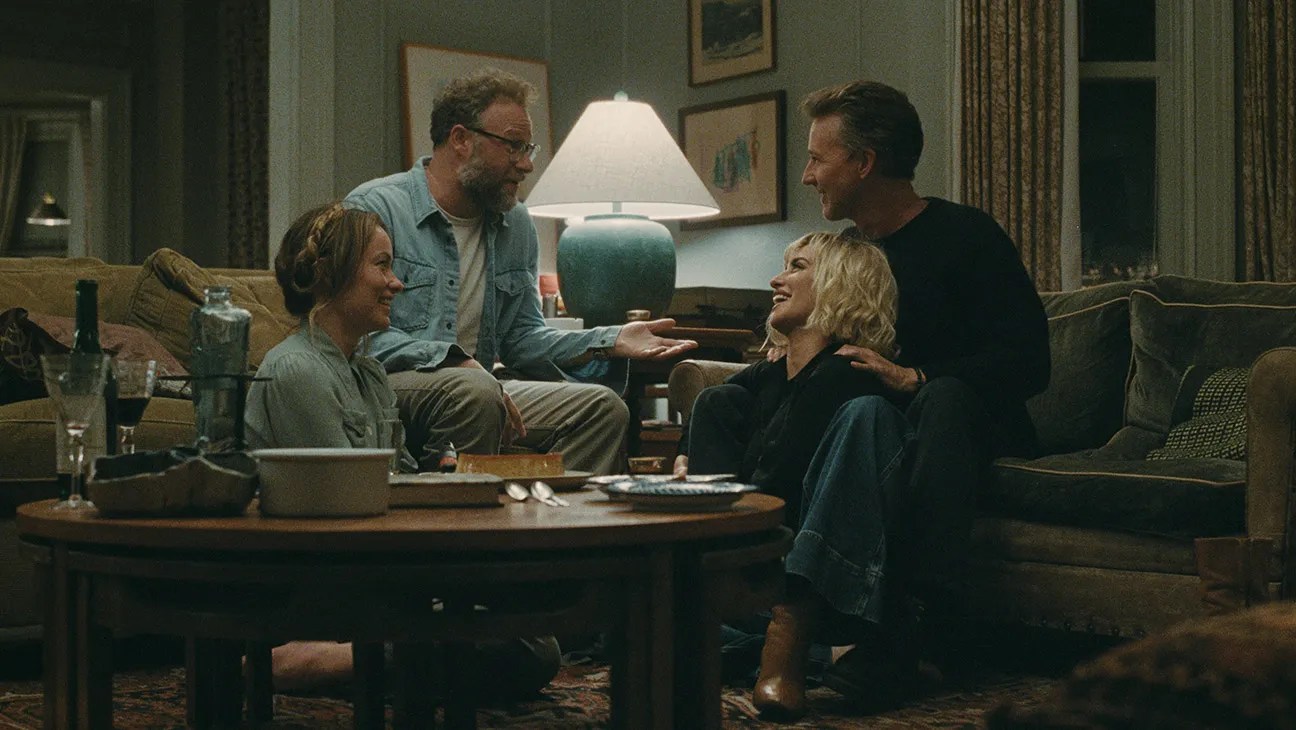

Questions of happiness and fulfillment take center stage in “The Invite,” a barbed comedy about a couple at a bitter crossroads in their marriage. Angela (Olivia Wilde) and Joe (Seth Rogen) are further challenged by their upstairs neighbors who, over the course of a single dinner, amplify every marital tension with passive-aggressive relish. Wilde, the actress who served notice as a filmmaker with the puckishly insightful “Booksmart” (2019), then faltered with the 2022 “Don’t Worry Darling,” gets back to her funny-not-funny roots with this adaptation of the 2020 Spanish film “The People Upstairs.”
The tart script by Will McCormack and Rashida Jones feels like it was written for the nuanced personalities of this cast. Seth Rogen centers the ensemble with his large and loud everyman, Joe, a failed musician who teaches music at a middling conservatory. Angela is a soul adrift. What defines them most as a couple — and holds them together — is their preteen daughter and their collective unease with their station in life. Bougie problems, to be sure, but palpable and real. They also haven’t had sex in nearly a year, and that’s why the dinner invite to the newish couple upstairs is such a loaded gambit. Joe wants to confront them about the raucous sex that keeps them up at night, while Angela admires the woman’s ability to have vigorous and vocal orgasms.
Our expectation of the couple is set by the hosts as they busily arrange mounds of cheese and charcuterie. Joe has failed in his assignment to pick up the wine, protesting that he didn’t know they were having company. The upstairs couple arrives, relaxed and cool. Smooth and boyish Hawk (Edward Norton), a retired firefighter, seems far too comfortable in his own skin. His partner, Piña (Penélope Cruz), is a sultry firebrand whose leading questions would sound impertinent coming from anyone else.
It doesn’t take long for Hawk and Piña to hone in on the simmering tension between Joe and Angela, and the pair probes and widens the rift. The four consume mood-altering quantities of tequila and marijuana to assuage these uncomfortable moments, and about halfway through, there’s a reveal that, like the disclosure in “The Drama,” goes beyond the critics’ spoiler code limit. We won’t do you a dirty, but it puts Joe and Angela in a no-turning-back position. Much of the conversation from there out examines the benefits of various sex toys and positions.
The film’s roots as a stage play are evident, and still, Wilde keeps the camera moving with purposefulness. For such a contained set, “The Invite” has an energy and seamlessness that feel innate and natural, but the main reason that the frisky, First-World, mid-life crisis has any teeth is its cast and the material’s edgy irreverence. Rogen and Wilde carry the onus of the film but also embody the deeper, more vulnerable characters. Cruz approaches perfection as Piña, leveraging her therapist trappings to wheedle and pry — without malice, but still eviscerating — while Norton’s Hawk is a hang-back strategist, assessing the situation before wading into the fray.
The film begins with a quote from Oscar Wilde: “One should always be in love. That is the reason one should never marry.” It portends much for both couples, but most pointedly for Joe and Angela. Wilde assumed her own last name as a homage to the playwright — who, if alive today, might take a modicum of glee in his namesake’s messy marriage drama and its ribald debauchery.


Leave a Reply