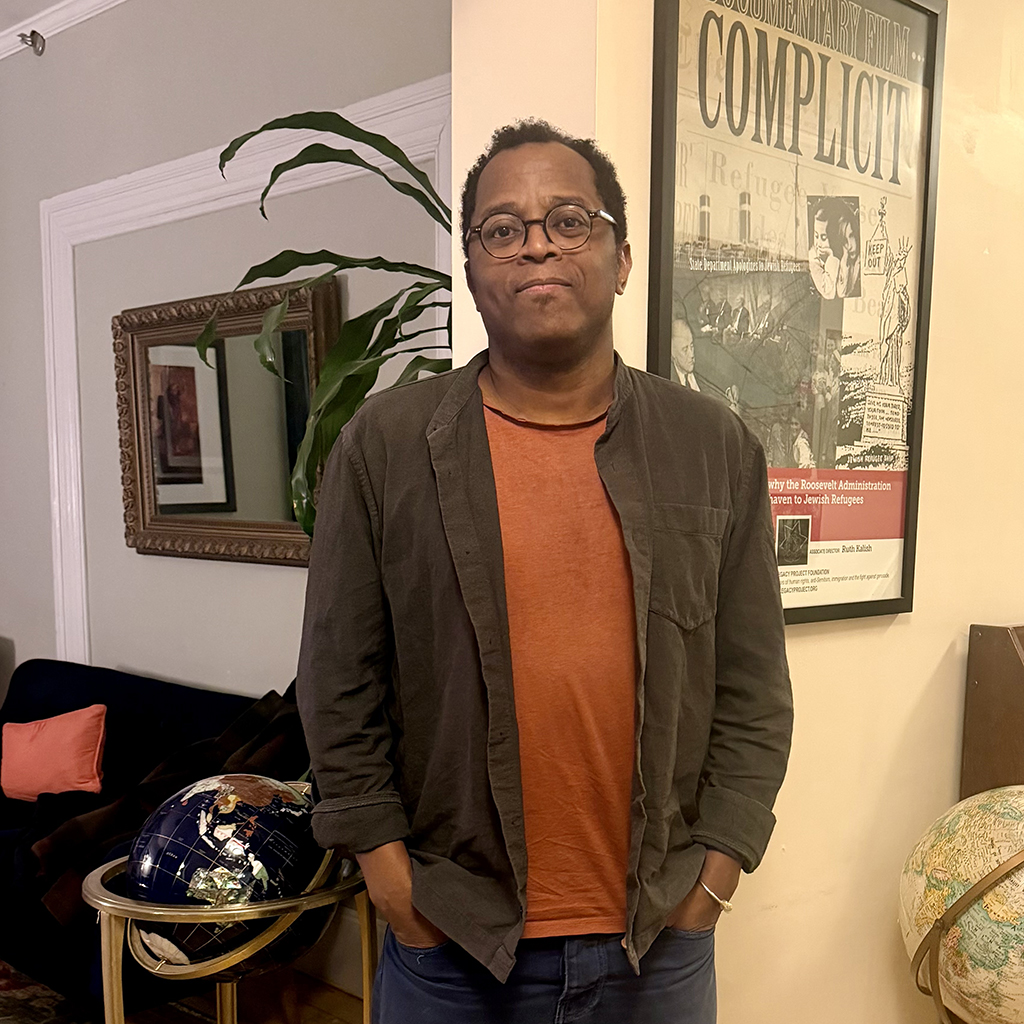
Alain Kassanda, Congolese French filmmaker
Alain Kassanda‘s documentaries take personal stories and make them confront and reframe history, exploring matters of identity, race and power.
Kassanda‘s films will show at Harvard University this weekend, part of his residency as this year’s McMillan-Stewart Fellow in Distinguished Filmmaking. The fellowship, jointly hosted by the Harvard Film Archive and Harvard’s Film Study Center, brings internationally recognized filmmakers to campus for screenings, classroom visits and public conversations. He spoke with Cambridge Day at the beginning of his residency.
His first feature, “Trouble Sleep,” (2020), showed Friday. His second film, “Colette and Justin” (2022), shows tonight at 7 p.m. at the Harvard Film Archive. His most recent, “Coconut Head Generation” (2023), will screen Monday.
The works together trace a line from European colonial rule in Central Africa to modern protest movements shaped by globalization and economic extraction. Though Kassanda’s scope spans Congo, France and Nigeria, his starting point is personal. Born in Kinshasa, at 11 he left the Democratic Republic of Congo for France. In Congo he felt he was seen as French and in France as Congolese — a duality that would become the emotional engine of his filmmaking.
As a longtime cinephile, Kassanda’s path to filmmaking began when he worked selecting movies to show at a small theater outside Paris. “I became a film programmer by accident — out of love for films,” he said. These were films being released in France. What struck him were how people of color were portrayed as stereotypes, “as a Black French man, I couldn’t see myself in French films. The stories I wanted to see simply were not being made.”
“Colette and Justin,” his first hour-plus film, was driven by the loss of his mother at 12 and his dual identity. He began interviewing his grandparents about their life in the Congo in the 1950s and 1960s. That became “Colette and Justin” (his grandparents’ first names). “Making the film began with acknowledging my own ignorance about my family and my country,” he said. “The film was also a way of learning who I am.”
Continue reading
 Bart Layton’s neo-noir crime drama has a killer cast draped in a B-movie sheen. The aloof antihero is Mike Davis (Chris Hemsworth), who executes precise jewelry heists. Mike knows every detail of the courier or shop he’s knocking over and every job is done within a mile of LA’s 101 freeway, hence the name, shared with Don Winslow’s novella from which the movie is adapted.


 Muse Films


 For What it's Worth