Murderous marathon for an American dystopia by Vietnam-era Stephen King
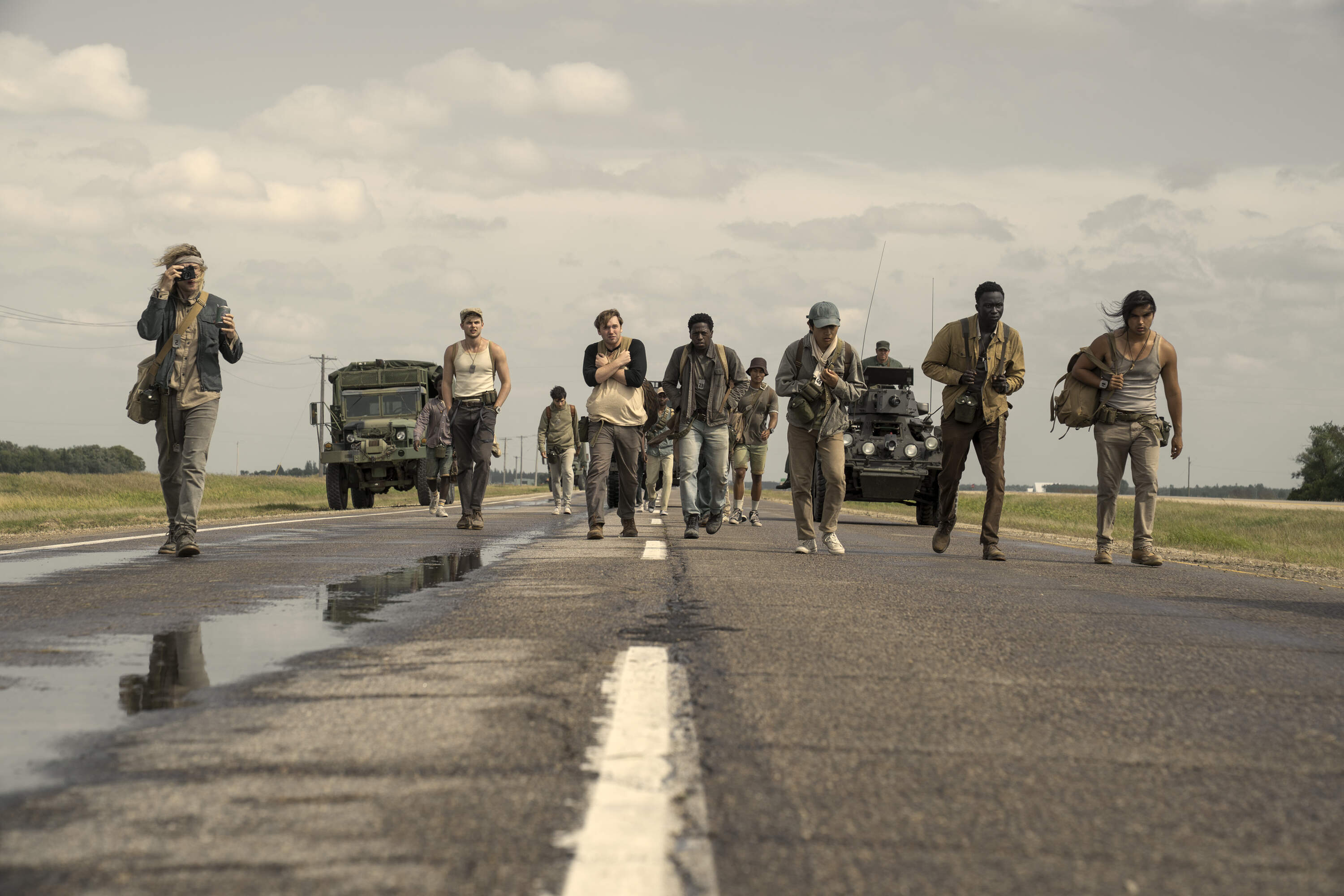

There’s little surprising or new in “The Long Walk” despite its pedigree, passion and professionalism. It’s still a compelling and emotionally charged tale primarily because of those three Ps – and the grim prospect of how much further we as a society can fall. It’s based on Stephen King’s first novel, written as a student while at the University of Maine but not published until 1979; even then it went under King’s pen name of Richard Bachman, like “The Running Man.”
In “Walk,” we get dropped into a dystopian America in the late 1960s or ’70s. It takes a while to register, but the unhappy alter reality has the distinct tang of “The Mist” or “The Stand”: The United States has just emerged from a war, but the country is not the portrait of Ozzie and Harriet productivity we’ve all been sold on. Much of what we see in our limited lens is the depressed and the needy. Most of the people we see along the long stroll could use a hot shower, a bowl of hot soup and some new threads.
Though you could see it as a post-World War II outcome that’s not ours, more “The Plot Against America” than “The Man in the High Castle,” the war in question is arguably an allegory for Vietnam, given when King wrote it. The “walk” of the title is a lottery process that happens each year with one young male participant selected to represent each state – a draft – and the disproportionate racial makeup fits with the face of who got sent and who got a pass during that unwanted war.
The contest crosses the desolate highways of Middle America with participants having to walk at the same cadence and at no slower than 3 mph. Need to pee or poop, be quick and be efficient – and you do see lads dropping trou midstride – because if you fall behind you get only three warnings to catch up. If you don’t, you catch a bullet in the head from one of the military personnel aboard the flanking jeeps and armored vehicles that shepherd the 50 along the desolate country highway. The whole spectacle is overseen by a fascist military rah-rah know as The Major (Jedi pupil turned master Mark Hamill).
What seems like an opportunity for a better life and young men bro-bonding quickly becomes a trail of fear and blood. It’s “The Hunger Games” or “Lord of the Flies” via pavement. As told in wispy bits – but never witnessed – the winner of the ordeal gets life-altering riches and is granted a wish upon becoming the last one standing.
There is intentionally no fanfare until mile 300, when there are five-ish marchers left. Much of the film is simply dwindling numbers of men marching – up hills, through the rain, day and night – and always talking, getting to know each other, with the occasional local flavor out on their front yards to observe and always soldiers just inches away, clutching their carbines.
Brains get blown out, there are moments that edge near rebellion and glimmers of backstory and the bigger America fill in the frame. (For anyone thinking they’re seeing the Midwest or near coastal South of Mississippi or Louisiana, the film was shot in Canada.) The themes of oppression, community sacrifice and rebellion are thin, but there.
Our two mains are Ray (Cooper Hoffman) and Peter (David Jonsson). Ray’s the local entry who gets dropped off by his mother (Judy Greer) as if it’s the first day of camp. Peter is a little less fleshed out, but there is that big, nasty scar across his face. Much is asked of Hoffman, taking on a more mature role than his impressive debut in “Licorice Pizza” (2021), and he’s more than adequate but used too much as a mooring post emotionally for the other lads and the film overall. It’s Jonsson, so good as the dad-joke cracking synth in “Alien: Romulus” (2024), who lights up the screen with deeply tamped-down anger and jocular, brotherly compassion for his fellow strollers under the gun.
The film’s directed by Francis Lawrence, who directed “Red Sparrow” (2018) and the bulk of the “Hunger Games” films, which means he worked with Hoffman’s father, Philip Seymour, in his final role (“The Hunger Games: Mockingjay – Part 2,” for which Lawrence had to rescript and use CGI to fill in); the script’s by JT Mollner, who knocked it out of the park last year with the cleverly twisty serial-killer thriller “Strange Darling.”
The film stumbles over conveniences of plot, or when one of the lads springs forward and erupts mentally or emotionally essentially without simmering or provocation – a pattern that repeats too often.
After seeing Hamill, so stiff and inert in “The Last Jedi” (2017), kick it up a notch this year in another King curio, “The Life of Chuck,” he again proves he wasn’t a one-hit wonder and ’70s footnote. Both performances are Oscar worthy and key to the films’ successes. Also good as part of the pack fodder are Roman Griffin Davis (“Jojo Rabbit”) as the wide-eyed innocent; Joshua Odjick as a seething lone wolf; and Ben Wang as the undersized jokester. It’s a solid ensemble that needed something more substantial to wade through.
 For What it's Worth
Leave a comment