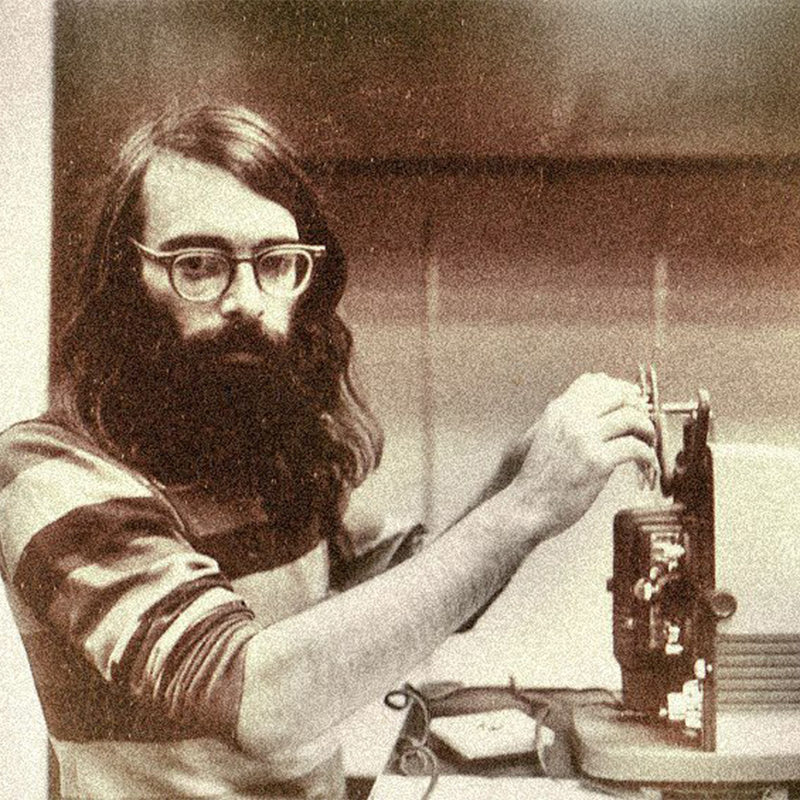
Filmmaker Saul Levine in 1968.
The Revolutions per Minute Festival hosts 10 works by Somerville experimental filmmaker Saul Levine at The Brattle Theatre on Sunday.
Not sure what experimental films are? If you’ve ever been to Boston’s Institute of Contemporary Art and seen trippy, surreal video installations, you’re on your way. Experimental or avant-garde film is usually deeply personal, often sociopolitical in context and reflective of the artist’s life in the moment.
Levine, born 1938, has been producing films for nearly 60 years; he was a professor in the Visual Arts Program at MassArt for 39 years.
Levine started his filmmaking career with “Salt of the Sea” (1965), featuring footage of his friends hopping from a boat to a buoy in the New Haven harbor. “I tried to make the jump with the camera,” Levine said, “and I fell into the water but held on to the camera.” The waterlogged footage, which Levine described as “abstract swirls of magenta and turquoise,” was turned into a four-minute short that ended with a clear shot of his friend perched upon the buoy.
If you watch Levine’s later works, such as his series “Driven (Boston After Dark)” (2002-present), in which Levine rides around in a car filming subjects and captures moments in time, or “Sun Drum Moon Note” (2018), which screens Sunday, you’ll notice shaky camera work. Part of that is Levine’s editing style, but adding to it are genetic neurological ticks – what Levine refers to as “tremors” – that he’s had since birth. As a result, Levine also speaks with a noticeable stammer.
Age and neurological affliction keeps Levine from getting behind the camera as much as he used to. Levine’s time at MassArt was also cut short, ending with his resignation in 2018. He said he felt “forced out” after school administrators accused him of harming students by showing his compiled film “Notes After a Long Silence” (1989), a collage that includes scenes of him having sex with his then partner. “It was ridiculous,” Levine said, as he’d screened “Notes” over several years without complaint and “the film was posted on the school’s website.” Levine gave passionate commentary on the situation in a video on Facebook, saying he felt “ambushed” by the school’s administration. The same year, fellow MassArt professor Nicholas Nixon, a Guggenheim fellow and photographer, came under scrutiny in a Boston Globe article for more severe, yet similar allegations of inappropriate academic behavior. The Globe mentioned Levine in conjunction with Nixon, who also resigned.
He remains an avid filmgoer. He recently married longtime partner Claribel Santiago. The pair met at the Harvard Film Archive, where Levine says he attends screenings almost daily.
At the time of our conversation, the latest film Levine and Santiago watched was Brady Corbet’s Golden Globe winner, “The Brutalist,” to which Levine (who is Jewish, but describes himself as a “secular atheist”) gave a mixed reaction. He was more enrapt by the film’s portrait of the working-class Jewish experience and identity post-World War II than with the dilemma of the artist’s existentialism, he said. He was a bigger fan of Sean Baker’s “Anora.” Baker, a filmmaker who made his first films on iPhones and has featured trans actors in “Tangerine” (2015), is something of an experimental filmmaker in his own right. “Anora” plays at The Brattle on Friday and Saturday, the two days before Levine’s retrospective.
Levine’s biggest influences as he came into the filmmaking scene were Kenneth Anger and Maya Deren, whose “Meshes in the Afternoon” is a dreamy and haunting film worthy of comparison to Chris Marker’s iconic “La Jetée.” Anger, who died in 2023, was influential in championing American avant-garde film and LGBTQ and alternative-lifestyle voices. Martin Scorsese has also credited Anger as an influence, and Anger’s “Scorpio Rising” (1963) has an echo in David Lynch’s “Blue Velvet” (1986) in its “Sandman” scene.
On a mission to lend voice to experimental filmmakers, the RPM Festival is a local organization that focuses on alternative filmmaking and screens works at The Brattle monthly as well as running programs at venues around the country. Its annual film fest typically holds events at The Brattle, the Museum of Fine Arts, Boston, and Goethe-Institut Boston to show contemporary films selected by a committee through a submission process. Programs such as the one featuring Levine are curated on body of work and merit.
Levine will attend Sunday and be in conversation with RPM Festival curator and film programer Brett Melican.
 For What it's Worth
Leave a comment