Archive | September, 2024

Critical Mass comes to Cambridge to remember three riders who died after being hit by vehicles

29 Sep

Bicyclists ride a Cambridge rotary Friday to honor three victims of fatal crashes.

More than 700 bicyclists came Friday to ride three times around the Cambridge rotary where Memorial Drive intersects with the Boston University Bridge – once for each of the riders who have died on Cambridge Streets over the past four months: Minh-Thi Nguyen and Kim Staley, who were struck and killed in June, and John Corcoran, who was killed Monday on a sidewalk by the nearby DeWolfe Boathouse.

The rush-hour protest was put on by the Boston chapter of Critical Mass, an organization with branches in several hundred cities worldwide that hold group rides to promote street safety and advocate for better cycling infrastructure.

Riders met at the Boston Public Library for a brief rally before heading to the bridge near the boathouse where Corcoran was struck. The ride continued down Memorial Drive before heading back into Boston across the Harvard Bridge, ending at Boston Common. The ride was well organized, with ride marshals giving commands to stop or mass up to obey the rules of the road or to let cars out caught in the throng of riders.

Critical Mass had gone dormant in the area for nearly eight years because many members felt there was a confrontational aspect growing among the ridership. Citywide group rides morphed into the Boston Bike Party, which had a more festive and less activist evening events; Critical Mass rides targeted rush hours on the fourth Friday of every month.

Bicyclists gather in Boston on Friday before riding into Cambridge for a memorial. (Photo: Tom Meek)

The dedication of Corcoran’s ghost bike was held Saturday at the BU boathouse. In attendance were Corcoran’s family and friends and about 100 cyclists and other community members.

Ghost bikes mark where cyclists have died; a bike painted white is chained at the site permanently. “We have placed too many of these,” MassBike director and volunteer ghost bike committee organizer Galen Mook said at the ceremony.

The service was co-led by the Revs. James Weldon, Corcoran’s minister at the Parish of the Good Shepherd in Newton, and Laura Everett, a bike advocate and part of the ghost bike committee. Weldon biked to the ceremony and was clad for it. The bike was donated by Bikes Not Bombs in Boston’s Jamaica Plain neighborhood and painted by committee member Peter Cheung. The ceremony focused on community and grief for Corcoran, an investment manager who was remembered as a kind and giving spirit with strong ties to Harvard University, where his son and daughter – who were in attendance – are a senior and a junior.
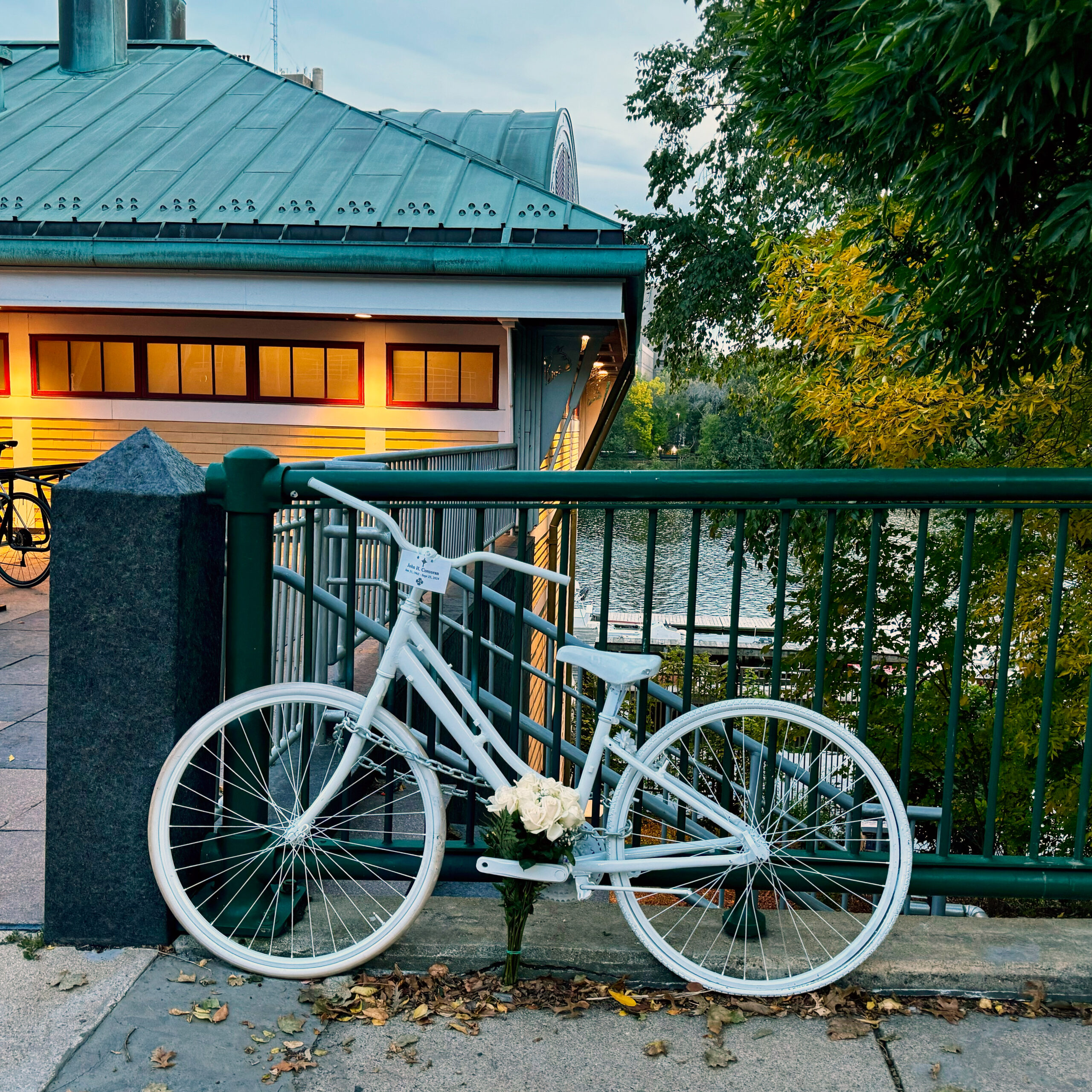
The ghost bike placed Saturday in honor of John Corcoran.

There was a time for advocacy and a push for change, but that was not the purpose Saturday, Mook said in remarks to the crowd. They were hard to discern as cars on Memorial Drive zipped by fast enough to make attendees on the sidewalk uncomfortable.

“We’ve been begging the DCR for seven years to make changes to this road, and we’ve been continually ghosted,” said Jamie Katz-Christy, head of the Green Streets Initiative and a member of the Cambridge Bicycle Safety Group and Memorial Drive Alliance. She referred to the state Department of Conservation and Recreation, which oversees the road.

A department spokesperson told The Boston Globe on Wednesday that work was underway “to introduce additional bike lanes to this area of Memorial Drive to improve safety for both cyclists and pedestrians.” (Mook countered that “They’ve known this is a problem” for years.)

The penultimate part of the ceremony was a “litany of grief and gratitude” before the family came forward to dedicate the ghost bike amid a chant of “from a place of death to a place of life.”
Short Takes: “Rebel Ridge” and “The Union”

22 Sep

‘Rebel Ridge’ (2024)

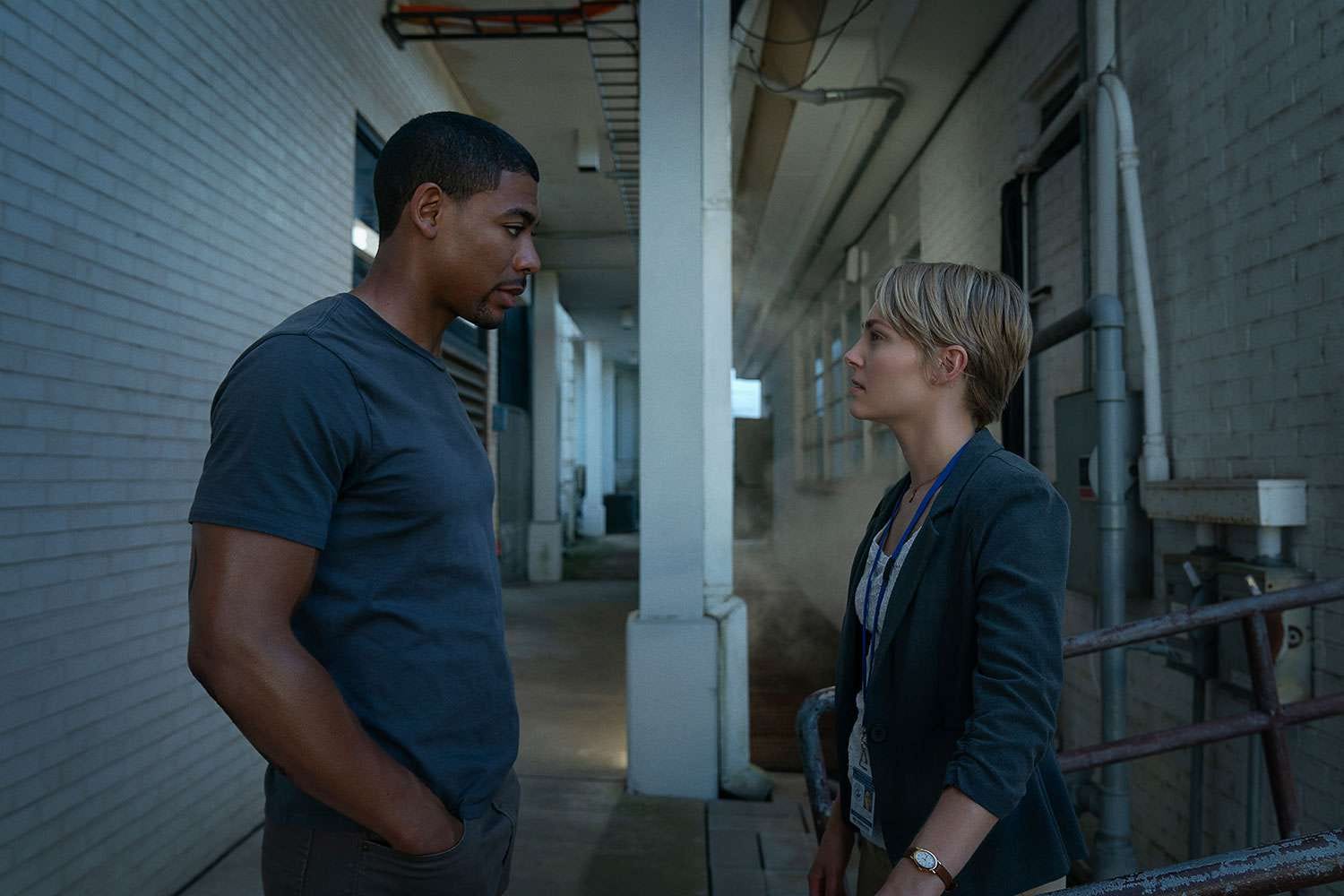
The latest slow burn from Jeremy Saulnier, the deft hand behind the acclaimed “Blue Ruin” (2013) and “The Green Room” (2015), has the feel of a “Jack Reacher” or “Rambo” film, with a drifter on the wrong side of the law serving up some social justice. The setup is simple, but working out the problem is not. We open with a well-toned young man riding a bicycle through small-town Louisiana. He’s not your typical Lycra warrior – quite the opposite, he pedals with a sense of urgency that goes beyond logging miles; he’s on a mission. The bicyclist, Terry Richmond (Aaron Pierre), has $36,000 in an overstuffed backpack, $10,000 of which is to bail out his cousin who’s in on a minor possession charge. Out of nowhere, a cop car taps his bike and throws him. The resolute and hulking Terry, like Rambo and Reacher, is former military, while the cop standing over him looks like a menacing version of Richard Jewell as portrayed by Paul Walter Hauser in the 2019 film by Clint Eastwood. (Nearly every cop in the corrupt town of Shelby Springs seems to have the same stylist and barber save the chief, played by a game Don Johnson, and the lone woman on the force who’s mostly behind a keyboard.) Johnson’s head honcho takes the money on some pseudo-legal technicality, and it turns out these kinds of shakedowns are a regular thing in Shelby Springs with nearly everyone, even the judge (James Cromwell), in on the scheme. Terry is not leaving town without the money or his cousin, though, and the depths of local misdeeds are further exposed when Terry gets a reluctant hand from court paralegal Summer McBride (AnnaSophia Robb, “Soul Surfer”). Nothing is made about race outwardly in “Rebel Ridge,” but it’s there; in one scene, when pulled over, Terry asks the officer, “Are my hands in the right place?” Pierre (“Foe,” “Old”) does much with his emotive eyes and carries the film with a brimming rage that is tamped down constantly in favor of the more strategic move. There are many fine and realistic action sequences, but the film is as much a chess match of legal gamesmanship – yet when Terry acts, it is with the brutal, surgical precision of a martial arts expert trained in disarming and disabling. As the single mom with everything to lose, Robb is a standout, though Johnson and the rest playing the corrupt cops – and a few not so corrupt – are nuanced and polished in their supporting parts. It’s a well-executed thriller that lands somewhere between “And Justice for All” (1979) and “First Blood” (1982). This is the action film to put in your queue.


‘The Union’ (2024)

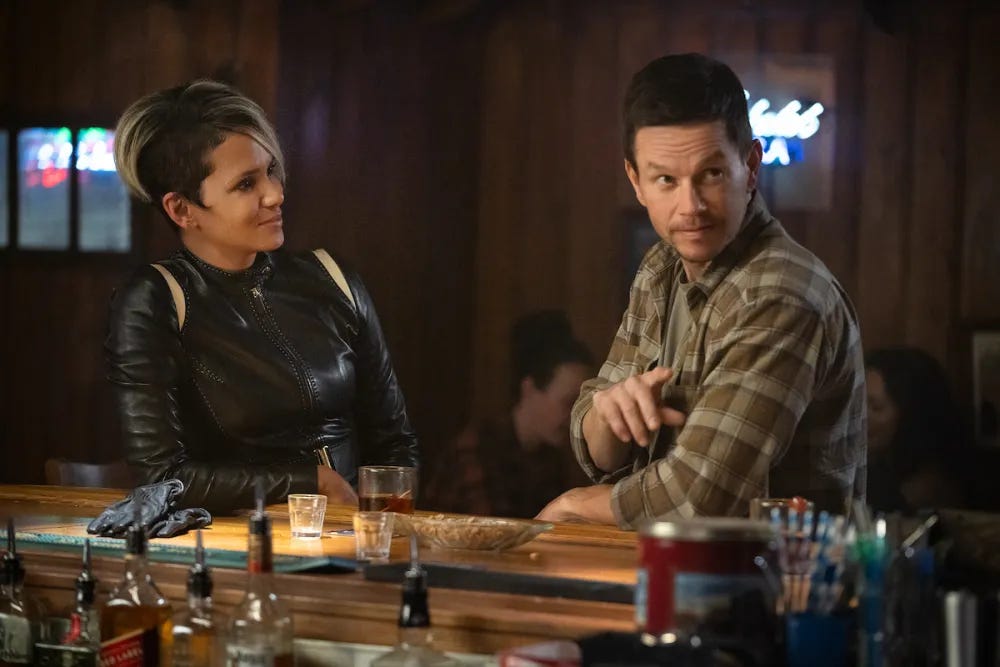
With a star-studded cast featuring Oscar winners Halle Berry (“Monster’s Ball”) and J.K. Simmons (“Whiplash”), the reliable box office draw of Mark Wahlberg and a world-hopping budget, on paper “The Union” has all the ingredients for a mission win. Yet, like other recent Netflix-produced actioners( “Spenser Confidential,” “The Gray Man” and “Red Notice”), it falters in execution. Our can-do heroine Roxanne Hall (Berry) works for The Union, a CIA-like organization – think of it like the IMF in the Tom Cruise “Mission: Impossible” films. The opener has Roxanne, looking like Irma Vep as she darts through the alleyways of Trieste, Italy, arriving at the critical checkpoint too late, losing the assigned package and her entire team. To get that package – a hard drive bearing a coveted secret – the mission requires an “ordinary Joe” to go to “the auction.” Roxanne suggests her high school ex, Mike McKenna (Wahlberg), who still lives with his mom in Bruce Springsteen-worshipping New Jersey and hooks up with his seventh-grade math teacher (a very wry Dana Delany, who scores one of the film’s high points). Roxanne’s higher-up (Simmons) isn’t too keen on the idea, and gets even less so after Mike loses $4 million on his first foray. Directed by Julian Farino, “The Union” boasts a smattering of fine shootouts and car chases through the streets of London, but the rest is generic MacGuffin spy mash with a lazy ladling of rom-com. The leads have chemistry but are hobbled by the thin construct and mushy dialogue that often unnecessarily explains deets about “the Union” and “the auction.” If you do make it to the end, stick around for the credits, when pics of Roxanne and Mike from high school roll. Someone had a good time digging up teenage snaps of Berry and Wahlberg and fusing them. Besides Delany and a neat “Good Will Hunting” zinger, it’s one of the rare, well-earned grins in the film.

My Speedo!

21 Sep

A short story about grief and cat-nappers recently published in the Fall Edition of Word Disorder.


         The text came in at 12:22 in the morning. “I have ur cat. The $$ is now $200.”

         Miriam had been unable to sleep that evening, it had been three days since Speedo scampered out the door of their third-floor walk-up and hadn’t returned. It wasn’t the first time the black cat with a white blaze across its face and one white paw went on a “walkabout” as Miriam and Charles affectionately called it. The first time he disappeared Miriam was riddled with angst and emailed the neighborhood listserv at 4:30 in the morning, “Our cat Speedo has gone missing. Have you seen him? We are worried sick. If you see him, please call.” She included her cellphone number and attached her favorite picture of the pet, which was the embodiment of kitty cuteness, though the creature’s piercing green eyes probed the viewer as if the cat knew the beholder’s deepest, darkest secret. Later that day, the McFadden’s son, home from college on a laundry run, found Speedo batting around a balled-up paper bag in the basement. To thank the boy, Miriam and Charles invited the young McFadden up for a brunch of vegetarian black bean chili crowned with poached eggs and hollandaise along with Miriam’s personal pride, home cured lox on bagel crisps with whipped cream cheese and chive. As Miriam arduously whisked the thick yellow sauce, the scene of Charles assembling a bagel as he listened to the boy talk excitedly about his future plans—something outdoors, urban planning, land conservation or maybe renewables—tweaked memories of the weekends that Leah would come home from veterinary school for comfort food and quiet. She laughed inwardly for a second because Charles always overloaded his bagel with a triple spread and a double heaping of onions with capers rolling off a teetering crown of sprouts, and then there was the two layers of her meaty, thick lox, and as usual, a good portion of it ended up in his bushy beard. She was about to do a subtle chin point behind the boy’s back but paused in mid motion as a hot tear welled up and made its way down her cheek and into the hollandaise.

         More overnight “Where’s Speedo?” disappearances happened, but the cat always returned the next day for his mid-morning feeding, and seemed to be eerily cognizant that Wednesday, Friday and Sunday, were sardine days as he’d always be there waiting in the kitchen for Miriam, excitedly purring and crashing into her legs, nearly tripping her as she tried to fork a pungent headless filet into the cat’s bowl. As Speedo escape days became more and more, the mode of which, the stealthily trailing of a pant leg of an unwary resident, delivery person or anyone else operating the heavy wooden door that closed with creaking, achey slowness, Miriam and Charles began to fret less, often sharing a glass of crisp kosher white wine and laughing about, “Speedo being Speedo.” “He’s out saving the world,” Charles said one night as he sipped wine and noshed on crackers crowned with a diced mixture of Miriam’s lox, capers and pickles. To Miriam’s non-reaction he reiterated, “I’m serious, I think he morphs into a giant crime-fighting kitty.”

         Miriam took a long sip of wine, savored the buttery oak sweetness for a contemplative beat, and then nodded in reluctant agreement.

         “See?” Charles said, perching forward in his chair, “I’m telling you, it’s a thing. What do you think his superpower is?”

         Again, Miriam regarded the question with pause and said, “Laser beam eyes and saber claws, or maybe, he can command other cats as allies like the rat girl in ‘The Suicide Squad’?”

         “A giant starfish and Jim Ignatowski with Christmas tree lights popping out of his head? That movie was utter poop!” Charles bellowed. “Superhero films are ruining cinema.”

         “So says the grown-up man who collects kewpie dolls.”

         “They are trolls! Trolls are not ruining film!”

         ***

Continue reading

The Substance

21 Sep

Demi Moore’s cure for aging goes beyond spine tingling into spine-rending

As far as gonzo art-house horror goes, “The Substance,” certain to make a stir as it drops into theaters this week, is an ineffable, WTF spectacle that’ll cement Coralie Fargeat as one of the rising new wave of auteurs of the outré. Her ghoulish company includes the likes of Julia Ducournau (“Titaine”), Ari Aster (“Midsommer”) and Brandon Cronenberg (“Infinity Pool”) among others – a youth movement taking the reins from Brandon’s dear dad David (“Rabid,” “Crimes of the Future”) and the other David of nightmarish bad trips, David Lynch.

The inspired casting of Demi Moore and Margaret Qualley as the same ego/persona is nothing short of a lightning strike. Moore plays aging fitness queen Elisabeth Sparkle, who at one point was an Oscar darling (Jane Fonda, anyone?). When we meet Elisabeth taping a segment of her TV show “Sparkle Your Life with Elisabeth,” we learn she’s 50ish, though looks 15 years younger; the real shocker is that Moore in real life is 10 years older than Ms. Sparkle. The producer of the show, a snaky ball of smarmy insincerity with the moniker of just Harvey (played with infectious hambone glee by Dennis Quaid, who can now let go of his recent “Reagan” biopic flop) wants a younger, more nubile centerpiece that will light up the stage, appeal to the younger generation and titillate the studio’s white-haired board.

Given all that (the name, the old-boy network), the #MeToo allusions are hard to ignore, but “The Substance” is a lot closer to “All About Eve” (1950) by way of the “Elephant Man” (1980) and “Carrie” (1976) than the criminal fall of the swaggering dick who built Miramax. Elisabeth, distraught at the realization her days are numbered, gets into a violent car accident that lands her in the hospital. The attending assistant, a taut-faced young man with piercing eyes, does a gentle, yet firm probing of the spine and mutteringly remarks that  Elizabeth would make a “good candidate.” Though he retracts the statement and sends Elisabeth on her way, Elisabeth later finds in her coat pocket a drive with the label “The Substance” printed on it in big bold letters. What’s on the drive isn’t too far off from Cronenberg’s “Videodrome” (1983) – both films about the evils of big media and the prospect of rebirth (the “new flesh”) that come with consequence. The long and short is that Elisabeth can attain “a newer, better” her by taking a series of injections. The catch is that you have to reverse the process every seven days. Without exception. Or else.

The trashy alleyway locker where Elisabeth gets her renewal kit feel weirdly familiar; wafts of the dumpster scene in Lynch’s “Mulholland Drive” (2001) drift subtly through your mind, and the strange process of getting into the brain of John Malkovich in “Being John Malkovich” (1999). Fargeat holds the fringe masters in high regard and layers in clear references to De Palma (the aforementioned “Carrie”) and Kubrick, whose “The Shining” (1980) gets multiple references. To a lesser degree but perhaps with greater stylistic impact, “2001: A Space Odyssey” (1968) does as well. Some references go over the top and feel forced, but some are apt and effective homages. For cinephiles the film is a gleeful Easter egg hunt.

Much of the transformation process takes place in a cavernous white-tiled bathroom of Elisabeth’s upscale high-rise (akin to the serene purgatory in which Dave winds up at the end of “2001”) – and always in the buff.  The first injection triggers an immediate seizure that leaves Elisabeth on the ground writhing and convulsing. Just like a scene out of an “Alien” flick, her spine splits open and a slimy, porcelain other slithers out. That other, simply known as Sue (Qualley), following the renewal kit instructions, stitches up Elisabeth’s back and heads down to the studio to audition to be Elisabeth’s replacement, leaving the comatose husk on the bathroom floor hooked up to an IV or the like for sustenance.

Continue reading

Short Takes: “See No Evil,” “Slingshot” and more

15 Sep

‘His Three Daughters’ (2023)

In the latest from Azazel Jacobs (“French Exit”) grief and sisterly differences are wrestled with as familial tensions crest, crash, subside and flow. We open in a small, spare Brooklyn apartment (black pleather couches, an Ikea-esque dining set and no carpeting) as estranged sisters Katie (Carrie Coon), Christina (Elizabeth Olsen) and Rachel (Natasha Lyonne) try to work out the logistics of their terminally ill father’s final hospice cycle. Katie, the oldest, is a bit of a control freak, as evidenced by her telephone disagreements with her husband and teenage daughter back home in California. Christina’s the idealistic free spirit trying to hold the situation together while figuring out the next chapter in her life, and Rachel is the one who’s been living with dad and taking care of him while slacking around the apartment and smoking weed. In short, three very different personalities that, given the heightened emotional state, clash more than not. The three leads deliver genuine, deeply felt performances that ripple with rage, regret and vulnerability. In scope and tenor, “His Three Daughters” is not far off from Florian Zeller’s quietly compelling “The Father” (2020), including a shift in reality that brings home the palpable final punch. The are times the film – which one could imagine as an intimate, in-the-round stage play – gets a bit too cyclical, but usually the dutiful hospice worker named Angel (Rudy Galvan) steps in to update the trio on the changing reality. He’s regarded as both valued family ally and annoying interloper. You never really see or hear the father other than as the sound of a respirator and beeps from a heart monitor reverberating from the back room while the three women in the tiny living room try to make sense of their past, present and future as a family.


‘Merchant Ivory’ (2024)

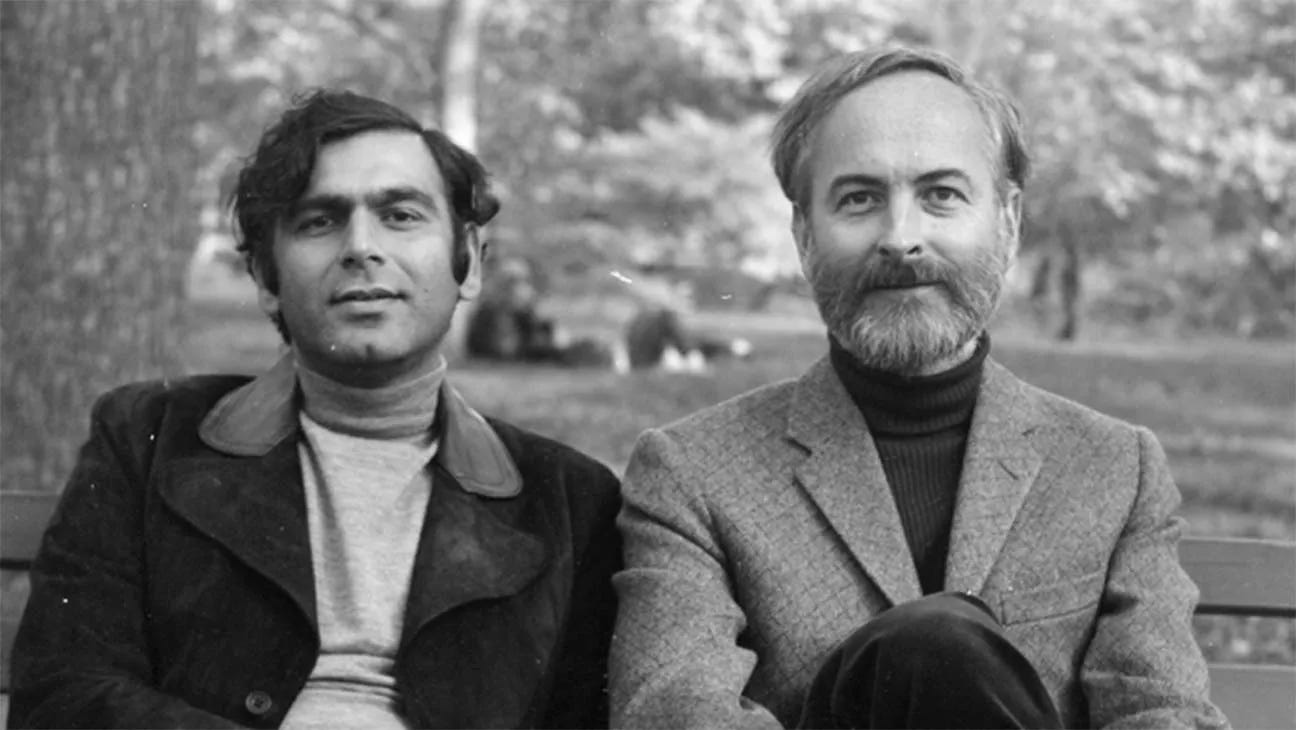
Stephen Soucy’s hagiography of the legendary filmmaking tandem that produced such critically acclaimed period dramas as “Howard’s End” (1985), “A Room with a View” (1992) and “Remains of the Day” (1993) puts their output into historical and cultural context and pulls back the veil on the challenges the two faced as a gay couple during less accepting times. Their films were the backbone of art house cinema in the ’80s and ’90s and beyond, until producer Ismail Merchant’s untimely death in 2005. Director James Ivory is still with us and spry in his mid-90s as he offers candid insight into production challenges and his dynamic with Merchant, the high-energy producer always looking to cut costs (you’d be shocked at how little some of these classics were made for) and shill projects to potential investors versus Ivory’s more somber, quiet approach. Soucy gives you the full rewind from Ivory being an adoptee (Ivory notes that the Paul Newman post-Depression, Great War film “Mr. & Mrs. Bridge” felt reflective of his childhood) to Merchant’s upbringing as a Muslim in Northern India, as well as a look into the rest of a production company “family” that included screenwriter Ruth Prawer Jhabvala, a German-born Jew reared in England (due to a guy named Hitler), and composer Richard Robbins, educated at the New England Conservatory. It was Jhabvala’s prize-winning book “Heat and Dust” that drew interest from Merchant and Ivory; when they chose to adapt, they educed a career shift for Jhabvala, collaborating on 16 films and winning Oscars for “Howard’s End” and “A Room with a View.” Troupe regulars Emma Thompson, Vanessa Redgrave and Helena Bonham Carter are on hand to chime in, as are Hugh Grant, James Wilby and Rupert Graves, who starred together in “Maurice” (1987), a film Soucy and Ivory home in on specifically – not only because of its examination of a closeted gay couple during a time when being gay was a crime in Britain, but because of its powerful context at the time of its release when the AIDs crisis and Act Up were beginning to boil over. The access Soucy earns and Ivory’s frankness create an intimate portrait, including the willingness to concede that some of the team’s later films (“Jefferson in Paris” and “A Soldier’s Daughter Never Cries” among them), while well funded, never registered the kind of critical success as the earlier films. Ivory’s only Oscar came as a writer in 2018 on “Call Me By Your Name.” Breathing in Soucy’s intoxicating love letter, you wish you could go back in time and be part of the Merchant-Ivory “family.” You will also want to go back and rewatch their classics, and perhaps even revisit some of those so-called miscues.

Continue reading

Beetlejuice Beetlejuice

8 Sep

Burton’s classic comedy and cast deserved new life, and here are the Deetz

It’s been more than 35 years since we heard Harry Belafonte belting out the “Banana Boat” song (day-o!) as Winona Ryder’s dour teen danced on air in the original “Beetlejuice.” The 1988 film, now followed by “Beetlejuice Beetlejuice,” cemented Tim Burton as a quirky voice to be reckoned with. Sure, he made “Pee-wee’s Big Adventure” three years earlier, but “Beetlejuice” was the game changer that would give Burton the keys to the castle to make future passion projects “Edward Scissorhands” (1990) and “Ed Wood” (1994) and of course, the crown jewel, the original big-screen “Batman” (1989), bursting box-office records and making Burton look like a man who could do no cinematic wrong. (The Ill-conceived “Planet of the Apes” reboot would drop inertly nearly a decade later, and there was “Mars Attacks!”). 

Plus there was Michael Keaton, a guy who started out as a minor cast member on “Mister Rogers’ Neighborhood,” dropped into comedy series such as the envelope-pushing “Maude” and even had a short-lived slapstick endeavor called “Working Stiffs” opposite John Belushi in 1979. He bit into the gonzo, undead title role with such effusive vim and vigor that the performance and the film became instant classics, more than just a little left of center. I don’t think we realized it then, but we were getting a glimmer of one of the most under-the-radar talented actors of our time. The gear shift from comedic to stoic (“Beetlejuice” to “Batman”) showed a range that would morph and reform seamlessly over the years, be it the crime classics “Jackie Brown” (1997) and “Out of Sight” (1998), in which Keaton played the same Elmore Lenard-penned FBI agent for auteurs Tarantino and Soderbergh, or his Academy Award-nominated turn in “Birdman” (2014) for director Alejandro G. Iñárritu, who won Best Director for his work with Keaton. In short, Keaton’s a director’s go-to third-down-back, a thespian safety valve who rarely errs. He’s done Bostonian as Globe editor Robby Robinson in “Spotlight” (2015), the Oscar winner about unearthing one of the city’s dark chapters. He’s even taken a few turns as a filmmaker, most recently the crime thriller “Knox Goes Away.” Did I mention his body of work isn’t well enough appreciated?

But enough with the accolades (all due and deserved) and history. Is “Beetlejuice Beetlejuice” any good? It’s packed with nostalgia and some smart script rewirings. Ryder’s goth girl who could (and still can) see the dead, Lydia Deetz, is now a grown-up single mom who rakes in the big bucks with a paranormal TV show called “Ghost House.” Her daughter Astrid (Jenny Ortega, who rocks Burton’s Netflix Addams Family spinoff series, “Wednesday”) is off at a New England prep school and think mom’s a hoax. Catherine O’Hara’s back as Lydia’s stepmom, Delia, and still parading around with a vibrant shock of red hair. But her garish art has become a thing – a big thing, bringing in Banksy and Picasso dinero. 

Though life is relatively good for the Deetz women financially, Astrid’s father perished in a boating mishap while on a climate justice mission in Brazil and Lydia’s father, Charles, is also gone. Understandable: Actor Jeffrey Jones was convicted in 2003 for soliciting a minor to pose for lewd photos and is a registered sex offender. The film sidesteps the matter with a neat animation sequence and a shark.

His death is the reason for all to return to Winter River, Connecticut (shot in East Corinth, Vermont), where his funeral is to be held at his beloved country estate. In tow is Lydia’s TV producer and nasally love interest (Justin Theroux, replete with a cheesy short ponytail) hoping for the opportunity to spin the sojourn into a matrimony prospect as well. But it’s Astrid who sparks romantic tinder first, as she agrees to a Halloween-night date with a reclusive local boy (Arthur Conti of “House of the Dragon”). Without giving away too much, the date turns into the reason Beetlejuice is invoked and even mortals end up in the neon-green lit, checker-tiled, Dr. Caligari underworld – or its limbo waiting room, anyhow. 

Continue reading