Archive | April, 2024

Film Clips

27 Apr

Of Beavers and Boys, reviewed: ‘Hundreds of Beavers’ and ‘Boy Kills World’

Cult camp is an odd genre bucket that collects a vast variety of films dumped there for varying reasons. Some (“El Topo,” “Barbarella” and even the recently released “Sasquatch Sunset”) end up there by design; others (“Showgirls,” “Mommy Dearest”) wind up there because they’re unintended, rubbernecking-worthy spectacles. Two films from this week’s roundup land there with mixed results: “Hundreds of Beavers,” which had a held-over-by-popular-demand extended run at the Somerville Theatre this year and is now available on streaming platforms, and “Boy Kills World,” which played as part of the Boston Underground Film Festival at The Brattle Theatre and opens at Apple Cinemas Fresh Pond on Friday. Two different films with distinctly different outcomes.

‘Hundreds of Beavers’ (2022)

“Beavers,” co-written by director Mike Cheslik and star Ryland Brickson Cole Tews, shoots for something new and markedly left of center. What the pair has concocted is slapstick, silent-era comedy mixed with loopy Looney Tunes animation and modern-day special effects. Made for a mere $150,000, the film has a premise that feels affectionately borrowed from Chaplin or Keaton: A 19th-century applejack seller named Jean Kayak (Tews), perpetually hopped up on his own hooch, gets into a skirmish with an army of beavers in the frozen wilds of the northern Midwest – think “Jeremiah Johnson” (1972) by way of “The Gold Rush” (1925). The beavers aren’t cute CGI creations, but dudes in suits with ginormous buckteeth. There’s something to do with a fur trader (Doug Mancheski) and his winsome daughter (Olivia Graves) whom Jean fancies, but it’s mostly Jean versus the bevy of beavers with cartoonish boinks and bams and some fairly taxing physical comedy performed by Tews as he hops from one log to another in a sawmill and slip-slides his way across the ice as a legion of angry beavers chases after him. No dialogue is spoken, and it’s shot in black and white. The experience (did I mention the daughter is pretty good at disemboweling beavers with a knife?) gets a bit repetitious, but Cheslik and Tews, all in on the hijinks, save some zaniness for the last go-round.

whitespace

‘Boy Kills World’ (2023)

“Boy Kills World” jumps out of the gate with promise; in the near dystopian future the aristocracy keep the masses in check with an annual lottery/purge called the “Culling.” What the film is, however, is a fairly pat, years-in-waiting revenge drama centered on a warrior known just as Boy (Bill Skarsgård, “Barbarian”) under the tutelage of a sensei (Yayan Ruhian, from the “Raid” films and “John Wick: Chapter 3 – Parabellum”) to beef up and exact revenge on Hilda Van Der Koy (Famke Janssen), the elitist who sanctioned the execution of his parents when he was an adolescent. The gimmick is that Boy can’t talk, yet the whole movie is narrated by him in voiceover. That’s done by H. Jon Benjamin (the voice of “Archer”), who makes Boy sound something like a cross between the gruff growl of Christian Bale’s caped crusader in Christopher Nolan’s “Batman” trilogy with the wily witticisms of Bruce Campbell in any of the Sam Raimi “Evil Dead” flicks. That is somewhat fitting, as Raimi serves as executive producer here, and though directed by Moritz Mohr, “Boy Kills World” has plenty of Raimi influences. The plot of rebel forces fighting an aristocratic tyranny means comparisons to films such as “V for Vendetta” (2005) are sure to drop, but the lesser, forgotten 1992 Mick Jagger vehicle “Freejack” is the more apt comparison, as the fun of watching Skarsgård the avenger’s parkour-propelled takedown of legions of baddies ultimately palls. Skarsgård, almost as jacked as older bro Alexander was in “The Northman” (2022), makes for an impressive onscreen presence, as does Jessica Rothe as the skilled assassin known as June27 equipped with a neat combat helmet that’s a cerebral message board of sorts. It’s too bad the narrative arc they ride isn’t as sleek and mean
Businesses can bring in the bicycling crowd, one $5 lifetime helmet sticker at a time

27 Apr

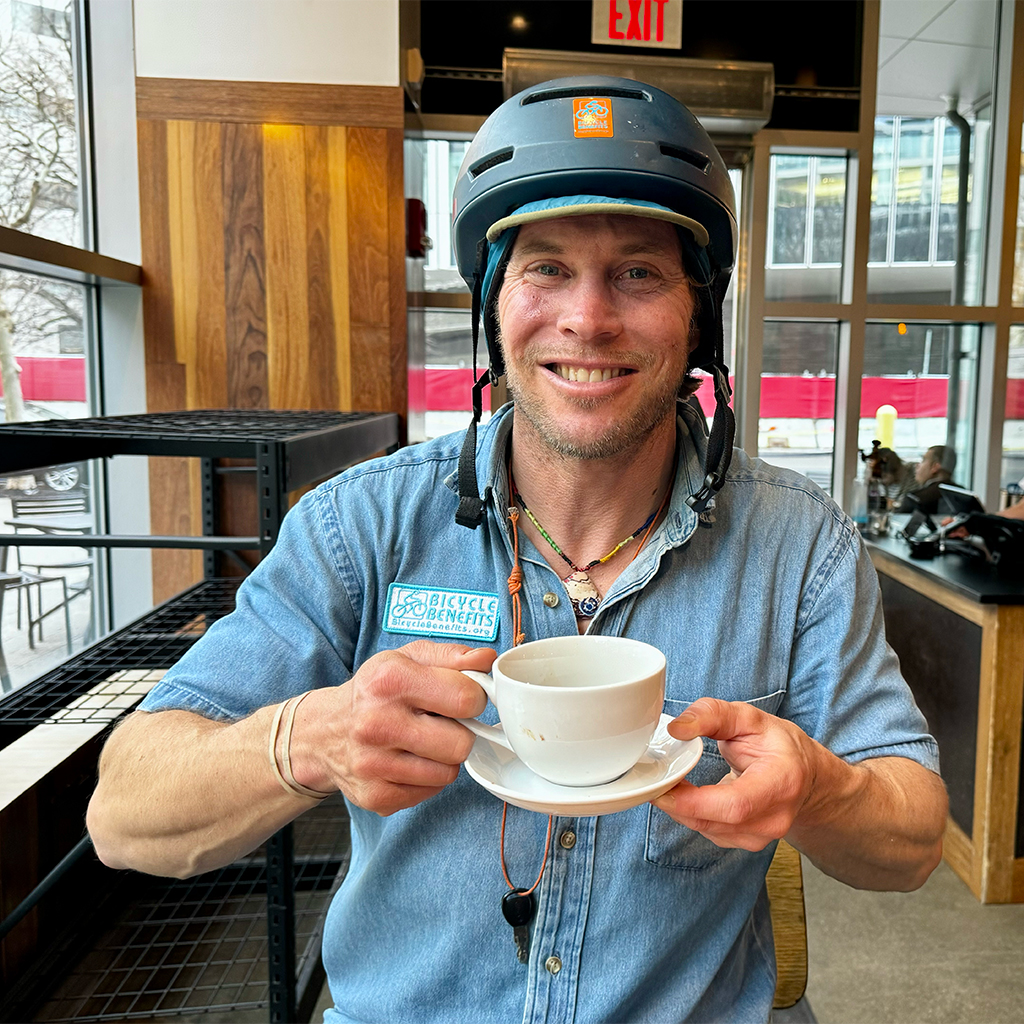
Bicycle Benefits founder Ian Klepetar takes advantage of a discount at Cambridge’s Area Four eatery unlocked with the sticker on his helmet.

Remember those $5 Bicycle Benefits stickers? They gave you deals such as 5 percent off at Petsi Pies if you showed a bike helmet at the cash register with the right sticker affixed to it.

They’re still around (so is Petsi Pies, now under new ownership and crushing it on Beacon Street in Somerville) but undergoing a relaunch of sorts in preparation for Bike Month in May.

Bicycle Benefits launched in 2007 in Saratoga Springs, New York – the hometown of sometime Somervillian Ian Klepetar – but a Greater Boston campaign arrived in 2008 to give people an exclusive financial incentive to get on bikes and out of cars. “We live in a culture which prioritizes an auto-focused existence despite the destructive nature of automobile travel,” Klepetar said. “Most people have access to a bicycle, yet often need a little extra nudge to ride it.”

There are approximately 40 cities in the United States with a Bicycle Benefits program. Part of the reason the program is being rebooted by Klepetar and his all-volunteer crew is the damage done by the Covid pandemic to the restaurant industry, which is a large sector of the businesses participating in Bicycle Benefits.

Before Covid, the program had about 40 partners in the Cambridge-Somerville area, Klepetar said. It is currently at 60, and he hopes to have that number at 100 by the end of the summer. Many of the businesses that participate in the program sell the stickers.

The program has a online map that makes it easy to look up partners in a city or by postal code and filter choices by business type – hardware store, bike shop, cafe, bar, restaurant, and so on. Some current deals Klepetar highlighted are a free coffee with the purchase of a pastry at the Area Four eatery (a discount he took advantage of while we met) and 10 percent off purchases at American Flatbreads in Somerville’s Davis Square.

Most participating businesses are local and independent, but there are nationwide chains – Ace Hardware and Whole Foods, for instance, which offers a $5 gift card for every $50 purchase at its grocery store on Beacon Street in Somerville.

Klepetar, who makes his living through maintenance and gardener gigs – and during the winters works at a ski resort in Utah – remains committed to the cause. When he went from Boston to Madison, Wisconsin, to launch a program there, he rode his bike the whole way.

“A lot of how we get around is within our control,” he said.

The website and other operating expenses for the program are paid out of income from people buying the $5 stickers – pretty much a one-time, lifetime purchase. When I told Klepetar I had three helmets and laid down my fiver, he gave me three stickers.

Chemicals from Rite-Way’s on-site dry cleaning have contaminated the ground and potential sale

27 Apr

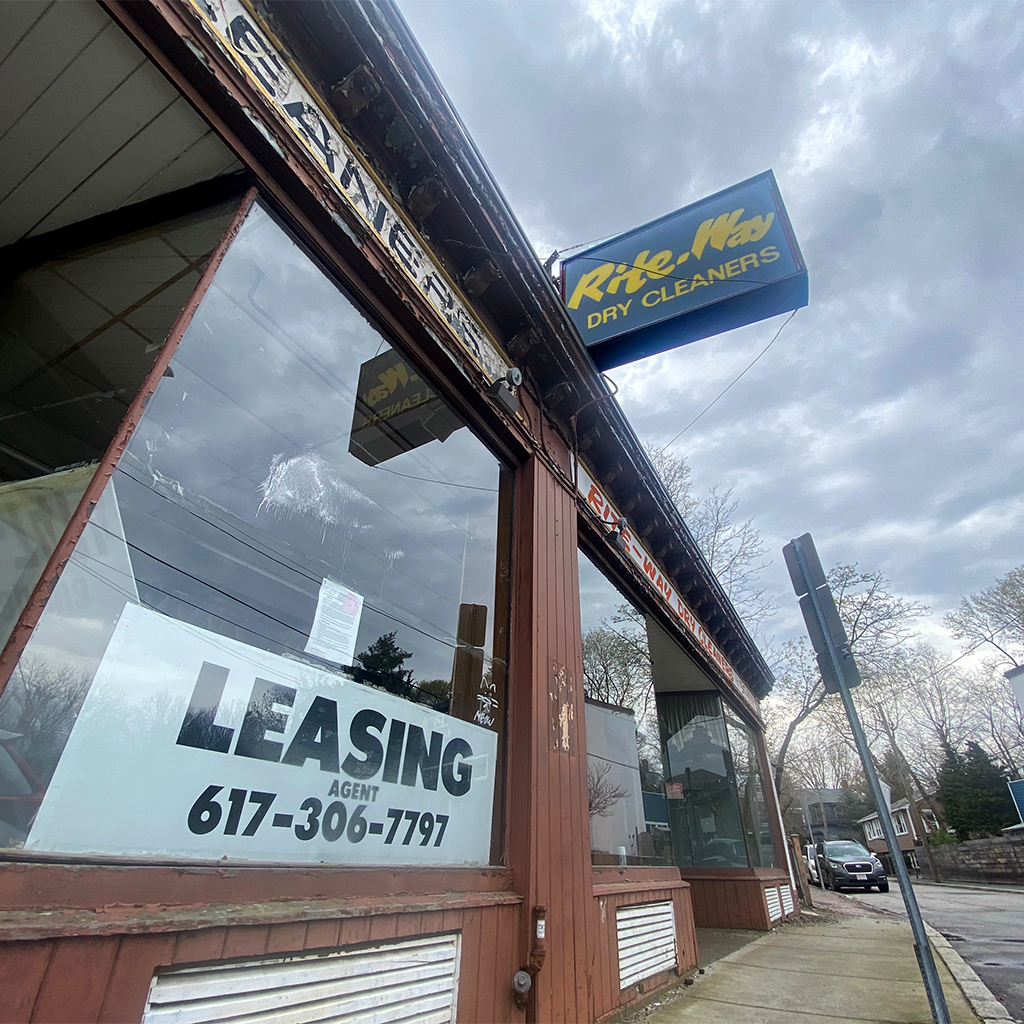
The empty former Rite-Way Dry Cleaners on Hudson Street in Cambridge’s Neighborhood 9 on Saturday.

Levels of contamination at the empty former Rite-Way Dry Cleaners are “high” and nearly unprecedented in their complexity in the experience of a 28-year environmental expert who talked with neighbors at a Thursday meeting.

A best-case scenario for remediation would be to demolish or do significant reconstruction of the structure, which would allow direct access for removal of contaminated soil under the building at 4 Hudson St. in the North Commons neighborhood of Neighborhood 9, said Daniel G. Jaffe of Environmental Properties, a firm in Newton.

The meeting was held as part of a state Department Environmental Protection public involvement plan required by the petition of concerned residents, mostly those living on lower Bowdoin Street and the abutting property of 3-5 Shepard St. At the meeting held at the Cambridge Main Library, illustrations from Jaffe showed a potential plume of impact ranging from Hudson Street down Massachusetts Avenue to south of Marathon Sports.

The Rite-Way structure was built in 1925 and has hosted a dry cleaning business from the 1960s until Rite-Way shuttered in the first half of 2018, according to documents prepared for the site’s owner, Nathaniel Swartz of Tennessee, and filed with the state. The building is technically part of a 1670-1672 Massachusetts Ave. parcel that also houses Floyd’s Barbershop and Wrapro Falafel & Grill, all owned by Irving Swartz until his death in 2006 and now handled by trustees, according to documents filed at the Middlesex Registry of Deeds.

When Rite-Way was in business, it was a point of pride for owner Babu Patel that his was “the only dry cleaner in the area who cleans clothes on-premises,” he told the publication American Drycleaner in 2014. “That means I can control quality as well as garment flow.” But it’s turned into a headache for Swartz’ trust, because suspected contamination makes a sale or leasing complicated. Under law, the owners of the property do not have to remediate contamination to sell, but they do have to disclose the contamination to a buyer, and it’s harder to finance purchase of a contaminated site and to insure it.

The property is represented by realtor Roy Papalia of Belmont, who said he’s had 4 Hudson St. on and off the market several times over the past half-dozen years. In a recent go-around, the trust decided to have the site tested, he said. (Nathaniel Swartz was reached by phone Friday evening  but deferred questions to an attorney.)

Venting contaminants

Documents filed with the state in 2022 by Jaffe referred back to testing as early as 2017, before Rite-Way closed. Contamination reports on the Massachusetts Office of Energy & Environmental Affairs website show significant quantities of tetrachloroethylene and trichloroethylene, chemicals used in dry cleaning that have been linked to liver, cervix and lymphatic system cancer.

Jaffe has tested air and soil in eight potentially affected buildings and installed in Floyd’s, Wrapro and the former Rite-Way what are called sub-slab depressurization systems – airtight PVC pipe systems that pump toxic vapors from under the building and vent them into the outside air. They are not final remediation solutions, but make human living areas safer and habitable until such measures can be accomplished.

It was the installations of these systems last year that upset neighbors in the two- and three-story structures around the single-story former Rite-Way, because the pipes’ mouths were not equipped with filters. Jaffe assured attendees at the Thursday meeting that the air being released is tested regularly and not a public health threat, with toxins below hazardous levels. Residents of 3-5 Shepard St. pushed back, citing their experience during a 2016 dispute with the owner of a restaurant called Shepard (in the space that now houses Moëca) when smoke from the restaurant’s wood-grill oven blew into their homes because of wind coming off Massachusetts Avenue and over one-story structures such as the restaurant and Rite-Way.

The systems essentially provide clean healthy environments for the trust’s tenants while releasing unhealthy air into the larger community, resident Bhupesh Patel said after the meeting.

Remediation planning

The best way to remediate is to remove the contaminated soil, but the multiple buildings involved in a dense urban area present logistical issues. Jaffe said microbes could be injected into the soil to break down the toxins, but that process takes longer and can also expand the borders of the contamination. Similar if lesser contamination once found at 1615 Massachusetts Ave., a site owned by Harvard, was remediated easily because a building was razed and the contaminated soil removed, Jaffe said.

The final version of the PIP is due June 7 with a public feedback period.

Deb Zucker, a resident at 3 Shepard St., said she was unaware of the contamination until her building got a request to have testing done on the property. It was the residents who then filed Dec. 23 with the state to get Rite-Way designated as public involvement plan site, which compelled the public informational meeting and interviews with the residents and state and local officials.

No representative from the state DEP attended the Thursday meeting; the office was contacted for comment Friday by email but did not immediately reply. State Rep. Marjorie Decker’s office sent a representative Thursday to better understand the situation.

“Nobody knows what’s going on,” said one Shepard Street resident. “There is no trust.”

Challengers

20 Apr

Triples tennis, lacking in rules

Luca Guadagnino knows how to stoke the erotic and push the boundaries of moral comfort (and then some) while delving into complex, fully formed souls living preternatural existences on the fringe of society. Take “I Am Love” (2009), in which Tilda Swinton played a well-to-do wife having an affair with her cook, or Timothée Chalamet as a fine young cannibal in “Bones and All” (2022) or even Guadagnino’s Oscar winner “Call Me by Your Name” (it won Best Screenplay and Chalamet and the film were nominated) that made him an international talent. They’re all rooted in viscerally deep carnal connections.

His latest, a fierce, fast passion play, hops into the ranks of pro tennis at the level just below Serena and Federer superstardom. You’re immediately wowed by bristling chemistry between its three wholesome leads, the raffish Josh O’Connor, also now on the screen in Alice Rohrwacher’s “La Chimera,” Mike Faist, who broke through as Riff in Steven Spielberg’s “West Side Story” (2021) and Zendaya, currently ruling the desert in “Dune: Part Two.” O’Connor and Faist play Patrick Zweig and Art Donaldson, besties since the age of 12 and more than pretty good with a racket. The flashbacks to their teenage doubles matches are showcases in cocky bravado that spill over into the after-parties that are all about netting members of the opposite sex. Now, however, the two are not so close. Art’s looking to play in the U.S. Open. He’s got a slam within his reach, but a recent slide has his confidence shaken and his game off, so his wife-coach Tashi (Zendaya) decides to have him play in a warmup tournament in nearby New Rochelle. It’s B-league, sponsored by a local tire outlet, but also draws Patrick, who lives pretty much hand to mouth sleeping in his car at tourneys. They haven’t seen each other in nearly 13 years, since Art won the hand of Tashi – who had been dating Patrick.

In rewinds (there’s a bevy of ’em, but with the help of Trent Reznor and Atticus Ross’ electric score and some slick, attentive costuming, it’s done pretty seamlessly) we learn that Tashi – then Tashi Duncan – was the next big thing in tennis, a Naomi or Coco heading to Stanford before owning the world. A knee injury changes all that. The three initially meet at a tourney where Tashi is the big draw. At the trophy awards ceremony, both lads jockey for her favor and invite her back to their stylish hotel room for a beer. Ultimately the evening turns into a three-way makeout session, with Tashi subtly sliding out of the triple tongue tickle, which proves to be an eye-popping realization for Art and Patrick and emblematic of Tashi being perpetually one step ahead and pulling the strings.

As energetic and comely as our gamers are in the reignited love triangle, there are reasons for pause. Namely their stoic, unbridled sense of self interest and lack of emotional connection or fealty; Art and Tashi have a young daughter in a hotel room she scoots out on to have illicit meetups with Patrick. It’s like a 150 mph ace serve, awesome to behold but hollow, if that’s all the match is: Pretty but cold, not the intoxicating grit of a hard-fought Connors-McEnroe marathon hanging on every stroke, antic and bead of sweat. That happens in the on-court sequences, which are viscerally and kinetically staged, but not off-court. The fault is not on the performers so much as on the script by Justin Kuritzkes, which has zing and zip but not depth. In execution it’s not far from Zendaya’s 2021 outing “Malcolm and Marie,” in which Sam Levinson’s framing of a marriage pushed to the edge is more cool conceit than credible lived experience. How “Challengers” ends, there’s no true match point. That may sit well with those smitten by the film’s postured aesthetics, but others searching for something more reflective will likely be left at the midcourt line, tennis’ version of no man’s land.

Short Takes: “The Ministry of Ungentlemanly Warfare” and “Sasquatch Sunset”

20 Apr

Sasquatch Sunset

David and Nathan Zellner churned out quirky, experimental indie works such as “Plastic Utopia” (1997) and “Goliath” (2008) and later veered into slightly more digestible alternative fare with “Kumiko, the Treasure Hunter” (2014), about a depressed Japanese office worker obsessed with the movie “Fargo” (1996) who searches for that film’s lost suitcase of cash. They opt for something more fantastic and scatological here as they embed us in a group of Sasquatch over the course of a calendar year. The film’s not far off from “The Dawn of Man” sequence in Stanley Kubrick’s “2001: A Space Odyssey” (1968); no human words are uttered, though there are plenty of human gestures. Amid the lush greenery of the Pacific Northwest we get to know our clan of cryptids; the brusque alpha male (co-director Nathan Zellner), the lone female (Riley Keough), the more demure junior male (Jesse Eisenberg) and an ostensibly adolescent ’squatch (Christophe Zajac-Denek). Early on we get a fairly gratuitous sex scene right out of “Clan of the Cave Bear” (1986), then there are bouts of masturbation and self-exploration of genitalia (yup, you get full-frontal bigfoot). As base as that may sound, the film unfurls more like a stock nature documentary until things move toward the comic and absurd: Employing a turtle withdrawn into its shell as something of a cellphone; or the alpha munching on what can best can be described as herbal hallucinogens and laying his desire for sex on a mountain lion, which does not go so well. It feels like “The Three Stooges” by way of Nat Geo, and near going over the top. There’s plenty of pissing and shitting too, especially when the clan discover a logging road running through their territory (it’s up to this point that it’s unclear if we’re in the Paleolithic or the present) and experience the need to mark it. As much as you could say it’s a “Beavis and Butt-Head” spin on the Pakuni from the 1970s Saturday morning TV staple “Land of the Lost,” there is vulnerability, fear, compassion, grief and a sense of community that registers onscreen. Well crafted (the costume, makeup and cinematography impress), “Sasquatch Sunset” is at turns weirdly touching and, as the title suggests, there is the heartbreak of witnessing what may be the last of a rare breed.


The Ministry of Ungentlemanly Warfare

The title might tie you up with thoughts of “The League of Extraordinary Gentlemen,” and isn’t too far off – both are about teams assembled by the British government to stave off evil forces with world domination in mind, and both have links to James Bond (more on that later). Beyond that, one is based on a comic book and the other on the real-life derring-do by a ragtag team of World War II commandos trying to cripple the Nazi naval war machine as Britain remains the lone European holdout against Hitler and prays for the entry of the United States into the war. 

Based on Damien Lewis’ 2016 nonfiction book spun up from Winston Churchill’s declassified papers, the Guy Ritchie-helmed film homes in on Operation Postmaster, one of Churchill’s unauthorized and unsanctioned covert ops that proved instrumental in swaying the balance of power in the war.

The rich potpourri of strapping can-dos is led by Maj. Gus March-Phillips (Henry Cavill, aka Superman, rocking a killer handlebar mustache), sprung from the brig for the suicide mission. With him are explosives expert Freddy Alvarez (Henry Golding, “Crazy Rich Asian”), Henry Hayes (Hero Fiennes Tiffin), captain of the modest fishing vessel used for the operation, and gleeful Scandinavian killing machine Anders Lassen (Alan Ritchson), who would give Alexander Skarsgård’s berserker in “The Northman” (2022) a run for his money in bloodletting and wear a broad beaming smile while doing it. The target is a critical Nazi supply ship (of CO2 filters for U-boats) and ammo depot on the West African island of Fernando Po, then a Spanish colony. Along the way the raffish rascals sink a Nazi patrol boat, liberate tactical strategist and ladies man Geoffrey Appleyard (Alex Pettyfer) and tangle with a British destroyer. They have operatives on the island as well with Richard Heron (Babs Olusanmokun) who, a la Rick in “Casablanca” (1942), runs a casino, and club chanteuse Marjorie Stewart (Eiza González), who’s deadly with a pistol but oft dangled as bait to ply Nazi command.

Ritchie, known for his cheeky, stylistic verve (“Lock, Stock and Two Smoking Barrels” and “The Gentlemen”), which the director set aside for his other “truly happened” effort “Guy Ritchie’s The Covenant” (2023), reverts pleasingly back to his roots. It’s “The Guns of Navarone”(1961) if reenvisioned through an “Inglourious Basterds” (2009) lens. The cast is all in, even if the narrative, long for its two-hour running time, ebbs when it should be cresting.

Back to that Bond thing: Under hushed asides from Churchill (played by Rory Kinnear, so electric in “Men” but no Gary Oldman here) there’s a Brigadier Gubbins code-named “M” (Cary Elwes) and his aide, a young Ian Fleming, the guy who would go on to pen the secret-agent novels–allegedly inspired by Cavill’s suave Major. The original 007, Sean Connery, played Allan Quatermain in that other “Gentlemen” movie. 

The Beast

12 Apr

Meeting again for the first time, hopping from disaster to disaster via DNA

Bertrand Bonello’s unsettling yet alluring contemplation on fate and the future, “The Beast,” is an enigmatic weave of three periods in which two actors – Léa Seydoux (“Dune: Part Two,” “Blue is the Warmest Color”) and George MacKay (“1917”) – play roughly the same attracted-to-each-other, but unable-to-connect souls. It’s based loosely on or, I’d say, more inspired by Henry James’ 1903 short story “The Beast in the Jungle.” In the story, a fickle man of stature feels fated to suffer infamy, and as a result, lives a cautious, coddled existence trying to avoid the inevitable. The punchline is that it’s this that makes him notorious. Bonello’s reimagining is more “Cloud Atlas” (2012) by way of “Mulholland Drive” (2001) than anything truly Jamesian.

The film begins with Gabrielle (Seydoux), a pianist and French socialite, perusing an art exhibit in a Parisian gallery circa 1910. Amid the meandering cascade of transmogrified nude men captured in various torturous states, mouths agape and phalluses prominently on display, she bumps into a young British aristocrat named Louis (MacKay) who claims they have met before. Whether the claim is true or a ploy, the connection between the two feels instant and deep and immediately illicit, as Gabrielle’s husband is in the next room. The flirtation as they walk and talk in dour, somber tones isn’t sexual per se, but more soulful, as Louis vows to be Gabrielle’s savior when she, à la James’ protagonist, professes a perpetual fear she cannot fully articulate. From there we jump to 2044 Paris with Gabrielle working with an AI assistant – they have progressed to fully realistic, near-flesh incarnations and can even engage in sex – to try to find work, but can’t because she is too cluttered by emotion (that fear?) and thus less desirable (because emotions make you less effective, or so that is the premise). In both the Belle Époque and future Paris, the streets are nearly bare, as if a pandemic or apocalypse has occurred. All we ever see is Gabrielle and maybe one or two other wandering souls. The gorgeously shot, stark framing is beyond visceral, and that 1910 timeframe is intentional: The sequence takes place right after the Great Flood of Paris, when the Seine overflowed and the streets were knee deep in water, a historic occurrence that later folds into the plot with dire consequences as Lous and Gabrielle pay a visit to the doll factory owned by her husband (a stoic and purposeful Martin Scali).

The third and most jarring of threads takes place in Los Angeles 2014. Gabrielle is an aspiring actor housesitting a spartan glass manse in a upscale neighborhood while Louis, a never-been-kissed incel who vlogs his hate for women, catches sight of Gabrielle at a club and begins to stalk her. Like that Parisian flood, it’s a natural catastrophe – an earthquake – that becomes an agent of fate for the two.

Given all the time and personal hopping, Bonello’s tight narrative control is more than a neat party trick, but beyond that it’s the immersed performances by the actors that compel. Seydoux, whose Gabrielle is driven by a perennial sense of not knowing and doom, is the more rooted across the chapters, though her opening green screen scream scene and audition clips are priceless, eye-popping pullouts. MacKay is the one asked to do some broad changeups, toggling from dutiful gentleman to angry misogynist blaming the world for his failures. You know that in the filmmaking process there was time to change wardrobe and get into character, but as rendered it feels like bold turns on a dime – a wonderment, to be sure.

Pages from other films are clearly borrowed, but feel new. Gabrielle 2044 undergoing a DNA purification process to become a more employable candidate lies in a black isolation pool with a mechanical arm inserting a long needle into her ear. It’s a scene that feels pulled right from a Cronenberg body mutilation movie, which is hauntingly apt; Seydoux appeared in the auteur’s most recent endeavor, “Crimes of the Future” (2022). With the human-AI emotional connection there’s “Her” (2013), and a bit from Michael Haneke’s grim “Funny Games” (1997 and 2007), in which the rewind of video footage plays into the reshaping of the narrative.

The essence of “The Beast” is not unlike Kar-Wai Wong’s haunting elixir “2046” (2004). It’s imbued with a sense of bridled passion as the future and the past inform and influence each other. There’s dread and desire in every frame. Not all of it clicks, but overall its tonality mesmerizes, captivate and drives at you from within. 

Civil War

12 Apr

For correspondents in a torn country with echoes of today, any side is the wrong side

Alex Garland has always been thematically clear in his films. His first two directorial efforts, “Ex Machina” (2015) and “Annihilation” (2018), plumbed creationism and doom, while “Men” (2022) donned the veneer of horror as it wrestled with toxic masculinity and misogyny. Here Garland shifts to the more immediate and less fantastical with this loose-lensed scrutiny of journalism, namely its relevance and the ethics of those plying it. Sure, the civil war of the title is happening across the United States, but it’s vague as to why; all we know is that the Western Forces – a two-star alliance with their own, more spartan rendering of the ol’ red, white and blue – consists of seceded states Texas and California, and that Florida is a wild card trying to pull the Carolinas in to some kind of something or other. It’s a MacGuffin wrapped inside an enigma for certain, but Red and Blue states aligning is a bit of a stretch. Given the premise, folks are going to want to reflect on the nastiness here and now and how we move on, but “Civil War” is not that film. It takes a while to work that out and get on the page with Garland, a more-than-capable writer (“28 Days Later,” “Never Let Me Go”) and inherently immersive filmmaker.

“Civil War” opens with journalists in New York City recording mob unrest and the efforts of a bristling police presence trying to tamp it down. Again, the who and why isn’t explained, but given the immediacy of the scene, Garland and his crew transport us beyond our want-to-knows as veteran war photographer Lee Miller (Kirstin Dunst) snaps away at the post-explosion carnage of a car bomb. Trying to tag along is Jessie (Carlee Spaeny, the apple of Elvis’ eye in “Priscilla”) a Lee Miller wannabe who shoots on old-school film and would have been digitized herself if it weren’t for Lee pushing her out of the bomb blast. Like the punchy western journos in “Welcome to Sarajevo” (1997) and “The Year of Living Dangerously” (1982), the correspondents regroup in a hotel, drink scotch, milk each other for scoops and discuss the next hot spot locale to pursue a story. Lee and her pen man Joel (Wagner Moura) want to score an interview with the power-clinging, third-term president (Nick Offerman) before D.C. is beset. Jessie weasels her way in, as does Sammy (Stephen McKinley Henderson), an older political reporter from the Times looking to get to the front line in Charlottesville. The winding 800 miles to D.C. (can’t go down the main coastal roads) is filled with strange moments: a vintage boutique in a Southern hamlet seemingly untouched by the conflict, a gas stop where alleged looters hang from rafters awaiting “trial,” meticulous mass graves and plenty of skirmishes where not many seem to know what they are fighting for or who’s on whose side. “I’m just shooting at a guy who’s shooting at me,” one gentleman in camouflage and punk-dyed hair offers as he tries to suss out a sniper. 

At the end of the not-too-golden bricked road, Garland stages a phenomenally choreographed siege of Washington that’s as heartbreaking as it is breathtaking. Through it all he digs into the “objective indifference” of journalists – the professional tenet of getting the story and being impartial. It’s a cold and effective mirror that raises begging questions, and others more practical and immediate: If powers are to fall, will the organizations they file with still exist (the Times and Reuters) and if so, shouldn’t they become freelancers for foreign press such as the BBC or The Guardian? Then there’s the matters of personal preservation and the reasons for the civil war that are never discussed, which makes you see more notorious touch points in our recent past, namely Jan. 6 and the Proud Boys. To be clear, the Western Forces are no liberating army – or at least not one I’d want to be liberated by, as they shoot first and ask few questions. When they do ask, if your answers aren’t right, you’re dead. Twice as dead if you’re not white. 

It’s a slippery yet provocative slope. Some might call it manipulative stoking of fears without owning it, and they’d be right. The film also falters with Jessie; she’s as shallow as dew mist – an amalgam of parts with nothing human to grab on to, and Spaeny feels miscast. Thankfully that all fades in the rearview as things ramp up en route to D.C. As a visionary behind a pen or a lens, Garland has a penchant for lawless dystopia that translates well here, and frighteningly so. The war in the backyard holds our eyes and our minds even if the themes offered fail to fully crystallize in the billowing smoke of the distant hills.