‘Godzilla: King of the Monsters’: Reunion time for earth-shaking titans, humans underfoot
By Tom Meek

Who knew that “Godzilla: King of the Monsters” was a Boston movie? I won’t say how much it is, but I will say that the oldest ballpark in the country (RIP Bill Buckner) and that iconic high-rise so eloquently framed in a semi-famous short story by John Updike make it in there – and then some. The Japanese-launched franchise has matured to full CGI fury, improving on the effects in versions from 1998 and 2014 and certainly from its 1950s beginnings, when miniature models of Tokyo were stomped by a man in a rubber suit. (Let’s call those the MIRS years.)
The tagline is the same as in 1956, when American actor Raymond Burr (“Ironside”) lent his American mug to an early Japanese MIRS entry. Here, the film picks up five years from when “Godzilla” (2014) left off, namely the leveling of San Francisco, with all “titans” now neatly in hibernation. Some players from that chapter (Sally Hawkins and Ken Watanabe) reprise their roles as scientists, appearing before congress to try to derail plans to exterminate Godzilla and the other titans – while in hibernation, a cryptozoological agency known as Monarch has pretty much put all the beasts in an electronic lockdown. We also meet the Russells, a family of Monarch scientists fractured by the loss of their son in the stomping of San Fran. The father, Mark (Kyle Chandler, so good in “Manchester by the Sea” and “Zero Dark Thirty”), unable to cope with the grief, has gone off to film wolves in the wilds, while wife Emma (Vera Farmiga) and daughter Madison (Millie Bobby Brown, from “Stranger Things”) are nestled in a forest abode near one such titan bunker where they witness the larval birth of Mothra.
Before the flaming pterodactyl Rodan and three-header King Ghidorah – aka Monster Zero – make it into the mix, of course we need some zany zealot to bring down the boom. In this case that’s a former British special ops officer played with charm and menace by Charles Dance, who has had an awakening of his own and sees the only way to right humankind’s environmental wrongs being to raise the titans and let them cull the population. Much philosophical talk is made early on about man being an infection, and the titans something like white blood cells to take care of it. Sure, okay, nothing new: The original Godzilla was an incarnation raised by man’s use of nukes and nuclear energy, so the themes imbued here by writer/director Michael Dougherty seem in line. And a little biorhythm device Emma has made (the thing everybody wants) has the monster-whispering effect that the two thumb-sized Japanese twins had in the old MIRS flicks.
But this is a big CGI flick, seen to good effect as Brazil gets bowled over by Rodan and Ghidorah (which, given all the talk of infections and viruses, sounds even more like an STD) gets awakened from his icy crib. Boston, home of the Russells, hosts a Godzilla-Ghidorah smackdown – and if some of those new high rises in the Seaport irk your aesthetic eye, here’s a shot at some virtual schadenfreude.
The film does what it needs to. The trio of lead actors manage to elicit enough emotion and Godzilla, a hero whose mission and morals are as straightforward as Clint Eastwood’s indelible “Man with No Name,” gets to don the superhero cape, if just for a small while. It’s bang-bang fun that clicks by with smart, rapid pacing, all the while reminding us of just how much a mess we’ve made of this planet.


 It’s actually floating that proves to be the final desperate measure as a mother and two children drift haplessly down a river, hoping for a new beginning yet never able to see around the bend. The other big surprise to “Bird Box” is the impressive throng of talent involved – and their inability to lift the project. The unexceptional script written by Eric Heisserer, a scribe who not too long ago adapted another slack sci-fi story (“Arrival”) into a sharp, thinking person’s flick, adheres hard to the flat source material by rocker-turned-novelist Josh Malerman. There’s plenty of gold in the mix too: Lead actress Sandra Bullock has an Academy Award to her credit, and director Susanne Bier also has Oscar pedigree from her 2010 Danish film “In a Better World.” What gives? For one, the producers probably held Heisserer to the best-selling book for fear they might disenfranchise their ready-made target audience. It doesn’t help that Bier shoots this in a way that feels more like a TV miniseries than a big-budget, two-hour, end-of-the-world burn.
 The film begins accordingly with a bloody struggle inside a boxy sedan in predawn Los Angeles. In those tight confines, Garner’s Riley North eventually gains the upper hand and lets a bullet fly into the cranium of a highly tatted gangbanger. The thing you admire most about the whole affair and its aftermath is Riley’s steely resolve and professional efficiency. You know she’s done this before. The how and why of that get answered quickly as we flash back five years, with Riley now a Girl Scout-leading soccer mom. Things are pretty tight for the Norths: Riley works part time in a bank while her loving yet flawed husband Chris (Jeffery Hephner) labors in a garage while figuring out his next big move. Unwisely, he listens (just listens) to an offer to be part of a crew to rob a drug lord by the fantastically generic name of Diego Garcia (Juan Pablo Raba), who, as the film says over and over, is the Mr. Big of the L.A. crime scene. The offer gets turned down, but Garcia’s already caught wind of the job and takes out Chris and Riley’s 9-year-old daughter (Cailey Fleming) in a drive-by. Riley sees the whole ordeal – in repeat slow-mo – and even though she IDs the shooters to the police, once in court, the defense attorney smugly flips the case. The judge won’t listen to Riley’s plea and the prosecutors don’t seem to care. The shooter goes free. An enraged Riley is cuffed, dragged out of court and prepped for a mental institution.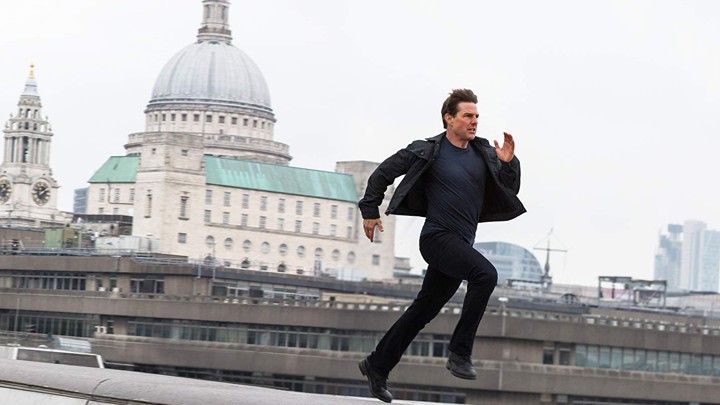
 The plot’s not all that much to bite into – there’s three mobile nukes on the loose in Europe and IMF agent Ethan Hunt (Cruise)
 As with all the “Jurassic” flicks, the action begins down in Costa Rica, at the theme park from the last chapter that’s been abandoned and overrun by rampaging dinos. The crisis du jour becomes increasing volcanic activity that threatens to “re-extinct” the “de-extinct” lizards (okay, birds). Congressional debate rages about saving them or not and, blessedly, Jeff Goldblum looms at the epicenter with rapturous logician metababble; then, just like that, the crew from the last “World” – the park overseer (Bryce Dallas Howard) and raptor wrangler (Chris Pratt) – are back as part of a conservation effort to get as many of the dinos as possible off the island and to a “sanctuary.”
 Steamy and ever shifting, “Red Sparrow” takes us back behind the curtain, ostensibly of Putin’s Russia, where the commoners live hand-to-mouth and at the mercy of the state. It’s there that Lawrence’s Dominika lives a cut above as the lead dancer of the elite Bolshoi Ballet, but just as we drink her in, up on the stage beguiling a packed house, a freak accident ends her career and she’s suddenly on the cusp of being evicted from her cozy pad and there’s no money to care for mum (Joely Richardson) who’s suffering some kind of illness. No worries, uncle Vanya (Matthias Schoenaerts), an intelligence officer, steps in and gives Dominika a “one-off” job that will solve her problems. All she’s got to do is lure an admiring fan and enemy of the state into a sting. The grand hotel where it all goes down, draped in red and gold, is regal and inviting; the mark, not so much. Needless to say, things veer off script, but in the end, Dominika gets it done. From there she’s in too deep – an intelligence liability, so to speak – so it’s either back to school or into the harbor.
  The tale is set in Oslo and the surrounding countryside, captured in gorgeous scenic shots. Everything is gray, drab and snowbound, also a fair assessment of all the characters skulking about a dark whodunit that reaches for the moody grandeur of a David Fincher film (“Se7en” or “The Girl With the Dragon Tattoo”) but winds up closer to “Body of Evidence” (1993), which effectively killed Madonna’s acting career and probably had Willem Dafoe thinking about swapping agents.
  For What it's Worth