Tag Archives: Ridley Scott

Gladiator II

21 Nov

Ridley Scott takes a stab at a sequel 24 years after Crowe, but going not quite as deep

Not sure that “Gladiator,” the Oscar-winning sword-and-sandal revenge epic starring Russell Crowe, needed a sequel, but the fates, furies and a cadre of calculating Hollywood studio execs have deemed it so with a clear, hopeful eye on a box-office bang-up. It’s not on par with its 2000 predecessor, but the script by David Scarpa, who collaborated last year on “Napoleon” with director Ridley Scott (still cranking them out well into his 80s), does connect the dots smartly with blood and purpose. We find ourselves 20-something years since the events of the last film that concluded with the death of Crowe’s Colosseum warrior, Maximus after killing hedonistic, self-interested Emperor Commodus (Joaquin Phoenix) and, in theory, restoring the voice of democracy to the senate and the people. What’s happened in the interim is anything but: Rome is run by two foppishly fey brothers, Geta (Joseph Quinn) and Caracalla (Fred Hechinger), man-boys with a penchant for mascara, bloodshed and monkeys. Taking a step back, it’s eerie to realize how much that paradigm feels all too close and reflective of our new now – earmarking the struggle for democracy as pervasive throughout humankind’s brief, short history.

G2 begins with the siege of Numidia (Northern Africa) by Roman legions led by general Marcus Acacius (Pedro Pascal), a dutiful soldier whose political ideals don’t align with those of the decadent, indulgent twin emperors, though he seems all-in on the expansion of the republic. Galleons crash into a seawall, flaming boulders are catapulted, arrows fly and swords get crossed. The resistance is fervent and game, led in part by a farmer-military tactician named Hanno (a beefed up Paul Mescal, of “Aftersun” and “Foe”) whose wife (Yuval Gowen) likewise straps on the lorica segmentata and joins the fray, but Marcus and his troops overwhelm the seaside city easily. Caught by an arrow, Hanno’s wife is one of the casualties. As a result – just as it was with Maximus – a blood grudge ignites and becomes the film’s plot-driving fire: revenge or death. 

Given the title and what came before, the action heads back to Rome, where Marcus is feted for his feat while Hanno is shackled and thrown into the gladiator pool overseen by Denzel Washington’s Macrinus, a former slave turned gladiator turned backroom fixer and ultimately, shrewd political manipulator. Rhinos, killer baboons and sharks (yes sharks, they flood the Colosseum for one such contest) join the endless legion of hulking Master Blasters the ill-equipped gladiators have to confront. Akin to the Maximus arc, Hanno becomes an arena sensation for his fortitude, smartly engineered victories (baboon biting not withstanding) and fanciful beheadings. But as this is old Rome, the real violence is what goes on behind gauzy veils in unofficial councils where schemes within schemes are hatched. Macrinus, who seems to have a J. Edgar Hoover-sized file on everyone in town, plays the ends against the means, promising Hanno his shot at Marcus if he can survive long enough; Marcus, angered by mass corruption and injustice, weighs an insurrection to return Rome to its starving masses. Marcus’ wife, Lucilla (Connie Nielsen), the sister of Commodus and Maximus’ love-interest in G1, it turns out, has blood ties to Hanno (the movie tries to obfuscate this point until midway in, but the plot twist – which I won’t tip – is as clear as day, early on).

The machinations feed and play off each other with Shakespearean overtones. Washington’s performance even feels like a kitschy extension of his 2021 performance in “The Tragedy of Macbeth.” He chews the screen while Mescal simmers, seethes and burns. This is Mescal’s first big studio film, and while he’s up to the task, his Hanno doesn’t have the gravelly gravitas of Crowe’s Maximus; he’s mono-focused whereas Maximus seemed to legitimately play the long game. As Marcus, Pascal is dour and soulful in the thin, thankless part that is mostly tinder fanned to fuel the plot. It’s Nielsen, classic and captivating, who shines with a bigger part to play. It’s her uneasy and evolving relationship with Hanno that becomes the film’s emotional epicenter.

Like “Napoleon,” there’s a lot packed into “Gladiator II.” Not all of it sticks. The overly sexualized identities of the two emperors (and others), gets far too close to the hyperbolic tipping point (think “Caligula”) and stokes the embers of gender politics that so roiled and divided our nation two weeks ago. Then there’s the matter of seemingly unlimited access to Hanno in his cordoned-off jail cell between contests, where Lucilla and Marcus continually score covert meetings despite the emperors’ forbidding. As far as history goes, Nielsen and Mescal’s characters were true historic figures, as was Commodus, but the plotlines and narrative in the two “Gladiators” are all historical fiction. It’s too bad we can’t turn the page like Scott and Scarpa and rescript this moment.
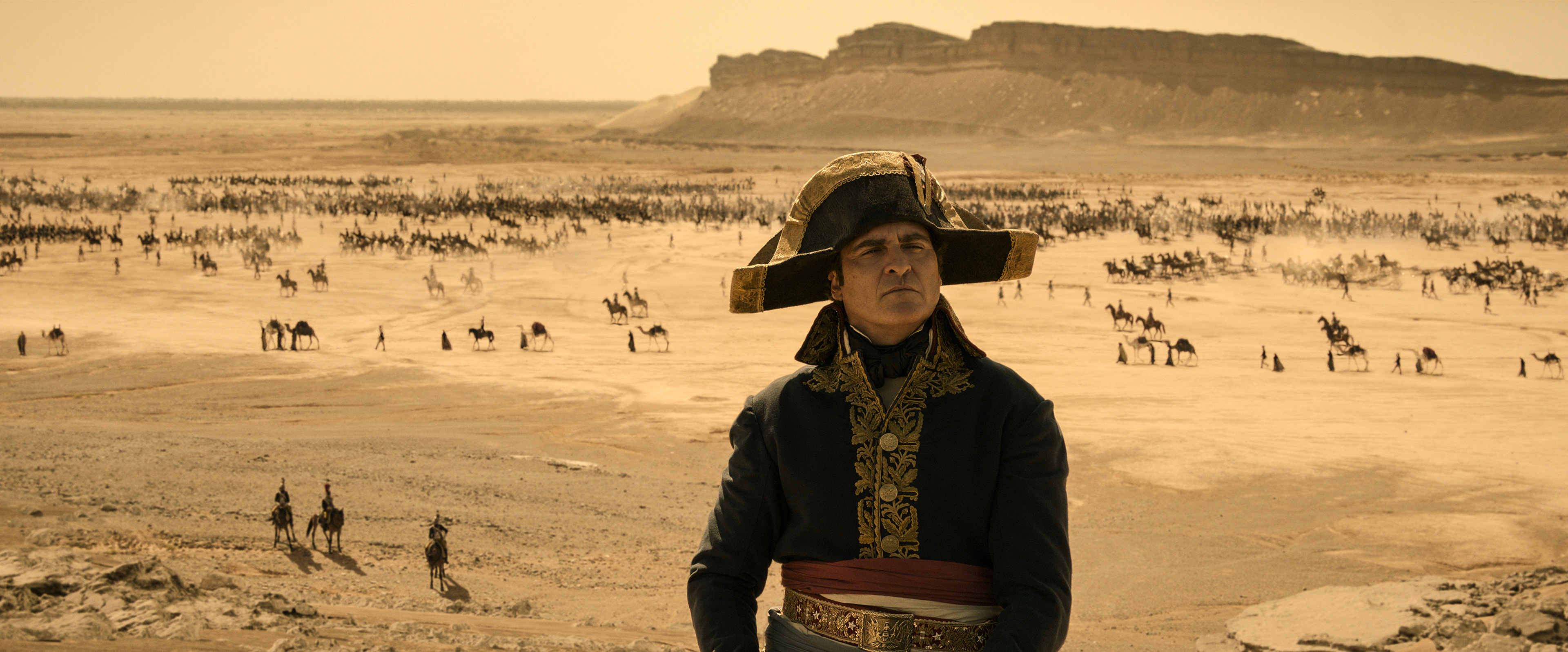
Napoleon

23 Nov

Like its topic, this biopic is not short, has epic battles and a Josephine worth the exile

When you think of the films of Ridley Scott, it’s most likely his early sci-fi classics “Alien” (1979) and “Blade Runner” (1982), but the prolific filmmaker’s first effort, “The Duelists” (1977), was a period piece set in France during the Napoleonic wars. In that film (not to be confused with “The Last Duel” from 2021, which Scott made with local guys Ben and Matt), the French emperor’s presence was felt constantly, but Napoleon himself never steps into the frame; it’s with a daub of poetic justice that Scott, nearly 50 years later and with a budget almost 200 times bigger, gets to deliver a biopic epic centered on the historically notorious icon known as much for his hubris and the self-esteem complex named after his alleged diminutive stature and inflammable ego as for his military gamesmanship.

As Napoleon, the usually reliable Joaquin Phoenix (“Beau is Afraid,” “You Were Never Really Here”) feels somewhat subdued. That said, it is intriguing to see him reunite with Scott some 22 years after “Gladiator,” in which Phoenix also played a self-absorbed ruler – a deliciously sniveling fop of a Roman emperor. What’s missing is some of the entitled, mercurial and Oscar-winning zing baked into his mirthless Gotham ghoul in “Joker” (2019).

The film opens with Napoleon witnessing the beheading of Marie Antoinette. The French Revolution is in full swing, and the British are looking to gain a bigger foothold across the channel. To prove his worth to the new republic, Napoleon leads the fierce and tactically astute Siege of Toulon, where underpowered French forces take out a well-ensconced British fort under the cloak of night. It doesn’t help that the Brits are in the midst of sweeping, drunken merriment and caught with their pants down, literally.

Thus begins Napoleon’s ascent from military marksman to iron-fisted ruler as one part of the French Consulate triumvirate and later emperor, and efforts to expand the French empire into Africa and Eastern Europe take hold as well as the long-simmering desire to crush the hated English and their hold on the seas (see “Master and Commander”). The main threads of Scott’s film, penned by David Scarpa (“Man in the High Castle” and Scott’s “All the Money in the World”) focus on Bonaparte’s obsession with besting Russian Tsar Alexander I (Édouard Philipponnat), a handsome man-boy that Napoleon seems to hold in deference, and his capricious relationship with Josephine (Vanessa Kirby). Scott’s orchestration of the Battle of Austerlitz, where Napoleon takes it to Russian and Austrian forces (also called the Battle of Three Emperors), as well as the infamous, post-Elba exile grudge match, Waterloo, are stunning in scope, choreography and gritty grandeur. Kirby, who plays the White Widow in the “Mission: Impossible” films, is no stranger to strong women and fills those shoes well here, yet the relationship and the tempo of its tears and folds is wildly uneven – which is not on Kirby, to say the least. Kirby portrays a woman whose confidence and sensuality are more than worthy of holding the gaze of a man with limitless power and, as a result, after their marriage implodes because of heir matters, remains a regularly sought confidant, counsel and simmering longing. The sex scenes have a cheeky silliness, not too far off from some of Scott’s work with Cameron Diaz and a racy sports coupe in “The Counselor” (2013) and most recently Lady Gaga and Adam Driver in “The House of Gucci” (2021).

Beyond the major battles – epic with a capital “E” – and sticking to the historic record, Scott and Scarpa don’t let Bonaparte off the hook for his actions. His Ahab-esque quests cost needless lives, something the film registers as clearly and coldly as the hoar of the harsh Russian winter. As far as the size thing goes, the record shows Napoleon at just north of 5-foot-6; it’s rumored that the Corsican (a lesser, looked-down-upon ilk to most French noblemen at the time) was surrounded intentionally by taller, statuesque guardsmen. Scott and Scarpa wisely choose not to delve into the matter, but Scott often shoots down on Bonaparte, or up from his POV, lending to the effect. 

The picture, which holds one’s eye throughout the 157-minute running time, is opulent but bears the jerky unevenness of Scott’s “Gucci.” Perhaps a Thanksgiving Day viewing will leave visual feasters of all things Napoleonic hungry and searching the streaming universe for the timeless 1927 treasure of the same name crafted by Abel Gance. Seek it out and enjoy the treat. It’s not an either-or, mind you, as Gance’s tale tells of a young Napoleon in school and his early days in the military, dovetailing nicely in time to where Scott’s vision starts. 

House of Gucci

27 Nov

‘House of Gucci’: The styles clash in family drama

By Tom Meek Friday, November 26, 202

Ridley Scott’s “House of Gucci” unfurls like an epic crime saga – think “The Godfather” (1972) by way of the hit streaming series “Succession.” It’s got devious parlor games, backroom corporate jockeying, bloody agendas and plenty of unintentional camp, which is both good and bad. 

We’re talking the Italian fashion industry in the 1970s, when old-school Gucci lions Rodolfo (Jeremy Irons) and Aldo (Pacino) prided themselves on the lineage of special cows used to make super soft, artisanal loafers and handbags that cost most people’s annual salary. Aldo wants to kick the business into the more modern world with innovations such as malls in Japan; Rodolfo resists. But the real focus of “Gucci” is the fatal relationship between Lady Gaga’s uncompromising Patrizia and Rodolfo’s bookish son, Maurizio (Adam Driver). By now, you’ve probably read about the steamy sex scene between Gaga and Driver, and while it is steamy, it’s more a physical, crash-bang-boom event than an erotic interlude, befitting Patrizia’s driven woman: She works in her family’s trucking business until she’s successfully stalking Maurizio in a bookstore and getting that big ring, then pushing Maurizio into the family business with a pinch of Lady Macbeth mania.

The narrative of “Gucci” may be driven by the above- and below-board dealings of the fashion empire, but what Scott’s assembled here is a potpourri of characters that pop off the screen with a capital P. As Aldo, Pacino serves up a Thanksgiving ham with a big, viscous side of pineapple sauce, somewhere between his over-the-top take on Jimmy Hoffa in Martin Scorsese’s “The Irishman” (2019) and his “Hoo-ah!” hokum in “Scent of a Woman’’ (1992). Besides Gaga – more on that in a bit – the real scene-stealer is Jared Leto, unrecognizable under bad hair, potbelly and a prosthetic nose like Tom Cruise in “Tropic Thunder” as Aldo’s attention-seeking son Paolo, the Guccis’ own Fredo Corleone sad sack, full of ambition and always biting his tail. Iron’s ailing Rodolfo is gaunt and wan in the extreme, looking like the undernourished version of Gary Oldman’s Count Dracula in Francis Ford Coppola’s 1992 spin on Bram Stoker’s novel. (Irons is one of the only actors in the impressive ensemble who doesn’t attempt an Italian accent, which is both disconcerting and a blessing.) Driver’s his fine, likable self as Maurizio in a film in which not many of the characters are.

The film clearly belongs to Gaga, giving a big, bold performance that proves what we knew when she was Oscar-nominated in 2018 for her pop-star-in-the-making turn in “A Star is Born”: The woman can act and is a force onscreen. She carries the film through silly and serious, and even though it’s a big performance, it never spins into spectacle like some of her castmates’ do.

Scott, who recently lambasted superhero films, has had a long line of critical success – I’ll cite “Alien” (1979), “Blade Runner” (1982) and “Black Hawk Down” (2000) among the many– but takes a bit of a stumble here. It’s a whirlwind of concepts, stylization, allegories and an incredible cast all getting their big solos (did I mention that Salma Hayek plays Patrizia’s brassy tarot card reader?) without gelling at the core. At more than two and a half hours, “House of Gucci” is highly entertaining and the use of pop tunes from Donna Summer, Blondie and George Michael, to name a few, anchors the era with perfect aural nostalgia. But for all its build, bluster and pomp, in the end “Gucci” gets sewn up and sold like a cheap knockoff pump in the secondary market.

American Woman

14 Jun


Image result for american woman movie

Can you imagine being a grandparent at age 36? In this dark, cloistered drama, we meet Debra (Sienna Miller), who had a daughter at age 16 who did the same thing at the same age. When we first catch up with Debra, she’s working as a waitress and sleeping with a married man who’s pretty much paying for her time. It ain’t pretty, but in her working-class neighborhood it feels like part of the American way.

The film spans 10 years. During it all, Deb’s older sister Katherine (Christina Hendricks) is across the street, disapproving of her sib’s lifestyle but giving out unconditional love and support.Not far away is their newly widowed mother (a dignified Amy Madigan) who, while compassionate and reflective, also harbors reservations. In short, we get three generations of women with the youngest, Bridget (Sky Ferreira, “Baby Driver”), rebellious and not all that great of a mom, often hitting the party scene and dumping her neonate, Jesse, on Deb. Funny how history repeats itself. The toddler’s fate seems sealed, but Deb holds it together as much as she can, clearly doing better than she did with Bridget. Then Bridget disappears, and the film shifts.

That abrupt changeup draws in the audience, going unpredictable places fast. Did the boy’s father Tyler (Alex Neustaedter), himself still a kid, have something to do with it? Is Bridget alive or dead? The not knowing almost literally kills Deb, but also forces her to be the mother to Jesse she wasn’t with Bridget. When we leap forward in time, Deb has changed and has a decent man in her life (Aaron Paul, from “Breaking Bad,” feeling a bit miscast), but the Bridget mystery remains, as does the fraught weight hanging on Deb. The film, directed by Jake Scott (Ridley’s boy), revolves around tropes about family and watching each other’s backs despite some wildly poor life choices. The script by Brad Ingelsby has Lifetime network written all over it as it ambles awkwardly out of the gate. Much is asked of Miller to hold it all together, and she responds with a gritty, emotionally deep performance. The rest of the cast is up to the task too, especially Will Sasso as Katherine’s protective husband (and perhaps the only decent man in the film), who saves Deb from more than one unsavory situation.

Digging around in the trivia trash heap, the film was originally called “The Burning Woman” and Ann Hathaway was set to star. (Hard to imagine her pulling this off any better than Miller, capable as she is.) There’s no question the film could have used a better title: Many will associate this with the indelible 1970 song by The Guess Who – not bad company, mind you, but also no way to distinguish yourself. “American Women” might have made more sense. Without Miller bringing the burning misery of uncertainty to the fore, “American Woman” would be just another generic American drama with a dusting of grit and woe.

Blade Runner 2049

13 Oct

Ryan Gosling (right) brings a subdued performance to a dismal future filled with spectacular visuals

Warner Bros. Pictures

Ryan Gosling (right) brings a subdued performance to a dismal future filled with spectacular visuals.

At over two hours, Villeneuve paces the film effectively, smartly holding back and ever ratcheting it up — a feat the director didn’t quite master in his last sci-fi outing Arrival (2016). As you should expect, the action takes place in 2049. Los Angeles is a lot more crowded but still a dark, rain-slicked Gotham with shocks of neon blooming above the drab cityscape. Opening info tells us the Earth’s been beset by overcrowding and famine. There’s nothing green anywhere anymore, so protein farms where mealworm larvae are harvested to feed the masses Soylent Green-esque pap in ramen bowls have popped up. Not to mention there’s the great “Blackout of 2022” where scads of data files and historical records were lost. Gone the way of Lehman Brothers is the old Tyrell Corporation. The manufacturer of “replicants” (biorobotic androids for those unfamiliar with the earlier film or the Phillip K. Dick novel it was based on), are made by Wallace Industries who make the new line “skin jobs” more obedient, yet still physiologically superior to humans, and all imbued with manufactured personal memories, even though they are self aware they are implants — which seems somewhat illogical and superfluous given the implant process is an arduous one. Continue reading

Alien: Covenant

19 May

Almost 40 Years Since ‘Alien’ Brought Sci-Fi To Pop Culture, ‘Covenant’ Goes Back To Basics

"Alien: Covenant." (Courtesy Mark Rogers/Twentieth Century Fox)

It’s hard to believe it has been nearly 40 years since that little wiggle of a vorpal worm ripped its way out of John Hurt’s abdomen in “Alien,” the sci-fi movie experience that took the fun and fantasy of “Star Wars” and flipped it on its head.

That film’s helmer Ridley Scott, a genius by some accounts, a hack by others and now almost 80 years of age, has shown great commitment to the franchise returning again for “Alien: Covenant.” The film is the sequel to “Prometheus” (2012), which is the first chapter of a prequel series to Scott’s 1979 space chiller that kept audiences up at night, fearful of mutant xenomorph with cascading sets of jaws.

“Alien: Covenant” takes place 10 years after “Prometheus” and approximately two decades before Ripley and her salvage crew discover that wrecked ship loaded with leathery undulating egg casings that we now know better than to peer down into. Bolstered by an impressively eclectic cast, “Prometheus” was a quirky reboot and something of a meta contemplation on creationism and origins that didn’t resonate with a wide fan base — not enough aliens and too many hidden agendas.

The good news with “Alien: Covenant,” especially for loyalists, is that Scott goes back to the basics. But because he has to build off the groundwork laid by his 2012 effort, there’s also plenty of ideologue about man, his creations superseding him and his viability in the universe over time. Scott and his screenwriters — John Logan and Dante Harper — do a nice job getting the plot points to line up seamlessly, though pacing and character development are sacrificed as a result.  Continue reading