By Tom Meek
Wednesday, April 27, 2022
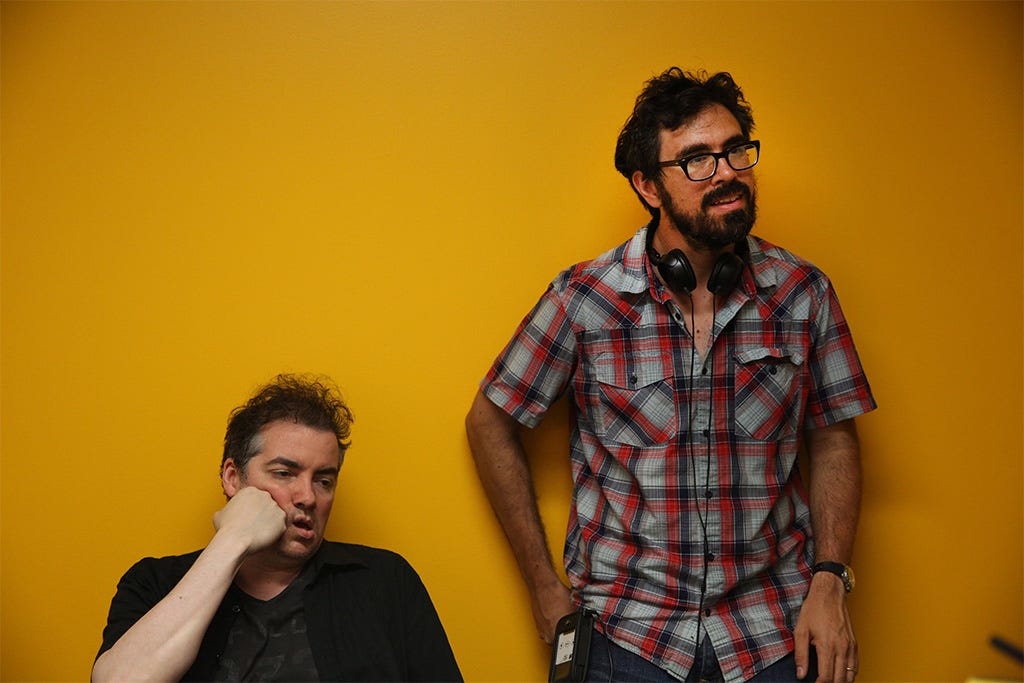
Director Andrew Bujalski, right, with actor Kevin Corrigan on the set of his 2015 film “Results.” (Photo: Ryan Green/ Magnolia Pictures)
Funny, it feels like “mumblecore” is a genre from the distant 1980s or ’90s, but it’s much more recent: The term was coined in 2005 by sound editor Eric Masunaga at the South by Southwest Film Festival, when he used it to encompass the lo-fi independent films “The Puffy Chair” by Mark Duplass and Jay Duplass, “Kissing on the Mouth” by Joe Swanberg and “Mutual Appreciation” by Andrew Bujalski. Bujalski – for whom Masunaga has been a longtime collaborator – is often referred to as “the godfather of mumblecore,” and his first film, “Funny Ha Ha” (2002), about a wayward young woman (Kate Dollenmayer), is widely considered a cornerstone of the canon.
Bujalski, who grew up in Boston, studied filmmaking at Harvard and shot that debut feature in and around the area, is back in town for a 20th anniversary screening of the film Thursday at the Coolidge Corner Theatre with a Q&A moderated by Cantabrigian filmmaker and critic Gerald Peary. (Look for some insider play with Peary, who had a small role in Bujalski’s fourth feature, “Computer Chess.”) I spoke with Bujalski about labels and the challenges of making low-budget films and supporting a family.
“I think the only thing that was different, quote unquote, or new or seemed to capture a moment was a generational divide. We just happened to be the young people at that moment,” Bujalski said of the “mumblecore” term. “Lord knows I was not setting out to define any kind of aesthetic or anything.” Mumblecore films by definition are low-budget, dialogue-driven and feature young stars, with a generational vernacular often punctuated with “uhms” “likes” and “you knows.” “Chatty movies about young, middle-class white people,” is how Bujalski sums it up.
The making of “Funny Ha Ha” had a lot of happenstance to it. Bujalski had Dollenmayer in mind when he wrote the lead role of Marnie, a recent college grad who tempers her malaise with alcohol and sets her sights on a college friend already in a relationship. The two were roommates in Boston, but after college Bujalski was living in Austin, Texas, and Dollenmayer was looking to go to grad school in L.A. Fate, family and friendly resources landed them back in Boston to do the shoot – they had thought about L.A., but Bujalski said that would have been a “disaster.” The film wrapped in late August 2001, just two weeks before 9/11.
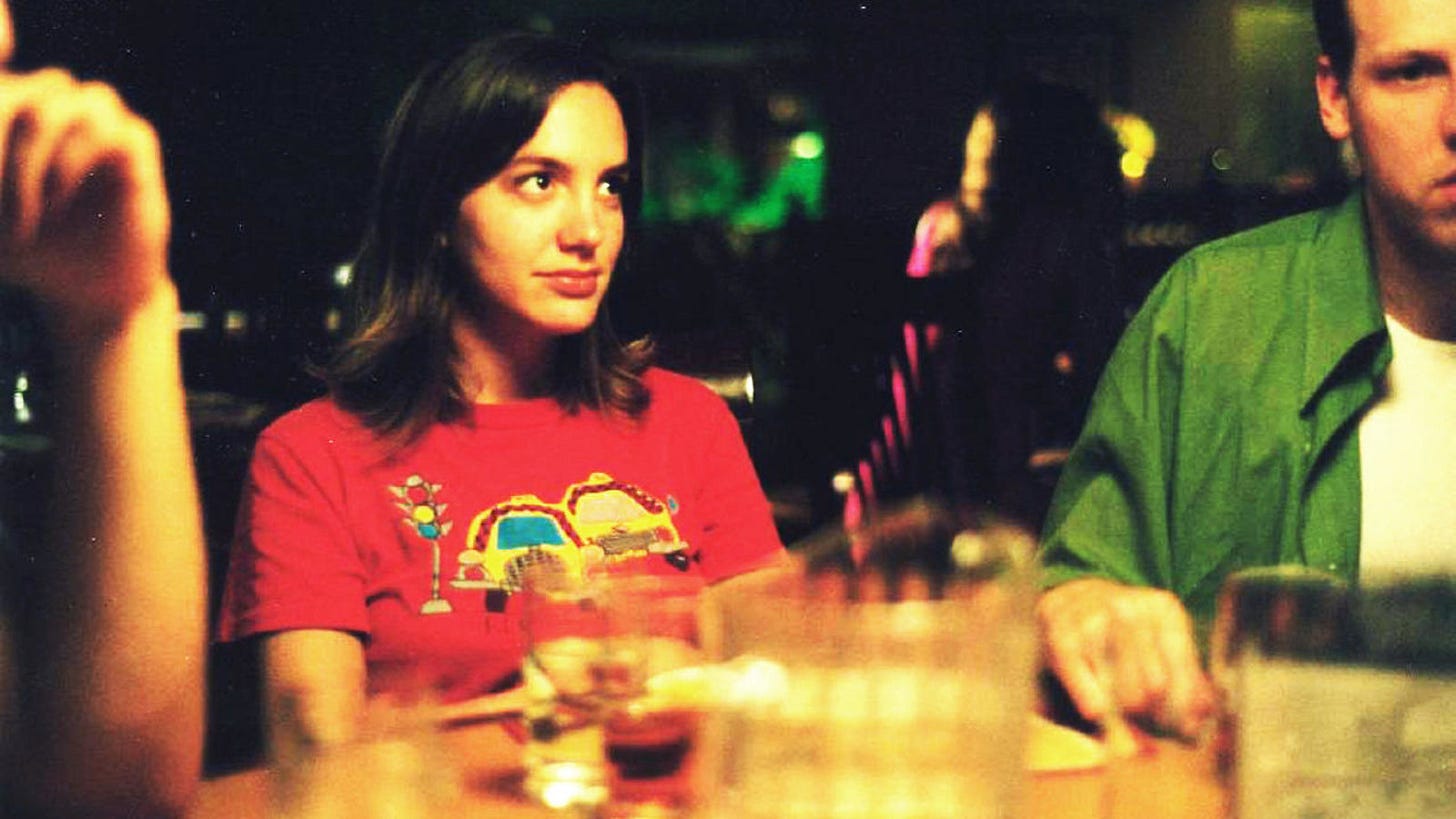
Bujalski’s presence in Austin isn’t an accident. One of the key cited influences for mumblecore (which has a horror subgenre called “mumblegore”) is Richard Linklater’s 1990 debut “Slacker,” which kicked off a new ripple of independent filmmaking. “Talk about godfather,” Bujalski says of Linklater (“Boyhood” and “Waking Life” – the latter being one of the few other films Dollenmayer worked on), a fellow Texan who runs the Austin Film Society and has made the city something of an indie filmmakers’ haven.
Of his own, mumblecore “godfather” tag, Bujalski laughs, both embracing it and shrugging it off. “At the time it kind of irked me, because it felt like a slight,” he said.
Now no longer the 20-something he makes films about, Bujalski is married with 7- and 11-year-old children. With his 2015 get in shape flick “Results,” his work went upscale with some A-minus-list actors (Guy Pearce, Coby Smulders, Kevin Corrigan and Giovanni Ribisi) and a bigger budget – but he remains coy about that, saying only that all of his seven films could be made for what a first-time Sundance smash might cost. (The Internet says $30,000 for “Funny Ha Ha”). His films generally gross north of $100,000 and garner critical raves.
Of money, Bujalski says, “I have two modes: not care, and panic. I’m getting close to panic now.” For “side hustles” Bujalski says he does whatever comes his way in the industry, including working on the dubbed version of the critically acclaimed, Oscar-nominated French film “I Lost My Body” (2019), a Best Animated Film pick by the Boston Society of Film Critics.
Bujalski is working on his seventh film, “There There,” which includes Lili Taylor, Jason Schwartzman and Lennie James of “The Walking Dead” among its cast. The director was reticent to describe it beyond not being the film Bujalski set out to make; Covid thwarted those plans, and he pivoted to “There There.” (Bujalski also did not say what that eighth feature might be about.)
“We’re not sure how to describe it,” Bujalski said of “There There.” “We’re just gonna put it on the screen and let everybody else tell us what we did.”




 The intimate nature of the film (Gerwig also writes, but does not appear) builds in subtle yet palpable strokes with a devilishly barbed edge as it tackles the mandatory rites of senior year: prom, sex and college acceptance. One of the many angles that makes Christine such an intriguing character study isn’t so much her sass with a dash of surly, or red-shocked (dyed) locks that give her a tint of goth-punk, but the fact she’s a perpetual outsider, not religious and not well off, going to a parochial school and running in circles of affluence while dad (an endearing Tracy Letts), an outdated computer programmer, can’t land a job and mom (Laurie Metcalf, giving the best mom performance of the year behind Allison Janney in “I,Tonya”) hold the house together with stoic tough love.
 The setup’s simple enough. Chris (Daniel Kaluuya), an aspiring photog, agrees reluctantly to meet the parents of his girlfriend, Rose (Allison Williams of “Girls”), whom he’s been dating for five months – just long enough to have to take these things seriously.
 Bujalski’s first film cost just $30,000 to make (it grossed about $75,000) and starred no-name actors; here he’s blessed with the reliable Guy Pearce, Cobie Smulders (Agent Maria Hill in the “Avengers” movie and “Agents of S.H.I.E.L.D.” television series) and character actor Kevin Corrigan (“Superbad” and “Goodfellas”) who steps to the fore and delivers a knockout performance. “Results” is based on the well-being fad, in which everyone wants to get physically and emotionally fit and fortified. Danny (Corrigan) newly and painfully out of a marriage he didn’t want to exit, transplants to Austin. He’s doughy, rich and angry. He also wants to be able to take a punch, so he signs up for a personal trainer at Power for Life, a boutique health spa run by Trevor (a gaunt and toned Pearce) who pushes the philosophy that wellness is more than physical beauty, even though his crew of crack coaches look like magazine cover specimens. The upbeat but aggressive Kat (Smulders) gets the assign and spends time at Danny’s palatial spread trying to get him lean and buff, but he drags her down into his routine of single-malt scotch and weed. Turns out she’s a bit depressed and angry too. If there’s a deadbeat client, Kat’s more than happy to switch over to into loan collector mode, and boy can she run – look out Lola, she’s on your tail.
 If there’s one thing painfully obvious (like, “My Best Friend’s Wedding” obvious), it’s that Luke and Kate are meant to be together, but thankfully Swanberg – one of the early adaptors of mumblecore filmmaking (the lo-fi indie film movement in which production values, most notably sound, play second fiddle to the visceral and ideological elements) along with the Duplass brothers (“Puffy Chair”) and Andrew Bujalski (“Funny Ha Ha”) – is after something a bit more nuanced and un-Hollywood. For inexplicable reasons Chris leaves Kate, which further enables Kate and Luke’s hop-infused brewmance. The pair, along with other vat rats from work, spend many a late night lighting up the dingy side of Chicago, while Jill, conveniently a teacher, sits at home toiling away on art projects for her special-needs students.
  For What it's Worth