Tag Archives: History

Harvard Square sees the light again

5 Dec

By Tom Meek

Friday, December 5, 2025

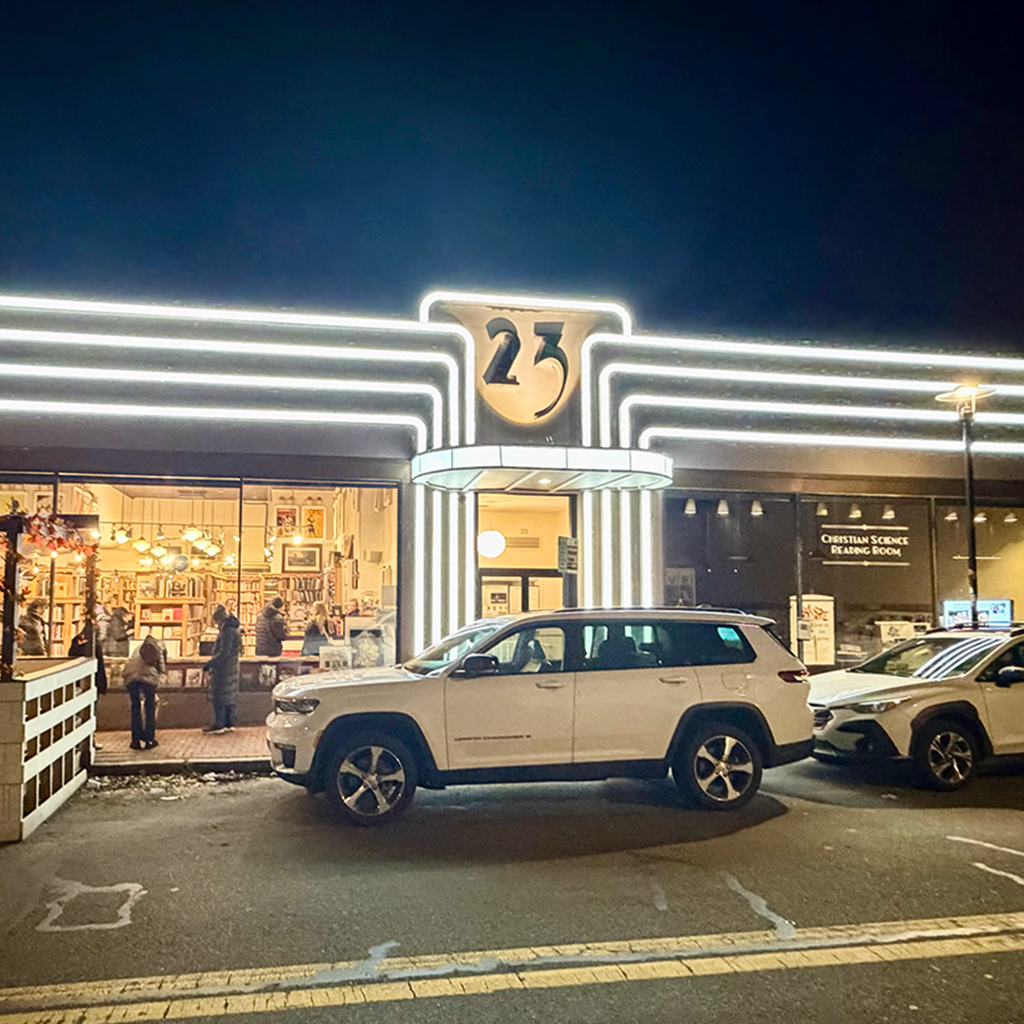
The restored lighting at the Christian Science Reading Room on Church Street in Cambridge’s Harvard Square.

A burst of brightness came to a gloomy stretch of Church Street last month as the Christian Science Reading Room restored soft white art deco lighting absent from the building’s facade for decades.
The lights returned to Church Street, across from the long-dormant AMC Loews Harvard Square, at a Nov. 7 unveiling. Pictures of the alluring illumination have become a slow-trending wave on local social media.

“Now when you see it, it catches your eye,” said Jason Fredette of Poyant Signs, the New Bedford company that restored the lighting over nine months. “The building looks totally different.”
The first structure at the site was a blacksmith shop in the late 1800s, later a veterinary practice. That became mixed retail at the turn of the century as Harvard Square became more thickly settled and the subway arrived in 1912, said Cambridge Historical Commission executive director Charles Sullivan. The 23 Church St. structure was razed in favor of the current one-story 1936 art deco design by architect William Laurence Galvin as a new, upscale home for Cambridge Gas and Electric Light Co.

Continue reading

Danehy Park at 35: a dump that became a glowing urban emerald

15 Sep

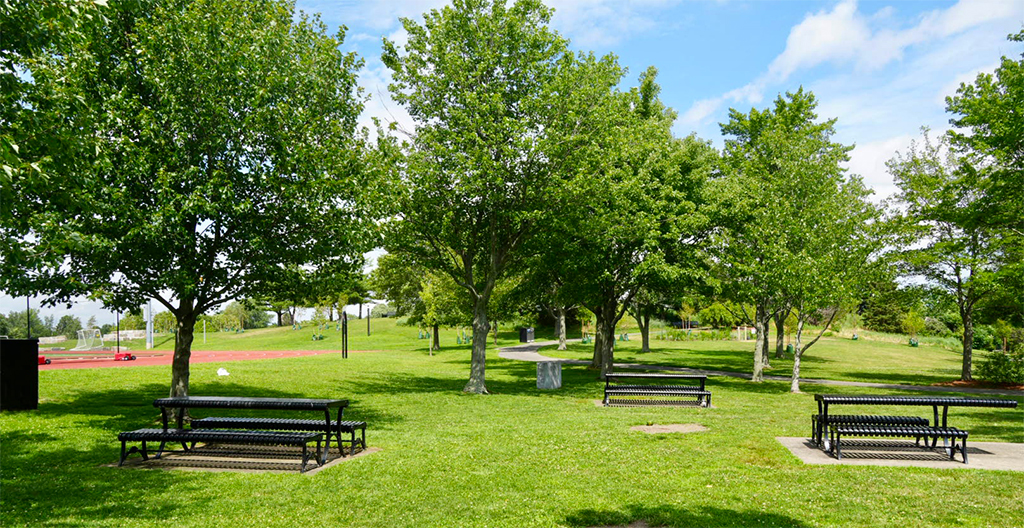
Cambridge’s Danehy Park is a green destination born from a dump.

Hard to believe Danehy Park turns 35 on Monday.

This 50-acre North Cambridge destination for lounging and recreation, picnicking, sports and events big and small hosts the annual Family Day on Saturday; a jazz festival in July; and Shakespeare troupes and the Oldtime Baseball Game, with guests of Red Sox royalty such as Lou Merloni, Oil Can Boyd, Jonathan Papelbon and Pedro Martinez suiting up at St. Peter’s Field.

Continue reading

Talk returns of bridge for bikes and pedestrians behind museum, a $302M proposal from 2023

1 Sep

A rendering of a proposed “Riverwalk” for bicyclist and pedestrians across the Charles River. The Museum of Science refused use of the image without the watermark labeling it “conceptual.”

A bike lane and footpath bridge across the Charles River past the Museum of Science is being discussed again by state Department of Transportation officials as being in early stages of planning.

The “Riverwalk” path along the back of the Museum of Science would connect Lechmere Canal Park and the CambridgeSide mall with the Teddy Ebersol Field section of Boston’s Esplanade without having to navigate the bustle of the McGrath-O’Brien Highway in Cambridge and Somerville or Leverett Circle across the river.

Continue reading

‘Hold,’ an installation suggesting enslavers’ ship, offers place for reflection in idyllic Radcliffe Yard

7 Jun

“Hold,” by Curry J. Hackett and Gabriel Jean-Paul Soomar, is installed in Radcliffe Yard near Harvard Square.

Idyllic Radcliffe Yard on Brattle Street in Harvard Square hosts rotating art exhibits in the cozy, verdant nook known as the Susan S. and Kenneth L. Wallach Garden. You know, those perfectly formed mounds of sand and gravel, the stately, tiered wooden walkway or perhaps the picturesque, grassy green knolls with wispy reeds reaching skyward. The Harvard Radcliffe Institute has held a biennial competition within the Harvard community since 2012 to produce and deliver these public installations.

This year’s winner, “Hold,” by Graduate School of Design students Curry J. Hackett and Gabriel Jean-Paul Soomar debuted before commencement ceremonies: an abstract rendering of a slave ship’s cargo hold. It may just be the institute’s most provocative installation to date, as it stirs the painful legacy of slavery in America and, more pointedly, at Harvard.

The 30-foot, U-shaped structure of wood and translucent plexiglass represents the nave or “hold” of a ship where those forcefully abducted from their native land, put in chains and separated from their families existed for long stretches under inhumane conditions – relative darkness and little food or water – as they were harried across the ocean and into the shackles of plantation enslavement. The rising wall on the Garden Street side of the installation is an evocation of the ship’s sail that caught the wind and drove the vessel.

The open, interactive design invites visitors to step inside the “Hold” and interact with history and the ripples of injustice across decades and centuries. “Sometimes when I go there I see a ruin. Other times I go there and I see a common,” Hackett said over coffee, reflecting on his own interactions with the piece.

Curry J. Hackett, left, and Gabriel Jean-Paul Soomar at the May 15 opening event for “Hold.”  

Hackett and Soomar didn’t come together so much because of a Harvard connection, but because Soomar’s mentor at the University of Miami knew of Hackett, who had taught design at Howard University and the University of Tennessee. The inspiration for “Hold,” Soomar said, came as the two sought to create “an inviting safe place for Black and brown people and others marginalized who might not otherwise have such a space at Harvard.”

“We wanted to bring forth narratives and histories and create a conversation,” Soomar said.

A key conceptual bonding point for the two and the design were the writings of professor Katherine McKittrick, a prominent feminist and activist at Canada’s Queen’s University. Most specifically, her essay on “Plantation Futures” and the notion of enclosure and the walling off of Black peoples. The walls that enclose here go beyond the hull of the ship, as there are other barriers that sequester and separate, be they redlining, disproportionate incarceration or inequity in educational opportunity – the list is long. Additionally, the Radcliffe Institute, an interdisciplinary academic research center with a focus on issues of race and gender, invited applicants to propose topics and themes that might be related to “Harvard & the Legacy of Slavery” report released in 2022 during the tenure of president Lawrence Bacow.

“Hold” is a multimedia experience. An audio component that enriches the sense of immersion is slated to change over the exhibit’s two-year tenure but now plays “A Baptism Story” – a bit of “personal oral history” as Hackett describes it. If you plug in your earbuds and scan the barcode on the plaque, you hear a soundscape Hackett recorded around Boston and the banks of the Charles River – the repetitive clanging of a pile driver at a construction site, the rustle of reeds and pronounced splashing of water – mixed with a looped phone conversation between Hackett and his mother recalling her baptism in rural Virginia and singing a few bars of a hymn.

The recording is meant to evoke spirituality and sensation, Hackett said, though much of the conversation is obfuscated by other sounds to protect the privacy between mother and son while conveying the essence of their relationship and bond. If you go at sunset, there are weatherproof speakers embedded in the ground around “Hold” that play the nearly 15-minute track. “It’s like you’re in the middle of a conversation,” Hackett said. The site-projected audio is far more affecting and immersive than the streamable alternative. Like a good Dolby system, you hear sounds in the aural fore and some that are faraway; from the splashes, you can practically feel your feet in the water. There’s also a track of chimes that play at 11 a.m. Sunday, the time many Black churches schedule services.

The soundscape for “Hold” will play on holidays such as Juneteenth, Martin Luther King Jr. Day and Independence Day.

A new soundscape is expected every three months. Next up, Soomar, who was born in Miami and raised in Trinidad and Florida, will bring a collage of celebratory sounds from diasporic carnivals in Trinidad, London, Boston and Nigeria. “It’ll be like going from one room to another with different music,” Soomar said. From there, Hackett and Soomar, graduates from the School of Design as of May, will curate additional soundscapes, working with Radcliffe staff to draw from the Harvard community.

The ongoing process also provides an opportunity for Hackett and Soomar to reconnect with their creation. The hope is to have other events – community gatherings and perhaps panel talks, Hackett said.

Hackett, who has a design consultancy, is looking to return to the classroom, though where is still to be decided. Soomar will teach this summer at the Arts for Learning program in Miami and will likely launch his own consultancy.

The Radcliffe selection process was something of a sojourn of endurance. Hackett and Soomar submitted their initial design sketches and concept overview early in 2023 and were told that March they were one of five shortlisted entries. They submitted a prototype of their design and in June 2023 found they’d won. It was “fulfilling and humbling,” Soomar said.

As a result of the “Legacy of Slavery” report, the Bacow administration pledged $100 million to redress the stain of slavery in the university’s past, including a public memorial acknowledging the use of enslaved people to build and operate the school. Last week the memorial committee heads, English professor Tracy K. Smith and Carpenter Center director Dan I. Byers, resigned, citing pressures to rush the project. The timeline for the memorial is still unknown, though 2027 was an early goal. In the interim there is “Hold.”

The Man Who Killed Hitler and Then Bigfoot

10 Feb

‘The Man Who Killed Hitler, Then Bigfoot’: FBI has work for a senior with experience


Image result for the man who killed hitler and then

As far as freaky, gonzo film titles go, it’s pretty tough to top “The Man Who Killed Hitler and Then the Bigfoot.” The film lands on streaming platforms Friday and was shot in part locally – out in Turners Falls, where the emerging director behind this era-hopping fantasy hails from.

Does it live up to the audaciousness of the title?

Well, yes and no. Checkboxes are checked and the film is bolstered quite vividly by the gorgeous cinematography of Alex Vendler with visual effects help from Douglas Trumbull, whose credits include “2001: A Space Odyssey” (1968) and “Blade Runner” (1982). Of course, the big draw is current Academy Award nominee Sam Elliott (for “A Star Is Born”) as the legendary man of the title, Calvin Barr, who gets it done during WWII. When things kick off we’re somewhere in the late ’70s in a podunk town, with Barr driving a classic boxy Ford LTD or the like that a band of punks want to take from him. Good luck. They get the drop on Barr initially, but this grizzled old vet with can-do valor and battle-tested brawn isn’t quite over the hill. In teasers we flash back to the younger Barr (a handsome Aidan Turner) as a multilingual infiltrator dressed up as an SS officer crisscrossing Germany on a quest to take out der Führer. We go back and forth until midway in, in the ’70s now, an FBI agent (Ron Livingston from “Office Space”) comes a-begging for Barr to saddle up and take out Sasquatch. Steve Austin must have been tied up.

The why’s a wispy WTF, something about being infected with the mother of all plagues with the creature isolated in a 50-mile dead zone north of the border (no life left but plants, we’re told, even though we see a stag once in); Barr’s the only one immune to the virus, and the only hope to take down the mangy beast. 

I’m not sure which quest is the more improbable onscreen, but writer-director Robert D. Krzykowski embraces them wholeheartedly, splicing the timelines together in nearly cohesive fashion. This first-time film is clearly a passion project, and you can bet Krzykowski is a massive Sam fan. (But then again, who isn’t?) 

Elliot and Turner, good individually, don’t seem to be the same human – the connection between icy wartime assassin and affable backwoods gent just happy to spend time with his pooch is more than decades and worlds apart. No matter. “The Man Who Shot Hitler” is a high-quality spectacle though, if it weren’t such a mashup of history, myth and a revered, drawling thespian, it might not draw our eye. A definite curio for the curious.

The Better Angels

21 Nov
Braydon Denney plays a young Abraham Lincoln, although he could be confused for a young Calvin Klein model

Braydon Denney plays a young Abraham Lincoln, although he could be confused for a young Calvin Klein model

There’s little debate as to which U.S. president is the defacto favorite of Hollywood. Abraham Lincoln wins, whether it’s John Ford’s Young Mr. Lincoln, starring a fresh-faced Henry Fonda, or Steven Spielberg’s Lincoln, which earned Oscar gold for Daniel Day Lewis. Then, there’s also the silly, senseless Abraham Lincoln: Vampire Slayer. For the life of me, I can’t think of one resonating picture about George Washington and that famous cherry tree. When it comes to presidential hagiography, it’s Honest Abe who gets the lion’s share of celluloid exposure.

Considering all the previous Lincoln biopics, A.J. Edwards’s The Better Angels is another creature entirely. As certain as there’s black and white — and we should mention that the film is shot entirely in black-and-white — it’s about a 13-year-old Abe without ever really mentioning the lad’s name. It would be unfair to callBetter Angels plotless, though it unfurls in arcane wisps and etherial shards that you really can’t call linear. But through Edwards’ careful guidance, the flick still manages to paint a visceral and comprehensive collage. One might label it a historical record in dreams, something that the trippy visualist Terrence Malick (Days of Heaven, The Tree of Life) made an art form, and, interestingly enough, he’s one of the film’s producers and worked with Edwards on To the Wonder.   Continue reading

The Butler

15 Aug
Cambridge Day, Charleston City Paper and Here and Sphere

‘The Butler’: He serves eight presidents, and as a tale of black experience in U.S.

By Tom Meek
August 14, 2013

whitespace

In the wake of the George Zimmerman trial, you couldn’t ask for a better movie – or I should say movies – to help carve out a common understanding in the middle of the racial divide. No matter how you took the Zimmerman decision, Ryan Coogler’s “Fruitvale Station” delivered an air-tight version of the same story with the same tragic end, the main difference being that the shooting took place before an audience of cellphone cameras, leaving no wiggle room for conjecture as to what happened between two men in the dark. But also, and more to the point, the “based on real events” docudrama tapped eloquently into the plight of the young black man struggling to succeed in a society reticent to give him a fair shake based on the color of his skin.

081413i Lee Daniels’ The ButlerTo underscore that, and for anyone who’s of the mindset that we’re beyond the Civil Rights era and affirmative action and that opportunity is out there for all to take on equal terms, sit through “Lee Daniels’ The Butler” and see if you still feel that way. Perhaps the best way to describe “The Butler” is as a short, painful history of the black man in America. The film centers on one, who grew up basically a slave in the early 1900s and went on to serve eight presidents as a staff server in the White House.  Continue reading