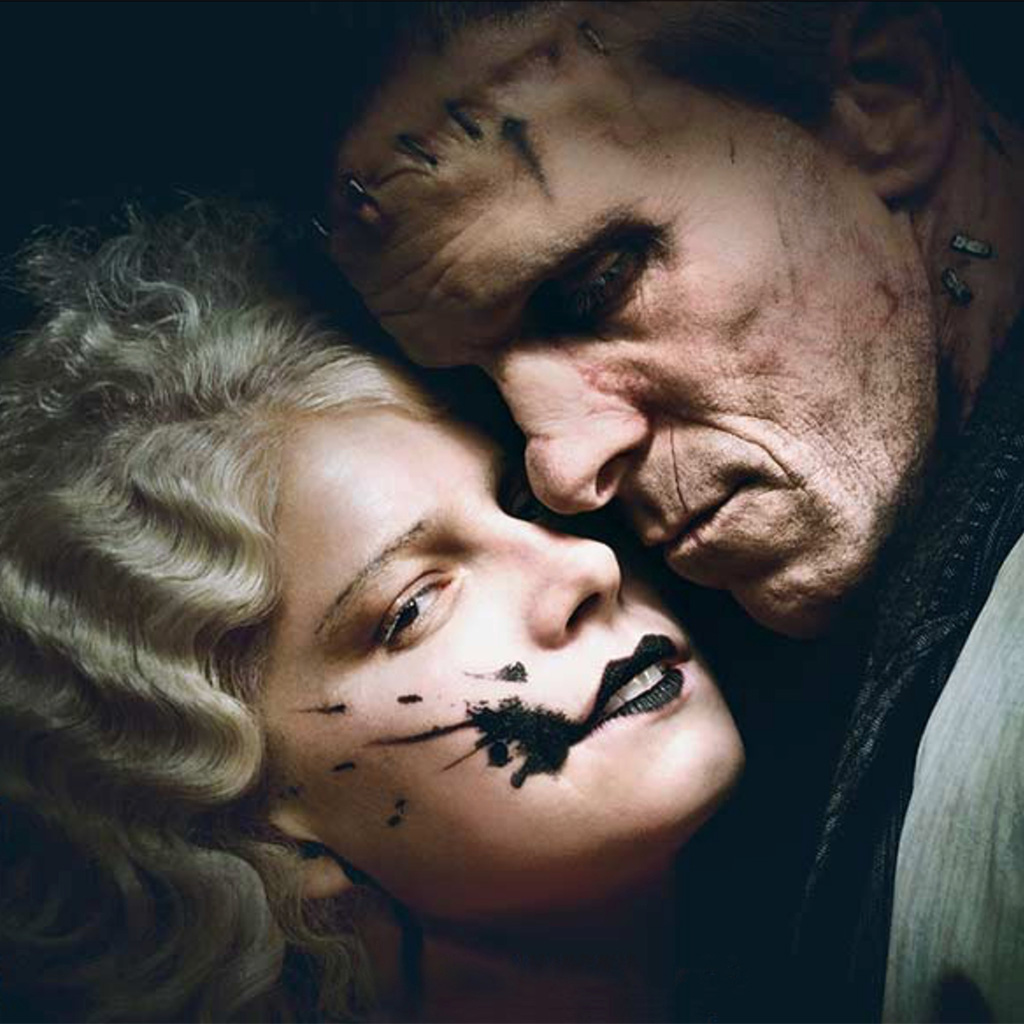
Jessie Buckley and Christian Bale in Maggie Gyllenhaal’s “The Bride!”
Right now cinemagoers can double their Frankenstein pleasure with “The Bride!” and Guillermo del Toro’s “Frankenstein,” up for the Best Picture Oscar this Sunday. Sure, “Frankenstein” is streaming on Netflix – it’s practically left theaters – but it is one of those films best seen on the big screen, as is Maggie Gyllenhaal’s newly opened grand spectacle. They play like bookends to the original story by Mary Shelley, just 18 at the time she wrote her 1818 novel subtitled “The Modern Prometheus.”
In the book, The Bride was promised but never made. It’s in the 1935 James Whale-directed sequel to “Frankenstein” (1931) and Gyllenhaal’s “The Bride!” that we get the realization of the corpse bride via very different narratives. Wedding crashers in the genre are “Frankenstein: The True Story” (1973), starring Jane Seymour and David McCallum of the “Man from U.N.C.L.E.,” and an emotionally inert 1985 version of “The Bride” pairing Jennifer Beals (“Flashdance”) with Sting, in which the rendering of The Bride was defined by the performer’s comely, magazine-cover self.
The latest from Guillermo del Toro (“The Shape of Water,” “Nightmare Alley”) is a he-said, they-said kind of a tale that’s fairly faithful to its Mary Shelley roots. In scope and success it’s akin to Kenneth Branagh’s 1994 effort with Robert De Niro as the Creature but won’t make anyone forget Boris Karloff and the 1931 James Whale classic. Del Toro gets his creepy-crawly shivers in early with a smattering of reanimation scenes as Victor Frankenstein (Oscar Isaac) plugs half corpses into a battery and gets them to sputter to life for a board of London scientists who are both wowed and appalled – “Only god can create life,” one shouts, and that was Shelley’s point: Don’t mess with Mother Nature. If you do, the consequences can be boss-level bad. And, in this case, existential and unrelenting. At nearly two and a half hours, the film is told in two chapters, one from Victors’ “he” perspective and one from the Creature’s “they” view – yes, pronouns back then mattered too, but in this case the “they” is a humanization of the Creature versus the “it” used by Victor and others. The Creature is played with empathetic loneliness and rage by Jacob Elordi (“Saltburn,” “Priscilla”). The most touching scenes are with a blind man in the woods (David Bradley, excellently channeling his inner Anthony Hopkins) and with scream-queen “it girl” Mia Goth (“X,” “Infinity Pool”) as Elizabeth, the fiancée of Victor’s brother Willam (Felix Kammerer, “All Quiet on the Western Front”) whom both the Creature and Victor have strong sexual tensions with. Goth also plays Claire Frankenstein, the lads’ mum who dies in birthing William – from bearer of life to love interest, a piquant ponder, right? The rendering of the Creature takes its cues from classic Karloff mashed up with the tall, porcelain-white alien beings in “Prometheus” (2012), who, as that movie had it, created us; it’s here we shall note that the subtitle of Shelley’s tale is “The Modern Prometheus.” Christopher Waltz is in the cast as Harlander, Elizabeth’s uncle and the financier of Victor’s reanimation lab, the tower atop a Scottish seaside cliff designed to pull down that massive bolt of lightning to bring the Creature to life. There’s a lot stitched into de Toro’s vision of Shelley, some a smooth, seamless period horror, other times moving in gangly, awkward leaps in which the timing of events is too overly convenient and implausible. Another round of editing and tightening may have helped, but del Toro’s “Frankenstein” is a wonderment that’s at its best when quiet and internal, or as Elordi rises up and roils in beast mode.
‘Aileen: Queen of the Serial Killers’ (2025)
Emily Turner’s documentary revisits the life and crimes of Aileen Wuornos, America’s first crowned female serial killer. The film doesn’t add much to the 2003 biopic “Monster,” which won Charlize Theron an Oscar for her portrayal of Wuornos, or Nick Broomfield’s docs “Aileen Wuornos: The Selling of a Serial Killer” (1992) and “Aileen: The Life and Death of a Serial Killer” (2003). If anything, it casts a softer light on Wuornos’ adoptive mother, Arlene Pralle, a horse breeder and born-again Christian; her hippie attorney, Steve Glazer; and childhood friend Dawn Botkins, who in Broomfield’s films were opportunists trying to make a buck off their proximity to Aileen. Aileen herself comes off as warm and engaging in her day-before-execution interview with Australian pen pal Jasmine Hirst – a stark contrast to Broomfield’s 2003 final interview. It’s telling too when Wuornos whispers into Hirst’s ear and tells her she’s “going to make millions.” The most interesting spins are the outtakes from “Dateline” investigator Michele Gillen’s interview footage, the testimony of the female judge removed from the case before trial and the brimming political aspirations of god-fearing prosecutor John Tanner. The rewind of a related cop scandal – investigators cut Hollywood deals while the investigation was ongoing – intrigues, as do the late reveals of Aileen’s confessional truth before execution. Both were well covered in Broomfield’s takes, and the latter to different conclusions. It’s not new, but Aileen still rivets, and this will likely send viewers to the archives for Broomfield’s bits and Gillen’s deep delve.
‘Ballad of a Small Player’ (2025)
Edward Berger’s casino drama dazzles in every scene framed by Academy Award-winning cinematographer James Friend (“All Quiet on the Western Front”) – though as a tale, it lacks sense and soul. The true star of the film is Macau, an island causeway south of Hong Kong that has become an international hub of casinos. Amid the bright lights we embed with gambler Lord Doyle (Colin Farrell), a dignified Brit with Bond-esque reserve who lives large but can’t pay for it. His tab at the posh hotel he has holed up in is $350,000, and it’s long past due. The next big hand keeps coming up bust, and soon Doyle’s only drip of credit is from a compassionate senior casino employee named Dao Ming (Fala Chen) who may not be as kind as her eyes present, and may, in fact, be a willful enabler. More mystery wafts in with Tilda Swinton as an investigator of white collar crimes, like Faye Dunaway in “The Thomas Crown Affair” (the 1968 Boston shot version). There are also some questions as to the verisimilitude of Doyle’s lineage. Farrell, recently in “The Banshees of Inisherin” (2022) and “The Penguin” series, keeps proving he’s become an actor willing to go all in for his character, but he’s not given enough here from Rowan Joffe’s adaptation of a Lawrence Osborne novel. Given Joffe’s and Berger’s CVs (“The American” and “Conclave” among them, respectively) it’s a disappointing sojourn of sideways movements that never finds a peak. “Ballad of a Small Player” marks the third successive Netflix project by a major filmmaker – along with “A House of Dynamite” and “Frankenstein” – to get a short theatrical run and mixed critical reactions before being moved to the streaming giant’s platform of plenty.
“Poor Things” is a nifty mashup of genres from Yorgos Lanthimos, curator of things off-kilter and unsettling – as evidenced by such engrossing, psychologically dark works as “The Lobster” (2015), “Dogtooth” (2009) and “The Killing of a Sacred Deer” (2017). The film, based on Alasdair Gray’s 1992 novel that borrows heavily from Mary Shelley’s “Frankenstein,” isn’t so much about reanimation as it is about reawakening. In this case, the subject is Bella (Emma Stone, who was Oscar-nominated for her last collaboration with Lanthimos playing a lady-in-waiting in a love triangle with Queen Anne in “The Favourite”). Her mind has not caught up to her body, as we hear her creator, Dr. Godwin Baxter (Willem Dafoe), remark to his affable Igor, a soulfully dark-eyed apprentice named Max (Ramy Youssef).
The time, as you can imagine, is Victorian London, which is rendered with more of a fantastical Disney theme-park vibe than Merchant-Ivory authenticity. Bella, as we first meet her, has a childlike brutishness. She delights at the giant bubbles emitted at the dinner table by Godwin – who in primal grunts she refers to as “God” (nothing heavy-handed there, though it is true that Shelley’s father was the philosopher William Godwin) – as the result of some deviant, Cronenbergian dialysis machine. Later, she punches Max in the nose with a gleeful smile and rapid “look at what I did” handclaps. In a quick flash through the receiving room door, a duck-headed dog scoots by; there are other cross-phylum curios roaming the homestead too, a harmless, friendly homemade menagerie. The special effects are well done. Godwin himself is hard to take your eyes off of, or perhaps too hard to linger on, as his face is panels of stitched flesh that look almost like you could peel them off and rearrange them should the desire rise.
For a while it’s a cozy, happy existence. The scientists poke at cadavers while Bella, mimicking them, hones her skills for a future at the local abattoir. As her mind becomes more adult, Godwin betroths her to Max, and the need for legal documentation brings a lecherous attorney into the mix. Mark Ruffalo’s Duncan Wedderburn might not be Snidely Whiplash, but he’s not far off, as he stokes her awakening womanhood and then absconds with her for a hedonistic traipse across Europe. Sex is a vigorous and rewarding wonderment to Bella, an act she refers to as “furious jumping,” through which she proves to be quite the vessel of female empowerment and independence, disappointed nearly to the point of scolding Duncan when he can’t go another round, and unabashed about receiving another man’s attentions and more. “Poor Things” could be taken as “Fear of Flying” before there were airplanes. What began as an uneasy predatory play by Duncan gets inverted and twisted, as Bella’s backstory comes to light in carefully meted strokes.
For the fabric of such a phantasmagoric yarn Lanthimos has stitched together a dark fairytale coverlet evocative of all things Tim Burton with the Kafka-esque surreality of “The Lobster” or “Dogtooth.” In Portugal, zeppelinlike sky trams float overhead, barely tethered to wispy wired tracks; and later, on a cruise, waves crest in pastel rolls of opulence; then there’s the Parisian brothel Bella takes up employment in endowed with a seemingly endless maze of antechambers – secret doors behind secret doors.
“Poor Things” registers a stunning visual achievement that one-ups itself continually. But if not for the heroic, all-in effort by the cast, Lanthimos’ toil might have been all for naught. Youssef and Dafoe make subtle yet critical contributions as cuck and creator; Ruffalo owns his part with amiable smarm and a faint vestige of vulnerability Not enough can be said about Stone and her evolution from grunting child inserted into an adult’s body to stirred woman with no regard for the patriarchy who is, as a result, free to skirt its curtails and checks. The lens on men behaving badly – and well – is intriguing, especially when the action comes home to roost and proves that Duncan isn’t the worst card in the deck. The ending may be a bit too neat, but the sojourn of Bella’s awakening is full of surprise.





 For What it's Worth