Not a claymation curio for the whole family, nor a sequel to “Marcel the Shell with Shoes On” (2021). No, this very dark and adult animated tale of twins separated after the death of their father and placed in foster care has edgy, plot-driving incursions into swinging, fat feeding, pyromania and religious zealotry. The film is wickedly funny at times but tenderly bittersweet, with deeply realized characters. The casting, an inspired all-star slate from Down Under, pairs “Succession” star Sarah Snook and Kodi Smit-McPhee (“Power of the Dog”) as Grace and Gilbert Pudel, fraternal twins born with health issues and bullied at school. Mom died early and dad, a street performer who struggles to keep the family afloat, succumbs a few years later; Grace and Gilbert get placed with families at opposite ends of Australia. Much of the film is told through the longing letters between the two, desperate to reunite. Neither is in an ideal situation. Gilbert lives with Calvinist religious zealots who want to “pray the gay out” and abusively employ him as indentured labor on their apple orchard. Grace lives pretty much on her own in a nice house, because her absentee foster parents are swingers and darting constantly out to key parties or nudist retreats. Her bestie is an 80-year-old firecracker named Pinky (a brilliant Jacki Weaver), whose tale of how she earned the nickname and a sidebar about having sex with John Denver in a helicopter are uproarious delights. Directed by Adam Elliot, making a strong impression with his second feature, “Memoir of a Snail” is agile in construct and scrumptious to behold – “The Nightmare Before Christmas” good. The “shell” theme about the personal baggage we all carry around with us and how we withdraw or put up walls is a bit thinly etched, but the movie’s sibling bond is strongly felt. It’s like the dark, loving embrace of Tim Burton done with the edgy verve of Trey Parker and Matt Stone. It’s also one of the best films you can see in a theater now.
‘A Real Pain’ (2024)
Another film featuring a “Succession” star (in addition to Sarah Snook in “Memoir of a Snail” and “The Apprentice,” starring Jeremy Strong in an Oscar-worthy turn, now on Amazon Prime). Kieran Culkin stars opposite Jessie Eisenberg (“The Social Network”) as Benji to his David, cousins who sojourn to Poland to visit the house their Holocaust-surviving grandmother lived in and connect with their Jewish roots. The two are cut from vastly different cloths; Benji is slack, conflicted and seemingly adrift, whereas David is rooted (married, with a child) and tightly wound. We never get the full details of their stateside profiles, but they don’t much matter and you can fill in the blanks easily given their dynamic. The pair signs onto a Holocaust tour led by an amiable guide (Will Sharpe) who, along with a survivor of the Rwandan civil war (Kurt Egyiawan) examining the toll of genocide in other parts of the world, are the only two who do not have personal, Jewish ties to Poland. In the group too is Jennifer Grey of “Dirty Dancing” fame as a middle-aged woman going through a tough divorce. Benji sidetracks the group regularly with his raffish whims – posing for photos at a statue of liberating soldiers as if part of the platoon, or requesting that the guide dig into the souls of Holocaust victims and tell their story rather than just reciting their names from a register. He becomes something of the group’s mercurial class clown, though many of his politely peevish plays are sparked by seeds of genuine emotional intelligence. He’s an amiable lost boy and clearly one subject of the film’s title. As youths, he and David used to be closer, but given time, space and the arc of life, have grown apart, so “the pain” refers also to Benji’s loneliness and the pair’s fraying over the years as well as the inherent trauma of digging into the atrocities of the past. The film, written and directed by Eisenberg, has a talky, European meandering feel to it, a bit like those Linklater films that paired Ethan Hawke with Julie Delpy – people who care deeply for each other yet who talk around a topic. Eisenberg also avoids making the Holocaust a didactic distraction with leaden exposition. It’s present in every frame, but “A Real Pain” is a character study first. Eisenberg, cutting just his second feature, does a solid job of balancing the tale with the looming shadow of world-changing events. It’s a journey of revelation and reconnection that works on the strength of authentic, awkward chemistry between its two leads.
“The Wild Robot,” “Don’t Move” and “Woman of the Hour”
‘The Wild Robot’ (2024)
A very “Wall-E”-esque pleaser with something to say about humans, machines, emotional intelligence and environmental stewardship. Marrying all that together is an AI ’bot named Roz (voiced by Oscar winner Lupita Nyong’o, “12 Years a Slave,” “Us”) whose shipping container is tossed overboard during a storm, marooning her on a remote island with rich Northeastern biodiversity (pinewoods, bears, beavers, geese and possums) that feels right out of Camden, Maine. Roz is a home helper droid made by a megacompany like Amazon to perform tasks such as making beds, building sheds, shearing sheep and so on. Borrowing a page from Isaac Asimov, the semihumanoid robot (think a rounder C-3PO with spindly arms and legs) has a “do no harm” rule – or close enough. Stranded in a humanless remote, Roz reprograms herself to learn animal lingo and learns that the fauna refer to her as “the monster.” In the awkward dance of finding a task to do, tragic happenstance has Roz becoming the mother imprint for a runt gosling named Brightbill (Kit Connor). The to-do then teaching the hatchling how to forage for food, swim and ultimately fly, because the fall migration is around the corner. Other geese don’t think Brightbill is long for this world and bully him, while hanging close to Roz is Fink (“Mandalorian” Pedro Pascal), a fox posing as a knowing adviser when his true intent is a fast meal. Roz’s transmitter to HQ keeps dropping out or breaking, which ultimately brings to the island a maintenance droid (Stephanie Hsu, “The Menu”) that’s not a fan of Roz developing emotionally. Issues of AI and the environment are at the fore, without pulling focus from the central core bonding of Roz, Fink and Brightbill. The animation, as orchestrated by Oscar nominee Chris Sanders (“Lilo & Stitch,” “How to Train Your Dragon”) is well-envisioned and robust and likely to earn him another nod (though it’ll have some real competition from the Latvian gem “Flow” that just played The Brattle). But the heart of the film is castaway Roz, a tin woodswoman who becomes emotionally aware.
‘Don’t Move’ (2024)
Nice-guy serial killers seem to be all the rage. Already this year we’ve had bad dad Josh Hartnett in “Trap,” and “Dating Game” contestant Rodney Alcala in Anna Kendrick’s impressive true-crime-adjacent debut “Woman of the Hour.” Now we get this tale of cat-and-mouse survivorship in which a grieving mother hiking the California mountains (Kelsey Asbille) stands at a ledge contemplating a jump and is talked down sort-of by a dashing, passing-by dad-guy (Finn Wittrock, so fun as one of the two DIY hedge fund knuckleheads in “The Big Short”). Everything’s cordial until they get to the trailhead parking lot and Wittrock’s Richard tases Asbille’s Iris. Iris is zip-tied, tossed in the back of his car and told that he’s going to take her to his cabin, braid her hair and add her to his list of female bodies at the bottom of the lake. Iris gets free and nearly overpowers Richard, and that’s when he hits her with his Plan B: She’s been injected with a paralyzing agent that’s 20 minutes away from kicking in. The film, directed by Brian Netto and Adam Schindler, moves in unpredictable turns as others – a police officer and a fellow cabin owner – cross paths with Richard and Iris. The tension remains high even if elements of the underlying story don’t quite work, including the how and why for Richard’s predilection. Asbille, controversial for her claims of Native Americans origins to shore up her casting as an Indigenous person in the hit series “Yellowstone,” is a bit too glamorous in the part but still compelling, doing much with her large, luminous eyes and trembling lips because, at one point, that’s all she got. It’s not bad, but if you’re on Netflix, “Woman of the Hour” is the better way to spend your time.
‘Woman of the Hour’ (2023)
Actress Anna Kendrick makes her directorial debut with this chilling true-crime-adjacent serial-killer thriller set in the late ’70s. Like this year’s “MaXXXine,” it revels in the era’s scummy kitsch and skewers its rampant misogyny. The main event is a “Dating Game” show segment in which a young, aspiring actor named Sheryl Bradshaw (Kendrick) is a reluctant contestant, having signed on at the behest of her agent. If you’ve never seen “The Dating Game” or other indelible shows of the time such as “The Gong Show” and “The Newlywed Game,” they’re peppered with innuendos, evoking a degree of cringeworthiness that’s captured well by Kendrick and writer Ian McDonald. Bachelor No. 1 is a bit of a blockhead who can’t answer a question confidently, No. 2’s not much better, but at least he doesn’t trip over his tongue. Then there’s No. 3, who cleans up, masterfully playing off Sheryl’s wit and verve and turning his adversaries’ miscues to his advantage. He’s also Rodney Alcala (Daniel Zovatto), who that year would be arrested and convicted of the murder of six women – and implicated in as many as 130 murders. Of course, he’s Sheryl’s pick. Kendrick and McDonald transform a rote, straight-ahead story into an ever-shifting collage of terror and charm, with cutaways showing Alcala helping a flight attendant move into her apartment, taking snaps of a lonely pregnant woman abandoned by her boyfriend at a national park, and a beach party photo shoot. I don’t need to tell you how these encounters go; it’s how Kendrick decides to shoot and navigate the grimness that matters, as it’s done with subtle, unconventional style and great, visceral affect. Zovatto is a great casting choice and performer, and his Alcala is a natural charmer with a brimming undercurrent of malice – echoing Philip Seymour Hoffman in some of his roles, or Vincent D’Onofrio in “Full Metal Jacket” (1987). Kendrick, not far from her refuses-to-be-a-victim persona of “A Simple Favor” (2018), has some feminist zing as Sheryl, going off script in the final round to ask the bachelors, “What are girls for?” You know Alcala’s a killer early, giving many of his scenes – with his prey, or in the offices of the Los Angeles Times, where he freelances as a photographer – a delectable unpredictability and creepiness. It’s an ambitious and impressive debut for Kendrick, and one that should bear greater casting opportunities for Zovatto.
In a single decade Francis Ford Coppola made not just one but four cinema-defining films: “The Godfather” (1972) and “The Godfather Part II” (1974); “The Conversation” (1974); and of course “Apocalypse Now” (1979). It’s a feat hard to beat, but since “Apocalypse Now,” which riveted audiences upon release and garners the adoration of each new generation of cinephiles, Coppola’s output has been less iconic. It’s varied from well-crafted S.E. Hinton adaptations (“The Outsiders” and “Rumble Fish”) to the purposefully idealistic (“Tucker: The Man and His Dream”), some lighthearted comedies (“Peggy Sue Got Married,” “Jack”), a megaselling John Grisham lawyer yarn (“The Rainmaker”) and of course his “Bram Stoker’s Dracula” (1992), all receiving middling receptions. Later in his career, there was work (“Tetro” and “Youth Without Youth”) that piqued interest but never quite went the distance. His latest, “Megalopolis,” is an ambitious, convoluted mess – pretty much a full-frontal mega-flop. To say so comes with great sadness.
Coppola allegedly pawned part of his vineyard and leveraged himself financially for this project, one he’s been incubating for nearly 40 years. From the insightful documentary “Hearts of Darkness: A Filmmaker’s Apocalypse” (1991), which chronicled the ruinous challenges surmounted to make “Apocalypse Now,” we know Coppola is an incredibly passionate and resourceful filmmaker. He’s bucked trends and gone it alone without studio funding before; in this case, maybe getting other eyes and thoughts involved could have salvaged something.
What’s the movie about? Platitudes and posturing on the future of and control over an urban micro-universe in the near, slightly dystopian future – something the current streaming series “The Penguin” does a much better job of. In this case it’s not Gotham, but New Rome, a city that’s closer to New York City now than any Batman-related project. Everything the camera homes in on is 1920s art deco, with much cinematic worship of the Chrysler Building.
In the opener, Adam Driver’s Cesar Catalina, a master architect and something of a nihilist Leonardo da Vinci, steps out on the ledge of the Chrysler Building to observe the activity below. When it looks like he might tumble off or jump, he shouts, “Time! Stop!” And it does. Everything but Cesar freezes – all the cars like ants below, birds in the air, the wind-pushed clouds and so on. With a snap of his fingers everything returns to normal. But even with such a gift, Cesar is not omnipotent, and he has many detractors, especially Mayor Cicero (Giancarlo Esposito), who wants to rebuild crumbling New Rome with casinos, corruption and cronyism. Cesar, head of the Design Authority, wants to build the utopia of the title, something that will “evolve alongside its people.”
Aside from his neat party trick, Cesar has a Nobel Prize for creating Megalon, a substance that can channel one’s dreams and make desires into reality. In an origin myth, one could see it leveraged by god or the gods to build Earth. In this case Cesar uses it to build an organic, ever-evolving city.
In the latest from Azazel Jacobs (“French Exit”) grief and sisterly differences are wrestled with as familial tensions crest, crash, subside and flow. We open in a small, spare Brooklyn apartment (black pleather couches, an Ikea-esque dining set and no carpeting) as estranged sisters Katie (Carrie Coon), Christina (Elizabeth Olsen) and Rachel (Natasha Lyonne) try to work out the logistics of their terminally ill father’s final hospice cycle. Katie, the oldest, is a bit of a control freak, as evidenced by her telephone disagreements with her husband and teenage daughter back home in California. Christina’s the idealistic free spirit trying to hold the situation together while figuring out the next chapter in her life, and Rachel is the one who’s been living with dad and taking care of him while slacking around the apartment and smoking weed. In short, three very different personalities that, given the heightened emotional state, clash more than not. The three leads deliver genuine, deeply felt performances that ripple with rage, regret and vulnerability. In scope and tenor, “His Three Daughters” is not far off from Florian Zeller’s quietly compelling “The Father” (2020), including a shift in reality that brings home the palpable final punch. The are times the film – which one could imagine as an intimate, in-the-round stage play – gets a bit too cyclical, but usually the dutiful hospice worker named Angel (Rudy Galvan) steps in to update the trio on the changing reality. He’s regarded as both valued family ally and annoying interloper. You never really see or hear the father other than as the sound of a respirator and beeps from a heart monitor reverberating from the back room while the three women in the tiny living room try to make sense of their past, present and future as a family.
‘Merchant Ivory’ (2024)
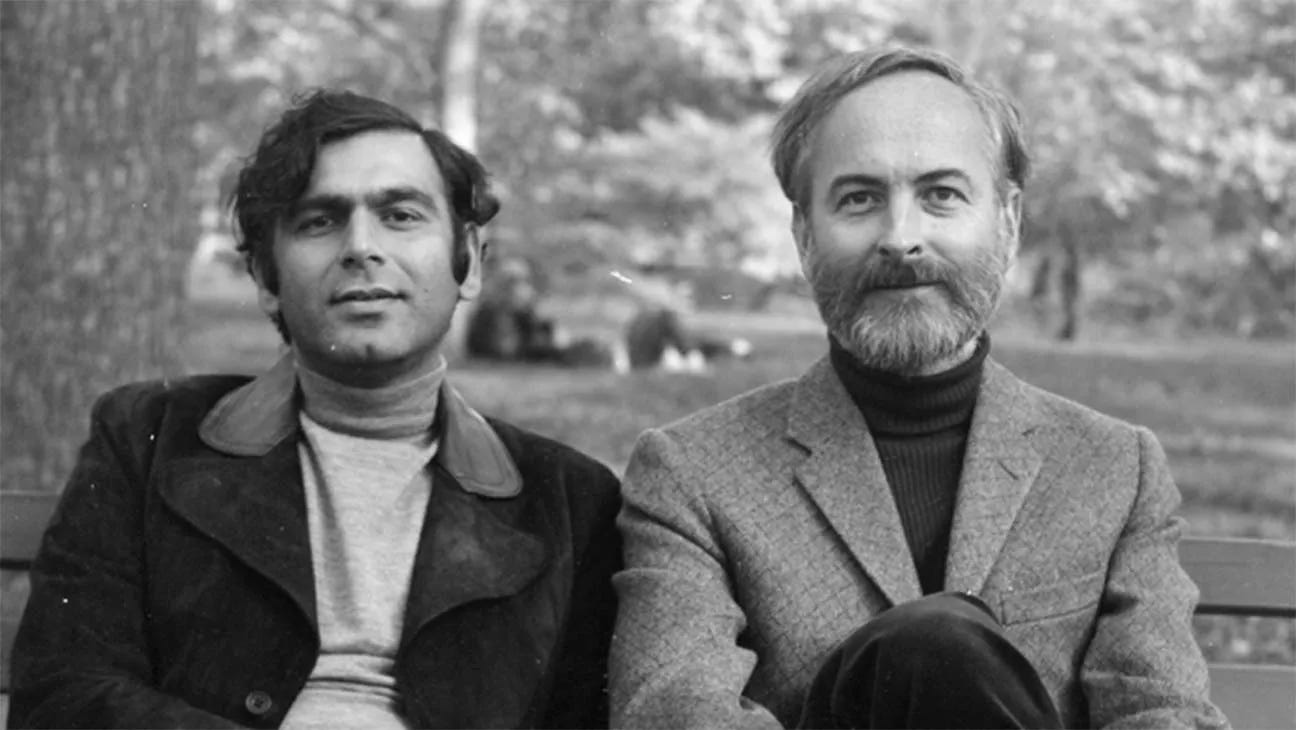
Stephen Soucy’s hagiography of the legendary filmmaking tandem that produced such critically acclaimed period dramas as “Howard’s End” (1985), “A Room with a View” (1992) and “Remains of the Day” (1993) puts their output into historical and cultural context and pulls back the veil on the challenges the two faced as a gay couple during less accepting times. Their films were the backbone of art house cinema in the ’80s and ’90s and beyond, until producer Ismail Merchant’s untimely death in 2005. Director James Ivory is still with us and spry in his mid-90s as he offers candid insight into production challenges and his dynamic with Merchant, the high-energy producer always looking to cut costs (you’d be shocked at how little some of these classics were made for) and shill projects to potential investors versus Ivory’s more somber, quiet approach. Soucy gives you the full rewind from Ivory being an adoptee (Ivory notes that the Paul Newman post-Depression, Great War film “Mr. & Mrs. Bridge” felt reflective of his childhood) to Merchant’s upbringing as a Muslim in Northern India, as well as a look into the rest of a production company “family” that included screenwriter Ruth Prawer Jhabvala, a German-born Jew reared in England (due to a guy named Hitler), and composer Richard Robbins, educated at the New England Conservatory. It was Jhabvala’s prize-winning book “Heat and Dust” that drew interest from Merchant and Ivory; when they chose to adapt, they educed a career shift for Jhabvala, collaborating on 16 films and winning Oscars for “Howard’s End” and “A Room with a View.” Troupe regulars Emma Thompson, Vanessa Redgrave and Helena Bonham Carter are on hand to chime in, as are Hugh Grant, James Wilby and Rupert Graves, who starred together in “Maurice” (1987), a film Soucy and Ivory home in on specifically – not only because of its examination of a closeted gay couple during a time when being gay was a crime in Britain, but because of its powerful context at the time of its release when the AIDs crisis and Act Up were beginning to boil over. The access Soucy earns and Ivory’s frankness create an intimate portrait, including the willingness to concede that some of the team’s later films (“Jefferson in Paris” and “A Soldier’s Daughter Never Cries” among them), while well funded, never registered the kind of critical success as the earlier films. Ivory’s only Oscar came as a writer in 2018 on “Call Me By Your Name.” Breathing in Soucy’s intoxicating love letter, you wish you could go back in time and be part of the Merchant-Ivory “family.” You will also want to go back and rewatch their classics, and perhaps even revisit some of those so-called miscues.
Faye Dunaway, who for my money was the actor who embodied the redefinition of women during the New Hollywood era – “the most exciting time in film,” she calls it in the new documentary from producer-turned-filmmaker Laurent Bouzereau. I couldn’t agree more. Dunaway’s chiseled, alluring countenance cut a striking image, and she was often a barn burner in her onscreen delivery. Dunaway would be Oscar nominated for her performances in “Bonnie and Clyde” (1967) and “Chinatown” (1974) and win the bald, golden guy for “Network” (1976). That body of work practically defined the time, with “Bonnie and Clyde” alone hailed as the cornerstone of a wave of classics that include the “Godfather” films, “The French Connection” (1971) and Monte Hellman’s “Two-Lane Blacktop” (1971). Bouzereau serves up a spry Dunaway (now in her 80s) reflecting on her childhood and marriage, relationships and affairs with Boston rocker Peter Wolf, film director Jerry Schatzberg (“Scarecrow,” “The Panic in Needle Park”) and Marcello Mastroianni among the starry lot. The Southern-born Dunaway had several ties to Boston besides Wolf: She attended Boston University, filmed the original 1968 “Thomas Crown Affair” with Steve McQueen here and sought regular guidance from playwright and Harvard professor William Alfred, whom she describes as the father she never had (her own father was an alcoholic, and her parents divorced when she was young). The jumping-off for the film is the iconic 1977 shot of Dunaway poolside at the Beverly Hills Hotel with her Oscar at an ungodly 6 a.m. the day after her win. The photo would lead to Dunaway marrying photographer Terry O’Neill; the couple would adopt Dunaway’s lone child, Liam, who in the film has much affection to offer about mom. Other talking heads that chime in are Mickey Rourke, who co-starred with Dunaway in the 1987 Charles Bukowski-inspired flick “Barfly” and fan-friend Sharon Stone, who broke a few glass ceilings in her own right, but there’s also no drop-in from “Chinatown” co-star Jack Nicholson. If there’s any downside to the film, it’s that it feels too curated by the actor and thus narrow in scope. Though we get Bette Davis making abundantly clear in one talk show clip that Dunaway was difficult to work with, even the Joan Crawford biopic “Mommie Dearest” (1981), which was critically drubbed at the time – especially Dunaway’s performance – gets spun in a way that pulls blame from Dunaway. The film touches on but does not delve into issues of mental health, a topic that feels so nonchalantly dropped in that it does the topic and the actor a disservice. “Faye” is a great rewind of one of (if not the) most defining periods in filmmaking, but holds the cards too tight on Dunaway as a person.
‘Skywalkers: A Love Story’ (2024)
One part promotion piece and one part jaw-dropping derring-do, this doc by Jeff Zimbalist (“Give Us This Day”) follows Angela Nikolai and Ivan Beerkus, Russian rooftoppers (people who climb skyscrapers illicitly for thrills) who during the last World Cup finals seek to climb the near-completed Merdeka tower in Malaysia – a 2,227-foot structure, the second-tallest in the world. It’s not quite “Man on Wire,” the fantastic 2008 Academy Award-winner that showcased Philippe Petit’s wire walk between the the World Trade Towers in 1974 (neither uses nets or wires, so what’s the difference between 1,368 and 2,227 feet if you fall?), but it grips in its own right. The staging and planning aspects provide intrigue, with World Cup mania leveraged as a distraction, and there’s the added challenge of Covid that shuts off the pair’s sponsorship funding; the couple are undaunted. Zimbalist delves into their strained relationship and backstories to add depth, but it’s not deep enough or blended in seamlessly enough and, if anything, detracts. Much of the stunt footage was shot by the couple, as it’s their bread and butter to garner likes and dollars on social media. It would have been interesting had Zimbalist peeled back more on how social media translate into dollars and how some of the amazing footage is captured – from what’s given, we can infer there are GoPros, selfie sticks and drones, but it’s all so polished there has to be more to it. There are accusations that much of what the pair do is staged and manufactured digitally, and while it doesn’t seem so, it’s another thing the film glosses over. Nikolai and Beerkus are bona fide artists and know how to strike a pose atop the universe (Nikolai will often bring a fancy dress), and the shots looking down are viscerally dizzying – if you have acrophobia, this is your content warning. Everyone else should hang on all the way through: Some of the most impressive stunt footage is at the end as the credits roll.
‘Land of Bad’ (2024)
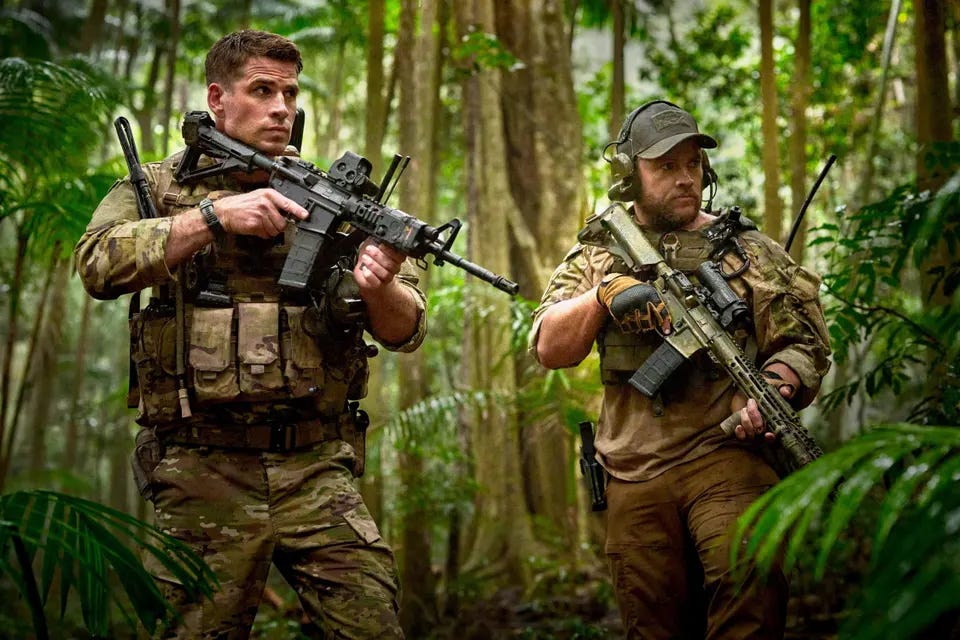
In this military actioner from director William Eubank in which U.S. Army Special Forces get dropped into a Philippine jungle to extract a CIA package, underpowered plot devices go off throughout: Turns out the simple in-and-out extraction isn’t so simple, as the camp the small strike force is sent into is a hive of international terrorists, largely unbeknownst to the smug higher-ups in intelligence. Shit goes south real fast, which leaves one soldier by the call name of Playboy (Liam Hemsworth) on the run from an endless “Assault on Precinct 13” horde of well-armed baddies. Getting to the extraction checkpoint is an endless task that keeps shifting as each possibility erupts into a new hot zone. The whole harrowing ordeal’s not far off from Marc Wahlberg-Peter Berg collaborations “Mile 22” (2020) and “Lone Survivor” (2013). Added to the mix is Russell Crowe as Reaper, a drone pilot back in Nevada keeping eyes on Playboy and occasionally firing off a Hellcat missile or two. (The two paired on the 2022 crime-thriller “Poker Face,” which Crowe directed.) Eubank, known for his lo-fi 2014 sci-fi thriller “The Signal,” delved into action with Kristen Stewart in the disappointingly unimpressive “Underwater” (2020) but improves here in his orchestration of race-against-time pow-bangs. Crowe and Hemsworth make the fairly pat play watchable, but Liam’s big bro, Chris (“Thor,”“Furiosa: A Mad Max Saga”) did the whole shebang a tad better in “Extraction” (2020), and “Guy Ritchie’s the Covenant” (2023) remains the best of the lot.
‘A Family Affair’ (2024)
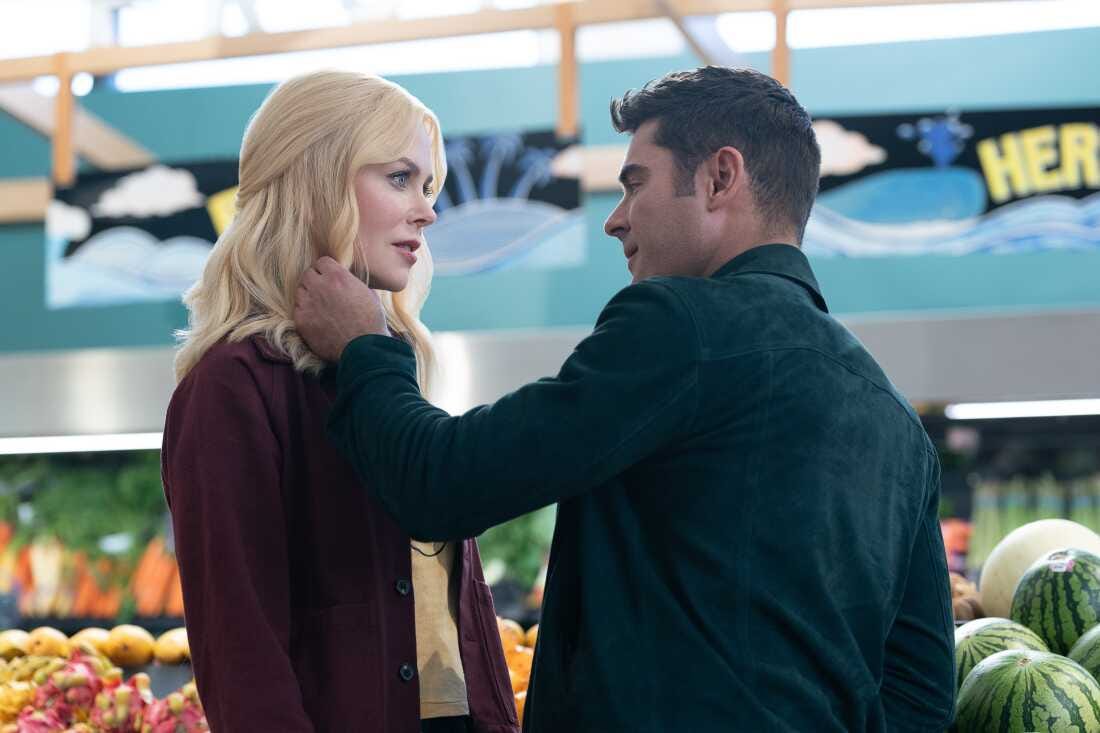
Light, silly rom-coms with predictable plots built around a Hollywood vet or two are a lo-fi way for streaming platforms to garner audiences. The Anne Hathaway mom-dating-younger-boy-band-hunk vehicle “The Idea of You” caught fire on Prime this year, and now on Netflix we have this Nicole Kidman-Zac Efron unlikelies-attract as Kidman’s widowed Brooke Harwood, an L.A. novelist, gets her groove back. She lives in a spacious, photo-worthy bungalow with her adult daughter Zara (Joey King, “The Kissing Booth”) who works for Efron’s Hollywood golden boy Chris Cole, something of a bland, watered-down hybrid of Tom Cruise and Robert Downey Jr. Chris is a dick of a boss who wants magical solutions to his first-world problems – my abs aren’t ripped enough, or my latte isn’t hot enough – and threatens to fire Zara in nearly every other frame. As you can expect, the family connection has him bumping into Brooke. Sparks fly, but Zara freaks out when she catches them in the act, especially knowing Chris is a serial dumper in addition to being a jerk to employees. The “affair” here, directed by Richard LaGravenese (“Living Out Loud”), is a plastic one, driven by hollow, entitled sorts with problems many would envy. Zara’s about the only one with a struggle that resonates (she wants to get into the film biz, but Chris keeps her locked into her gofer role). In the end, meandering the dew-misted produce aisles of a high-end boutique supermarket, she too gets shrink-wrapped.
Cult camp is an odd genre bucket that collects a vast variety of films dumped there for varying reasons. Some (“El Topo,” “Barbarella” and even the recently released “Sasquatch Sunset”) end up there by design; others (“Showgirls,” “Mommy Dearest”) wind up there because they’re unintended, rubbernecking-worthy spectacles. Two films from this week’s roundup land there with mixed results: “Hundreds of Beavers,” which had a held-over-by-popular-demand extended run at the Somerville Theatre this year and is now available on streaming platforms, and “Boy Kills World,” which played as part of the Boston Underground Film Festival at The Brattle Theatre and opens at Apple Cinemas Fresh Pond on Friday. Two different films with distinctly different outcomes.
‘Hundreds of Beavers’ (2022)
“Beavers,” co-written by director Mike Cheslik and star Ryland Brickson Cole Tews, shoots for something new and markedly left of center. What the pair has concocted is slapstick, silent-era comedy mixed with loopy Looney Tunes animation and modern-day special effects. Made for a mere $150,000, the film has a premise that feels affectionately borrowed from Chaplin or Keaton: A 19th-century applejack seller named Jean Kayak (Tews), perpetually hopped up on his own hooch, gets into a skirmish with an army of beavers in the frozen wilds of the northern Midwest – think “Jeremiah Johnson” (1972) by way of “The Gold Rush” (1925). The beavers aren’t cute CGI creations, but dudes in suits with ginormous buckteeth. There’s something to do with a fur trader (Doug Mancheski) and his winsome daughter (Olivia Graves) whom Jean fancies, but it’s mostly Jean versus the bevy of beavers with cartoonish boinks and bams and some fairly taxing physical comedy performed by Tews as he hops from one log to another in a sawmill and slip-slides his way across the ice as a legion of angry beavers chases after him. No dialogue is spoken, and it’s shot in black and white. The experience (did I mention the daughter is pretty good at disemboweling beavers with a knife?) gets a bit repetitious, but Cheslik and Tews, all in on the hijinks, save some zaniness for the last go-round.
‘Boy Kills World’ (2023)
“Boy Kills World” jumps out of the gate with promise; in the near dystopian future the aristocracy keep the masses in check with an annual lottery/purge called the “Culling.” What the film is, however, is a fairly pat, years-in-waiting revenge drama centered on a warrior known just as Boy (Bill Skarsgård, “Barbarian”) under the tutelage of a sensei (Yayan Ruhian, from the “Raid” films and “John Wick: Chapter 3 – Parabellum”) to beef up and exact revenge on Hilda Van Der Koy (Famke Janssen), the elitist who sanctioned the execution of his parents when he was an adolescent. The gimmick is that Boy can’t talk, yet the whole movie is narrated by him in voiceover. That’s done by H. Jon Benjamin (the voice of “Archer”), who makes Boy sound something like a cross between the gruff growl of Christian Bale’s caped crusader in Christopher Nolan’s “Batman” trilogy with the wily witticisms of Bruce Campbell in any of the Sam Raimi “Evil Dead” flicks. That is somewhat fitting, as Raimi serves as executive producer here, and though directed by Moritz Mohr, “Boy Kills World” has plenty of Raimi influences. The plot of rebel forces fighting an aristocratic tyranny means comparisons to films such as “V for Vendetta” (2005) are sure to drop, but the lesser, forgotten 1992 Mick Jagger vehicle “Freejack” is the more apt comparison, as the fun of watching Skarsgård the avenger’s parkour-propelled takedown of legions of baddies ultimately palls. Skarsgård, almost as jacked as older bro Alexander was in “The Northman” (2022), makes for an impressive onscreen presence, as does Jessica Rothe as the skilled assassin known as June27 equipped with a neat combat helmet that’s a cerebral message board of sorts. It’s too bad the narrative arc they ride isn’t as sleek and mean
David and Nathan Zellner churned out quirky, experimental indie works such as “Plastic Utopia” (1997) and “Goliath” (2008) and later veered into slightly more digestible alternative fare with “Kumiko, the Treasure Hunter” (2014), about a depressed Japanese office worker obsessed with the movie “Fargo” (1996) who searches for that film’s lost suitcase of cash. They opt for something more fantastic and scatological here as they embed us in a group of Sasquatch over the course of a calendar year. The film’s not far off from “The Dawn of Man” sequence in Stanley Kubrick’s “2001: A Space Odyssey” (1968); no human words are uttered, though there are plenty of human gestures. Amid the lush greenery of the Pacific Northwest we get to know our clan of cryptids; the brusque alpha male (co-director Nathan Zellner), the lone female (Riley Keough), the more demure junior male (Jesse Eisenberg) and an ostensibly adolescent ’squatch (Christophe Zajac-Denek). Early on we get a fairly gratuitous sex scene right out of “Clan of the Cave Bear” (1986), then there are bouts of masturbation and self-exploration of genitalia (yup, you get full-frontal bigfoot). As base as that may sound, the film unfurls more like a stock nature documentary until things move toward the comic and absurd: Employing a turtle withdrawn into its shell as something of a cellphone; or the alpha munching on what can best can be described as herbal hallucinogens and laying his desire for sex on a mountain lion, which does not go so well. It feels like “The Three Stooges” by way of Nat Geo, and near going over the top. There’s plenty of pissing and shitting too, especially when the clan discover a logging road running through their territory (it’s up to this point that it’s unclear if we’re in the Paleolithic or the present) and experience the need to mark it. As much as you could say it’s a “Beavis and Butt-Head” spin on the Pakuni from the 1970s Saturday morning TV staple “Land of the Lost,” there is vulnerability, fear, compassion, grief and a sense of community that registers onscreen. Well crafted (the costume, makeup and cinematography impress), “Sasquatch Sunset” is at turns weirdly touching and, as the title suggests, there is the heartbreak of witnessing what may be the last of a rare breed.
The title might tie you up with thoughts of “The League of Extraordinary Gentlemen,” and isn’t too far off – both are about teams assembled by the British government to stave off evil forces with world domination in mind, and both have links to James Bond (more on that later). Beyond that, one is based on a comic book and the other on the real-life derring-do by a ragtag team of World War II commandos trying to cripple the Nazi naval war machine as Britain remains the lone European holdout against Hitler and prays for the entry of the United States into the war.
Based on Damien Lewis’ 2016 nonfiction book spun up from Winston Churchill’s declassified papers, the Guy Ritchie-helmed film homes in on Operation Postmaster, one of Churchill’s unauthorized and unsanctioned covert ops that proved instrumental in swaying the balance of power in the war.
The rich potpourri of strapping can-dos is led by Maj. Gus March-Phillips (Henry Cavill, aka Superman, rocking a killer handlebar mustache), sprung from the brig for the suicide mission. With him are explosives expert Freddy Alvarez (Henry Golding, “Crazy Rich Asian”), Henry Hayes (Hero Fiennes Tiffin), captain of the modest fishing vessel used for the operation, and gleeful Scandinavian killing machine Anders Lassen (Alan Ritchson), who would give Alexander Skarsgård’s berserker in “The Northman” (2022) a run for his money in bloodletting and wear a broad beaming smile while doing it. The target is a critical Nazi supply ship (of CO2 filters for U-boats) and ammo depot on the West African island of Fernando Po, then a Spanish colony. Along the way the raffish rascals sink a Nazi patrol boat, liberate tactical strategist and ladies man Geoffrey Appleyard (Alex Pettyfer) and tangle with a British destroyer. They have operatives on the island as well with Richard Heron (Babs Olusanmokun) who, a la Rick in “Casablanca” (1942), runs a casino, and club chanteuse Marjorie Stewart (Eiza González), who’s deadly with a pistol but oft dangled as bait to ply Nazi command.
Ritchie, known for his cheeky, stylistic verve (“Lock, Stock and Two Smoking Barrels” and “The Gentlemen”), which the director set aside for his other “truly happened” effort “Guy Ritchie’s The Covenant” (2023), reverts pleasingly back to his roots. It’s “The Guns of Navarone”(1961) if reenvisioned through an “Inglourious Basterds” (2009) lens. The cast is all in, even if the narrative, long for its two-hour running time, ebbs when it should be cresting.
Back to that Bond thing: Under hushed asides from Churchill (played by Rory Kinnear, so electric in “Men” but no Gary Oldman here) there’s a Brigadier Gubbins code-named “M” (Cary Elwes) and his aide, a young Ian Fleming, the guy who would go on to pen the secret-agent novels–allegedly inspired by Cavill’s suave Major. The original 007, Sean Connery, played Allan Quatermain in that other “Gentlemen” movie.
2023 was a quietly powerful year at the movies. It marked the return of the sharply observant auteur, Jonathan Glazer after nearly a decade away since his beguiling sci-fi effort “Under the Skin.” Sure, we had the bofo ado over “Barbenheimer,” but anything for a headline and marketing promotion, right? I deeply appreciated “Barbie” and its pink ambition, but it didn’t crack my top 20. Of my top 10, five are International (Non-English) and three are documentaries—it was a very strong year for docs. Also, if you’ve never heard of the German actress Sandra Hüller, learn about her quick as she dominates the top of this year’s list, and whose name is destined to be called during award nods.
1. Anatomy of a Fall
Justine Triet’s “Anatomy of a Fall,” winner of the Palme d’Or at Cannes, dissects the slow, vicious implosion of a marriage. The reasons why are the usual suspects: grief, blame and jealousy. But there’s little else usual about Triet’s emotionally eviscerating narrative, which begins with the death of one spouse and, in carefully curated frames, rewinds as the survivor is put on trial for murder. The performance by Sandra Hüller as a revered German writer living in the remote highs of the French Alps and then subjected to character dissection in the courtroom, is immersive, fully felt and the reason the film rivets from opening to closing frame. Between her work here and “Zone of Interest” Hüller could see her name called twice when Oscar nominations are announced.
2. Zone of Interest
It’s been ten years since Jonathan Glazer last enchanted us with Scarlett Johansson as an otherworldly temptress in “Under the Skin,” driven by Mica Levi’s intoxicating and mood setting score. Interestingly “Zone” is a Holocaust film, which most would likely think, we’ve already done it to the point that there’s no new way to spin it to open one’s eyes anew. The answer is wrong. In this brave and unflinching adaptation of the Martin Amis novel (the writer passed earlier his year before the movie’s premier) Glazer replaces Amis’s fictionalized overseers of Auschwitz, dialing in tight on real-life camp commandant Rudolf Höss (Christian Friedel), his family (Sandra Hüller as his wife Hedwig) and their daily lives. You never really glimmer the inner workings of the diabolical Nazi machinery, instead you sit with the Höss’s as they dine and school their children in a well-manicured bungalow in the shadow of a high wall. Every now and then you hear a muffled wail, or the distant shots of gunfire—background noise that unnerves us the viewer as we drink in the complacency of a society willfully enlisted to undertake one of the most sinister acts of hate ever entered into the history books. Friedel and Hüller are flawless, and Levi again serves up a score that adds layers to deep moments unfurling onscreen.
3. You Hurt My Feelings
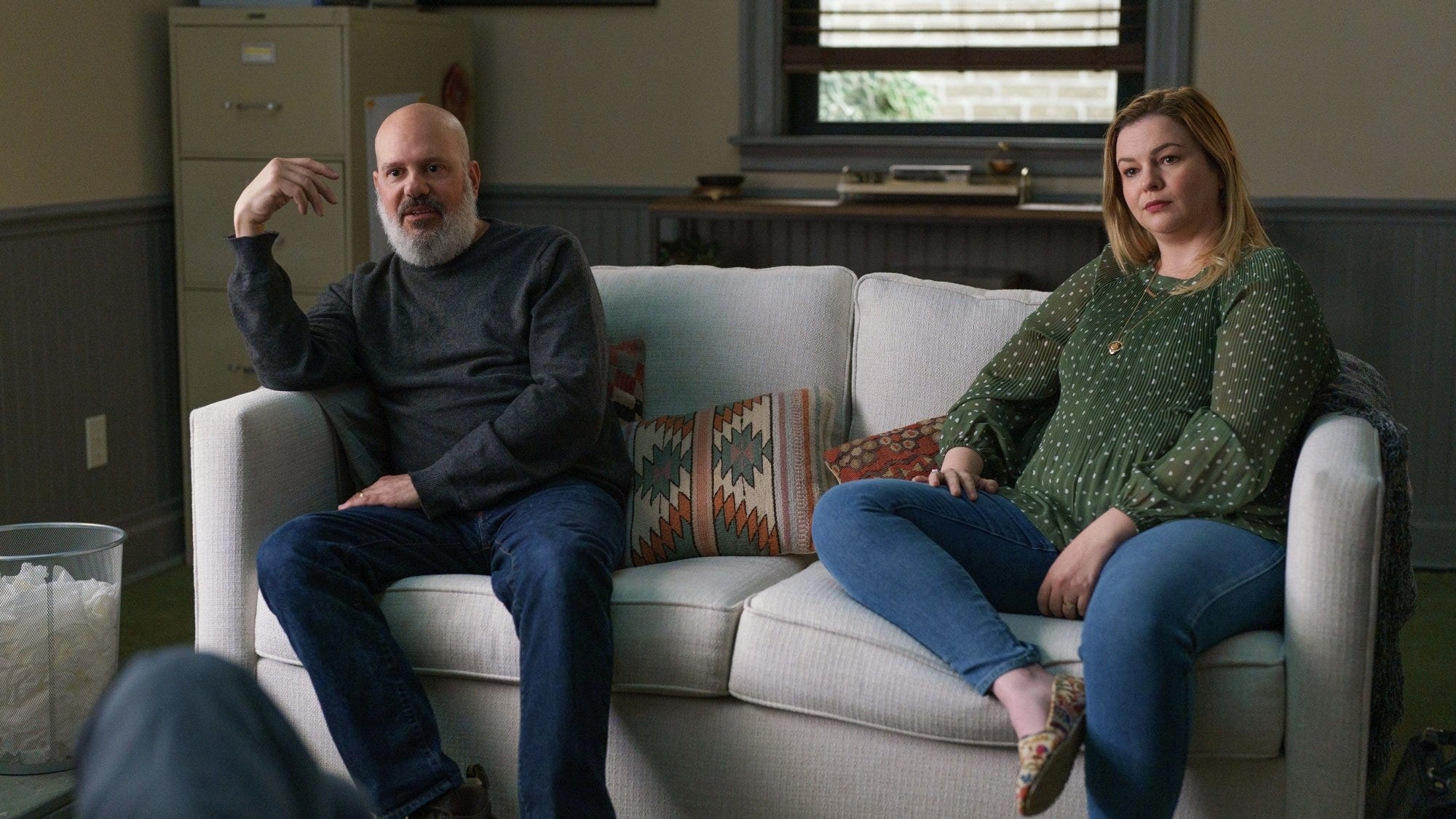
Indie writer-director Nicole Holofcener, the force behind such insightful dramadies as “Friends with Money” (2006) and “Lovely & Amazing” (2001), reunites with Julia Louis-Dreyfus (the pair worked on “Enough Said” back in 2013) for this barbed gem about the tender balance between brutal honesty and obligatory, loving support when Louis-Dreyfus’s Beth, a struggling novelist, overhears her husband Don (Tobias Menzies), tell his brother-in-law Mark (Arian Moayed, “Succession”) that he does not like Beth’s latest that’s still looking to catch on with her publisher. To her face, however Don tells her he likes it and thus a simple, but nagging conundrum ensues:does Beth confront Don or not? The sharp script moves in unexpected ways as Beth’s self-esteem is chipped away at by her publishers and her students in the classroom she commands. The bits with Don, a therapist with some of his own mounting professional woes, challenged by some of his clients including real-life wife and husband Amber Tamblyn and David Cross playing a miserable married couple, makes for dark, bristling hilarity. And as much as you laugh, the nuggets of revelation onscreen serve as a mirror to look uncomfortably inward.
4. The Holdovers
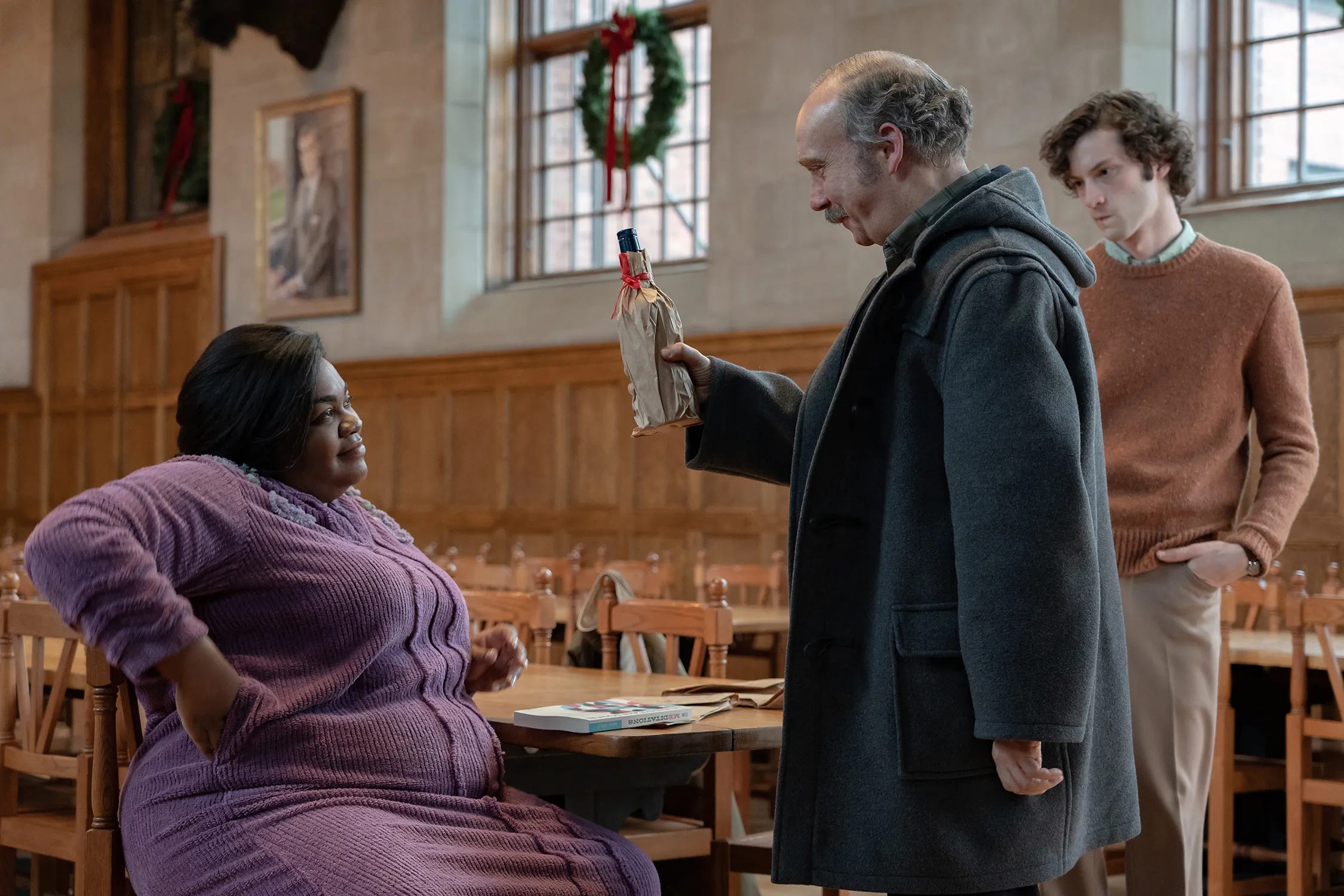
The latest from Alexander Payne (“Sideways,” “Citizen Ruth”), set at an all-boy, New England prep school in the early 1970s, bears the distinct tang of J.D. Salinger, not to mention Wes Anderson’s “Rushmore” (1998) as it homes in on the loneliness of the disenfranchised among the entitled elite. The setup’s fairly straightforward: Paul Hunham (Paul Giamatti), a gruff, unapologetic Western Civ. professor, is the faculty member who’s drawn the short-straw assignment of looking after the “holdovers” for Christmas break at a fictional New England preparatory called Barton. Joining Hunham and the five boys is school cook Mary Lamb (Da’Vine Joy Randolph, divine and scene-stealing) a Black woman who spends much of her time – even when cooking – drinking and smoking to hold down the grief of having just lost her only child, a Barton grad (the only non-caucasian we know to attend the school besides one Korean boy) killed in the Vietnam War. The film comes down to the human connection between the cantankerous Hunham and last lingering holdover, Angus Tully (Dominic Sessa, deep and winning in his big screen debut) as past skeletons come to the fore and human connections are the only means of redemption.
5. Oppenheimer
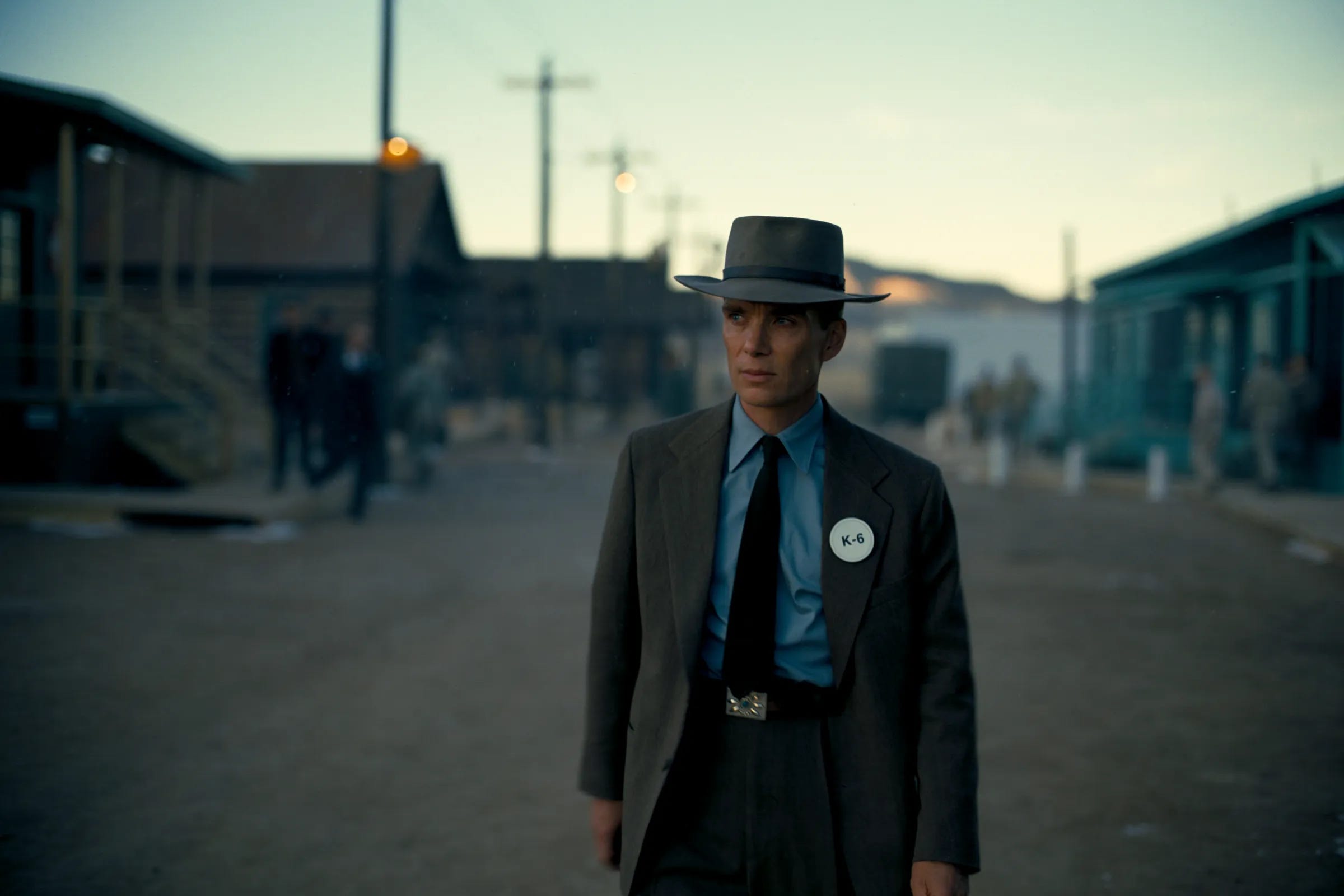
Christopher Nolan’s grand bio-pic plays loyally to its roots, the 2005 biography “American Prometheus: The Triumph and Tragedy of J. Robert Oppenheimer” by Kai Bird and Martin Sherwin, as both embrace Oppenheimer (“the father of the atomic bomb”) as a committed yet complicated man, caught at many crossroads: the morality of mass destruction, the dirty politics of Cold War paranoia as well as many messy personal relationships. As Oppenheimer, frequent Nolan collaborator Cillian Murphy portrays the scientist as a reserved, buttoned-up sort with a kind, demurring affect. He’s charismatic and approachable, with piercing blues and a gaunt sheen clearly deepened for the part, and Oppie’s signature wide-brim porkpie fedora goes a long way to cement the image. It’s a bravura performance that rightly sends Murphy, best known for the series “Peaky Blinders” and Danny Boyle’s “28 Days Later” (2002), to the fore after many years of almost getting there. He feels custom minted for the part. How Nolan pulls it all together is interesting in how much you see – or don’t – of the actual use of the atomic bomb and the devastation it had on Hiroshima and Nagasaki (though it’s in the corner of every frame) versus the high of the Trinity experiment at Los Alamos (well-orchestrated cinematically) and chaotic proceedings in the rooms and halls of government. Ever meticulous, Nolan also does a masterful job of gathering subthreads and small gestures and weaving them into surprising and disparate places with subtle poetic panache that doesn’t scream, “Did you just see what I did there?”
6. Killers of the Flower Moon
Working from journalist David Grann’s 2017 real-life account with the additional tag “The Osage Murders and the Birth of the FBI,” there’s much in Martin Scorsese’s film that leverages the director’s mean-streets, gangland roots and much that unfurls, that if not stated as nonfiction, would otherwise be hard to believe. Set on an Osage reservation post-World War I, “Killers of the Flower Moon” has the grand, neo-western feel of Michael Cimino’s “Heaven’s Gate” (1980) and even Sergio Leone’s “Once Upon a Time in the West” (1968) as Leonardo DiCaprio’s Ernest Burkhart, returning from the war (a cook, not a soldier, because he has a weak stomach) steps off a train in Fairfax, Oklahoma, and through nefarious opportunistic schemes orchestrated by Burkhart’s business man uncle William “King” Hale (Robert De Niro), making the bulk of his wealth off the Osage who have conditional oil rights, marries an Osage woman (Lily Gladstone who hold court with Oscar winners DiCaprio and De Niro) to bilk her of assets. The insidious ripples of colonialism and false sense of human respect and equality are put on full display; a must see for those who cling to the tenets and practices of American expansionism.
7. Geographies of Solitude
Jacquelyn Mills’s arresting documentary in one long, riveting contemplation on nature, loneliness, and commitment. The film depicts Sable Island a harsh stretch of land 100 miles off the coast of Nova Scotia as it follows the island’s only resident, Zoe Lucas who’s been there since the early 1970s studying the niche ecosystem where only horses, seals and insects thrive. The use of archival footage (Jacques Cousteau makes a visit via helicopter) and Lucas still going about her business in the now (cataloging the horses and tracking plastic pollution around the globe) is woven together as a medication that invites you onto the island in an observant, intimate way.
8. 20 Days in Mariupol
When Russia invaded the Ukraine in February of 2021 Associated Press video journalist Mstyslav Chernov was imbedded at a hospital in the port city of Mariupol. What Chernov endures and witnesses is the early part of the siege where residents trying to go about their daily lives are caught up in something they can’t quite comprehend. As Chernov weaves his way around the city with his crew it becomes evident too that he must leave, but most venues have been shut down. It’s a harrowing boots on the ground view into the wanton incursion that still pervades today.
9. Menus-Plaisirs – Les Troisgros
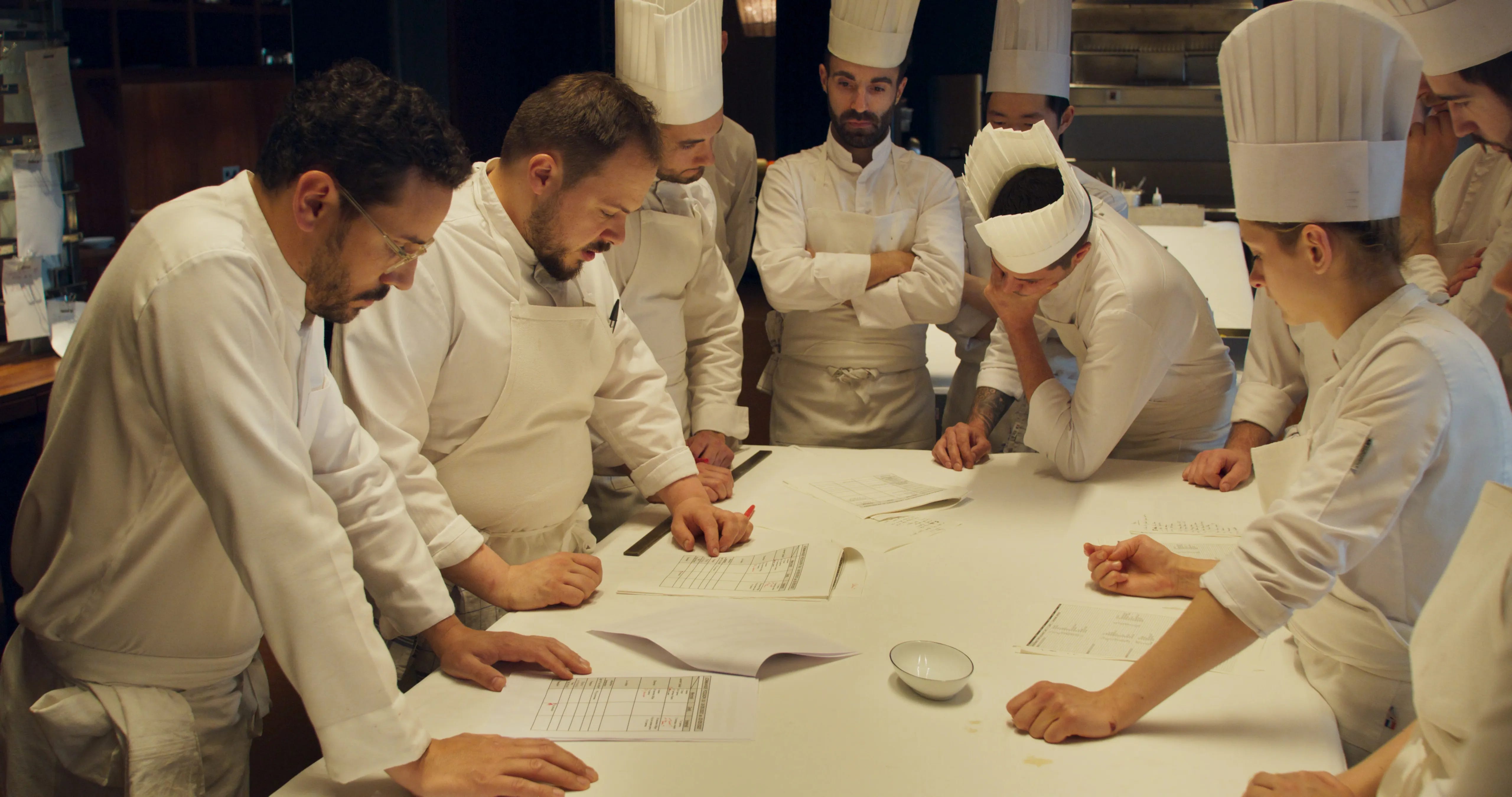
Loosely translated “The Menu” and nothing to do with last year’s elite dinner party turned torture fest. At the young age of 90, local documentarian Fred Wiseman (“Titicut Follies”) shows no signs of slowing down with this lens turn on Troisgros family, who run the Michelin 3-star restaurant La Maison Troisgros in Central France. At four hours, the running time may give you pause, but Wiseman, a master of fly-on-the-wall observation, captures all the right moments, head chefs planning meals, the quality control selection of ingredients and the ballet of orchestration in the kitchen when it’s showtime. Reality TV cooking show this is not, it’s authentically more real, there’s no stitched together narrative for pomp and hype, just careful attention, arduous repetition, the hard work and the dish assembly collaborations that bring a world class meal to mouths expectant diners’ palates.
10. Taste of Things
Keeping with all things culinary is this visually scrumptious feast from Tran Anh Hung (“Scent of Green Papaya,” “Cyclo”), a keen observer of human longing, subtle sensualities and social restraints, which tells the tale of a cook Eugenie (the ever sublime Juliette Binoche) 20 years in the service of tacit gourmand Dodin (Benoît Magimel, on the mark here and also strong in “Pacification” that also came out this year). Based on the popular French novel “The Passionate Epicure” by Marcel Rouff, the culinary doings take place at a French chateau in the late 19th century as Eugenie and her small staff, with close oversight from Dodin prepare lavish and complex meals for Dodin’s coterie of friends. The long takes of food preparation are so stunning and in-the-moment, you can almost taste what you are seeing. It’s also impressive that the two-decade relationship between Eugenie and Dodin is conveyed in full through furtive glances and short exchanges as one peers through billows of steam rising from a pot or they carefully tresses a bird. Food hasn’t been this sensual or used as a narrative vehicle so completely since the “Babette’s Feast” (1987).
Close and in the hunt: Yorgos Lanthimos’s feminine, sexual spin on Frankenstein, “Poor Things,” Celine Song’s haunting tale of longing in “Past Lives,” the killer tandem of Juliane Moore and Natalie Portman in Todd Haynes’s “May December,” the creepy vacation excursion “Infinity Pool” from Brandon Cronenberg, son of horror auteur, David, the witty and endearing animation feature about a dog and his ‘bot, “Robot Dreams,” single mother, life balance nightmares in “Full Time,” Zac Ephron transforming himself into a WWE bruiser in Sean Durkin’s wrestling bio-pic, “Iron Claw,” “The Pigeon Tunnel,” Errol Morri’s intimate look into the surprising back story of David Cornwell: aka famed spy novelist John le Carré, the always excellent Mads Mikkelsen battling for land rights in “The Promised Land,” and Wim Wenders (“Wings of Desire”) helming “Perfect Day” the current Japanese entry for Best International Feature.
“Star Wars: The Last Jedi” picks up right where “The Force Awakens” left off, and smartly so with Rey (Daisy Ridley, amping up the grit factor favorably) on a remote, bucolic planet trying to press Luke Skywalker (Mark Hamill) into a few rounds of Jedi training while Luke’s sister, Princess/Gen. Leia (a fitting final performance from Carrie Fisher, who passed away after principal photography completed) tries to steer the remaining Resistance forces to a new base with the evil Empire’s First Order in hot pursuit. How it all sorts out isn’t a straightforward affair, and that plays to its advantage with plenty of twists, turns and pleasant surprises to hold an audience rapt over the two-and-a-half-hour running time.
Given all that, it’s still an unenviable task to have to take over the reins from J.J. Abrams, the creative wunderkind who helmed “The Force Awakens” and has a reputation for making what’s old trendy and hip again – i.e., the “Star Trek” reboot – but Rian Johnson, who also scripted, proves more than game to go where Abrams has taken the next franchise trilogy, and beyond. To be sure, there’s a lot going on in “Last Jedi”; the gaping absence of Han Solo (Harrison Ford), the elevation of Skywalker back to the fore (Hamill well up to the task), the deeper darkening of Darth Vader successor Kylo Ren (a palpably conflicted Adam Driver) and the Trump-like megalomania of the craggy supreme leader with the silly moniker of Snoke (Andy Serkis doing what he does best: seamless live-action capture) and even Yoda – yes, Yoda. But Johnson, who had so effectively juggled time travel threads folding back in on themselves in the satisfying sci-fi thriller “Looper” (2012), orchestrates it all masterfully, jumping from one far-flung point in the galaxy to the next without disconnect, and with plenty of humor and wit to fill any dead space. Continue reading →
Guillermo del Toro returns to fine form with this fairy tale-cum-horror story that effectively echoes the texture, mood and style of his 2006 gem, “Pan’s Labyrinth.” Appetizing as that sounds, “The Shape of Water” doesn’t quite have the fullness or magical immersion of the Mexican auteur’s crowning achievement (to date) – but that’s a mighty yardstick for any film to be measured by.
Set in Cold War-era Baltimore, the narrative flows through the mundane life of a demure, mute cleaning woman named Elsa (Sally Hawkins, who lays it all on the line and should be recognized for such a fine effort), who we learn grew up an orphan and was abused as a child. Given all that, Elsa’s got pretty neat digs above a classic nickelodeon (and del Toro has fun with the marquee and features it plays) and works the nightshift at a secretive military installation where all kinds of strange experiments growl and bark from behind steel doors – often requiring a SWAT team of cleaners to mop up the bloody aftermath.
Locked behind one such portal is an amphibious humanoid referred to as “The Asset,” something of a sleeker version of the Creature from the Black Lagoon if crossed with Abe Sapien from del Toro’s raucously fun “Hellboy” films. Chained and shackled in a pool, the creature is routinely beaten and electrocuted by a square-jawed operative named Strickland (Michael Shannon) who fished it out of the murky waters of South America. Strickland goes after his charge with all the oppressive superiority of a plantation owner, and Shannon’s natural southern drawl helps sell the notion. If there’s any question as to what del Toro is aiming for, there’s a scene at a diner where a black couple are not allowed to sit at the counter and Elsa’s next-door neighbor, Giles (Richard Jenkins), exists deep in the closet and is shunned regularly for his quirky “difference.” Then there’s Elsa’s understanding work partner, Zelda (the ever-affable Octavia Spencer), an African-American woman. In short, everyone around Elsa who gets her is disenfranchised or oppressed. They’re a merry band of outliers, a not so subtle sociopolitical subtext – that feels a bit too strapped on – and the most robust and likable of all that come across the screen. Continue reading →



























 Given all that, it’s still an unenviable task to have to take over the reins from J.J. Abrams, the creative wunderkind who helmed “The Force Awakens” and has a reputation for making what’s old trendy and hip again – i.e., the “Star Trek” reboot – but Rian Johnson, who also scripted, proves more than game to go where Abrams has taken the next franchise trilogy, and beyond. To be sure, there’s a lot going on in “Last Jedi”; the gaping absence of Han Solo (Harrison Ford), the elevation of Skywalker back to the fore (Hamill well up to the task), the deeper darkening of Darth Vader successor Kylo Ren (a palpably conflicted Adam Driver) and the Trump-like megalomania of the craggy supreme leader with the silly moniker of Snoke (Andy Serkis doing what he does best: seamless live-action capture) and even Yoda – yes, Yoda. But Johnson, who had so effectively juggled time travel threads folding back in on themselves in the satisfying sci-fi thriller “Looper” (2012), orchestrates it all masterfully, jumping from one far-flung point in the galaxy to the next without disconnect, and with plenty of humor and wit to fill any dead space.
  Set in Cold War-era Baltimore, the narrative flows through the mundane life of a demure, mute cleaning woman named Elsa (Sally Hawkins, who lays it all on the line and should be recognized for such a fine effort), who we learn grew up an orphan and was abused as a child. Given all that, Elsa’s got pretty neat digs above a classic nickelodeon (and del Toro has fun with the marquee and features it plays) and works the nightshift at a secretive military installation where all kinds of strange experiments growl and bark from behind steel doors – often requiring a SWAT team of cleaners to mop up the bloody aftermath.
 For What it's Worth