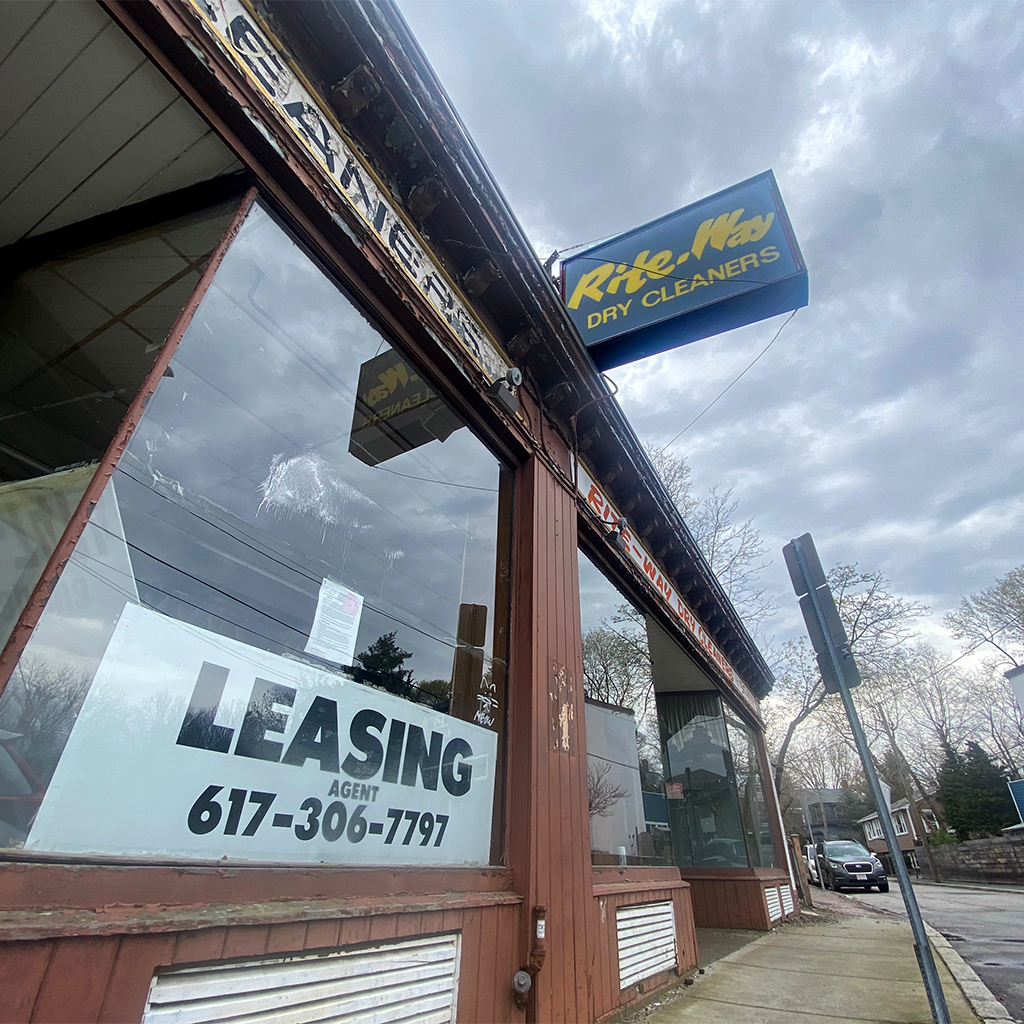
The empty former Rite-Way Dry Cleaners on Hudson Street in Cambridge’s Neighborhood 9 on Saturday.
Levels of contamination at the empty former Rite-Way Dry Cleaners are “high” and nearly unprecedented in their complexity in the experience of a 28-year environmental expert who talked with neighbors at a Thursday meeting.
A best-case scenario for remediation would be to demolish or do significant reconstruction of the structure, which would allow direct access for removal of contaminated soil under the building at 4 Hudson St. in the North Commons neighborhood of Neighborhood 9, said Daniel G. Jaffe of Environmental Properties, a firm in Newton.
The meeting was held as part of a state Department Environmental Protection public involvement plan required by the petition of concerned residents, mostly those living on lower Bowdoin Street and the abutting property of 3-5 Shepard St. At the meeting held at the Cambridge Main Library, illustrations from Jaffe showed a potential plume of impact ranging from Hudson Street down Massachusetts Avenue to south of Marathon Sports.
The Rite-Way structure was built in 1925 and has hosted a dry cleaning business from the 1960s until Rite-Way shuttered in the first half of 2018, according to documents prepared for the site’s owner, Nathaniel Swartz of Tennessee, and filed with the state. The building is technically part of a 1670-1672 Massachusetts Ave. parcel that also houses Floyd’s Barbershop and Wrapro Falafel & Grill, all owned by Irving Swartz until his death in 2006 and now handled by trustees, according to documents filed at the Middlesex Registry of Deeds.
When Rite-Way was in business, it was a point of pride for owner Babu Patel that his was “the only dry cleaner in the area who cleans clothes on-premises,” he told the publication American Drycleaner in 2014. “That means I can control quality as well as garment flow.” But it’s turned into a headache for Swartz’ trust, because suspected contamination makes a sale or leasing complicated. Under law, the owners of the property do not have to remediate contamination to sell, but they do have to disclose the contamination to a buyer, and it’s harder to finance purchase of a contaminated site and to insure it.
The property is represented by realtor Roy Papalia of Belmont, who said he’s had 4 Hudson St. on and off the market several times over the past half-dozen years. In a recent go-around, the trust decided to have the site tested, he said. (Nathaniel Swartz was reached by phone Friday evening but deferred questions to an attorney.)
Venting contaminants
Documents filed with the state in 2022 by Jaffe referred back to testing as early as 2017, before Rite-Way closed. Contamination reports on the Massachusetts Office of Energy & Environmental Affairs website show significant quantities of tetrachloroethylene and trichloroethylene, chemicals used in dry cleaning that have been linked to liver, cervix and lymphatic system cancer.
Jaffe has tested air and soil in eight potentially affected buildings and installed in Floyd’s, Wrapro and the former Rite-Way what are called sub-slab depressurization systems – airtight PVC pipe systems that pump toxic vapors from under the building and vent them into the outside air. They are not final remediation solutions, but make human living areas safer and habitable until such measures can be accomplished.
It was the installations of these systems last year that upset neighbors in the two- and three-story structures around the single-story former Rite-Way, because the pipes’ mouths were not equipped with filters. Jaffe assured attendees at the Thursday meeting that the air being released is tested regularly and not a public health threat, with toxins below hazardous levels. Residents of 3-5 Shepard St. pushed back, citing their experience during a 2016 dispute with the owner of a restaurant called Shepard (in the space that now houses Moëca) when smoke from the restaurant’s wood-grill oven blew into their homes because of wind coming off Massachusetts Avenue and over one-story structures such as the restaurant and Rite-Way.
The systems essentially provide clean healthy environments for the trust’s tenants while releasing unhealthy air into the larger community, resident Bhupesh Patel said after the meeting.
Remediation planning
The best way to remediate is to remove the contaminated soil, but the multiple buildings involved in a dense urban area present logistical issues. Jaffe said microbes could be injected into the soil to break down the toxins, but that process takes longer and can also expand the borders of the contamination. Similar if lesser contamination once found at 1615 Massachusetts Ave., a site owned by Harvard, was remediated easily because a building was razed and the contaminated soil removed, Jaffe said.
The final version of the PIP is due June 7 with a public feedback period.
Deb Zucker, a resident at 3 Shepard St., said she was unaware of the contamination until her building got a request to have testing done on the property. It was the residents who then filed Dec. 23 with the state to get Rite-Way designated as public involvement plan site, which compelled the public informational meeting and interviews with the residents and state and local officials.
No representative from the state DEP attended the Thursday meeting; the office was contacted for comment Friday by email but did not immediately reply. State Rep. Marjorie Decker’s office sent a representative Thursday to better understand the situation.
“Nobody knows what’s going on,” said one Shepard Street resident. “There is no trust.”


 If that sounds like a win-win, it is – except that to do so you must get shrunk down to five inches and live in domed enclaves full of mini mansions, rolling green golf courses and swank nightclubs and eateries. Once done, your $50-a-week food budget can cover you for half a year. It’s a choice, and the world is roughly split down the middle between bigs and littles. Occupational therapist Paul Safrenek (local boy Matt Damon, more in the news these days for his backfiring #MeToo opines) and his wife, Audrey (Kristen Wiig, in the film far too little) decide the only way to achieve the house of their dreams is to go small. The medical process isn’t so easy either, and god forbid you leave dental implants in during the process. The matter for Paul becomes a quest for self-discovery in a new land after his wife (genders separate as they do the process en masse and in the bare) balks in the eleventh hour before shrinkage and hops a jet elsewhere.
  For What it's Worth