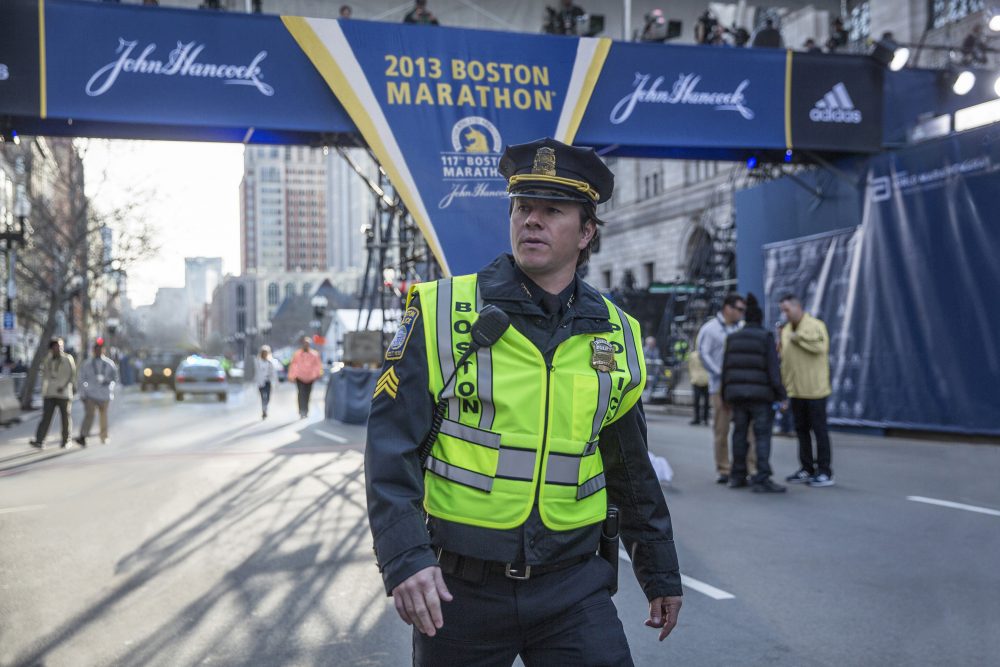
So here comes the big cinematic rendering of the 2013 Boston Marathon bombing that rocked the city for the better part of a week and now seems destined to be etched into our collective history just below city-defining headliners like the Boston Tea Party, busing in the ‘70s and the murderous legacy of Whitey Bulger.
The good news about “Patriots Day,” which opens Wednesday, is that it delivers a modicum of cathartic release as well as an intriguing look behind the scenes as an active crime investigation takes shape. The bad news, however, is that it knowingly injects fiction into the mix in a way that nearly subverts the project’s mission of “getting it right,” as Boston-bred star and producer Mark Wahlberg has said repeatedly. In the process, the dramatization shortchanges those that were there — the heroes and the victims — and the character of our fair city.
Three screenwriters, including the director Peter Berg, are credited with the script. The studio’s publicists informed me that the sources ranged from conversations with the Boston Police Department and other local agencies that responded to news reports and “60 Minutes.” What they’ve cooked up feels like a cobbling together of news feeds condensed and sanitized into a singular heroic narrative that regularly brims with the Boston Strong motto.


 The story of how Bulger undermined the North End Mafia and rose up to became the city’s criminal kingpin, then vanished for almost 15 years, all while being the brother of Massachusetts’ most powerful politician, always seemed bigger than the papers it was printed on (or for the broad screens of the first generation of flat-screen TVs sold at Lechmere). Here, in the hands of director Scott Cooper, who did well with “Crazy Heart” (2008) and “Out of the Furnace” (2013), the narrative become a bit too broad to settle in and gel. It’s choked with details and not enough nuance. That’s understandable in part because it is based on the book “Black Mass: The True Story of an Unholy Alliance Between the FBI and the Irish Mob” by Boston Globe reporters Dick Lehr and Gerard O’Neill (since retitled “Black Mass: Whitey Bulger, the FBI, and a Devil’s Deal”), but still, screenwriters Jez Butterworth (“Edge of Tomorrow”) and Mark Mallouk never free themselves and take chances. The framework of FBI interrogations, whether in the now or in flashbacks, doesn’t add much; it only cuts into Depp’s screen time as his steely-eyed Whitey and his posse off gruesomely anyone who looks at them the wrong way. There’s also the late development in which O’Neill and Lehr drop in as Bernstein and Woodward on the case.


 For What it's Worth