Tag Archives: Bike

Critical Mass comes to Cambridge to remember three riders who died after being hit by vehicles

29 Sep

Bicyclists ride a Cambridge rotary Friday to honor three victims of fatal crashes.

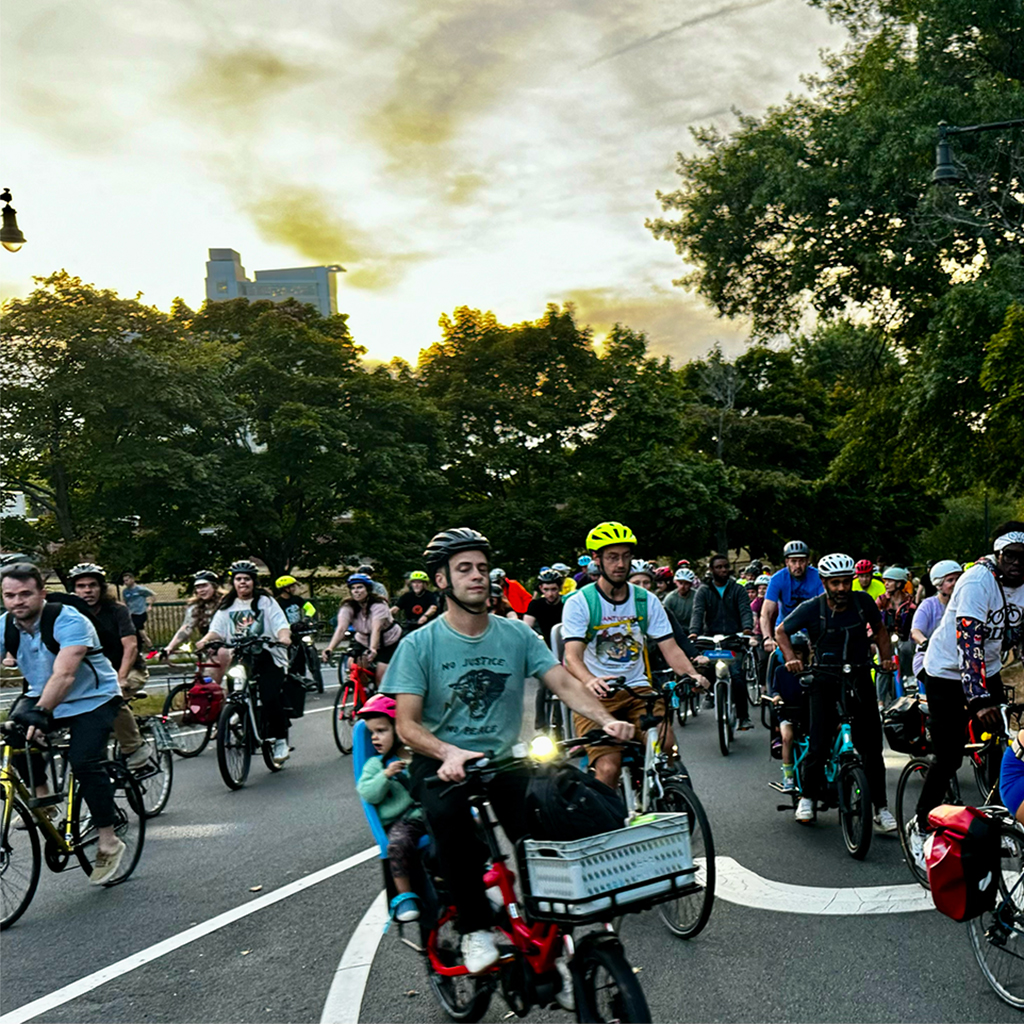
More than 700 bicyclists came Friday to ride three times around the Cambridge rotary where Memorial Drive intersects with the Boston University Bridge – once for each of the riders who have died on Cambridge Streets over the past four months: Minh-Thi Nguyen and Kim Staley, who were struck and killed in June, and John Corcoran, who was killed Monday on a sidewalk by the nearby DeWolfe Boathouse.

The rush-hour protest was put on by the Boston chapter of Critical Mass, an organization with branches in several hundred cities worldwide that hold group rides to promote street safety and advocate for better cycling infrastructure.

Riders met at the Boston Public Library for a brief rally before heading to the bridge near the boathouse where Corcoran was struck. The ride continued down Memorial Drive before heading back into Boston across the Harvard Bridge, ending at Boston Common. The ride was well organized, with ride marshals giving commands to stop or mass up to obey the rules of the road or to let cars out caught in the throng of riders.

Critical Mass had gone dormant in the area for nearly eight years because many members felt there was a confrontational aspect growing among the ridership. Citywide group rides morphed into the Boston Bike Party, which had a more festive and less activist evening events; Critical Mass rides targeted rush hours on the fourth Friday of every month.
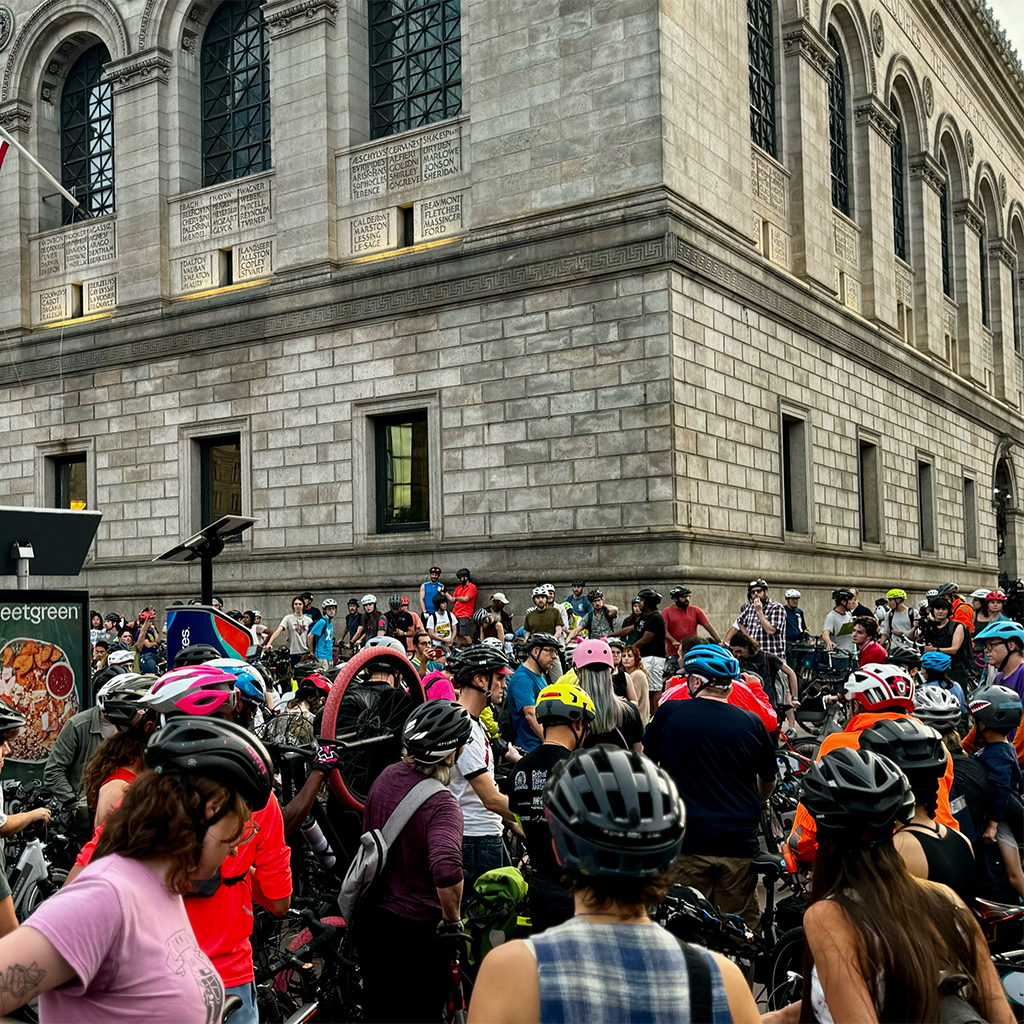
Bicyclists gather in Boston on Friday before riding into Cambridge for a memorial. (Photo: Tom Meek)

The dedication of Corcoran’s ghost bike was held Saturday at the BU boathouse. In attendance were Corcoran’s family and friends and about 100 cyclists and other community members.

Ghost bikes mark where cyclists have died; a bike painted white is chained at the site permanently. “We have placed too many of these,” MassBike director and volunteer ghost bike committee organizer Galen Mook said at the ceremony.

The service was co-led by the Revs. James Weldon, Corcoran’s minister at the Parish of the Good Shepherd in Newton, and Laura Everett, a bike advocate and part of the ghost bike committee. Weldon biked to the ceremony and was clad for it. The bike was donated by Bikes Not Bombs in Boston’s Jamaica Plain neighborhood and painted by committee member Peter Cheung. The ceremony focused on community and grief for Corcoran, an investment manager who was remembered as a kind and giving spirit with strong ties to Harvard University, where his son and daughter – who were in attendance – are a senior and a junior.
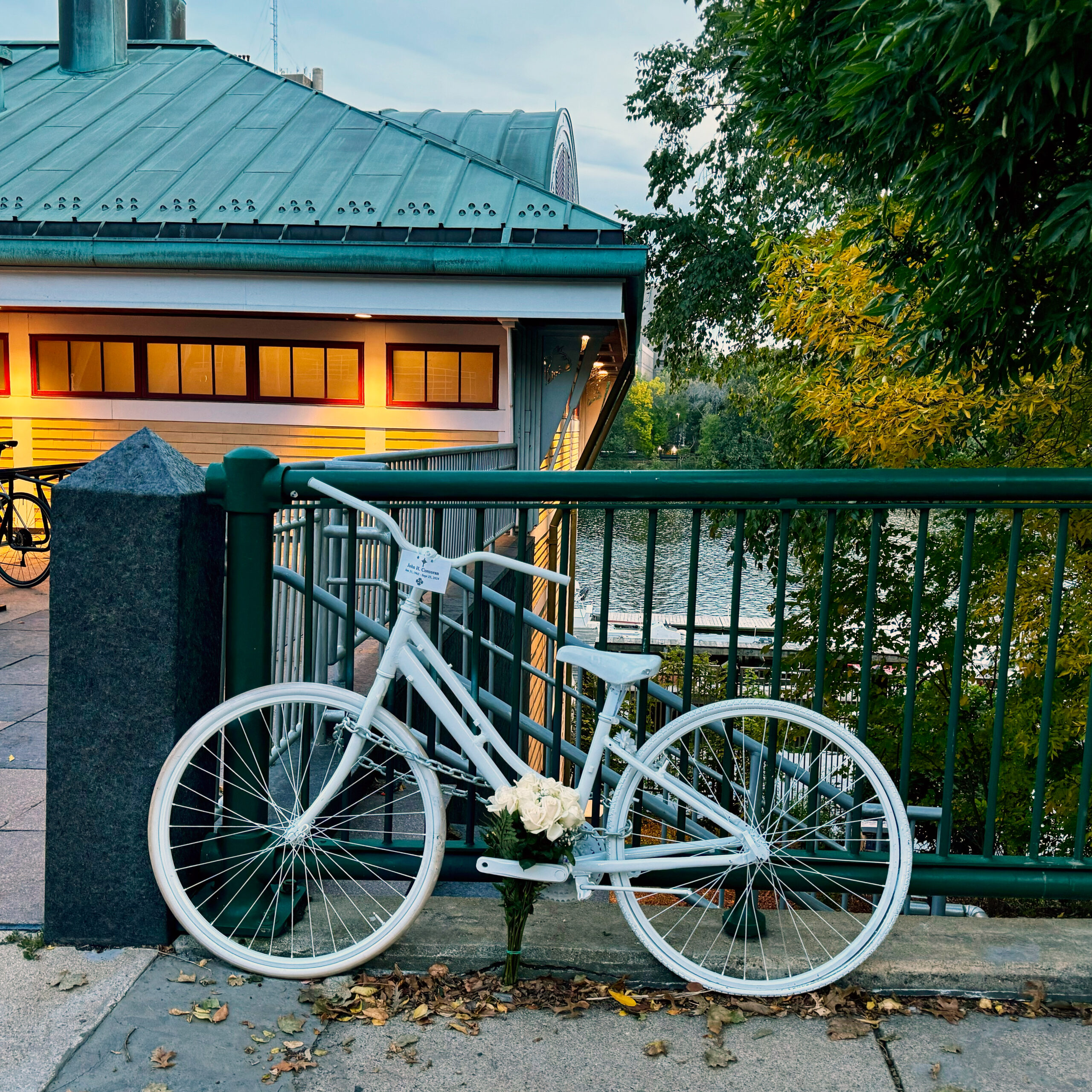
The ghost bike placed Saturday in honor of John Corcoran.

There was a time for advocacy and a push for change, but that was not the purpose Saturday, Mook said in remarks to the crowd. They were hard to discern as cars on Memorial Drive zipped by fast enough to make attendees on the sidewalk uncomfortable.

“We’ve been begging the DCR for seven years to make changes to this road, and we’ve been continually ghosted,” said Jamie Katz-Christy, head of the Green Streets Initiative and a member of the Cambridge Bicycle Safety Group and Memorial Drive Alliance. She referred to the state Department of Conservation and Recreation, which oversees the road.

A department spokesperson told The Boston Globe on Wednesday that work was underway “to introduce additional bike lanes to this area of Memorial Drive to improve safety for both cyclists and pedestrians.” (Mook countered that “They’ve known this is a problem” for years.)

The penultimate part of the ceremony was a “litany of grief and gratitude” before the family came forward to dedicate the ghost bike amid a chant of “from a place of death to a place of life.”

The bike bus rolls on each Friday in Cambridge, but a recent kids’ ride was more like a parade

23 May

By Tom Meek

Saturday, May 18, 2024

Darren Buck leads a bike bus in Cambridge on Friday.

The Peabody/Rindge Avenue Upper School bike bus is about to notch its second anniversary. It launched at the end of June 2022, just as Cambridge was emerging from pandemic lockdowns and shut-ins, and has operated nearly every Friday of the academic calendar since.

A bike bus is a parent-chaperoned group of children who ride to school together. There’s safety in numbers that provide visibility and street presence, and participants get a low-stress, fresh-air outing. The Peabody/RAUS group led by parents Katherine Beaty and Darren Buck is one of nine bike bus initiatives in Greater Boston and the only one in Cambridge. There are three in Somerville.

Beaty started the bike bus because being a bike advocate in the more traditional, political sense had become taxing, she said, noting its meetings, campaigns, emails and follow-ups yielding little immediate result or much joy. “I wanted to do something that would bring me joy and get my kids to school,” she said, speaking before a bike bus presentation she and Buck gave Wednesday as part of the Streetwise lecture series at the Aeronaut Brewery. Buck, who works in transportation policy, was in the midst of scouting cities to relocate his family to and happened to encounter Beaty leading a group of kids on bike. He knew immediately Cambridge was the place to land, he said.

One of the leading proponents for the bike bus movement is “Coach” Sam Balto, a Portland, Oregon, physical education educator who taught at the David A. Ellis School in Roxbury. He’s also a self-described tactical urbanist – activists such as those in Critical Mass or the Boston Bike Party who take a physical approach and might spray paint bike lanes on a street in the middle of the night. When in Boston, Balto used to place cardboard cutouts of Tom Brady around the Ellis school to get cars to slow down. Beaty referred to him as her “guru.”

A May 8 ride in recognition of National Walk, Bike and Roll to School Day included performers from the School of Honk.

In their Streetwise presentation, Beaty and Buck outlined the three steps necessary for a successful bike bus. First is finding a calm, safe route to the destination, probably less-trafficked side streets; there’s an engagement component of reaching out to the community, other parents and the school administration; the most critical part is to have fun. For a May 8 recognition of the National Walk, Bike and Roll to School Day, the Peabody/RAUC bike bus was accompanied by members of School of Honk, who performed while rolling along. Vice mayor Marc McGovern spoke and rode with the group. Beaty said the caravan had more than 130 riders.

For this past Friday’s regular ride, which I attended, revered Boston institution Keytar Bear was supposed to join but was unable to make it because off traffic issues, promising to accompany a future date instead. This time there was approximately 40 riders, which Beaty said was typical; drop-off in the winter is not significant, she said, though some rides have to be canceled when there’s ice or heavy snow or rain.

The route that Beaty and Buck lead begins at Russell Field near the Alewife T station, with organizers first gathering riders from the Fresh Pond Apartments on Rindge Avenue. Beside parents who serve as ride marshals, there are volunteers from the Cambridge Bike Safety Group who help make sure intersections are safe to proceed through and block traffic as necessary. The right, safer route in this case includes Dudley and Reed streets, some of it parallel to the busier avenue where the school is. Students of all ages participate, with some riding with parents in e-assisted cargo bikes, some kicking along on balance bikes and others doing their own two-wheel propulsion. The communal joy of the activity is palpable, and an apt flourish to the end the week. Most people the bike bus passes cheer and wave, Beaty and another Bike Safety volunteer said. You can often see on the faces of onlookers the effect of a parade of second-graders gliding by.

The Peabody bike bus works only for the commute to school, not from, because of varying after-school schedules and one-way streets that prevent a calm and safe path back to Russell Field. Many parents bike their kids home on the sidewalk, or load their bicycles into their car or the hold of a cargo bike. Organizers are asking the city to designate certain streets as a Neighborway, as they are doing in Somerville.

Beaty said she would love to see more bike buses, but cannot be in two places at once – and she and Buck live close to Russell Field. Their children won’t be at Peabody forever, either, and Beaty, a Harvard library employee, will be on a research sabbatical in Rome next year. The hope is that others will step up. Given the group’s energy and levels of participation, that might not be a problem.

Rally promotes safer bike lanes, other solutions that protect riders across city lines and statewide

20 Sep

By Tom Meek Tuesday, September 20, 2022

Lily Linke speaks Saturday at a Safe Streets rally she co-organized in Somerville’s Davis Square. (Photo: Tom Meek)

More aggressive pushes for bike lanes and other safety measures were promoted at a weekend rally in Somerville inspired by the August death of Stephen Conley, 72, in a “dooring” incident with a car.

The Saturday rally for Safe Streets at Seven Hills Park in Davis Square drew speakers that included state Reps. Mike Connolly and Erika Uyterhoeven, Somerville city councilor Willie Burnley Jr., former Cambridge vice mayor Jan Devereux, Cambridge city councilor Burhan Azeem and several residents.

Burnley, a first-term member and “proud member of the carless,” announced that he was calling for a safe streets ordinance similar to Cambridge’s Cycling Safety Ordinance, which requires miles of protected bike lanes to be installed on an aggressive timeline. The frequent need to remove parking to make room has created a divide with some residents and businesses; many speakers acknowledged the controversy but said it steeled their resolve.

“We know there’s a backlash,” Connolly said. “Unfortunately there are lawsuits and a degree of Nimby-ism. Certainly everyone’s entitled to their opinion. But I can tell you, as an elected official, we’re not going backward. We’re going to achieve Vision Zero.” The term refers to street engineered to be safe enough to cause zero deaths.

A crowd gathers to listen to speakers at Saturday’s rally in Davis Square. (Photo: Tom Meek)

Azeem spoke more directly to challenges in Cambridge. “It’s hard when you’re sitting across the table from a small-business owner who says, ‘You know, if you take away my parking, it will shut down my business,’ but this [bike law] is literally life or death,” Azeem said.

Uyterhoeven shared her own story of long recovery after being hit by a cab in Boston while bicycling, and she encouraged activists to keep pushing until bike lanes were statewide – raising the issue of complications across city lines. Somerville’s portion of Webster Avenue has a protected bike lane, for example, but it ends at the back of a parked car at the Cambridge line to morph into what cyclists and transportation experts call a “door zone” bike lane of just a painted line next to parked cars. “Municipal structures don’t make those cross-city collaborations very easy. But they’re still critical to do,” Devereux said, cited Webster’s disjointed solution.

Another idea Burnley said he was working on with Somerville Mayor Katjana Ballantyne was the prospect of using 311 tickets as a means of ticketing cars parked illegally in bike lanes. Like when failing to pay a toll, a ticket for the infraction would be mailed to the violator. A petition to decriminalize jaywalking circulated before speakers took the stage.

Among the residents speaking were Nadav Tanners, widower of doctor and social activist Leah Zallman. who was walking in Davis square when she was killed by a pickup truck in November 2020; and Cambridge Bicycle Group member Janie Katz-Christy, who talked about the perils and challenges of cycling with children.

The event was organized and hosted by husband and wife Seth Hurwitz and Lily Linke and drew around 100 people, including several cargo bikes laden with children.

Linke and Burnley wore bright red jumpsuits. The outfits were “not coordinated,” Linke said, “but the idea was the same: ‘Stop’ traffic violence.”

Latest fatality of a bicyclist because of ‘dooring’ brings reminders of the lifesaving Dutch Reach

23 Aug

Bike Safety Measures Needed

By Tom Meek, Tuesday, August 23, 2022

A mobile traffic sign in Somerville promotes the “Dutch Reach” technique for bicyclist safety. (Photo: The Dutch Reach Project via Twitter)

Bicyclists are calling urgently for Somerville to install more protected bike lanes since the Aug. 12 death of Stephen Conley, 72, from a dooring on Broadway near Teele Square.

“Protected bike lanes prevent this kind of crash,” said George Schneeloch, a member of the Somerville Bike Safety group. “The city must work urgently to prevent future fatal crashes like this one by installing protected bike lanes in both directions on Broadway, so that bicyclists are kept clear of car doors.”

Somerville Mayor Katjana Ballantyne has committed to immediate safety changes, but not to a timeline for bike lanes, Schneeloch said. The commitment was reported Aug. 16 by StreetsblogMass.

There’s another solution that could have prevented the Conley crash, though, and doesn’t rely on potentially expensive infrastructure changes: the Dutch Reach, a method of opening a car door using the farthest hand from it.

The Dutch Reach prevents swinging a car door open fully and forces drivers’ heads to turn and see more of the surrounding conditions, said Michael Charney on Monday.

Michael Charney in a screen capture from “All Things Bike with Fred Thomas” in October 2019.

Charney, 76 and still getting around mostly by bike, is a retired physician and bicycling safety advocate who lives in Cambridge just outside Somerville’s Union Square – and credited as the originator of the term “Dutch Reach” and vital in getting adopted worldwide.

A dooring is when a driver opens a car door without looking and a cyclist crashes into it, often getting thrown into traffic. Massachusetts law says, “No person shall open a door on a motor vehicle unless it is reasonably safe to do so without interfering with the movement of other traffic, including bicyclists and pedestrians.” The fine for such a violation is up to $100.

Doorings account for 20 percent of bike crashes in Cambridge, according to city development officials. Jeremy Warnick, director of communications and media relations for Cambridge police, noted in a Tuesday email that July saw three doorings in Cambridge, and a severe dooring in Kendall Square in April that led to riders on a tandem bike being taken to a hospital after first aid was applied by officers on site.

The number of Cambridge bicycle crashes involving a “dooring” in 2020 was six, or 9 percent of the 66 total bicycle crashes reported to Cambridge police, but the number of citations issued for opening a door when unsafe that year was 58, Warnick said. In 2021, those figures were nine (or 12 percent of the 76 total bicycle crashes reported to police) and 50, respectively. Police see the pandemic as a cause for the drop from the typical 20 percent, Warnick said.

But data collection is complicated for doorings, said Charney and Galen Mock, executive director of the Massachusetts Bicycle Coalition. There are arguably accidents where near-doorings result in a fatality when the rider swerves into a traffic lane and is hit by a passing motor vehicle, but a dooring would likely not be recorded as a factor in the crash. A pending state Act to Reduce Traffic Fatalities would standardize how bike crash data is captured and categorized, Mock said in a Monday email.

Coining a term, starting a movement

The Dutch Reach, while an invention of the Netherlands, was introduced in this country by Charney after he was shaken by the dooring death of cyclist Amanda Phillips in Inman Square in June 2016. Charney launched the Dutch Reach Project by sending a series of “Dutch Reach haikus” to the Cambridge and Somerville police departments – and it was Somerville that took the haikus to heart and placed mobile traffic signs with Charney’s poems flashing on them. Charney’s work helped convince Massachusetts to include the Dutch Reach in its driver’s ed programs starting in 2017. Charney said he has gone on to speak via Zoom with cycling safety organizations as far away as Malaysia and India.

“I practically fell off the chair realizing that this is such a simple solution,” Charney said on the Maine-based “All Things Bike with Fred Thomas” in October 2019. “Dutch reach was my coinage, and it worked out very well for various reasons – one is ‘teach the reach,’ ‘preach the reach.’ What wasn’t appreciated by me at the time that I coined it was that there’s a whole string of [other phrases such as] ‘Dutch treat,’ ‘Dutch uncle,’ also there’s a thing ‘Dutch ding-dong’ that have outré connotations and create a buzz among millennials … Though there’s nothing dirty about the Dutch Reach. It just saves lives.”

Other paths to safety

Charney also endorsed the concept of a “road hierarchy” that places less legal onus on the most vulnerable on the road, starting with pedestrians, then cyclists, motorcycles and scooters, cars, SUVs and vans and, as the most dangerous, trucks and buses.

Another safety measure Charney suggested where there are “door zone bike lanes,” meaning those separated from parked cars only by paint on the road: Cyclists can “take the lane.” Riding in front of cars can be intimidating for cyclists, as motorists tend to get frustrated with slower-moving traffic and might honk or harass them, especially if there’s a bike lane available. But in Massachusetts a cyclist has the right to assume a full traffic lane on nearly all municipally maintained streets, Charney said.

Charney calls his solutions no-cost but partial, as he feels there’s no single cure-all for road safety, but many baby steps to safer roads – including that  “motor vehicle technology, sensors, cameras and computers, keep getting smarter and will be another partial solution to greater road safety.” But always check your mirrors, use the Dutch Reach and slowly, and look for fellow road users, he said.

Of Lanes and Games

7 Mar

City will miss cycling safety law’s May 1 deadline on changes to traffic through Porter Square area

By Tom Meek and Marc Levy Saturday, March 5, 2022

A bicyclist rides south through Porter Square on Jan. 25. (Photo: Marc Levy)

The city will miss its May 1 deadline to install quick-build separated bicycle lanes on Massachusetts Avenue through Porter Square, the city manager will tell the City Council on Monday.

Community engagement requirements, the need for more time to develop and install infrastructure to make up for the loss of current parking spaces and complications in scheduling contractors combine to make it impossible to meet the demands set by the city’s Cycling Safety Ordinance, City Manager Louis A. DePasquale said. The letter was included Thursday in the agenda packet for the next council meeting.

The bike lanes between Beech Street and Roseland Street are to be done in quick-build fashion using road paint and plastic flex-posts, with parking meters and loading zones moved to side streets to make up for some loss of spaces on Massachusetts Avenue. But a quick-build bus-and-bike project in November that cost parking spaces, angering businesses west of Porter Square, forced a reconsideration of how the Traffic, Parking & Transportation Department moved ahead with community engagement and mitigation efforts.

Continue reading

Proposals for taking down trolley wire system then ‘partial-build’ bike lanes nudge forward

23 Feb

Bike Lane Games

By Tom Meek Friday, February 18, 2022

A sign taped to a municipal meeting notice warns that the city plans to “give away” Porter Square with quick-build bike lanes. Unlike with many websites, the URL on the flyer works only when https:// precedes it. (Photo: Marc Levy)

Transportation officials are moving toward removing overhead trolley wires that will allow an approach to building bike lanes that keeps more parking along Massachusetts Avenue in the northern parts of the city, representatives for the city and state said in two community meetings this week.

The MBTA held an information session virtually Tuesday on bus electrification and the North Cambridge depot redesign, drawing more than 150 attendees. Scott Hamwey, the MBTA’s director of bus modernization, said the state planned to de-electrify overhead catenary wires and switch to battery electric buses beginning in mid-March, removing the wires sometime in late 2023 or 2024. The North Cambridge depot would shut down for two years as it was turned into a bus-charging station; construction would start within the next year, Hamwey said. While just 3 percent of the fleet is electric now, the agency plans to make it fully electric by 2040.

Many in the audience argued that the current, wired buses were cleaner than the BEBs, which would be equipped with a small diesel engine cycling on and off to add warmth for riders on days cold enough that the buses’ electric heat is inadequate. The rebuilt depot would include a 5,000-gallon diesel tank on the north side of the site.

Only a small amount of the bus fleet use the overhead wires, which are deployed in only a small part of MBTA territory, and the system and buses that use it are aging and will require significant cost to upgrade and maintain, said Hamwey and senior director of vehicle engineering Bill Wolfgang.

Planning for Porter

The city showed “partial” bike-lane constructions options as part of a Wednesday presentation.

Continue reading

Wheel Good People, Part Deux

23 Oct

More wheel good people: Bicyclist help goes on, including an Oct. 24 Halloween party in The Port

By Tom MeekThursday, October 14, 2021

Lonnell Wells in his CambridgeSide mall Bike Give Back space with an organization intern. (Photo: Tom Meek )

A year ago we cast the spotlight on efforts by bicyclists to help those at risk from Covid-19 and to confront racism. Those ills persist, but so does the work by the Bike Delivery Program and the tight-knit team behind the Cambridge Bike Give Back initiative. Each mission has been sustained by the toil and generosity of volunteers, but now could use a lending hand.

The Cambridge Bike Give Back initiative, which takes old and unwanted bikes and retools them for those in need, was launched in August 2020 by Lonnell Wells and friends in reaction to the murder of George Floyd. It gives bicycles to kids who might not otherwise have one to ride with friends, or a person just out of prison needing an inexpensive way to get around in their reentry to society, Wells said. The program now has a storefront in the Cambridgeside mall parking garage. Vice mayor Alanna Mallon and former mayor Anthony Galluccio helped broker the arrangement, Wells said, and his sources for steel steeds has grown too. He’s reached out to municipal and collegiate police forces for unclaimed bikes and forged a partnership with Bikes Not Bombs, the original bike-driven social activist group down in Jamaica Plain. 

The Give Back program has provided more than 350 bikes since its founding last year, Wells said, in addition to hosting community barbecues and sponsoring a Black Lives Matter ride around Cambridge.

The program plans a family-themed Halloween party from 1 to 4 p.m. Oct. 24 at the Greene-Rose Heritage Park in The Port neighborhood. There will be a costume contest, games and candy for kids, free food for all and a raffle; bikes will be given away, and bike tuneups offered. (Organizers are looking for able bike mechanics to help on Sunday. If you have a bike you want to unload, they could use that, too. Email cambridgikegiveback@gmail.com.)

Continue reading

Of Bike Lanes and Politics

4 Oct

With the installation of protected bike lanes comes a fast-moving issue for council race

By Tom Meek Friday, October 1, 2021

A bicyclist travels in a quick-build protected bike lane in Central Square. (Photo: MassAve4 Impacts Analysis)

A springtime study about bike lanes replacing on-street parking continues to send out shock waves, and is now playing a role in November’s elections.

Citizens groups have been formed, petitions are circulating and candidates are getting endorsements around the MassAve4 Impact Analysis report and other issues relating to the city’s Cycling Safety Ordinance. Passed by the City Council in 2019 and updated in October 2020, it calls for around 25 miles of protected bike lanes to be installed throughout Cambridge within five to seven years.

When released in April, the MassAve4 report triggered panic among business owners and residents who feared that nearly all on-street parking spaces would be removed in favor of quick-build protected bike lanes along Massachusetts Avenue from Harvard Square to Dudley Street, including Porter Square. The city quickly assured that it was only studying the effects of achieving the ordinance’s goals with quick-build options such as flex posts, signs and road markings rather than curb cuts, sidewalk and road surface alterations that would demand more planning, cost and resources and be less likely to meet the law’s timeline.

The city has not released a plan, but by May the city manager expects to identify where quick-build bike lanes will work and get City Council approval for a timeline on installing other kinds of bike infrastructure, according to the MassAve4 project page. Outreach and community engagement will be part of the process. If the city fails to have a plan approved in 2023, quick-build lanes along the corridor will be mandated by the ordinance.

Continue reading

Bike Lane Impact Report Sends Ripples

22 May

Study of bike lanes showing parking loss alarms, but even bicyclists reject most extreme options

By Tom MeekFriday, May 21, 2021

A bicyclist travels in a protected bike lane in Kendall Square in an image from the city’s MassAve4 Impacts Analysis.

Fallout from a report about quick-build separated bike lanes continued Thursday at a virtual meeting of the Porter Square Neighborhood Association, with concerns from residents and business owners that parking would be eliminated along Massachusetts Avenue north of Cambridge Common.

“The city dropped the worse-case scenario,” said Ruth Ryals, president of the association.

No one at the meeting, bicyclists included, supported the most extreme options from the MassAve4 Impacts Analysis Report that would sacrifice significant amounts of parking along the avenue.

The report, released just in time to beat a May 1 deadline, is a byproduct of the 2020 Cycling Safety Ordinance, which calls for 25 miles of protected bike lanes to be built over the next five to seven years. Massachusetts Avenue is targeted for them as a major route through the city.

The ordinance acknowledges that quick-build bike lanes (defined mainly by flex posts and paint, but still relocating parking spaces, as happened with Cambridge Street) are easier to achieve than construction that involves adding concrete medians and shifting bus wires, which could force changes to the timeline to accommodate logistical challenges.

The city has said the report is not a protected bike-lane proposal, but about their potential effect on parking, but that’s a distinction some found hard to discern in the text. “I read the report and panicked,” Ryals said in her opening comments.

Bicyclists and business owners

Several members of the Cambridge Bicycle Safety Group, the local activist organization that pushed for the ordinance, spoke Thursday, including Rebecca Neuman, Sam Feigenbaum and cofounder Nathanael Fillmore. The positive community and environmental impacts of cyclists and cycling was stressed by Neuman, organizer of a Cambridge Bike Delivery initiative that engages volunteers to deliver food pantry items to community refrigerators in Cambridge and Somerville and to people with limited mobility. Others highlighted cycling deaths in areas with deficient cycling infrastructure – including Amanda Phillips in Inman Square; Bernard “Joe” Lavins in Porter Square; and Darryl Willis in Harvard Square – and shared city-gathered survey results showing that only 20 percent of those responding felt comfortable biking without a protected or separated bike lanes; 70 percent said the lanes would make them feel safer and more likely to take to the street by bike. Feigenbaum, a Harvard Law student, walked the audience through the details of the ordinance.

Fillmore summed up, saying what was illustrated in the report “was too extreme and not necessary,” and walked thorough some possible protected bike lane solutions that would not eliminate parking along the northern stretch of the avenue.

Business owners expressed concern for cyclists’ safety – and began their comments by stating their own use of bicycles and mass transit – but also fear for the economic impact resulting from the study’s findings. “Elimination of parking would be disastrous,” said Jeanne Oster, of the family-run Guitar Stop, opened by her father in the 1960s. Steven Beaucher, of Ward Maps, said if he had no way for people to come in and pick up large maps and the heavy transit signs sold by the store, he’d have to take his business online. He also conceded that losing some parking could be for the greater good.

More agreement than disagreement

Theodora Skeadas, executive director of the Cambridge Local First small-business group, attended the meeting. City councillor Dennis Carlone joined briefly to share his sympathy and concerns for cyclists and local business owners, and pointed out that while the council approves policy such as the cycling ordinance, it does not approve roadway and traffic changes. That work is handled by the city manager and his staff.

The evening meeting showed no signs of the battling among cyclists, residents and business owners seen over bike lane proposals after an initial rapid rollout in 2017. All groups wanted the others to succeed and be safe, and an improved quality of street life and amenities along the avenue. A “road diet” was discussed that including removing some stretches of Massachusetts Avenue median to make room for bike lanes; having the median was called something of a “religious” adherence by long-time residents, but ultimately people at the meeting didn’t consider it vital. Ryals said the avenue still has “that highway feel to it.”

“I came away from the meeting feeling quite positive, since from the discussion it sounded like there are broad areas of alignment between business owners, Porter Square neighbors and bicycle safety advocates – much more agreement than disagreement, in fact,” Fillmore said. He was optimistic roadway changes could be made “in a responsible and technically feasible way that will improve rather than detract from the ability of small businesses to thrive.”

City staff said the next steps would be to determine if quick build lanes are possible, and to provide protected bike lane options for review by the public.

The Climb

17 Nov

‘The Climb’: Clever twists along trail of bike ride where soon-to-married bud really feels the burn

By Tom Meek
Thursday, November 12, 2020

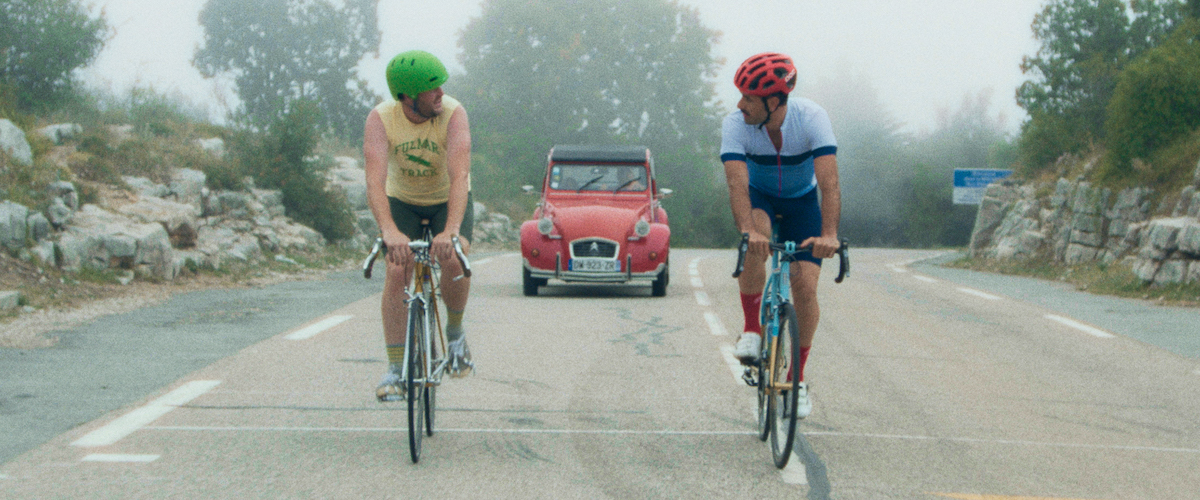
If “The Climb” were a pop song, it would be a spin on Lady Gaga’s “Bad Romance”; call it “Bad Bromance.” The dark, witty indie gem begins with the event of the title, a long bike climb through the hills of France as one buddy Mike (director, co-writer Michael Angelo Covino) gives climb and cadence instructions to bestie Kyle (co-writer Kyle Marvin) as they ascend the seeming endless rise. Between the wheezing and puffing we learn that Kyle’s about to be married, and the endurance undertaking is the bachelor bonding event du jour. Then Mike lets out the sucker punch that he’s slept with Kyle’s fiancee – multiple times. “I’m going to kill you!” Kyle huffs, unable to catch up to the object of his ire. “I know; that’s why I told you on a hill,” retorts Mike without care or fear.

With friends like that, who needs enemies, right? Mike and Kyle end up in a French hospital for reasons other than what you’d imagine, where Kyle’s to-be shows up and things really get skewed. Like the cagey recent thriller “Let Him Go” there’s a sudden pivot to a major life event. You expect it to be a funeral or a wedding (I’m not going to tell you which), but you drop into the opposite. “The Climb,” which begins with a masterful long shot by cinematographer Zach Kuperstein, feels contained in location and time, but then the action goes stateside – Upstate New York, to be exact – and spans years. Mike’s something of an alcoholic mess, while nice guy Kyle has moved on and found another mate to marry (Gayle Rankin, also quite good in “Blow the Man Down”). It’s Kyle’s meddlesome mom (Talia Balsam, while George Wendt of “Cheers” plays dad) who draws Mike back into the fold, and sure enough, with another fiancee in the wings, history looks to repeat itself.

There’s not a lot of action in “The Climb.” It’s a character study of just how far one friend can push another. Remember just how much fun it was to wince and smile at the insanely descriptive tactics of Thomas Hayden Church in “Sideways” (2004)? Same here. We never even really find out what Mike or Kyle do for a living – it’s besides the point. The film’s competently made and droll; you can tell these two spent many a nights penning and rehearsing the material together, and given the names are what they are, you wonder where the characters begin and the real Mike and Kyle leave off. “The Climb” is a quick, nasty burn with some clever twists. Some might even find it life-affirming. I’m not sure I did, but I’m curious to see what this tandem comes up with next.