Tag Archives: alex-garland

“28 Years Later: The Bone Temple”

27 Jan


Faster, angrier and meaner—that’s how folks have come to like their zombies since director Danny Boyle and writer Alex Garland flipped the genre on its head in 2002’s “28 Days Later.” They introduced a “rage virus” that transformed infected humans into berserk, flesh-rending decathletes on crack. George Romero’s shamblers could barely hold the beer of these boss-level zombies and a series was hatched. The latest entry, “28 Years Later: The Bone Temple,” is chomping its way through theaters.

Boyle and Garland have dropped in and out of the series. Neither were onboard for the 2007 follow up, “28 Weeks Later” (perhaps its best chapter), but reunited last year for “28 Years Later”—the ostensible cornerstone of a trilogy, now a tetralogy probably still not complete. Garland wrote the script for “Bone Temple” but Boyle hands directorial duties to Nia DaCosta, who caught our eye with their 2021 “Candyman” remake, lost us with their insipid “Marvels” meander in 2023, but regained our interest with last year’s opulent and bawdy “Hedda.” DaCosta may not be a top orchestrator of character and the human element, but they do have a formidable visual sense, and “Bone Temple” is strikingly framed — be it scenes of bloody butchery or serene countryside meadows. Its rampant gore is hard to look away from.

At the end of last year’s first act, our pre-teen protagonist Spike (Alfie Williams) had left his family’s island enclave to seek answers on the mainland. There he teamed up with Sir Jimmy Crystal (Jack O’Connell) and his band of lost boys, known as the Jimmys. A cartoonish ending (golf clubs and parkour to take out the “infected”) offered a wisp of hope. But “Bone Temple” finds them in a place that is dark, sinister and grim.

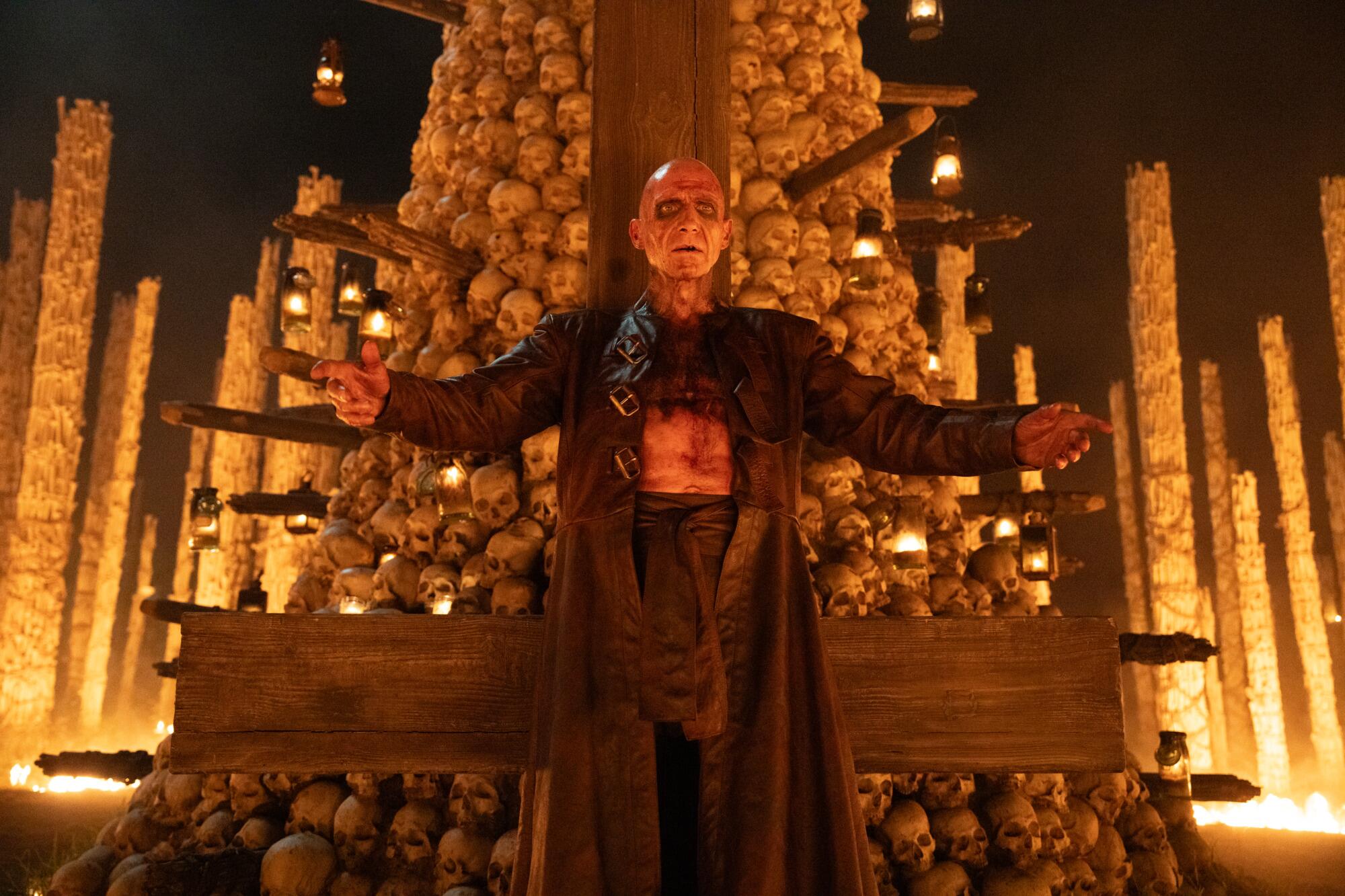
The sequel opens with Spike in a death match to earn his into Jimmy’s gang. O’Connell’s Jimmy presides over the fray, a cartoonish Nero savoring the slow demise of another. The film’s other thread reunites us with Dr. Ian Kelson (Ralph Fiennes), curator of the Bone Temple ossuary — pillars of bleached ulnas and tibias surrounding a tower of skulls — and observer of the infected. Kelson, slathered in iodine (which staves off the virus), has developed the neat trick of using morphine darts to tranquilize zombie Alphas, infected that can rip the spine from a human like blowing their nose. This allows him to bond with one regular visitor that he names Samson (six-foot-eight former MMA fighter Chi Lewis-Parry, who looks like Jason Momoa’s maxi-me). It’s an intriguing relationship, with Kelson something of a fatherly Frankenstein seeking to strike connection and balance.

Jimmy has a different relationship with the “infected.” He was the young boy watching the “Teletubbies” in act one’s preamble when his da, a priest, embraced the horde descending on his house and church as a divine intervention (Jimmy is the only one who escapes). Jimmy’s character is inspired by flamboyant, blonde-wig wearing 1960s–’80s British TV host Jimmy Savile, who was revealed after his death in 2011 to have been a prolific pedophile and sexual predator. But Jimmy and his wig-wearing minions put another evil layer on things — they roam the countryside pillaging and torturing other quarantined survivors in the name of Old Nick (another name for Satan). It’s a bit of a leap, but one that DaCosta, O’Connell, and Garland mostly make stick.

O’Connell was also a villain in “Sinners,” playing the opportunistic vampire Remmick in Ryan Coogler’s imaginative, genre-blending period piece and current awards contender. At least Remmick had a code. Jimmy is an amoral sadist with a deity complex and an intense amount of charm, which makes him twice as lethal.

The Kelson and Jimmy threads eventually converge, not because of Spike’s prior connection to Kelson, but through Jimmy’s manipulation when he deems Kelson Old Nick himself due to his Satan-red application of iodine — a claim Jimmy weaponizes to cement his authority over his restless charges.

“Bone Temple” moves in strange and unexpected ways that mostly work. When it falters, Sean Bobbitt’s rich visuals and a knockout performance by Fiennes easily carry it past the rough patches. Williams, too, is strong as the torn and vulnerable youth roped into an unenviable and horrific existence, Lewis-Parry gives  anuanced turn as the massive, naked Alpha. O’Connell is just as (for better or worse) pop-off-the-screen audacious here as he was in the waning moments of last year’s film.

Those expecting waves of zombie carnage may be surprised by “Bone Temple.” Its ugliest horrors come from human cruelty dressed up as moral purpose, acts Jimmy chillingly tags as “charity.” These are often peek-through-your-fingers grim. As with previous entries in the series, “Bone Temple” closes on a note of wary hope, punctuated by a big reveal that promises that the “28 Years” saga will shamble on.

28 Years Later

20 Jun

You can try to live with rage virus but it’ll just keep evolving into something weirder

As laid out, this latest in the Danny Boyle-Alex Garland zombie apocalypse series is more reboot than a trilogy closeout for “28 Days Later” (2002) and “28 Weeks Later” (2007). In fact, it’s alleged to be the start of a new trilogy, with “28 Years Later: The Bone Temple” already slated for 2026. But two films, a cinematic hat-trick does not make.

We also need to clear the chronology slate, 28 years later is not 2053, but more around now – 2030, if we extrapolate from the release date of “28 Days Later.” As with the other films, the setting is Britain, which still is the only infected area in the world as far as we know – in “Weeks,” as well as here, there are implications that the “rage virus” may be elsewhere, but it’s teaser. As to why survivors still reside on the isle of Britain: The island nation is quarantined and its coast patrolled rigorously by other countries – France and Sweden, at least.

Continue reading

Civil War

12 Apr

For correspondents in a torn country with echoes of today, any side is the wrong side

Alex Garland has always been thematically clear in his films. His first two directorial efforts, “Ex Machina” (2015) and “Annihilation” (2018), plumbed creationism and doom, while “Men” (2022) donned the veneer of horror as it wrestled with toxic masculinity and misogyny. Here Garland shifts to the more immediate and less fantastical with this loose-lensed scrutiny of journalism, namely its relevance and the ethics of those plying it. Sure, the civil war of the title is happening across the United States, but it’s vague as to why; all we know is that the Western Forces – a two-star alliance with their own, more spartan rendering of the ol’ red, white and blue – consists of seceded states Texas and California, and that Florida is a wild card trying to pull the Carolinas in to some kind of something or other. It’s a MacGuffin wrapped inside an enigma for certain, but Red and Blue states aligning is a bit of a stretch. Given the premise, folks are going to want to reflect on the nastiness here and now and how we move on, but “Civil War” is not that film. It takes a while to work that out and get on the page with Garland, a more-than-capable writer (“28 Days Later,” “Never Let Me Go”) and inherently immersive filmmaker.

“Civil War” opens with journalists in New York City recording mob unrest and the efforts of a bristling police presence trying to tamp it down. Again, the who and why isn’t explained, but given the immediacy of the scene, Garland and his crew transport us beyond our want-to-knows as veteran war photographer Lee Miller (Kirstin Dunst) snaps away at the post-explosion carnage of a car bomb. Trying to tag along is Jessie (Carlee Spaeny, the apple of Elvis’ eye in “Priscilla”) a Lee Miller wannabe who shoots on old-school film and would have been digitized herself if it weren’t for Lee pushing her out of the bomb blast. Like the punchy western journos in “Welcome to Sarajevo” (1997) and “The Year of Living Dangerously” (1982), the correspondents regroup in a hotel, drink scotch, milk each other for scoops and discuss the next hot spot locale to pursue a story. Lee and her pen man Joel (Wagner Moura) want to score an interview with the power-clinging, third-term president (Nick Offerman) before D.C. is beset. Jessie weasels her way in, as does Sammy (Stephen McKinley Henderson), an older political reporter from the Times looking to get to the front line in Charlottesville. The winding 800 miles to D.C. (can’t go down the main coastal roads) is filled with strange moments: a vintage boutique in a Southern hamlet seemingly untouched by the conflict, a gas stop where alleged looters hang from rafters awaiting “trial,” meticulous mass graves and plenty of skirmishes where not many seem to know what they are fighting for or who’s on whose side. “I’m just shooting at a guy who’s shooting at me,” one gentleman in camouflage and punk-dyed hair offers as he tries to suss out a sniper. 

At the end of the not-too-golden bricked road, Garland stages a phenomenally choreographed siege of Washington that’s as heartbreaking as it is breathtaking. Through it all he digs into the “objective indifference” of journalists – the professional tenet of getting the story and being impartial. It’s a cold and effective mirror that raises begging questions, and others more practical and immediate: If powers are to fall, will the organizations they file with still exist (the Times and Reuters) and if so, shouldn’t they become freelancers for foreign press such as the BBC or The Guardian? Then there’s the matters of personal preservation and the reasons for the civil war that are never discussed, which makes you see more notorious touch points in our recent past, namely Jan. 6 and the Proud Boys. To be clear, the Western Forces are no liberating army – or at least not one I’d want to be liberated by, as they shoot first and ask few questions. When they do ask, if your answers aren’t right, you’re dead. Twice as dead if you’re not white. 

It’s a slippery yet provocative slope. Some might call it manipulative stoking of fears without owning it, and they’d be right. The film also falters with Jessie; she’s as shallow as dew mist – an amalgam of parts with nothing human to grab on to, and Spaeny feels miscast. Thankfully that all fades in the rearview as things ramp up en route to D.C. As a visionary behind a pen or a lens, Garland has a penchant for lawless dystopia that translates well here, and frighteningly so. The war in the backyard holds our eyes and our minds even if the themes offered fail to fully crystallize in the billowing smoke of the distant hills.