The Accountant

26 Oct

“The Accountant,” a far-reaching thriller starring Ben Affleck, asks much of its audience – but for some patience and suspension of disbelief there are rewards to be had as it morphs slowly and surprisingly into something more entertaining than it has any right to be. You could think of it as Affleck’s midlife answer (bat suit aside) to buddy Matt Damon’s “Jason Bourne” series, though Affleck alter-ego Christian Wolff isn’t a juiced-up CIA operative with a bad case of amnesia and a troubled past (though he does have that). As the title tells us, he’s a pencil-pusher, though one who incidentally can spatter a melon from atop a fencepost a mile out with a high-powered rifle; and should some of his clients take exception to his accrual methods, he can unleash a tirade of chop-socky martial arts to dispatch the deplorables with James Bond efficiency.

101316i-the-accountantFew probably knew that balancing the books could be such a lethal endeavor, or that such a cockamamie idea, especially with the normally tacit and wooden Affleck, could translate into such a satiating pleasure – a guilty one. With ledger-entry care we get into it one plodding record at a time, beginning with blurry images of a hitman taking out linguini-eating mobsters in a scene that’s reminiscent of the young Michael Corleone removing the family nuisance in “The Godfather.” Then, before we get the assassin’s mug, we flash to a quaint country manse in the hills of New Hampshire where the young Christian (Seth Lee), having a bit of an OCD fit, is being interviewed by a doctor who specializes in children with Asperger’s and autism. It’s here, in the unhappy family moment, that we also learn that the lad can solve a complicated puzzle in 20 licks. Continue reading

26 Oct
A “ghost bike” memorial is set up Tuesday in Porter Square in memory of bicyclist Bernard “Joe” Lavins. (Photo: Andrew Huang)

More than 200 cyclists, co-workers and friends gathered in Porter Square on Tuesday to hold a candlelight vigil for Dr. Bernard “Joe” Lavins, who was struck and killed Oct. 5 by an 18-wheeler while bicycling through the tangled intersection in front of Christopher’s restaurant.

Details of the accident have yet to be released, but his death marks the second cyclist in Cambridge killed in a little over three months after Amanda Phillips was doored and struck by a lawn service vehicle June 23 in Inman Square.

The ceremony, led by the Rev. Laura Everett, head of the Massachusetts Council of Churches and a cycle advocate, dedicated a “ghost bike” memorial in Lavins’ memory, and mourners recalled Lavins, a 60 year-old research scientist at Ironwood Pharmaceuticals in Cambridge.

The Rev. Laura Everett leads the Tuesday memorial ceremony in Porter Square. (Photo: Tom Meek)

He was a cautious man, mourners said, who took a bike safety class put on by the company before he began commuting from his home in Lexington two years ago. (To get away from the frustrations of driving and to get more exercise, because he loved junk food too much, one friend pointed out.)

Ken Carlson, a colleague of Lavins’ at Ironwood who also chairs the Somerville Bike Committee, and Chris O’Dea, another co-worker who cycles, called for “something positive to come from the terrible tragedy” – namely to make Porter Square and all hazardous hotspots throughout the city safe for cycling.

Five city councillors attended the event – Craig Kelley, Leland Cheung, Jan Devereux, Nadeem Mazen and vice mayor Marc McGovern – and John Adams, proprietor of the Kendall Square pool hall Flat Top Johnny’s, gave a history of the ghost bike, a symbol of remembrance and a reminder to motorists to share the road. Peter Cheung, a video editor and cycling enthusiast from Jamaica Plain, painted Lavins’ ghost bike after it was found in the basement of Flat Top Johnny’s. Admiration of his work brought a sweeping response from Cheung: “No more ghost bikes.”

Lavins leaves behind a wife and a 13-year-old daughter – and a heartbroken cycling community that wants change now.

Bike safety

26 Oct

Flowers in Porter Square for cyclist killed by truck yesterday morning.

Sadly, this is the second time in a little over three months that I’m writing about the hazardous state of cycling in Cambridge, Boston and the surrounding areas – now after the death of Bernard Lavins, 60, who was dragged under an 18-wheeler in Porter Square this week. In June, Amanda Phillips was doored in Inman Square and killed by a passing lawn service truck. Both came after the conclusion of Bike Month, when I submitted a passionate callout of municipalities for their slack and slow response to perilous hot zones outlined in letters submitted to the respective transportation departments requesting their attention before something tragic happened. Continue reading

American Pastoral

26 Oct

Ewan McGregor’s uneven adaptation of Phillip Roth’s Pulitzer Prize-winning novel “American Pastoral” extends the trend of Roth novels not quite hitting the author’s intended notes on the big screen. It also marks McGregor’s first foray behind the lens, which shows promise and may have borne bigger fruit had he not also cast himself as in the pivotal role of Seymour “Swede’’ Levov, a blond-haired, blue-eyed gridiron god looking starkly Scandinavian against fellow Newark Jews. Early reviews have claimed McGregor miscast, but yet none cite suggestions of who would work. Jude law, Andrew Garfield, Brad Pitt? The list is endless, but if you’re going to cry foul, have a bird in the hand.

102116i-american-pastoralMcGregor, the British actor who played Obi-Wan in the “Star Wars” films, is passable for the man delivered through the Greatest Generation and blessed with much. In the wake of the war he marries a non-Jewish beauty queen (Jennifer Connelly), takes over the family glove manufacturing business and moves out to WASPy Old Rimrock of Morris County. But as the 1950s shift into the 1960s, Swede’s world is upended by the women in his life: Merry, his sweet, effervescent daughter cursed with a pronounced stammer, witnesses the iconic monk immolation that swept TV screens in 1963 and blossoms into a radical activist (played with palpable turmoil by Dakota Fanning) who may be responsible for the firebombing of Rimrock’s post office that leaves a cherished townsman dead. Merry goes underground and Connelly’s Dawn has a nervous breakdown, only to rise an adulterous mass consumer moved on from the memory of her daughter. Swede never relents, and blames himself. Continue reading

Birth of a Nation

5 Oct

Nate Parker's Birth of a Nation is as much a harrowing historical drama as it is a commentary on modern violence and race relations in America

Courtesy of Fox Searchlight

Nate Parker’s Birth of a Nation is as much a harrowing historical drama as it is a commentary on modern violence and race relations in America

Birth of a Nation, the much-anticipated dramatization of Nat Turner’s bloody 1831 slave rebellion, has great timing and relevance in its arrival, especially given the spate of the blue-on-black violence that has swept headlines and caused angry protests all over the country. The film is both a look forward and back, with the promise of a unified nation, where all are treated equal regardless of color. It serves as a grim, yet provocative probe into the relationships between humans, where one owns the other in the manner of livestock, and holds the power to do with as they please — including slaughter — with righteous impunity.

The film, which in its branding boldly reclaims the title from D. W. Griffith’s 1915 silent classic extolling the heroics of Confederates and Klansmen, also became the righteous answer to the “Oscars so white” outcry when it premiered earlier this year at the Sundance Film Festival. It went on to score the biggest purse ($17.5 million) for any picture snapped up in the snowy hills of Park City. Cause and effect? Much like the young Nat (Tony Espinosa) experiencing prophetic dreams of his ancestors, the film from that moment on, whether it desired to or not, had become anointed and earmarked for some greater purpose.

Nat is born and grows up on a Virginia plantation filling the role of a playmate to the owner’s young son, Samuel Turner (Griffin Freeman), who in a decade or so will become Nat’s master. Because of such proximity, Nat (Nate Parker, who also directs the breakout project) learns to read, and due to his master’s over-indulgence in drink and poor fiscal standing, is passed from plantation to plantation to read the scripture to fellow slaves in an effort to help calm and motivate them in their work. It’s a plan that initially works for all involved, though Nat, head hung, becomes painfully aware that he’s selling his brother out, if even for the ephemeral moments of solace. Continue reading

A Sidewalk Picasso — Artist Eric Kluin Makes Newbury Street His Studio

3 Oct

Published in the WBUR ARTery

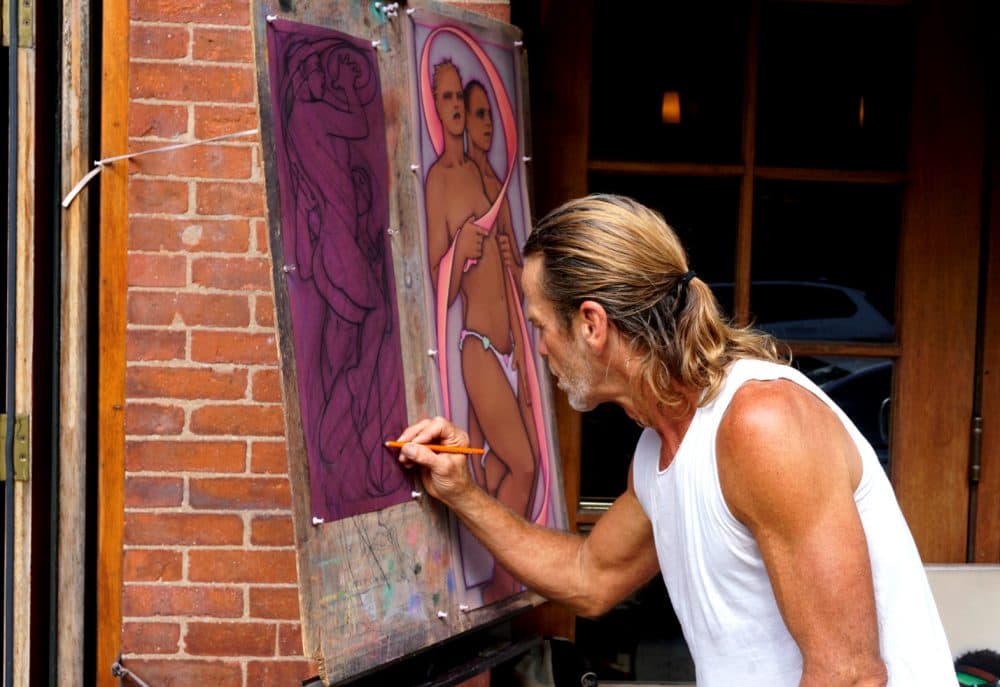
Artist Eric Kluin outside the Newbury Street restaurant Sonsie. (Tom Meek for WBUR)

If you’ve ever been by Sonsie on Newbury Street on a bright sunny day in the past 20-plus years (since the restaurant’s opening back in 1993), you’ve probably seen Eric Kluin — the surfer-esque painter with six-pack abs — busily at work on his easel perched just outside the establishment’s welcoming French windows that open out onto the sidewalk.

A shirtless fixture that’s hard to miss, Kluin’s something of a curio. Does he have a license to secure that spot? Is this some entitled ploy to pick up women? These are questions you might ask yourself as you pass by. Reasonable questions for the intrigued, but the answers might surprise you.

Kluin, a pretty laid back individual, moved to Boston in the late ’80s after working at a halfway house in Arizona where he had formerly been a resident. He’s been a recovering alcoholic for 22 years, and ironically, it was a bar that gave him his shot at a sustained recovery.

He began consuming alcohol abusively at the University of Michigan where he studied art, and didn’t stop until he was scraped off the floor of his flat in Boston by a concerned friend and tossed into rehab — twice. He admittedly describes himself as a “classic alcoholic who would drink himself to death if given the opportunity.”  Continue reading

Deepwater Horizon

29 Sep

If you’re still pissed at British Petroleum for the 2010 spill in the Louisiana Bay that notched the worst ecological disaster in history, get ready to have your ire stoked by Peter Berg’s harrowing real-life rewind. You won’t get many of those indelible images of oil-matted pelicans and mounds of dead fish piled along the coastline because, much like“Snowden” and “Sully,” other recent docudramas depicting barely faded news flashpoints, “Deepwater Horizon” steers clear of what we already know and lays out the events and lives leading up to the unthinkable – which it does with meticulous care.

092916i-deepwater-horizonAt its core “Deepwater” is a disaster flick, and a nail-biter to boot, but much of what propels it are the human stories, the selfless actions of those caught in the way of harm and the shocking arrogance unfurled by British Petroleum higher-ups wanting to turn a fast buck. The film hangs on two caught at the epicenter of the ordeal: Kurt Russell’s rig commander, Jimmy Harrell, and Mark Wahlberg’s second-in-command, Mike Williams. These are two actors who in recent outings – “The Hateful Eight” and “Lone Survivor” – were left bloodied and beaten, and worse, which in hindsight must have been preparation for what would come: asphyxiation by gushing oil, shrapnel whizzing at every turn and a few ungainly forays into parkour as one incinerating part of the rig lists and crashes downward; and if you think the sea a good exit, it’s nothing but a pool of fire for as far as one can see. Continue reading

The Magnificent Seven

28 Sep
The all-star lineup fails to shine through in Antoine Fuqua's remake of The Magnificent Seven

Courtesy Sony Pictures

The all-star lineup fails to shine through in Antoine Fuqua’s remake of The Magnificent Seven

Steve McQueen, Charles Bronson, and Yul Brynner — that’s a pretty tough trio to beat in any context and just one half of the star-studded cast of the original Magnificent Seven. That Western classic directed by John Sturges was itself a rebranding of Akira Kurosawa’s The Seven Samurai (1954) and while the cross-genre translation made sense back in 1960, the current redux by Antoine Fuqua (Shooter and Training Day) doesn’t offer much of a spin besides boasting a diverse crew (an African American, Asian, Native American, and Mexican among the mix). Even then, with the exception of one “his kind” comment in reference to Byong-hun Lee’s blade-wielding character of Chinese descent, there’s not one drop of racial tension. Had the septet been hot pink fuchsia, the bad guy’s wouldn’t take notice. It certainly wouldn’t flavor their dull backlot dialog, but it might improve their ability to shoot and hit anything, because as the movie has it, their blazing guns — sans a lone Gatling gun mounted outside the cow-poke town — couldn’t strike the broadside of Kim Kardashian’s famous posterior.

Fuqua’s posse, which features Denzel Washington, Chris Pratt, and Ethan Hawke, is a pretty well-armed lot, but as they team up and ride out it becomes clear that something’s off with thisSeven. Sure, the scenery’s panoramic and lovely, but after a long, bouncy canter across the prairie, saddle soreness sets in well before the first bullet’s chambered. What’s missing are personality and philosophical idealism let alone brooding, macho conflict — all requisite when telling a tale of morally ambiguous men walking in a lawless land. It’s as if Fuqua took Sturges’ blueprint, connected the dots, then forgot to bring his palette to the set. Continue reading

Demon

21 Sep
Don't tell us that dancing the funky chicken at wedding receptions is any less unnerving than demonic possession

Courtesy of Telewizja Polska, The Orchard

Don’t tell us that dancing the funky chicken at wedding receptions is any less unnerving than demonic possession

Marcin Wrona’s soft-horror thinker Demon unfurls a competent and moody bit of filmmaking, which much like Robert Eggers’s Puritan period piece The Witch, becomes just as much about the dynamics of the society it’s set against as it is about a supernatural incursion. In this case a Polish man, about to be wed, gets possessed by a dybbuk (a demon of Jewish lore). The real eerie air swirling about, however, comes in the sad side note that Wrona, having had this, his third film, play the Toronto International Film Festival last year, committed suicide on the eve the film was to be shown at the Gdynia Film Festival, Poland’s annual film fest. There remains as much mystery in his tragic parting as there is in his protagonist’s slow consumption by the soul of another.

Much of the action takes place against bawdy wedding proceedings. There’s plenty of drinking and merriment, even as the spiritual affliction begins to break down the couple at the center of the celebration. Adapted from Piotr Rowicki’s 2008 playAdhere ce, the film begins on a somber, hopeful chord as Piotr (Itay Tiran), who like Jeremy Iron’s work-seeking Pol in Jerzy Skolimowski’s Moonlighting (1982), labors for a living wage in London, returns to Poland to marry the lovely Zaneta (a radiant Agnieszka Zulewska). The pairing is something of an arranged marriage. After the two are wed, they will be gifted Zaneta’s grandparents’ old farmhouse in the country, which is also the site of the wedding. Continue reading

Lo and Behold

21 Sep
In Lo and Behold, famed director Werner Herzog takes a look at the digital world's effect on our own reality

Courtesy of Magnolia Pictures

In Lo and Behold, famed director Werner Herzog takes a look at the digital world’s effect on our own reality

In 10 micro chapters, Werner Herzog, the director of the classic odysseys Fitzcarraldo (1982) and Aquirre, the Wrath of God(1972), tackles the internet, its rise, and the perils and promise of a connected world. The scope and the questions are nothing new — “Who is going to be liable if a computer makes a mistake?” Herzog asks about self-driving cars — but the filmmaker’s laid-back yet probing style and quest for getting at the human condition is nothing short of infectious, viral, if you will.

The segments, with pointed titles like “The Internet of Me,” “The Glory of the ‘Net,” and, of course, “The Future,” each delve into a different facet of the internet, be it historical or conjecture. Herzog buffers most of the blips with the Dickian question, “Does the internet dream of itself?” The segments that provoke the most are the segments that tackle the downside of being connected. One woman tags the Net as a “manifestation of the Anti-Christ.” The underscoring of that is a family who lost their daughter in a car accident, and the pain that the graphically snapped photos from the scene inflicted on them during their grieving as they were unleashed out onto the web, ever proliferating, unretrievable and unstoppable.

That tale of tragedy becomes the sad underbelly to hypertext inventor Ted Nelson’s optimistic allusion to water as a metaphor for flow of connectivity. Other notable talking heads in the documentary include convicted hacker Kevin Mitnick, and Pay Pal and Tesla entrepreneur Elon Musk. Continue reading