Archive | Review RSS feed for this section

Nowitzki: The Perfect Shot

24 Jul
<i>Nowitzki: The Perfect Shot</i>

As a hagiographic ode, Sebastian Dehnhardt’s documentary covers the life and career of Dallas Maverick’s all-world superstar, Dirk Nowitzki, from gangly kid in Würzburg, Germany, where he was often told he was “too small to play,” to NBA top gun. For such a rah-rah career-capping fist bump, The Perfect Shot offers enough surprises, insights and revelations to be more than just a Sports Center highlight reel.

Part of that comes in the fact that Dehnhardt is German too and has deep personal knowledge of Nowitzki’s roots and the history of basketball in their homeland, which was brought there in the ’30s, by an obsessive who went to America to encamp with the game’s founder, James Naismith. We catch up with Nowitzki, now in his mid-thirties, heading toward retirement and the Hall of Fame, at the doctor where we learn that most of his joints have severe ailments from the stress of the game. One teammate remarks that it’s amazing that Nowitzki is so stiff and gimpy yet can take the court and “drop in thirty or forty points, and [make] it look easy.”

One reason for that is Nowitzki’s longtime partnership with Holger Geschwinder, who’s been a mentor to Nowitzki since he was a teen and now serves as part of the Mavericks’ coaching staff. Their workout sessions are long, grueling ordeals during which Geschwinder—who teammate Vince Carter refers to as “the mad scientist”—is always looking for a new physiological or scientific (he has a physics background) means to give Nowitzki the edge. Geschwinder, Mavs’ coach Rick Carlisle and rival Kobe Bryant all weigh in on conditioning, endless practice and execution. In his down time, Geschwinder seeks the object of the film’s title—a shot that’s not blockable and able to drop through the hoop without possibility of hitting and bouncing off the rim (which he calculates to require an arc of sixty degrees).  Continue reading

Tangerine

20 Jul

“Tangerine” is the kind of film you probably wouldn’t have seen five or 10 years ago. For one, it was shot on an iPhone 5s (several, actually) and stars two transgendered actors. The last mainstream – albeit indie – film to feature a transgendered main was “Transamerica” (2005), in which Felicity Huffman played the cross-gendered protagonist; she was deservingly nominated for an Academy Award in the Best Actress category. “Tangerine” was clearly conceived and shot long before the public transition of Caitlyn Jenner, but the conjunction of the two points to a fresh ripple in the zeitgeist.

071715i TangerineBeyond the tightly coiled energy of Kitana Kiki Rodriguez, who plays Sin-Dee, a motormouth streetwalker newly out of jail and anxious to catch up to her cheating beau, what makes “Tangerine” kick is the fantastic editing and scoring by Sean Baker, who also writes, directs and shoots. The combination boasts a kinetic buzz that simultaneously emulates and accents Sin-Dee’s vulnerable rage as she plows through trash-strewn streets and seedy alleys looking for Chester (James Ransone) who, as her bestie Alexandra (Mya Taylor) puts it, has taken up with “a real bitch, vagina and all, real bitch.” (If the word offends, skip “Tangerine.” because it’s dropped as frequently as the article “the”).

The film begins and ends in a doughnut shop in a gritty section of West Hollywood, but follows three threads: Sin-Dee, collaring the other woman, Dinah (Mickey O’Hagan) in the middle of a trailer park-esque sex party – a depraved scene down at a level reserved for the likes of (early) John Waters and Harmony Korine; Alexandra, wandering through the burnt-out industrial landscape worried about Sin-Dee and mixing it up with a few johns – she points out to one parsimonious trick that she’s “got a dick too” and is willing to throw down to collect her pay; and Razmik (Karren Karagulian), a married Armenian taxi driver who likes to perform oral on transgendered beings of the night. A meet-up with Chester becomes inevitable.

It also happens to be Christmas Eve, bringing into sharp focus the freedom, hopelessness and loneliness of life on the street. But as the frenetic climax comes, “Tangerine” slips up, losing some of its mojo – where there once hung a stocking stuffed with edginess and unpredictability, something like a JV Judd Apatow effort fills the sock.

No matter. What Baker has cooked up here with verve, can-do, vision and a stellar effort from a cast who feel like they genuinely inhabit the skins of their characters should register as a jewel of wonderment and is most certainly a promise of bigger things to come.

Cartel Land

9 Jul

The documentary “Cartel Land” from Matthew Heineman – and boldfaced produced by Kathryn Bigelow – is a stunning exposé of the lawless southwest along the U.S.-Mexican border, where the crystal meth drug trade thrives and vigilante forces on both sides of the fence try to stem it. It’s nothing short of “The Wild Bunch” meets “Traffic,” sans the cathartic denouement.

070915i Cartel LandHeineman gained a perilous unlimited access to his subjects; it might be more accurate to say he’s embedded. The film begins with the steamy nighttime capture of an outdoor meth lab where the brewers wear bandannas to conceal their faces from the camera – and the noxious vapors. They do what they do out of opportunity. “As long as god allows it, we make drugs,” one offers meekly. They learned how to make their cocktail from an American chemist and his son. (Maybe Walter White is still kicking around?)

From there we meet Tim “Nailer” Foley, who leads Arizona Border Recon and is listed as an extremist by the Southern Poverty Law Center. He and his posse are well-armed, skilled and intrepid and never seem all that extreme, though some of their philosophies on other races and their intermingling might gain Donald Trump’s assent. Foley is a man’s man in every sense, lean, angular, philosophical, survivor of a hard life and tragedy, and he’s charismatic to boot.

You could see “Nailer” in a Clancy novel or Peckinpah movie, as well as Dr. José Manuel Mireles, who across the divide leads a paramilitary Autodefensas group that liberates villages from the tyranny of the drug cartels. Mireles, tall, striking, with a broad mustache, looks something like Robert Ryan in “The Wild Bunch,” and when we meet him he seems to have the popularity and adoration that followed Pancho Villa. About the only ones who have issues with his bringing stillness and order to remote outposts are the drug dealers, kidnapers and Mexican authorities, who as Heineman has it look to be complicit with those corrupting agents – a point that doesn’t get well explored.

Foley’s reflection on his troubled past and the revelation that Mireles is a surgeon by day and a grandfather give depth to the men and their community, while chaotic scenes of gunfire – with Heineman right in the middle of it all filming – fill the screen. It’s gorgeously shot and a step up for Heineman, whose last doc, “Escape Fire: The Fight to Rescue American Healthcare” was a heavy handed look at the ills of the medical/insurance industry. “Cartel Land” is much more organic and visceral, and the image cut by the two figures, both fearless and fighting their own righteous war, is legendary in scope, even if the pendulum or reality says differently.

The Overnight

2 Jul
overnight.jpg

The Overnight is one of those on-the-clock, dark comedies driven by melodrama and sexually charged situations. You’ve been there before with Edward Zwick’s Chicago-based About Last Night and Martin Scorsese’s late-night SoHo carouse, After Hours. The Overnight jumps in as the indie, LA-staged version.

The backbone to writer-director Patrick Brice’s late-nigher however isn’t rom-com relationship hell or a data entry wonk’s midnight sojourn into madness, but 30-something ennui and the notion that the grass may be greener, juicier, and more inviting in the boudoir of someone else’s castle. Meet Alex (Adam Scott) and Emily (Taylor Schilling), a pair of young urbanites recently transplanted to Silver Lake from Seattle. Alex still sports a grunge-style goatee and is a stay-at-home dad while Emily does something techie that fetches enough dinero to live in a nice, somewhat swank neighborhood. And nice is absolutely the perfect word, as Alex and Emily are boringly nice, socially awkward, and a bit stiff.  Continue reading

Terminator Genisys

2 Jul

“I’m old, but not obsolete,” is the new Arnold Schwarzenegger zinger in the “Terminator” franchise reboot, “Terminator Genisys.” “I’ll be back” gets recycled too, and there’s plenty of logic for the aged Schwarzenegger terminator – now affectionately called “Pops” – being gray and wrinkled (his external covering goes like ours). He even gets to confront the young, buff, naked Arnold, so sleek and intimidating as the lethal T-800 prototype back in 1984.

063015i Terminator GenisysMuch of what propels “Genisys” lies in the basis for James Cameron’s game-changing B-film some 30 years ago: the notion of rewinding the clock and altering history and destiny. Wrinkles upon wrinkle in time have changed the game so much you almost can’t tell where rebel leader John Connor (Jason Clarke, with a scar-marred face) ends and Skynet begins.

The ever-churning plot machinations are wild, but don’t offer much bite. Sarah Connor (Emilia Clarke from “Game of Thrones” – the second actress from the series to play Sarah Connor, as Lena Headey starred in the 2008 series “Terminator: The Sarah Connor Chronicles”) is still on the hit list, but knowledge from the future has worked its way back in time, so what was a pat scenario in previous chapters becomes a game of time-hopping chess, with Skynet and the humans trying to out-wrinkle the other.

Not to give too much away, but we begin in the Skynet future from where the young Arnold T-800 (a killer computer recreation) is sent back in time to L.A., exactly like in the ’84 original – but just as he’s about to steal the clothes from a trio of punks, things go off-script from what had been. The year of  Judgement Day (1997) has been pushed to 2017 as well. Why? Well, Skynet has decided the best way to rule the world isn’t an apocalyptic nuclear strike, but a Trojan horse computer virus through the highly sought new operating system Genisys – from a company that’s Apple cool and Microsoft hungry. There’s much more to it too; Oscar-winner J. K. Simmons (“Whiplash”) plays a cop in L.A. and again in San Fran in 2017. He’s a bit of a boozer, so no one really buys it when he says he’s seen time traveler Kyle Reese (played by the handsome but wooden Jai Courtney) and Sarah before.

Continue reading

The Wolfpack

20 Jun

https://player.vimeo.com/video/127823073

Crystal Moselle’s intrigue documentary “The Wolfpack” follows the secluded lives of the six Angulo brothers, who were raised in relative isolation – never leaving their small Lower East Side apartment in Manhattan – for nearly 17 years. Homeschooled and without access to the Internet, the boys drank in such modern crime classics as “The Godfather,” “Reservoir Dogs” and the “Dark Knight” films and recreated them, transforming their claustrophobic confines into a sound stage of sorts.

061915i The WolfpackThe roots for the documentary go back to when Moselle ran into the boys, a.k.a. the Wolfpack, on the street, caught by their eye-catching long hair (down to their waists) and demeanor. What unfolds is talking heads and recreations looking back to their early childhood, when the boys were kept under lock and key. Their father, Oscar, a Hare Krishna who met their mother, Susan, in his native Peru, blessed all his offspring with uber-long Sanskrit names. As a patriarch and a man, Oscar’s more hippie than overbearing despot, but his logic – to lock the boys within the plastered walls of a tenement apartment in the projects to keep them safe from outside harm and violence lurking in the streets – seems odd given the blood-soaked nature of their cinematic diet.

Surprisingly, the boys are all reflective, polite and articulate, and tinged with varying degrees of disdain for a father who ran the family as something of a cult colony – “our own race,” one of the boys says – where his law was long taken as God’s law. You don’t meet Oscar for most of the movie, but when you do it’s a bit of a letdown, given he’s a nonworking, rather unintimidating alcoholic whose great plan was to accrue money in New York and move the brood to Scandinavia where he felt the state would provide a better quality of life. Then there’s Susan, seemingly intelligent and caring, yet complicit. She’s on camera much more more than Oscar. Her big moment comes when she calls her 88-year-old mother, with whom she had not spoken in decades, largely because Oscar forbade it.

There’s a tipping point when one of the elder boys finally walks out on his own – wearing a Michael Myers mask, no less. As tensions in the apartment rise, the film ends on a note of promise and change. But given the enigmatic journey, there feels like some things go undivulged or unexplored, like the Angulo’s sister, who is mentioned as being “special” but is seen only in home movie footage. Then there’s the odd calm when Oscar and the boys are in the same room, starkly juxtaposed with their harshly rebuking him on camera for restraining them. The compelling quality of Moselle’s exploration get a great boost from the motion-creating editing and frenetic metal score, not to mention her caring touch. Perhaps her her objective lens got fogged.

Jurassic World

12 Jun

Jurassic World is bigger and badder than its predecessors, but we really miss the original cast

Jurassic Work

It’s been nearly 15 years since the last Jurassic Park installment, and a lot has changed in the world: 9/11 rocked and divided our nation as the War on Terror took root, smartphones replaced cumbersome cellphones, and GMOs have become talking points at cocktail parties. What’s all this have to do with the revival of the dino-park movie franchise based on the slim yet innovative novel by Michael Crichton and initially helmed by Stephen Spielberg?

The answer is everything. Like the problem of a bigger, meaner and more thrilling wow (read: dangerous) that confronts the conglomerate structure behind Jurassic World, the filmmakers spinning out Jurassic World are saddled with the burden of outdoing what came before. The good news is that the quality of special FX has come light-years.

Today, people caught in the middle of a dino herd don’t look like they’re being shot against a screen and pasted into a jerkily moving computer rendering; they’re now seamlessly in there with the “real” possibility of being trampled or squashed or snatched up by the genetically engineered Indominus Rex, the new badass on the block, cooked up in a lab by a bunch of avaricious DNA jockeys to scare the shit out of money-paying vacationers seeking an adrenaline rush just to know they’re alive.

At the park on a lush tropical island off the coast of Costa Rica, at any time, there are some 20,000 people being run through the vast array of exhibits and rides and fleeced for cash with the rapier efficiency of a Disney or Sea World. Money is a driving force at Jurassic World, and in the birthing lab, there too looms a myriad of hidden agendas and covert, need-to-know data points — like who’s DNA went into good ole Indominus — that breeds malcontent and dubious action.

Continue reading

Results

5 Jun

https://player.vimeo.com/video/129493381

Sometimes having everything makes you empty. Such is the paradox explored in Andrew Bujalski’s “Results,” part fable, part human experiment in desire, fears and means, and perhaps the most offbeat love triangle to grace the screen since Joe Swanberg’s brew-mance “Drinking Buddies.” It’s an apt comparison too, with Swanberg a stalwart of the mumblecore filmmaking movement and Bujalski long considered its godfather with such lo-fi (and low-audio) efforts as “Funny Ha Ha” and “Computer Chess.” With “Results,” however, Boston-born and Harvard-educated Bujalski goes upscale with some A-minus-list actors and a bigger budget – although what that figure is seems to be a secret to all but Bujalski and the NSA.

060515i ResultsBujalski’s first film cost just $30,000 to make (it grossed about $75,000) and starred no-name actors; here he’s blessed with the reliable Guy Pearce, Cobie Smulders (Agent Maria Hill in the “Avengers” movie and “Agents of S.H.I.E.L.D.” television series) and character actor Kevin Corrigan (“Superbad” and “Goodfellas”) who steps to the fore and delivers a knockout performance. “Results” is based on the well-being fad, in which everyone wants to get physically and emotionally fit and fortified. Danny (Corrigan) newly and painfully out of a marriage he didn’t want to exit, transplants to Austin. He’s doughy, rich and angry. He also wants to be able to take a punch, so he signs up for a personal trainer at Power for Life, a boutique health spa run by Trevor (a gaunt and toned Pearce) who pushes the philosophy that wellness is more than physical beauty, even though his crew of crack coaches look like magazine cover specimens. The upbeat but aggressive Kat (Smulders) gets the assign and spends time at Danny’s palatial spread trying to get him lean and buff, but he drags her down into his routine of single-malt scotch and weed. Turns out she’s a bit depressed and angry too. If there’s a deadbeat client, Kat’s more than happy to switch over to into loan collector mode, and boy can she run – look out Lola, she’s on your tail.   Continue reading
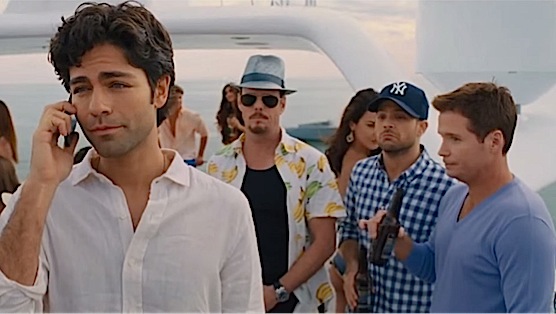
Entourage

5 Jun

When it comes to wrapping it up, TV shows tend to go out in one of three ways: the dour blaze of glory (The Sopranos, Breaking Bad), sheer hyperbole, a.k.a. jumping the shark (hello Happy Days), or the slow fade to syndication and nostalgic recall of the early years when the writing was tight and the characters sizzled with vivid crispness. For the latter, if the residual market thrives and enough of the show’s talent is milling around, there’s also that shot for a second life up on the big screen. It worked somewhat for Sex and the City and now the lads from Entourage are getting their chance.

The good news is that the whole cast is back and under direction of series creator Doug Ellin. The result is a facelift of sorts from where the HBO series slacked off in 2011. To stretch out the situational hijinks to a feature-length product, Hollywood “it” boy Vince Chase (Adrian Grenier) has hit a mid-career malaise and wants to do something different besides being just another pretty face. Like Clooney, Costner and Eastwood before, he decides to direct. In transition, too, are Vince’s former agent, Ari Gold (Jeremy Piven) now a studio exec, and pudgy bud Turtle (Jerry Ferrara), who has dropped most of the extra pounds and founded a boutique line of tequila. Former pizza slinger Eric (Kevin Connolly), too, has stepped it up, taking the reins as the producer of Vince’s film project, called Hyde (as in Dr. Jekyll and set in a zombie-apocalypse future), and is also expecting with Sloan (Emmanuelle Chriqui), though they’re estranged. The only one who hasn’t had a life-altering realization is Johnny Drama (Kevin Dillon) still fussing over food and living in baby brother Vince’s big shadow.  Continue reading

Slow West

1 Jun

Here’s something: a Western in which a young Scot is guided by an Irishman through the inhospitable American frontier of the late 1800s. That landscape in “Slow West” is breathtaking to behold, mountainous, verdant, fertile and feral, but none of it is truly American – the film was shot in New Zealand in the same wondrous mountains where Peter Jackson staged much of the “Lord of the Rings” films.

052815i Slow WestThe writer/director, John Maclean, played in a retro-alternative band and is Scots himself, so there’s that with the how and why. He also happened to make a pair of short films with the versatile actor Michael Fassbender, whose broad CV includes sci-fi (“Prometheus” and two “X-Men” films) and collaborations with Quentin Tarantino and Steve McQueen (they’ve hooked up three times, including “Twelve Years a Slave”), so enticing the Irish thespian to take up the role of an enigmatic drifter in the mold of Clint Eastwood’s “Man With No Name” for his feature debut must have been a simple dialup of favors among friends.

The re-partnering pays dividends, but for all the grandiose high stakes and murderous guns that loom at every turn, “Slow West” moves more like a dream than your prototypical western, broken and filled with misty motifs that drift by and never fully weave together. The slow quest west get driven by the misguided passion of one Jay Cavendish (Kodi Smit-McPhee, the young boy in “The Road”), a wayward lad imperiled in a foreign land, unaware and lovelorn for a lass from his homeland (Caden Pistorius) who fled to America (from Scotland) to escape a bloody and unfortunate mishap. Luckily for Jay he is happened upon by Fassbender’s Silas Selleck, more than pretty good with a gun and whose services can be had for a reasonable fee. The great peril in their mission isn’t so much that Jay won’t find his love, but the ruthless bounty hunters seeking the hefty fee on the lass’ head and knowing Jay is the only possessor of the few clues as to where she might be.  Continue reading