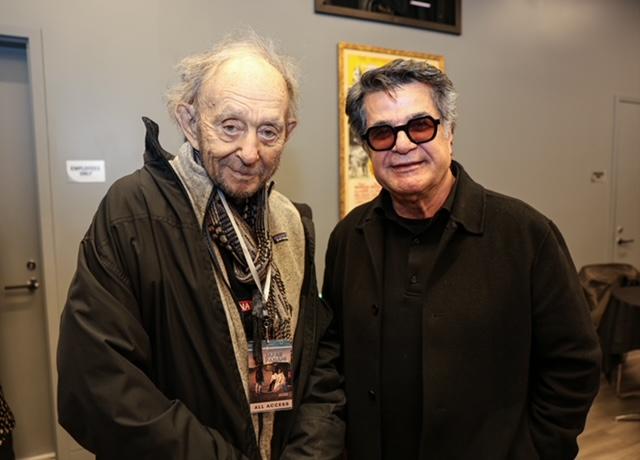
Fred Wiseman (left) and Iranian filmmaker Jafar Panahi at the Coolidge Corner Theater (Claire Vail).
Frederick Wiseman, the critically revered documentarian whose films mapped the moral frame of American life, died Monday at 96 at his home near Porter Square, in the city he in many ways, spent a career studying.
Born in Boston in 1930 and trained as a lawyer (Yale Law and a stint in the army) before turning to filmmaking, Wiseman carried a jurist’s sensibility into cinema — gathering evidence, observing behavior, withholding judgment. His camera did not accuse; it revealed. His body of work may be one of the most sustained portraits of modern democratic society ever assembled on film.
For more than six decades across roughly 45 films Wiseman examined institutions in a way that documented human behavior under systems of power. He was still a lawyer and teaching law at Boston University when he got the idea for the first, the incendiary “Titicut Follies” (1967), his unflinching portrait of the poor conditions inside the Bridgewater State Hospital for the criminally insane — for which Massachusetts suppressed the film for nearly 20 years.
Wiseman always let the camera roll, sheer fly-on-the-wall observation. He shaped meaning through accumulation rather than argument — no interviewing or editorializing a la Michael Moore (“Roger & Me,” “Fahrenheit 9/11”) or Morgan Spurlock (“Super Size Me”). Wiseman’s work was called cinéma vérité (“truthful camera”), but he shunned that as “a pompous French term.” His apparent neutrality was in fact rigorous authorship. He insisted editing was an act of storytelling akin to writing fiction, telling me in 2015, “I make movies on unstaged events and edit them into dramatic narratives.”
Emblematic of his observational essays was “Boxing Gym” (2010), a transfixing look into the ardor and cadence of pugilism.
Since Wiseman toiled in the back chambers of documentary filmmaking, his was not a household name, but eventually the rest of the world caught up to what critics and niche documentary junkies knew. In 2016 Wiseman received an Honorary Academy Award for documentaries that “examine the familiar and reveal the unexpected,” alongside a MacArthur “genius” fellowship. He also notched Peabody and George Polk honors, multiple Emmy Awards, and lifetime-achievement prizes from Venice and the New York Film Critics Circle.
Length and scope never seemed a concern for Wiseman. “Titicut Follies” was barely 90 minutes, “Boxing Gym” 91, but his 2020 film “City Hall” chronicling Marty Walsh’s stewardship of Boston ran almost five hours. It didn’t feel that long.
One of his biggest critical successes was “Jackson Heights” (2015), Wiseman’s examination of one of America’s most diverse neighborhoods. It told the story of community through individuals, not outside perceptions or politics. In an interview, Wiseman told me that film “isn’t an argument. It’s an experience. I made the film in the editing room.”
Wiseman was avuncular, warm, wise and humble. He did not put himself in his movies, though he did provide the radio announcer voiceover in the sleeper indie hit “Eephus” last year. He also appeared in the Jodie Foster murder mystery “A Private Life,” shot in Paris, Wiseman’s home away from Cambridge. He didn’t need to or want to prove anything to anyone. I saw in him an innate refusal to simplify or conform. He trusted his viewers to sit inside the complexity of his films long enough to discover meaning themselves.
He kept working into his 90s, releasing “Menus-Plaisirs — Les Troisgros” —about the backroom doings of a Michelin star restaurant in France — in 2023, proof that curiosity, for him, never aged. He exuded a clear love of food, ballet and rhythm.
In Cambridge, where debate and observation are civic habits, Wiseman was an institution himself — a quiet presence reminding us that attention is a form of respect.
What he ultimately gave audiences was permission to look longer. In an era increasingly defined by speed and certainty, Wiseman gently argued that understanding requires duration. His films will endure because they do not tell us what to think. They show us who we are.
 For What it's Worth
Leave a comment