“It Was Just An Accident”


The latest from Iranian director and noted dissident Jafar Panahi is something more contrived and ambitious than his normal quietly observant style — de facto cinéma vérité in its oblique shining of the light on the oppressive nature of Iran’s theocracy. Take “Offside” (2006), “This is Not a Film” (2011) — made while under house arrest when Panahi was banned from making films — or his masterwork, “The Circle” (2000), with its zinger of a reveal that women in what seems to be a social setting are in fact in jail for the equivalent of jaywalking or speeding.
In his first film since being released from prison in 2023, Panahi engages a stage-like convention akin to something Martin McDonagh (“In Bruges,” “The Banshees of Inisherin”) might cook up, set in our world but with the players seemingly acting in their own absurdist universe. An auto mechanic, Vahid (Vahid Mobasseri), recognizes Eghbal (Ebrahim Azizi), whom he believes tortured him while in prison. Vahid employs the flat of a shovel during a traffic confrontation in the middle of a busy street to render Eghbal pliable and whisk him into his windowless van. The big tell is that the victimizer had a prosthetic leg, as does Eghbal. But Vahid was blindfolded and only know his assailant from the feel and hollowness of the leg. To ensure he has the right man, Vahid enlists the aid of others tortured by “Peg Leg” — all, likewise blindfolded. It’s an existential jurisprudence conundrum as the victims ride around in Vahid’s van bursting into bouts of rage and uncertainty as they debate what to do with their alleged former torturer, bound and gagged and locked in a tool chest in the back of the van.
The film won the Palme d’Or at Cannes last year, and it will make many best-of lists (as it should) but it is atypical Panahi, rich in production values and gingerly plotted, something that Panahi’s other films — seeking to skirt government censorship — avoided in their raw, natural, unflinching lens.
“Eden”
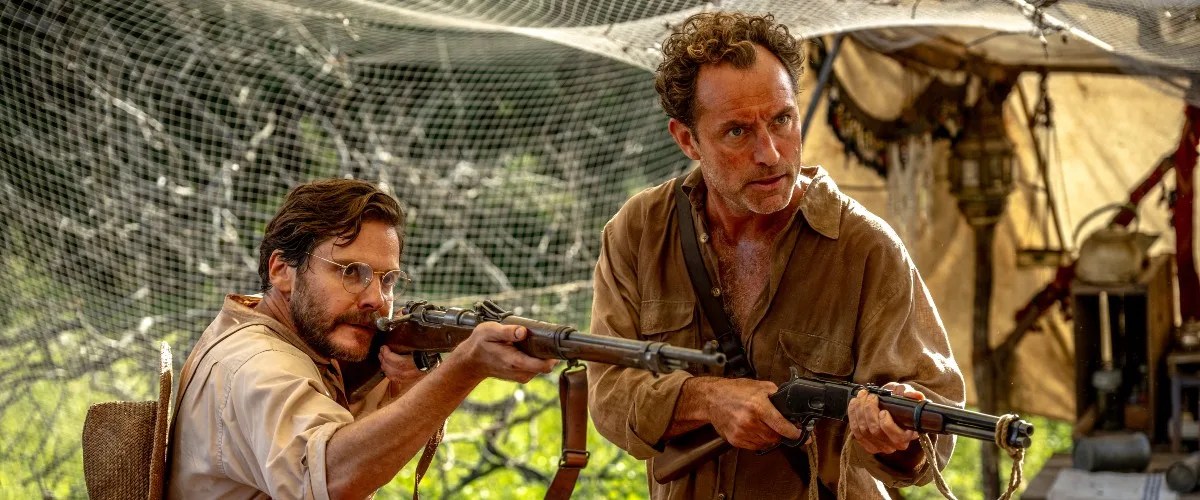

This Ron Howard-directed frontier misadventure is the OG “Survivor” series, set on an island with no outside resources or governing agency other than Mother Nature and the participants’ own moral compass. It’s based on true occurrences that happened shortly after the Great Depression placed its economics stranglehold on the world. To escape such, Dr. Friedrich Ritter (Jude Law), an idealist writing a manifesto on how to rebuild civilization, and his partner (Vanessa Kirby, The White Widow in the “Mission Impossible” films) have retreated to the isle of Floreana in Ecuador’s Galápagos Archipelago. Ritter becomes something of a proto-viral sensation through the publication of his letters, which inspires others to seek out his perceived paradise.
First arrivals are a German couple (Daniel Brühl and Sydney Sweeney) unable to pay for a sanatorium for their son, who has tuberculosis. They are not well received by the gruff Ritter, and things around the rim of the cloistered cove get more tense when the Baroness Eloise Bosquet de Wagner Wehrhorn (Ana de Armas) shows up with a posse of fops and engineers with designs on building a beach side resort. Ideological conflicts between the parties add to the mounting friction as coveted resources are stolen and/or sabotaged. It’s “Lord of the Flies,” the adult version.
Unfortunately, the action moves in jerky lunges and lolls, but it is a dark compelling spin that rises on the power of its ensemble. Law and Brühl’s righteous lads give the film its anchor as resolute ideologue and man willing to go to all ends to protect his family, while de Armas, nearly unrecognizable in the part with a tongue twisting name and blistering sexual charms and chaotic opportunism, turns the dial up to eleven. Because of the film’s unevenness, the studio was not firmly behind it when released earlier this year, but now that it’s available on streaming platforms, it is a unique chapter of history with some stellar performances that’s worthy of a two-hour cruise.
“The Great Flood”
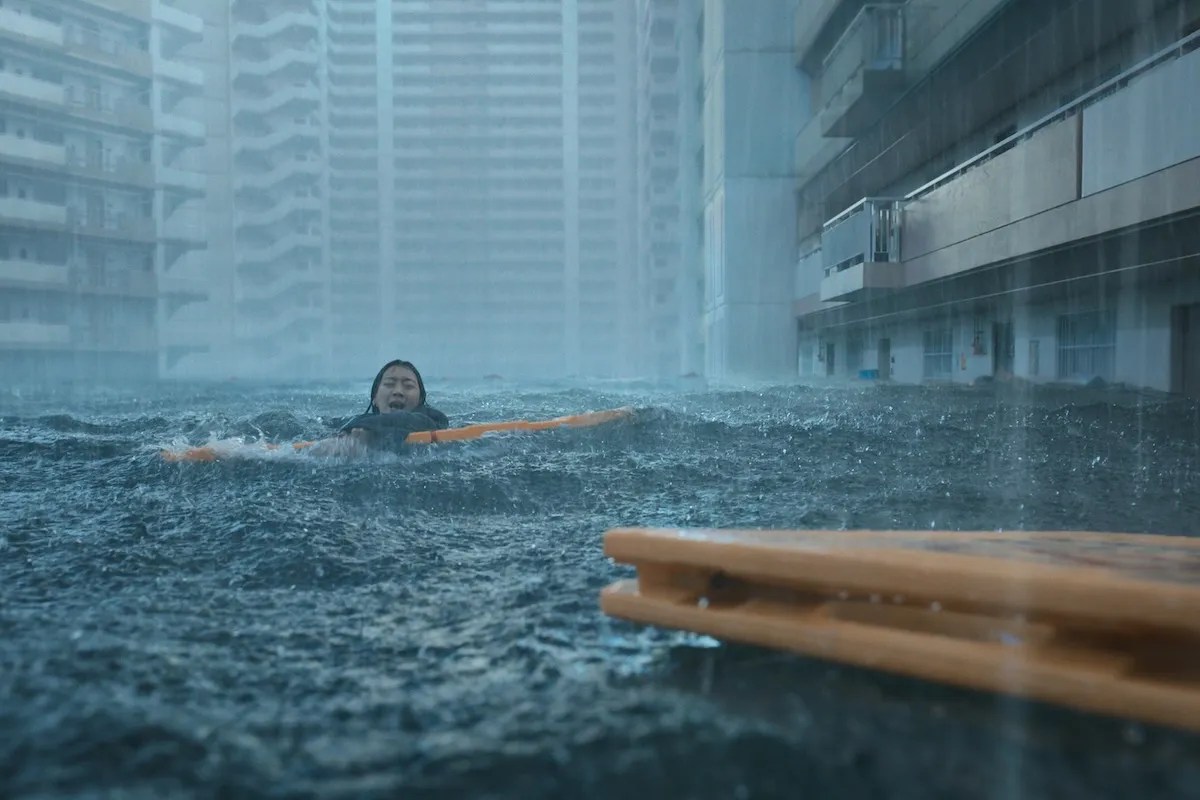
This Korean disaster thriller has eerie relevance, given recent revelations that if Antarctica’s Thwaites Glacier—aka, the “Doomsday Glacier” — broke off and melted, ocean levels would rise over two feet and turn much of our current terra firma into Atlantis: Boston’s Seaport district for one. In the movie, a meteor strike to the South Pole triggers world-wide tsunamis. Our micro-focus for the end of the world is An-na (Kim Da-mi) and her six-year-old son (Kwon Eun-seong) trying to beat hordes of others to the roof of their 30-plus story apartment complex, where they can be taken to safety via helicopter. The rub is that An-na is also an AI scientist working on emotional engineering for human clones — perhaps at the successor to “Blade Runner’s” Tyrell Corporation. She’s a priority for bigger forces that believe Earth will be toast, so humankind’s smartest and brightest — along with a few said clones — need to be Noah’s Ark-ed to space. From there “The Great Flood” becomes something of a time folding redo akin to Tom Cruise’s “Edge of Tomorrow” (2014), and to a lesser degree, Christopher Nolan’s “Interstellar” (2010), with security forces in the “matrix” trying to take out An-na and her guardian operative (Park Hae-soo). There’s a lot of threads that director Kim Byung-woo throws into the vortex. Some of it’s confounding and confusing, but it’s never dull.
 For What it's Worth
Leave a comment