
Faster, angrier and meaner—that’s how folks have come to like their zombies since director Danny Boyle and writer Alex Garland flipped the genre on its head in 2002’s “28 Days Later.” They introduced a “rage virus” that transformed infected humans into berserk, flesh-rending decathletes on crack. George Romero’s shamblers could barely hold the beer of these boss-level zombies and a series was hatched. The latest entry, “28 Years Later: The Bone Temple,” is chomping its way through theaters.
Boyle and Garland have dropped in and out of the series. Neither were onboard for the 2007 follow up, “28 Weeks Later” (perhaps its best chapter), but reunited last year for “28 Years Later”—the ostensible cornerstone of a trilogy, now a tetralogy probably still not complete. Garland wrote the script for “Bone Temple” but Boyle hands directorial duties to Nia DaCosta, who caught our eye with their 2021 “Candyman” remake, lost us with their insipid “Marvels” meander in 2023, but regained our interest with last year’s opulent and bawdy “Hedda.” DaCosta may not be a top orchestrator of character and the human element, but they do have a formidable visual sense, and “Bone Temple” is strikingly framed — be it scenes of bloody butchery or serene countryside meadows. Its rampant gore is hard to look away from.
At the end of last year’s first act, our pre-teen protagonist Spike (Alfie Williams) had left his family’s island enclave to seek answers on the mainland. There he teamed up with Sir Jimmy Crystal (Jack O’Connell) and his band of lost boys, known as the Jimmys. A cartoonish ending (golf clubs and parkour to take out the “infected”) offered a wisp of hope. But “Bone Temple” finds them in a place that is dark, sinister and grim.
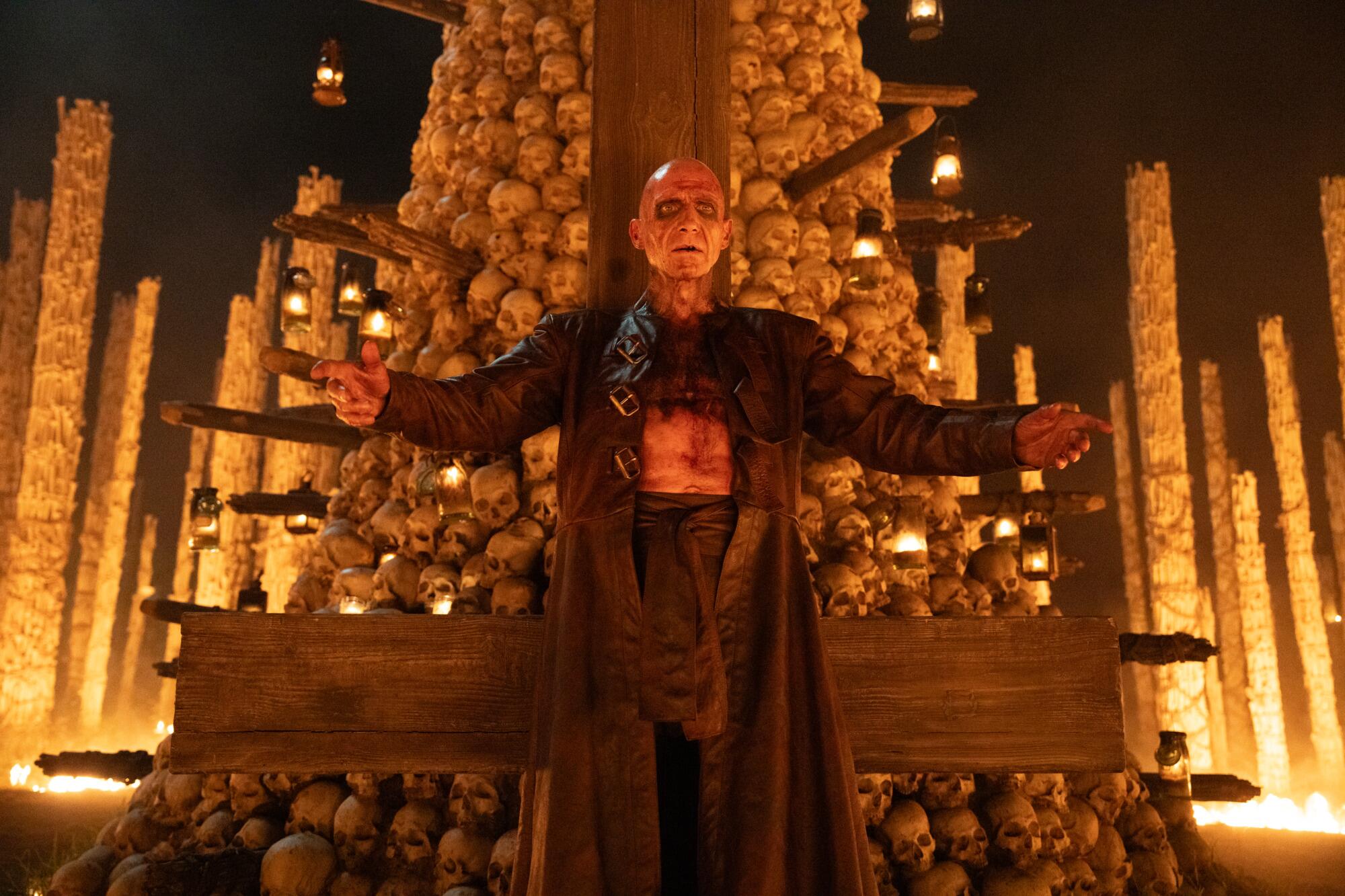
The sequel opens with Spike in a death match to earn his into Jimmy’s gang. O’Connell’s Jimmy presides over the fray, a cartoonish Nero savoring the slow demise of another. The film’s other thread reunites us with Dr. Ian Kelson (Ralph Fiennes), curator of the Bone Temple ossuary — pillars of bleached ulnas and tibias surrounding a tower of skulls — and observer of the infected. Kelson, slathered in iodine (which staves off the virus), has developed the neat trick of using morphine darts to tranquilize zombie Alphas, infected that can rip the spine from a human like blowing their nose. This allows him to bond with one regular visitor that he names Samson (six-foot-eight former MMA fighter Chi Lewis-Parry, who looks like Jason Momoa’s maxi-me). It’s an intriguing relationship, with Kelson something of a fatherly Frankenstein seeking to strike connection and balance.
Jimmy has a different relationship with the “infected.” He was the young boy watching the “Teletubbies” in act one’s preamble when his da, a priest, embraced the horde descending on his house and church as a divine intervention (Jimmy is the only one who escapes). Jimmy’s character is inspired by flamboyant, blonde-wig wearing 1960s–’80s British TV host Jimmy Savile, who was revealed after his death in 2011 to have been a prolific pedophile and sexual predator. But Jimmy and his wig-wearing minions put another evil layer on things — they roam the countryside pillaging and torturing other quarantined survivors in the name of Old Nick (another name for Satan). It’s a bit of a leap, but one that DaCosta, O’Connell, and Garland mostly make stick.
O’Connell was also a villain in “Sinners,” playing the opportunistic vampire Remmick in Ryan Coogler’s imaginative, genre-blending period piece and current awards contender. At least Remmick had a code. Jimmy is an amoral sadist with a deity complex and an intense amount of charm, which makes him twice as lethal.
The Kelson and Jimmy threads eventually converge, not because of Spike’s prior connection to Kelson, but through Jimmy’s manipulation when he deems Kelson Old Nick himself due to his Satan-red application of iodine — a claim Jimmy weaponizes to cement his authority over his restless charges.
“Bone Temple” moves in strange and unexpected ways that mostly work. When it falters, Sean Bobbitt’s rich visuals and a knockout performance by Fiennes easily carry it past the rough patches. Williams, too, is strong as the torn and vulnerable youth roped into an unenviable and horrific existence, Lewis-Parry gives anuanced turn as the massive, naked Alpha. O’Connell is just as (for better or worse) pop-off-the-screen audacious here as he was in the waning moments of last year’s film.
Those expecting waves of zombie carnage may be surprised by “Bone Temple.” Its ugliest horrors come from human cruelty dressed up as moral purpose, acts Jimmy chillingly tags as “charity.” These are often peek-through-your-fingers grim. As with previous entries in the series, “Bone Temple” closes on a note of wary hope, punctuated by a big reveal that promises that the “28 Years” saga will shamble on.



 For What it's Worth